
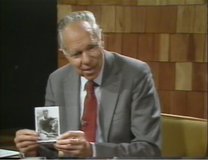
Reminiscences and Reflections: Keynote Address by Glenn T. Seaborg at ACS Science Reporters Workshop
- 1990-Aug-25

These captions and transcript were generated by a computer and may contain errors. If there are significant errors that should be corrected, please let us know by emailing digital@sciencehistory.org.
Transcript
00:00:00 It's a pleasure to welcome you to the Press Club for our evening functions.
00:00:15 It's an honor for me to introduce our featured speaker this evening,
00:00:22 Professor Glenn Seaborg of the University of California at Berkeley,
00:00:27 Lawrence Berkeley Laboratory.
00:00:30 Professor Seaborg is an individual, a gentleman who has served the nation
00:00:37 with distinction for 50 years or more in the capacity of scientist,
00:00:44 educator, university administrator, public official.
00:00:51 He's got an extraordinary history of research in the sciences.
00:00:59 I think many of you know that back in 1940 he discovered the element plutonium,
00:01:07 and in fact that was just the first of many extraordinary contributions
00:01:12 he made to our understanding of the universe
00:01:16 and the fundamental building blocks of the universe.
00:01:19 In fact, I think we could perhaps more graphically show his contributions
00:01:23 to our understanding of the elements by just looking at the periodic table.
00:01:29 And I hope you'll have a moment to speak about it,
00:01:32 but basically all of these and these elements,
00:01:38 and not only individual elements but the structure in which they fit
00:01:42 into this periodic table can be directly attributed to the work
00:01:48 of our evening speaker, an extraordinary contribution to our knowledge
00:01:54 of nature and its role.
00:02:02 For this work in the sciences, Professor Seaborg shared the Nobel Prize
00:02:09 for chemistry with Dr. Edward McMillan, Nobel Prize in 1951.
00:02:15 And as many of you know, his discoveries did find needed application
00:02:20 in the Manhattan Project where he was responsible for a major effort
00:02:24 to extract plutonium for the production of nuclear weapons.
00:02:30 He moved on from his outstanding career in basic research and science
00:02:36 into public life, and in 1961 he was designated the chairman
00:02:42 of the Atomic Energy Commission.
00:02:44 And in fact, he held that position for some 10 years under three different
00:02:48 presidents, Presidents Kennedy, Johnson, and Nixon.
00:02:53 And during that period, he was also very effective in negotiating
00:02:57 limited test ground treaties in 1963 and the Nonproliferation Treaty in 1969.
00:03:05 After that, Dr. Seaborg returned to Berkeley in 1971,
00:03:09 where he was designated university professor of the University of California,
00:03:13 which is the highest distinction that can be conferred upon any individual
00:03:17 by the regents of the University of California.
00:03:21 In the past few years, Dr. Seaborg has focused tremendous energy
00:03:25 on the question of education, both inside and outside of the classroom,
00:03:31 particularly education for young folks, the pre-college level education.
00:03:36 He's been a co-author of a wide variety of reports expressing concern
00:03:42 about the deficiencies in education and has assumed major responsibilities
00:03:46 in Berkeley and in the nation to remedy those situations.
00:03:50 In Berkeley, he's the chairman of the Lawrence Hall of Science,
00:03:54 which in my mind is one of the preeminent institutions in the nation
00:03:59 for informal science education.
00:04:03 He is also serving in another capacity as a key advisor to a joint project
00:04:11 between the American Chemical Society and the Smithsonian Institution.
00:04:14 This is a multimillion-dollar project called Science and American Life,
00:04:18 and we're in the beginning phases of that.
00:04:21 We're going to start getting down to the science just on Tuesday,
00:04:24 but in the fall of 1993, that will open up,
00:04:28 discussing the interrelationships between science and society.
00:04:31 I know Professor Seaborg's contributions will be very substantial in that vein.
00:04:36 Let me just close with a brief personal note,
00:04:40 and that is that he's also a very helpful and patient boss.
00:04:43 I worked for Professor Seaborg as a postdoctoral fellow before I came back here
00:04:48 as a congressional science fellow in 1977.
00:04:51 He was an extraordinary leader in the search for super-heavy elements at the time,
00:04:58 and it was a genuine honor and pleasure for me to work for him in the late 70s.
00:05:04 So I take great pleasure in introducing Professor Seaborg,
00:05:08 who's going to share with us some of his recollections and reminiscences
00:05:11 over 50 years of research.
00:05:13 Dr. Seaborg.
00:05:15 Thank you.
00:05:25 Well, thank you very much, Eric.
00:05:28 You gave a sort of a preview of what I was going to say, or what I'm going to say,
00:05:34 but I'll go into it in a little more detail.
00:05:39 I'm going to illustrate my talk with a number of slides.
00:05:43 It is going to be mainly reminiscences and reflections,
00:05:49 but I'll work in a little bit of science concerning the heaviest elements,
00:05:57 the transuranium elements.
00:06:00 I notice that there is a periodic table over there.
00:06:03 I don't know that you can see it very well.
00:06:06 It doesn't matter.
00:06:09 It's not very accurate.
00:06:11 I haven't been able to find anybody who puts out an accurate periodic table.
00:06:17 It's got these crazy symbols for some of the heavy undiscovered elements,
00:06:21 and I'll have something to say about that in the course of my talk.
00:06:25 Now, if I know how to operate all of these things,
00:06:28 I'm going to start with a list of the known transuranium elements.
00:06:39 I don't expect you to absorb all this at one sitting, but it's a kind of a preview.
00:06:45 There are 17 elements.
00:06:50 I sometimes forget.
00:06:52 I'm wearing my periodic table tie today,
00:07:00 in case I do forget where these elements fit into the periodic table.
00:07:05 There are 17 of them, and the last four are not named.
00:07:10 I may get to that.
00:07:13 These are the names that have been applied.
00:07:15 I'm going to sort of run through them once over lightly to tell you something about them.
00:07:21 Beginning in the 1930s, I actually started work in the field
00:07:28 as a first-year graduate student at Berkeley in 1934,
00:07:33 five years before the discovery of fission.
00:07:39 This is the way the periodic table looked at that time.
00:07:44 You don't need to go into this in any great detail,
00:07:52 but the point is that thorium, protactinium, and uranium
00:07:57 were misplaced in the periodic table up in the body this way,
00:08:01 and this led everyone, including me,
00:08:04 to expect that the transuranium elements,
00:08:07 that is, they would have to be man-made elements,
00:08:11 artificial elements, synthetic elements,
00:08:14 would fit in in these places here.
00:08:16 Uranium has the atomic number 92.
00:08:20 The element with the atomic number 93 under rhenium, 94 under osmium,
00:08:24 95 under iridium, and so forth.
00:08:26 And this is what we did.
00:08:28 We all believed that this is the way the periodic table would look
00:08:32 if these elements could be synthesized and identified.
00:08:37 Of course, we were wrong.
00:08:39 I won't have time to go into this.
00:08:41 Fermi and co-workers in Italy, Hahn and co-workers in Germany
00:08:48 bombarded uranium with neutrons,
00:08:50 and they produced radioactive isotopes,
00:08:54 and they thought they fit into the periodic table in this way.
00:08:57 As you know, they were wrong.
00:08:59 The neutrons were splitting the uranium in half
00:09:03 and giving you fission products,
00:09:07 and it wasn't then until 1940
00:09:11 that the real transuranium elements began to be discovered.
00:09:17 This is a map of the Berkeley campus at that time,
00:09:23 before World War II.
00:09:26 I don't think, other than those who are close by,
00:09:30 can read the identifications.
00:09:33 But the chemistry buildings,
00:09:35 Gilman Hall, where we made the chemical identification of plutonium, is here.
00:09:39 The cyclotron is here in Crocker Laboratory.
00:09:43 This is the East Hall, where we worked all night long, many nights.
00:09:53 This is Telegraph Avenue, Broadway.
00:09:57 This is the Varsity Candy Shop,
00:10:00 where we used to go after midnight,
00:10:02 after we finished our experiments for the day,
00:10:05 and ruminate about their meaning and their results.
00:10:12 This is a picture taken at one of the celebrations at a restaurant.
00:10:25 In March of 1940, there's Ernest Lawrence and Vannevar Bush.
00:10:34 The reason I'm showing it, though, is that this attractive young woman here
00:10:39 is Helen Griggs, who is sitting here in front of me.
00:10:45 I told her I was going to refer to her, but I wouldn't say why.
00:10:50 This is, of course, before I was going with her.
00:10:55 She was going with somebody else, and I was going with somebody else.
00:11:00 It took me a couple of years to get around that,
00:11:04 and we got married in 1942.
00:11:07 I'm going to run through this pretty quickly.
00:11:10 Then, in 1940, with the transuranium elements all having disappeared,
00:11:15 they were fission products,
00:11:17 MacMillan and Abelson bombarded uranium with neutrons,
00:11:21 and they identified an isotope,
00:11:24 which was really a transuranium element,
00:11:28 element 93 with the mass number 239.
00:11:31 They couldn't identify the daughter,
00:11:36 and the reason for that was that it was too long live.
00:11:39 If it doesn't decay very fast, it has a long half-life.
00:11:42 It doesn't emit much radiation, and they couldn't identify it.
00:11:46 MacMillan was called away for other work, war work,
00:11:52 and I took up the work with another young instructor and a graduate student,
00:11:57 Joe Kennedy and Art Wall,
00:11:59 and along about the end of 1940 and 1941,
00:12:03 we bombarded uranium with deuterons
00:12:06 to form another isotope of element 93,
00:12:09 which we hoped would decay to a shorter-lived isotope of 94
00:12:14 that we could identify, and we did.
00:12:16 We did that the night of February 23, 1941.
00:12:22 Then, Segre joined us,
00:12:26 and in March of 1941,
00:12:28 we said we're going to use a brute force method.
00:12:31 We're going to find 94-239.
00:12:35 If we have to bombard pounds of uranium for days,
00:12:39 which we did,
00:12:40 and we identified the neptunium element 93
00:12:45 and found the daughter,
00:12:47 we could calculate that we'd made a half a microgram.
00:12:50 It's about 1 millionth of an ounce,
00:12:53 and that was enough to demonstrate that it was fissionable with slow neutrons,
00:12:57 and that led to the plutonium part of the Manhattan Project
00:13:02 for its manufacture to be used as the explosive ingredient of the atomic bomb.
00:13:09 This is a picture of me taking it about that time.
00:13:12 I like to show this because all my friends tell me I haven't changed a bit
00:13:15 in these 50 years.
00:13:21 I met a counter in the room in Gilman Hall that I mentioned earlier
00:13:26 where we are making these measurements.
00:13:30 This is how we decided to name these elements.
00:13:34 The heaviest element is named uranium.
00:13:37 It's named after the outermost planet at that time, Uranus.
00:13:41 In the meantime, when neptunium was discovered by MacMillan and Abelson,
00:13:47 MacMillan named it after the next planet, Neptune.
00:13:53 And then when we discovered plutonium, we named it after the next planet, Pluto.
00:13:58 Unfortunately, there are no more planets,
00:14:01 so we had to figure another way of naming these elements.
00:14:04 One of the things I'd like to point out about this is that,
00:14:07 and most people don't notice this,
00:14:11 we probably should have called it plutium.
00:14:14 But I like the sound of the word plutonium better.
00:14:18 It just rolled off better.
00:14:20 And certainly we should have given it the symbol PL.
00:14:23 We like the PL better.
00:14:27 And we thought, of course, we'd have trouble.
00:14:31 Of course, we kept this voluntarily secret.
00:14:35 But after the war, when it was declassified, we thought people would say,
00:14:38 my God, why did you give an element a symbol like that?
00:14:41 But nobody gave us any trouble.
00:14:44 Then we wrote a report in March of 1942.
00:14:49 By the way, I dictated that report to Helen.
00:14:54 And sent it into the Journal of American Chemical Society
00:14:59 after it could be declassified after the war.
00:15:02 And in this, I'll leave you to read it,
00:15:05 we made the suggestion for the name plutonium and the symbol PU.
00:15:12 Then we moved to Chicago.
00:15:15 Helen and I got, I went to Chicago and came back six weeks later
00:15:22 and picked up Helen on the way we got married.
00:15:26 And in Chicago, we worked on, as Eric said,
00:15:33 the chemical processes for the extraction of plutonium.
00:15:36 And in order to work out a chemical process,
00:15:41 we needed to have weighable amounts.
00:15:43 And this was something one didn't even think of,
00:15:47 to produce weighable amounts by cyclotron bombardment.
00:15:52 But I said, I think it can be done.
00:15:54 And so we bombarded hundreds of pounds of uranium for a month at a time.
00:16:00 And we isolated microgram amounts.
00:16:03 And on September 10, 1942, this is the, the first sample was weighed,
00:16:10 2.77 micrograms of plutonium dioxide.
00:16:15 And I saved it.
00:16:17 The fellows were a little unhappy that I took this precious material
00:16:21 and just saved it for historical reasons, but I did.
00:16:24 And it's now on display in the Lawrence Hall of Science.
00:16:29 The original plutonium that we used to measure its fissionability
00:16:33 as illustrated on the previous slide, is in the Smithsonian.
00:16:40 Here we are in Chicago during the war.
00:16:43 We worked six days a week, attended meetings five evenings a week,
00:16:49 took Sunday off to play golf.
00:16:51 And here is Helen again, and me and a couple of our friends.
00:17:00 This is a picture taken in my office at the Metallurgical Laboratory
00:17:05 of the University of Chicago in January of 1946,
00:17:09 after the end of the war, when the photographers of Life magazine
00:17:13 came in to photograph us and our equipment.
00:17:17 And a story appeared that summer.
00:17:22 Now, we thought that when we had produced elements 93 and 94,
00:17:31 and they were chemically like uranium, that we'd figured it out.
00:17:36 We now knew what the periodic table was like.
00:17:39 We were starting a new rare earth series here,
00:17:42 and these 14 elements beyond uranium up to 106 would be chemically like uranium.
00:17:49 Just like the rare earth, 14 elements following lanthanum are chemically like lanthanum,
00:17:55 due to the filling of an inner shell.
00:17:58 We don't need to dwell on that.
00:18:00 But they were called the lanthanide series, lanthanum-like.
00:18:03 So we thought we had a uranide series, and then we'd have 95 and 96
00:18:09 would be like uranium, neptunium, plutonium.
00:18:14 Wrong again.
00:18:15 I like to say we were slow learners.
00:18:17 We tried to identify elements 95 and 96 on this basis,
00:18:23 and we were wrong, because we had the wrong...
00:18:27 You have to make a chemical separation,
00:18:29 because you make a very small amount of the thing you're looking for
00:18:33 with billions of times more radioactivity of other things.
00:18:37 So you have to have a chemical theory.
00:18:40 And when we used this, we were wrong.
00:18:44 Then I got the idea in July of 1944
00:18:48 that maybe the whole periodic table at the upper end was wrong,
00:18:52 that we should move these elements here and start a new series here
00:18:57 with actinium as the prototype.
00:18:59 And then if you count over, you'd have 95, a homologue of europium,
00:19:06 96, a homologue of gadolinium.
00:19:09 And when we tried this, it worked.
00:19:13 And we could identify the next two elements,
00:19:15 those with atomic numbers 95 and 96.
00:19:18 I showed this periodic table
00:19:21 to the two leading inorganic chemists in the world
00:19:26 and told them I was going to publish it.
00:19:28 And they said, Don't you do it, Glenn.
00:19:30 It would ruin your scientific reputation.
00:19:33 It was just so hard to conceive
00:19:37 that the periodic table had been this wrong.
00:19:40 So don't you do it.
00:19:41 It would ruin your scientific reputation.
00:19:43 Well, I didn't have any scientific reputation.
00:19:46 So I went ahead and published it.
00:19:48 Two things I'm not proud of.
00:19:50 Notice I was afraid to remove these completely from their old place.
00:19:53 So I put them in there in a kind of a half-baked manner,
00:19:56 I think hoping that nobody would notice them.
00:19:59 And I didn't have the nerve to put in 97, 98, 99, 100, 101, 102, 103 here.
00:20:04 I guess I figured anybody could figure that out.
00:20:07 But on the basis of this,
00:20:09 then we could identify these one by one, you see,
00:20:11 by analogy with the rarest in our chemical separation procedures.
00:20:15 Now, the interesting thing is that
00:20:18 we then succeeded in discovering elements 95 and 96.
00:20:23 And I had it cleared to present it
00:20:26 at a symposium of the American Chemical Society.
00:20:30 It was scheduled for Northwestern University
00:20:32 at Friday, November 16, 1945.
00:20:37 It so happened that I appeared on the Quiz Kids program.
00:20:40 Unfortunately, most of the young reporters here,
00:20:44 science writers here tonight,
00:20:49 are too young to probably even have heard of the Quiz Kids.
00:20:52 But this is a program where bright kids,
00:20:55 5 to 15 years old,
00:20:57 appeared every Sunday night on the radio.
00:20:59 And a quiz master named Joe Kelly
00:21:02 asked them questions sent in by the radio audience
00:21:04 and those who answered them first correctly received prizes.
00:21:09 They turned this thing around
00:21:11 and they turned the second half of the program
00:21:14 over to the kids asking me questions.
00:21:18 And in the course of that, one of the kids asked me,
00:21:22 by the way, have there been any new elements discovered
00:21:25 here at the Met Lab during the war?
00:21:28 And since I had it clear, I blurted out, yes,
00:21:31 the elements with the atomic numbers 95 and 96.
00:21:34 And this was the announcement to the world.
00:21:38 Now the interesting thing about this
00:21:46 is that this was recorded
00:21:50 as it went out over the air that night.
00:21:55 And on a 78 RPM record,
00:22:00 I had it transposed to a cassette tape.
00:22:03 And if we can figure out how to work this,
00:22:06 I'm going to play that tape for you now.
00:22:10 I guess it's...
00:22:14 Well, let's see here. Should we try this one?
00:22:21 That sounds...
00:22:24 Thank you, Bob Murphy, and good evening, everyone.
00:22:27 Now, children, we have the great honor to present
00:22:30 as our guest observer on this Armistice Day program
00:22:33 a most distinguished scientist, Dr. Glenn T. Seaborg.
00:22:36 Dr. Seaborg was a co-discoverer of the new element plutonium
00:22:40 at the University of California,
00:22:43 and he was closely concerned with the development
00:22:46 of the atomic bomb at the University of Chicago.
00:22:49 Because the whole world is rightfully curious
00:22:52 about the atomic bomb and its grave implications
00:22:55 or world annihilation,
00:22:58 it seems a very appropriate subject for our Armistice Day discussion.
00:23:02 We're going to reverse roles in our final question session
00:23:05 to let you children quiz Dr. Seaborg on the atomic bomb.
00:23:09 I hope you'll have some good, solid questions ready for them.
00:23:12 Now, let's get roll call started. Harvey?
00:23:15 I'm Harvey Bennett Fishman. I'm 15 years old,
00:23:18 and I'm a sophomore at the South Shore High School in Chicago.
00:23:22 Well, Doctor, do you really think they'll be able to harness the energy
00:23:25 of the atom and use it for driving ships or planes
00:23:28 in the post-war world?
00:23:30 Well, Harvey, yes. I think they will.
00:23:33 Not right away, but sometime in the future,
00:23:36 say 10 or 15 years.
00:23:39 Richard, how about your question?
00:23:41 Well, Doctor, how long do you think it'll be
00:23:44 before some of the more stable elements
00:23:47 will be split, that is, on a practical scale?
00:23:51 Oh, on a practical scale.
00:23:53 They've been split on a small scale.
00:23:56 On a practical scale, I don't know.
00:24:00 A new principle would have to be discovered
00:24:03 or a new type of reaction.
00:24:07 However, it's probably...
00:24:09 I wouldn't say that it'd be impossible, maybe in 50 years or so.
00:24:12 Well, another thing,
00:24:14 have there been any other new elements discovered,
00:24:17 like plutonium and neptunium?
00:24:20 Oh, yes, Dick.
00:24:22 Recently, there have been two new elements discovered,
00:24:25 elements with atomic number 95 and 96,
00:24:28 out at the Metallurgical Laboratory here in Chicago.
00:24:31 So now you'll have to tell your teachers
00:24:34 to change the 92 elements in your school books
00:24:37 to 96 elements.
00:24:39 Now listen.
00:24:41 We didn't have Dr. Seaborg at the microphone
00:24:44 for the entire half hour.
00:24:46 We certainly thank you, Dr. Seaborg,
00:24:48 for your many pressing commitments to be with us tonight.
00:24:51 This is Joe Kelly dismissing the Quiz Kids class
00:24:54 until the same time next Sunday
00:24:56 when we are broadcast from Youngstown.
00:24:58 Good night, kids.
00:24:59 Good night, Mr. Kelly.
00:25:04 Listen to the Quiz Kids every Sunday
00:25:06 and listen to your old friends Lumb and Ebner
00:25:08 every Monday through Thursday.
00:25:10 Folks, check your family supply of Alka-Seltzer.
00:25:13 And remember, when your tablets get down to four,
00:25:16 that's the time to buy some more.
00:25:18 This is Bob Murphy speaking.
00:25:25 I think this goes right here.
00:25:40 Then we returned to the University of California at Berkeley
00:25:45 and this is a picture of me with Ernest Lawrence
00:25:49 and Robert Oppenheimer
00:25:51 taken at that time just when the big cyclotron
00:25:54 was turning on the 184-inch cyclotron.
00:25:58 Oppenheimer, of course, then left the following year
00:26:03 to become the director of the Institute for Advanced Study
00:26:08 at Princeton
00:26:10 and then had some problems afterwards,
00:26:13 as you may have heard.
00:26:16 This, then, is the periodic table as it stands today.
00:26:22 We went on then and we could identify berkelium
00:26:25 because it's like terbium in California,
00:26:27 98 like it's dysprosium and so forth.
00:26:30 In other words, not only was it possible
00:26:33 to predict the chemical properties of these elements
00:26:36 on the basis of my actinide concept,
00:26:39 but very precisely.
00:26:42 Not only that, but we knew that when you hit 103,
00:26:44 if you didn't make a mistake in arithmetic,
00:26:46 you had to be able to add 14 to 89.
00:26:49 If you didn't make any mistake there,
00:26:51 then you knew that 104 would go back up
00:26:53 in the body of the periodic table
00:26:56 and would be like hafnium
00:26:57 and 105 would be like tantalum and so forth.
00:27:00 By the way, by now it has been possible
00:27:04 to study the chemical properties of even those elements
00:27:08 and they do have chemical properties
00:27:10 as predicted by the actinide concept.
00:27:15 These elements were named.
00:27:17 Americium was named after the Americas
00:27:20 like its analog, europium, was named after Europe.
00:27:24 Curium was named after the Curies,
00:27:29 Pierre and Marie Curie,
00:27:30 just like gadolinium was named after a person,
00:27:34 a Finnish chemist.
00:27:35 Then we sort of hit it lucky.
00:27:38 Terbium is named after a city,
00:27:41 so we named berkelium after the city of Berkeley.
00:27:46 Then we ran out of luck.
00:27:47 Dysprosium is named after a Greek word
00:27:51 meaning difficult to get at.
00:27:53 We used the analogy that in the days of the 49ers,
00:28:00 California was difficult to get at,
00:28:03 but other than that,
00:28:05 we just named it after the state of California.
00:28:08 And then we began naming them after people,
00:28:12 Einstein, Ferrumium, Mendelevium,
00:28:15 Nobel, Laurencium, Rutherfordium, and Hanium.
00:28:22 Now, I never lose an opportunity
00:28:26 to decry this crazy IUPAC.
00:28:29 IUPAC is the International Union of Pure and Applied Chemistry,
00:28:33 who suggest you name these unnamed elements
00:28:36 by this silly scheme.
00:28:38 I use as an example 111.
00:28:42 It's un-un-un-ium,
00:28:44 and the symbol is u-u-u or whatever.
00:28:47 And I and all my colleagues suggest
00:28:50 if you have any reason to refer to the undiscovered element
00:28:54 with the atomic number 111,
00:28:56 use the number 111.
00:29:00 And if you want to write a formula like the dioxide,
00:29:03 write 111 dioxide.
00:29:05 Don't use this crazy scheme.
00:29:07 All right.
00:29:09 Now, you remember that elements 99 and...
00:29:12 Well, I should tell you about Berkeleyman, California.
00:29:17 At the time that we published this,
00:29:23 the talk-of-the-town section of the New Yorker magazine
00:29:26 came out with a story saying they'd noticed
00:29:28 that some California scientists
00:29:32 had discovered two new elements,
00:29:34 and with characteristic modesty
00:29:36 they'd named them Berkeleyman, California.
00:29:39 They said, they really missed the boat.
00:29:41 They should have named element 97 universityum
00:29:45 and 98 ofium,
00:29:49 and then they could name 99 and 100, you see,
00:29:52 Berkeleyman, California.
00:29:54 I wrote back an answer.
00:29:56 They didn't print it.
00:29:58 I said that they might accuse us of lack of confidence,
00:30:02 but not lack of foresight.
00:30:04 We got our names in first,
00:30:06 thus foreclosing the possibility
00:30:08 of some New Yorker finding the next two elements
00:30:10 and naming them newium and lyricium.
00:30:14 Well, anyway, I'm going over this quickly.
00:30:17 Elements 99 and 100 were discovered unexpectedly
00:30:21 in the first hydrogen bomb explosion,
00:30:24 the Mike explosion on November 1, 1952,
00:30:28 and debris was collected
00:30:31 and chemical separation made,
00:30:34 and then using my aconite concept
00:30:36 you could identify these next two elements.
00:30:39 And this was in a Wetok atoll,
00:30:44 and here's a picture of it before the explosion.
00:30:47 There's the explosion,
00:30:49 and then the island disappeared afterwards.
00:30:53 And these are the people
00:30:55 from the three laboratories involved.
00:30:57 I'm in the back row here.
00:31:01 And their names are here.
00:31:04 Los Alamos Scientific Laboratory in New Mexico,
00:31:07 the Argonne National Laboratory,
00:31:09 and our Radiation Laboratory at Berkeley.
00:31:12 Now we had to get a new system.
00:31:15 In order to get up higher,
00:31:17 we had to bombard with heavy ions.
00:31:19 You notice everything we've done so far
00:31:21 is with protons or helium ions,
00:31:23 you know, charge one or two, or neutrons.
00:31:26 But we didn't have any starting material
00:31:28 to get up still heavier,
00:31:30 so you had to accelerate what we call heavy ions.
00:31:34 Of course, nowadays they're light heavy ions,
00:31:36 like carbon, atomic number six,
00:31:38 nitrogen, atomic number seven,
00:31:40 oxygen, atomic number eight.
00:31:43 And in order to do that,
00:31:45 we had to build a new accelerator,
00:31:46 a heavy ion linear accelerator.
00:31:48 And here it is being brought up the hill
00:31:50 in 1956 or so.
00:31:53 And I like to show this slide
00:31:55 because there was a fear
00:31:57 that this 100-ton tank would break loose
00:32:00 coming around this hairpin turn up to Berkeley
00:32:03 and roll down on the campus in the city of Berkeley.
00:32:06 In order to be sure this wouldn't happen,
00:32:08 they tied it with this rope here
00:32:10 up to that tree at that point.
00:32:12 So you see, every precaution was taken.
00:32:23 Well, this is just in case you're getting lost,
00:32:26 this is to show you again.
00:32:28 Here we have these elements,
00:32:31 nobelium, lorencium,
00:32:34 and then finally rutherfordium and honium,
00:32:38 and then the last elements.
00:32:41 106 was discovered in Berkeley
00:32:45 and some Soviets claim they also discovered it
00:32:49 and that's why it's not named
00:32:50 because there's a dispute over who discovered it.
00:32:55 And the discoverer had the right to name it.
00:32:57 But 106 was discovered in 1974,
00:33:01 just one year before Eric came to Berkeley
00:33:04 to work with us.
00:33:08 So this is a little hard to make out,
00:33:19 but maybe you can see it better than I can.
00:33:22 But then I became chancellor at Berkeley
00:33:27 of the Berkeley campus
00:33:30 and I had a different set of responsibilities.
00:33:39 One was, of course, to be sure that the football team,
00:33:44 here I am with the football players in Memorial Stadium,
00:33:49 performed adequately.
00:33:52 And here I am with Pete Newell,
00:33:55 our very able basketball coach,
00:33:57 and Al Buck, the captain of the team.
00:34:02 I seldom resist the temptation to point out
00:34:05 that while I was chancellor at Berkeley,
00:34:08 they had the most amazing success in athletics
00:34:12 that they've ever had before or since.
00:34:15 Went to the Rose Bowl in football,
00:34:18 the last, haven't gone since.
00:34:21 Won the national championship in basketball,
00:34:24 NCAA championship, one year.
00:34:28 And reached the finals the other year,
00:34:30 haven't gone since.
00:34:33 A year before, while I was serving as faculty
00:34:35 athletic representative,
00:34:38 won the national championship in baseball,
00:34:40 NCAA championship.
00:34:42 Had the first American miler
00:34:45 who ran the mile under four minutes,
00:34:47 Don Bowden.
00:34:48 Won the national championship in water polo,
00:34:51 undefeated in rugby, and I go on and on.
00:34:54 And people will say, you know,
00:34:57 Glenn, you don't take credit for that, do you?
00:35:00 And I say, look, never did it before?
00:35:03 No.
00:35:04 Never have done it since?
00:35:06 No.
00:35:07 I rest my case.
00:35:10 Oh, well, there were a number of funny incidents
00:35:14 while I was chancellor.
00:35:19 It was before the days of the free speech movement,
00:35:22 but don't think I didn't have problems.
00:35:25 I remember on one occasion,
00:35:28 we had a campus humor magazine
00:35:32 called the Pelican.
00:35:35 And some writer in the Pelican
00:35:38 wrote an article, a modest proposal,
00:35:42 suggesting that the student union
00:35:45 be turned into a brothel.
00:35:49 Well, you can imagine the reaction of parents,
00:35:55 you know, and the state legislature,
00:35:57 you know, everything.
00:35:59 They wanted me to expel this guy and so forth.
00:36:02 Well, I had enough sense not to get into that.
00:36:05 So the way I handled this is
00:36:08 I had the student in,
00:36:11 and I talked with him, you know,
00:36:13 about fires of the day and this, that, and the other,
00:36:15 and then said thank you and left.
00:36:17 I'm sure he was confused, the guy who wrote this.
00:36:20 And then when anybody called me, I said,
00:36:22 boy, I had that fellow in, and I gave him a talking to.
00:36:25 So another one,
00:36:28 another, well, you had to do that, you know.
00:36:33 Another one was that there was some professor
00:36:36 at the University of Illinois
00:36:38 who advocated free love.
00:36:42 Well, that would be nothing today, you know,
00:36:45 but back in 1960, that was terrible.
00:36:48 Everybody was up in arms.
00:36:52 Oh, and I had a vice chancellor
00:36:55 who wasn't so smart.
00:36:58 And when I was out of town,
00:37:01 he threatened the students and said
00:37:04 that when the chancellor came back,
00:37:06 he will deal with this, you know.
00:37:08 Oh, I should have said that our student government
00:37:12 wrote, I should have said this earlier,
00:37:15 our student government wrote to the people
00:37:17 at the University of Illinois
00:37:19 and endorsed this free love business, you see.
00:37:22 And so the vice chancellor said
00:37:24 when Chancellor Seaborg comes back,
00:37:26 he'll deal with this.
00:37:27 Boy, as soon as I saw that, I thought,
00:37:29 my God, how can I do this?
00:37:31 And then in the paper every day,
00:37:33 the Daily Californian every day,
00:37:35 they'd say, well, we're not going to rescind this
00:37:37 like your vice chancellor said you're going to demand.
00:37:40 What are you going to do about it?
00:37:42 And I thought and I thought and I thought
00:37:44 and I came up with a perfect solution.
00:37:47 I very ostentatiously called the letter
00:37:51 that they wrote to the University of Illinois
00:37:54 null and void.
00:37:56 And they were fit to be tied, you know.
00:38:01 They knew it didn't mean anything,
00:38:03 but I took the attitude, I'm in charge,
00:38:06 it's null and void, let's get on to the next thing.
00:38:10 And it worked.
00:38:12 So that's the sort of thing she had to do.
00:38:22 Then, now I'm going back to my public service thing.
00:38:25 I hope I'll speed up a little bit.
00:38:29 Right after the war,
00:38:31 the Atomic Energy Commission was created.
00:38:34 And here we have President Truman
00:38:39 signing the Transfer Act
00:38:42 from the Manhattan District
00:38:44 to the new Atomic Energy Commission.
00:38:46 And we have the commissioners,
00:38:48 the first chairman was David Lilienthal,
00:38:50 the first general manager was Carol Wilson,
00:38:52 and here are the other commissioners.
00:38:54 And the reason I show this is that
00:38:56 I was a member of the first general advisory committee
00:38:59 of the Atomic Energy Commission.
00:39:01 And that was a powerful group.
00:39:04 Oppenheimer was the chairman,
00:39:09 and it included Enrico Fermi,
00:39:12 James Conant,
00:39:15 Lee Dubridge,
00:39:17 Isidore Robbie,
00:39:19 myself and a couple of others.
00:39:21 I think it's probably the most prestigious
00:39:24 committee that I've ever heard of.
00:39:26 And I would say they not only advised
00:39:28 the Atomic Energy Commission,
00:39:30 they told them what to do.
00:39:32 And as I say,
00:39:35 I served for the first four years on that.
00:39:37 At the end of the 1950s,
00:39:42 I served on the first
00:39:44 President's Science Advisory Committee
00:39:46 for President Eisenhower.
00:39:48 And here's George Kistiakowsky,
00:39:50 who was the chairman at that time,
00:39:52 and Killian, who had been the chairman,
00:39:54 and Isidore Robbie.
00:39:56 I'm here in the back row,
00:39:57 as I often am in those things,
00:39:58 because I'm so tall.
00:40:00 I can never be in the front row
00:40:01 when they take a picture.
00:40:04 Then we moved to Washington.
00:40:07 One morning,
00:40:10 right after President Kennedy was elected,
00:40:15 well, actually it was early in January in 1961,
00:40:18 I received a call from
00:40:21 Senator John Kennedy,
00:40:24 and said, I'd like to have you come to Washington
00:40:27 to serve as chairman of my Atomic Energy Commission.
00:40:30 That caught me completely by surprise,
00:40:32 and I thought, my God.
00:40:33 I said, how long do I have to make up my mind?
00:40:36 And Senator Kennedy says,
00:40:38 take your time.
00:40:39 Let me know by tomorrow morning.
00:40:42 I went home that night,
00:40:44 and the kids,
00:40:48 they were up in arms.
00:40:50 They said they didn't want to move to Washington.
00:40:52 This is a picture of the kids with Helen
00:40:55 after we'd moved, by the way.
00:40:58 And they demanded a vote.
00:41:03 They wanted to say,
00:41:04 we're not going, we're going to vote.
00:41:06 And they voted.
00:41:08 He caught them up,
00:41:09 six kids and Helen and me.
00:41:10 That's eight.
00:41:11 The vote was seven to one
00:41:12 against going to Washington.
00:41:15 Including a vote,
00:41:16 and I don't know how that ever happened,
00:41:18 by Diane.
00:41:23 Diane here.
00:41:24 I think she was chorus.
00:41:27 Anyway, I exercised the prerogative
00:41:29 of the head of a democratic household,
00:41:31 and I vetoed the action.
00:41:34 No provisions for overriding the veto,
00:41:36 and we went to Washington.
00:41:38 I'm going to move this through pretty fast.
00:41:40 Here's my first meeting.
00:41:43 President Kennedy wanted to come out
00:41:45 to the Germantown headquarters.
00:41:48 He came out within a couple of weeks
00:41:49 to visit with us.
00:41:51 Here we're at our table here.
00:41:53 I like to show this
00:41:54 because I have my favorite Lorna Doones
00:41:56 here in front of me,
00:41:58 and these chocolate cookies
00:41:59 that I didn't care much about
00:42:00 in front of President Kennedy.
00:42:05 And here I am while he stands
00:42:07 at rapt attention,
00:42:08 briefing him on the fundamentals
00:42:13 of nuclear structure,
00:42:14 and atomic structure,
00:42:15 and this, that, and the other.
00:42:18 A good pupil.
00:42:19 A good pupil.
00:42:20 Very apt.
00:42:22 And then we resumed at the Soviets.
00:42:27 All of a sudden broke
00:42:28 a nuclear testing moratorium,
00:42:30 and we resumed atmospheric testing.
00:42:33 Well, boy, the news media,
00:42:37 you must be familiar with them,
00:42:41 got onto this right away,
00:42:43 and they wanted to interview me,
00:42:45 so I appeared on the cover of Time,
00:42:48 appeared on the cover of Newsweek.
00:42:50 I don't know where they got this picture.
00:42:53 I was never that fat.
00:42:56 I've never been fat my whole life.
00:42:59 And a little later in Businessweek
00:43:01 and so forth.
00:43:04 Anyway, we resumed atmospheric testing.
00:43:08 Then, as Eric said,
00:43:10 I got involved with the attainment
00:43:12 of the limited test ban treaty,
00:43:15 and I flew with Dean Rusk's delegation
00:43:19 to Moscow for the signing
00:43:21 of the limited test ban treaty.
00:43:22 That was done on August 5, 1963.
00:43:26 And after the signing,
00:43:27 we went into the big hall there,
00:43:29 Catherine's Hall,
00:43:30 and Khrushchev was carrying
00:43:32 in his back pocket some remarks,
00:43:35 and he stepped up to a microphone
00:43:37 and read these remarks,
00:43:40 and I took my life in my hand.
00:43:42 I was carrying a little Minox camera,
00:43:45 no bigger than this,
00:43:46 and so I snapped his picture.
00:43:47 I don't know what would happen
00:43:49 if they caught me, but here it is.
00:43:51 Here's the picture I took of Khrushchev
00:43:53 at that time.
00:43:55 Then President Johnson asked me
00:43:58 to stay on as chairman of the AEC.
00:44:01 I had a tremendous relationship
00:44:03 with him.
00:44:04 In fact, he somehow liked
00:44:08 everything I did.
00:44:09 He followed just about every
00:44:11 recommendation I made.
00:44:12 Of course, once in a while,
00:44:13 I had to get the word from him.
00:44:16 Here's President Johnson
00:44:18 giving me the word.
00:44:22 And here is a famous picture.
00:44:24 I don't know how many of you remember
00:44:27 that Adlai Stevenson had his hole
00:44:30 in his shoe here,
00:44:32 and that picture received
00:44:34 national attention.
00:44:35 Well, who was sitting next to him
00:44:36 there in the Greek theater
00:44:37 at Berkeley but me,
00:44:40 and there's Ralph Bunche.
00:44:43 Then I went on to President Nixon.
00:44:48 He asked me to serve on also,
00:44:50 even though I'd been in two
00:44:51 Democratic administrations.
00:44:56 I didn't get along as well with him.
00:44:58 I should have.
00:45:01 Well, he just sort of thought
00:45:04 that as a scientist,
00:45:06 I was not qualified to give advice
00:45:09 on political matters,
00:45:10 and I tried a couple times.
00:45:11 That was a mistake.
00:45:12 Of course, Kennedy and Johnson
00:45:13 thought as a scientist,
00:45:14 I wasn't disqualified.
00:45:15 I might be willing to, you know,
00:45:17 be able to give advice.
00:45:19 Anyway, I talked President Nixon
00:45:21 into giving an Atomic Pioneer Award
00:45:23 to General Groves and Vannevar Bush
00:45:26 and James Conant, you know,
00:45:27 who did the work on the atomic bomb
00:45:29 during the war,
00:45:30 and this is the ceremony
00:45:31 in the White House.
00:45:32 I had known Nixon for a long time.
00:45:34 We were among the ten
00:45:35 outstanding young men of the year
00:45:37 of the Junior Chamber of Commerce,
00:45:39 and this picture was taken
00:45:41 in Chattanooga, Tennessee in 1948,
00:45:44 and here I am, and here's Nixon.
00:45:46 So I should have gotten along
00:45:47 better with him.
00:45:49 I also knew President Ford.
00:45:53 This is actually when he was
00:45:55 Vice President.
00:45:56 I'm introducing him at a meeting
00:45:57 of the World Future Society here.
00:46:00 I knew Jimmy Carter.
00:46:02 This is a picture actually taken
00:46:03 after he was President
00:46:06 at the American Academy
00:46:08 of Achievement Annual Dinner.
00:46:10 That's Ted Turner of CNN there
00:46:14 with me.
00:46:15 This was taken in 1984.
00:46:17 I served on President Reagan's,
00:46:21 as Eric mentioned,
00:46:24 National Commission on Excellence
00:46:25 in Education.
00:46:26 I came out with that famous report,
00:46:29 A Nation at Risk,
00:46:30 that really swept the country.
00:46:34 In fact, I was responsible
00:46:35 for some of that strident language
00:46:37 in the opening paragraphs.
00:46:40 And then I knew George Bush,
00:46:44 of course, since the days
00:46:46 of the Nixon administration
00:46:48 when he was ambassador to the UN.
00:46:54 When he became President,
00:46:56 he agreed to come to the
00:46:58 Science Talent Search,
00:47:00 which is held every year
00:47:03 under the auspices of Science Service,
00:47:06 of which I've served as President
00:47:07 for 25 years.
00:47:09 And here he is at the
00:47:10 Science Talent Search last year
00:47:13 in 1989.
00:47:18 This Science Talent Search
00:47:20 has been going on now,
00:47:22 it will be 50 years.
00:47:25 We'll have our 50th anniversary
00:47:27 next March 1st
00:47:29 and are planning to bring all 2,000.
00:47:32 There's 40 of them each year.
00:47:34 And 50 times 40, I think, is 2,000.
00:47:38 So we invited them and their spouses
00:47:41 back here to Washington
00:47:42 for their 50th anniversary.
00:47:45 Here's another picture
00:47:46 with George Bush.
00:47:49 One morning about a year ago,
00:47:50 a little more,
00:47:51 it was April of last year,
00:47:55 I was intercepted at breakfast.
00:47:58 I'd gone out to have breakfast this time.
00:48:02 Helen wasn't feeling so well.
00:48:04 I told people where I was going.
00:48:06 I went to a restaurant in Lafayette.
00:48:09 They called me to the phone
00:48:11 and said that there's a call
00:48:12 from the White House
00:48:14 and could I catch the noon plane
00:48:16 to Washington.
00:48:17 President George Bush
00:48:19 wanted me to brief him
00:48:20 on cold fusion.
00:48:22 I don't have time to go
00:48:23 into cold fusion.
00:48:24 I said, yes, sir.
00:48:27 I went home,
00:48:28 caught the noon plane,
00:48:29 got into Washington
00:48:30 and was in President Bush's office
00:48:32 the next morning
00:48:34 briefing him on cold fusion.
00:48:35 I can just make a long story short
00:48:37 by saying I told him it's very cold.
00:48:40 I mean, it is.
00:48:42 And he created, therefore,
00:48:44 the commission to look into it,
00:48:46 which, of course,
00:48:47 came out with the result
00:48:49 that it is indeed cold.
00:48:54 As I said, I suggest
00:48:56 they create that commission.
00:49:00 This is just to remind me
00:49:02 to tell you that during my career
00:49:04 and particularly during the days
00:49:07 that I served as chairman
00:49:08 of the Atomic Energy Commission,
00:49:10 I visited many, many foreign countries
00:49:12 and met many, many heads of state.
00:49:17 Forty countries, as a matter of fact.
00:49:24 Was it 40 or was it 60?
00:49:25 Helen, do you remember?
00:49:27 Yeah, it's 60.
00:49:28 You see, she helps me in my talks.
00:49:31 Sixty countries.
00:49:33 This is afterwards.
00:49:34 This is visiting the People's Republic of China
00:49:38 when we visited with Zhou Enlai
00:49:41 and here's Helen there.
00:49:44 This was 1973
00:49:47 at the time of the Cultural Revolution.
00:49:50 I don't have time to go into that,
00:49:52 but that was very interesting to be there.
00:49:54 I was a part of the delegation
00:49:56 that negotiated with the Chinese
00:49:58 to have exchange agreements
00:50:02 in the social sciences and humanities,
00:50:06 although Zhou Enlai wouldn't buy it
00:50:10 in the social sciences and humanities,
00:50:12 but he was willing to go ahead in the sciences.
00:50:16 Now, I don't want Helen to look at these,
00:50:20 but I thought I would finish
00:50:22 with another aspect of my life.
00:50:25 Of course, a matter of duty all the time.
00:50:28 I don't know how many of you remember
00:50:33 Jeans Falkenberg.
00:50:34 She was a tennis champion,
00:50:36 but that isn't why she was here.
00:50:38 It was at a meeting
00:50:42 of the American Chemical Society
00:50:44 in 1957 or 58 in New York,
00:50:52 and they had me appear
00:50:53 on the Jeans Falkenberg
00:50:56 and Tex McCrary show.
00:50:58 She was married to Tex McCrary,
00:51:00 a TV show,
00:51:01 and anyway, they sent me a picture of it
00:51:04 and I thought you'd be interested.
00:51:08 Here I am with Shirley Temple.
00:51:12 I first met,
00:51:13 this was taken at the Commonwealth Club
00:51:17 in San Francisco,
00:51:20 where I was the speaker
00:51:21 and she was the chairman
00:51:22 and she had introduced me.
00:51:23 I remember how startled she was
00:51:26 when I began by saying
00:51:28 it was good to see Shirley again.
00:51:31 I first met her when she was five years old.
00:51:35 She, of course,
00:51:37 I immediately caught her attention.
00:51:41 I did.
00:51:42 I met her when she was about five years old.
00:51:44 That was 1934.
00:51:46 I happened to be on a vacation
00:51:47 with some friends at Lake Arrowhead
00:51:50 and we were walking around the lake
00:51:51 and we came across a filming crew
00:51:54 filming the movie Now and Forever
00:51:57 with Gary Cooper and Shirley Temple
00:52:00 and there she was.
00:52:01 I had a chance to,
00:52:04 they were filming Gary
00:52:05 so I had a good chance to talk to Shirley Temple
00:52:09 at that time.
00:52:11 Here's one of my favorites.
00:52:13 I don't know if you know who this is.
00:52:15 Does anybody here know?
00:52:17 Ann-Margret.
00:52:18 Ann-Margret.
00:52:19 Again, a matter of duty.
00:52:23 We were both chosen
00:52:27 to be co-recipients
00:52:29 of the Swedish Great Heritage Award.
00:52:35 See, I'm Swedish background
00:52:36 and she, of course,
00:52:37 is Swedish background.
00:52:38 They chose us as co-recipients.
00:52:40 I think the year was 1984 in Seattle
00:52:44 and so we had this picture taken.
00:52:48 As I say,
00:52:49 they're not Elvin's favorite pictures
00:52:51 but I'll show it to you.
00:52:53 And then finally,
00:52:54 I just wanted to show you
00:52:55 the periodic table
00:52:57 as it stands today,
00:52:59 expanded.
00:53:00 Remember the other one
00:53:01 ended here at Elvin 118.
00:53:06 I have suggested
00:53:08 that after that,
00:53:11 the next Elvin 119
00:53:13 will be an alkaline metal
00:53:15 and go over here.
00:53:16 And then 120
00:53:17 will be an alkaline earth
00:53:19 having properties like those
00:53:23 in this column.
00:53:24 And then I suggest
00:53:25 that there should be another
00:53:26 inter-electron shell field
00:53:29 and then we can begin Elvin 122.
00:53:34 This gets a little complicated.
00:53:38 There will be two
00:53:39 inter-electron shells here.
00:53:41 There are 14 here,
00:53:43 four-f electrons.
00:53:45 14 here,
00:53:46 five-f electrons.
00:53:48 There will not only be
00:53:49 14 six-f electrons here
00:53:51 but 18 five-g electrons.
00:53:53 You don't have to understand
00:53:54 what I'm saying,
00:53:55 but anyway,
00:53:56 it would be 14 plus 18
00:53:57 but it would be 32 in total
00:53:59 in this transition series.
00:54:01 I have named it
00:54:02 the superactinide series.
00:54:04 And then when you finish that,
00:54:06 you go back up
00:54:07 to the body of the periodic table
00:54:09 and run over here
00:54:10 to element 168,
00:54:12 which would be the next noble gas.
00:54:14 Actually, noble liquid
00:54:16 because its boiling point
00:54:17 would be above room temperature.
00:54:20 And using modern high-speed computers,
00:54:24 it's possible to calculate
00:54:26 using the well-known laws
00:54:29 of atomic structure
00:54:32 the electronic structure
00:54:34 of these elements
00:54:35 and they confirm this.
00:54:37 This is the way
00:54:38 it looks like they should.
00:54:40 However, unfortunately,
00:54:41 there are two reasons
00:54:42 why we'll never get up
00:54:43 to these heavy elements.
00:54:44 One is the nucleus
00:54:49 is too unstable.
00:54:51 It will decay too fast
00:54:52 to let the atom exist.
00:54:55 And the second,
00:54:56 we don't know any nuclear reactions
00:54:57 to make them anywhere.
00:54:58 On Earth,
00:54:59 I'm not saying they couldn't be made
00:55:00 in stars, neutron stars,
00:55:01 or something like that.
00:55:03 I do think, though,
00:55:04 that we'll get up as far
00:55:05 as element 114.
00:55:09 That's the island of stability
00:55:10 that was referred to earlier
00:55:11 that I didn't have time
00:55:12 to say anything about tonight.
00:55:14 We hope to jump up
00:55:15 all the way from 109
00:55:16 up to around 114
00:55:18 and reach that island of stability
00:55:19 where there are closed nucleon shells
00:55:22 which make the nuclei
00:55:24 not only more stable,
00:55:25 longer life than they would otherwise be,
00:55:28 but the yield's higher
00:55:29 in nuclear reactions.
00:55:31 And we hope to get there.
00:55:33 And that's what Eric referred to
00:55:36 in my introduction
00:55:38 as a field of research
00:55:42 in which he was involved in
00:55:44 when he was working with our group
00:55:47 back in 1975 to 77.
00:55:50 Eric, that brings me
00:55:51 to the end of my talk.
00:55:53 I'd be glad to try
00:55:54 to answer any questions.
00:55:56 Thank you.
00:56:10 Thank you.
00:56:16 I notice Helen isn't standing up,
00:56:18 but I think she's
00:56:21 heard me talk before.
00:56:23 I think, first of all,
00:56:25 we're having a hard time seeing,
00:56:27 so if there are any questions...
00:56:28 Yeah, you'll have to get out there, right?
00:56:30 ...very clearly.
00:56:34 If you get a stable element,
00:56:37 114, 115,
00:56:39 is it useful?
00:56:40 No.
00:56:41 It won't be stable.
00:56:43 The half-lives of elements 107, 108, 109
00:56:47 are milliseconds, thousandths of a second.
00:56:50 And if you extrapolate it right on down,
00:56:52 they'd be too short to measure.
00:56:55 All we think is that they'll get up again
00:56:58 to be measurable.
00:56:59 That's all.
00:57:00 No.
00:57:01 We produce them one atom at a time,
00:57:03 elements 107, 108, 109.
00:57:05 I say we, actually.
00:57:07 German scientists discovered
00:57:09 the last three elements.
00:57:11 And also the Soviets
00:57:14 are competing with them
00:57:16 and claim they have a right
00:57:18 to...
00:57:19 that they were the discoverers.
00:57:21 I'm digressing.
00:57:22 There is a committee now
00:57:24 working on this
00:57:25 to try to decide who has the right
00:57:27 to discover these elements
00:57:29 and who would name them.
00:57:31 No, there's no practical applications.
00:57:33 It's just...
00:57:34 but very important
00:57:35 for the understanding of atomic structure
00:57:37 and of nuclear structure.
00:57:39 Also,
00:57:40 when we first discovered
00:57:42 the transuranium elements,
00:57:43 we didn't know of any practical applications,
00:57:47 the lighter ones.
00:57:48 And, of course, now...
00:57:49 well, we immediately knew
00:57:51 that plutonium-239, of course,
00:57:53 had a very great potential
00:57:57 for the practical application
00:57:59 for the future of mankind.
00:58:01 But a number of the others
00:58:02 we didn't know.
00:58:03 Plutonium-238, for example, now,
00:58:05 is the energy source
00:58:07 for the fly-by missions,
00:58:11 fly-by Saturn and Jupiter
00:58:18 and Neptune and so forth.
00:58:20 I notice that...
00:58:22 I'd like to make a plea to any of you
00:58:24 if you ever describe some of these missions.
00:58:27 Please mention that they're only possible
00:58:30 because plutonium-238
00:58:32 is used as the energy source
00:58:35 whose heat of decay
00:58:36 is changed by the thermoelectric effect
00:58:39 into electric power,
00:58:41 which powers the instruments
00:58:43 that radios the information
00:58:46 back to Earth.
00:58:47 You couldn't do any of this
00:58:49 without the plutonium-238,
00:58:50 so please mention it once in a while.
00:58:53 The only mention we get
00:58:55 is that people trying to stop
00:58:58 the launching of these vehicles
00:59:02 because there's plutonium-238 aboard
00:59:05 and it might be dangerous.
00:59:08 Or there are other applications.
00:59:10 Californium-252 is used.
00:59:12 It decays by spontaneous fission,
00:59:14 so it is a neutron source.
00:59:16 And being infinitesimally small,
00:59:20 it can be put anywhere.
00:59:21 It's just like a nuclear reactor
00:59:23 except that it's pocket-sized
00:59:24 and it can be used to radiate cancers
00:59:27 with neutrons
00:59:28 or anywhere else a portable neutron source
00:59:31 is needed,
00:59:32 like to find ores
00:59:34 by neutron activation analysis,
00:59:36 oil well logging,
00:59:38 and things of that sort.
00:59:39 There are a lot of practical applications
00:59:41 for the lighter transuranium elements
00:59:43 that we did not anticipate at all.
00:59:50 Could you comment generally
00:59:51 on current U.S. nuclear energy policy?
00:59:58 All right.
01:00:01 Since you asked,
01:00:05 I'm a very strong proponent
01:00:12 of a comprehensive nuclear test ban.
01:00:15 I think that's the litmus test,
01:00:19 if you know what I mean.
01:00:21 The litmus test
01:00:22 as to whether we're serious
01:00:25 about arms limitation.
01:00:27 Stop nuclear testing
01:00:29 so that you can no longer improve
01:00:32 your nuclear weapons qualitatively.
01:00:36 Our policy is against that.
01:00:41 It's sometime in the indefinite future,
01:00:45 2010 or something,
01:00:47 when we've done everything,
01:00:49 developed all the weapons
01:00:50 that you could possibly think of,
01:00:52 then we would do it.
01:00:57 We're talking now about just cutting back.
01:01:02 We negotiate endlessly with the Soviets.
01:01:04 We each have 25,000 weapons.
01:01:08 We negotiate and we negotiate
01:01:09 and we negotiate.
01:01:10 By God, we get it down to 24,500.
01:01:14 This is meaningless.
01:01:16 I'm over-speaking.
01:01:18 I'm overreacting.
01:01:20 But I don't think
01:01:23 cutting back quantitatively a little bit
01:01:26 when you have each side
01:01:27 has 25,000 weapons
01:01:29 and 500 is enough
01:01:31 to destroy one country or the other
01:01:33 is going to make any difference.
01:01:35 We need to stop the qualitative improvement.
01:01:38 We need to stop nuclear testing.
01:01:41 I was a signer of the original Funk Report
01:01:45 back in June of 1945
01:01:48 that suggested that the atomic bomb
01:01:51 not be dropped on Japan,
01:01:53 that we demonstrate it
01:01:55 on an uninhabited island,
01:01:57 inviting UN representatives
01:02:00 and representatives of Japan there.
01:02:03 Then they would see
01:02:05 what a fantastic explosion this would be
01:02:08 and what it would do to their country.
01:02:10 Then the hope would be
01:02:11 that they would surrender
01:02:12 without our having to drop the bombs
01:02:14 on Hiroshima and Nagasaki.
01:02:17 That recommendation wasn't taken.
01:02:21 Of course, I can see
01:02:22 some of the arguments for not doing it.
01:02:25 There was a fear that the bomb
01:02:27 and the demonstration might not work.
01:02:29 The other one was
01:02:30 we only had about one or two.
01:02:33 If they didn't respond and surrender,
01:02:38 then you would have to wait
01:02:42 a little while before you had
01:02:43 another bomb to drop on Japan.
01:02:45 But in balance,
01:02:49 I think it would have been better.
01:02:51 It would have been better
01:02:52 to make a demonstration
01:02:53 and maybe would have killed
01:02:58 so many Japanese.
01:02:59 Not that overall lives weren't saved.
01:03:02 Without the atomic bomb, of course,
01:03:05 should an invasion have been necessary,
01:03:09 there would have been more people killed
01:03:11 than was killed by the atomic bomb,
01:03:13 including a lot of Americans.
01:03:14 I think his question was nuclear power.
01:03:18 I answered the wrong question.
01:03:19 Well, anyway, that's a good answer.
01:03:24 I mean, if you hadn't asked that,
01:03:26 I'd look for someone else.
01:03:31 Nuclear power.
01:03:35 This is going to surprise you to no end.
01:03:38 I happen to be a strong proponent
01:03:39 of nuclear power.
01:03:41 I believe that environmentally
01:03:45 and in practically every way
01:03:47 it's the most benign source.
01:03:51 People are coming around to that a little bit.
01:03:53 We have the greenhouse effect,
01:03:56 which could be catastrophic.
01:04:00 We have the problem of acid rain
01:04:05 from the use of fossil fuels.
01:04:08 Solar energy is going to be very long in coming
01:04:12 and it requires the use of huge areas
01:04:16 in order to collect enough energy from the sun.
01:04:22 I think that nuclear power is relatively safe.
01:04:27 You always have to make a comparison.
01:04:30 If you take it in terms of casualties,
01:04:34 however you want to define them,
01:04:36 per kilowatt hour of electricity produced,
01:04:39 nuclear will have the lowest number of casualties.
01:04:45 I have a follow-up to your previous answer.
01:04:48 See, I answered the question you should have asked.
01:04:55 How would you respond to the weapon scientists
01:04:58 at Los Alamos and Livermore and Sandia National Labs
01:05:02 who say that as long as you have nuclear weapons,
01:05:04 you have to be able to test them
01:05:07 so that a comprehensive test ban is not possible?
01:05:14 Would it be so bad?
01:05:18 Remember, this is both sides.
01:05:20 The Russians can't test theirs either.
01:05:24 Would it be so bad if, as years went on,
01:05:27 neither side could trust their weapons?
01:05:32 Would that be so bad?
01:05:35 You see, I'm overstating again.
01:05:37 Deliberately overstating.
01:05:40 But you have to remember that both sides
01:05:43 would be stopped testing.
01:05:46 Now, one answer to that is that the Soviets were smarter.
01:05:49 They built more reliable weapons and so forth
01:05:53 and they wouldn't worry.
01:05:54 They wouldn't need to test.
01:05:56 Of course, if I could eavesdrop on the Soviets,
01:05:58 I'm sure they're telling their leaders too,
01:06:01 the Soviet weapon scientists,
01:06:03 you know, those Americans,
01:06:05 their weapons are so good that they don't need to test.
01:06:12 It would finally come to the point, yes,
01:06:15 where you would have some...
01:06:20 Again, I've overstated it.
01:06:22 It isn't usually that the weapon wouldn't work at all.
01:06:29 It's that the yield would drop.
01:06:32 So a megaton bomb would be only, say,
01:06:35 eight-tenths of a megaton.
01:06:39 So it wouldn't be a disaster even from that point of view.
01:06:46 Can I ask another question?
01:06:48 You left fusion energy out of your response
01:06:50 of alternative energies.
01:06:52 Do you see fusion energy in our future?
01:06:57 I have to answer that maybe.
01:07:02 We have a long way to go.
01:07:07 There is not only the matter of demonstrating break-even,
01:07:17 but then building a fusion reactor of sufficient size
01:07:23 to produce a reasonable amount of electricity.
01:07:28 And then when you've done that, by the way,
01:07:30 and this is never really emphasized,
01:07:33 you haven't got energy, you've got neutrons.
01:07:36 That's what you get from the fusion reaction,
01:07:39 or the main thing.
01:07:42 So you've got to figure a way of transferring the energy
01:07:46 of those neutrons into heat energy to turn into electricity.
01:07:52 I found a saying that 30 years ago,
01:08:00 when people asked me how long it would take
01:08:03 to have usable electricity from the fusion source,
01:08:08 I used to say 20 years.
01:08:13 20 years ago when they asked me, I'd say 20 years.
01:08:18 10 years ago when they asked me, I'd say maybe 30 years.
01:08:23 Now when they ask me, I'd say probably 50 years.
01:08:27 It's a real tough one.
01:08:30 And it's also not free of radioactivity,
01:08:37 because with all those neutrons you produce radioactive isotopes.
01:08:43 I'm involved a little bit in a new source called aneutronic energy, no neutrons.
01:08:49 I don't have time to go into this,
01:08:52 but a friend of mine, Bogdan Maglik,
01:08:56 is trying to develop a fusion source that would be neutron-free.
01:09:03 At helium-3 plus deuterium, you have a helium-4 plus a proton,
01:09:12 if you follow the reaction, no neutrons.
01:09:15 And he thinks he can make that work through colliding beams.
01:09:19 And if he could do that, at least he would get around the problem
01:09:26 to some extent of the radioactivity in the waste disposal.
01:09:31 Fusion is not free of that problem.
01:09:35 But in summary, I'd say I think it's going to take a long time
01:09:39 before we have fusion.
01:09:41 I don't mean by this you shouldn't work on it.
01:09:43 You should. We should.
01:09:46 Maybe one more question.
01:09:50 Questions or comments?
01:09:52 There's been a lot of talk from NASA about how mining helium-3
01:09:57 from the surface of the moon could make fusion possible.
01:10:00 What are your feelings on that?
01:10:04 I think it was going to be hard, but I would put some effort into it, yes.
01:10:15 I would try somewhat.
01:10:18 Helium-3, one of the problems with this aneutronic fusion
01:10:22 that I told you about is the source of helium-3.
01:10:26 And if we go into aneutronic fusion, we would need helium-3.
01:10:33 And I would think we ought to at least look into it as a possibility.
01:10:38 Thank you again.
01:10:41 Thank you.
01:10:53 Can we sit down here, or where do you want to sit?
01:11:10 NASA Jet Propulsion Laboratory, California Institute of Technology
| Property | Value |
|---|---|
| Creator of work | |
| Format | |
| Genre | |
| Medium | |
| Extent |
|
| Language | |
| Subject | |
| Rights | In Copyright - Rights-holder(s) Unlocatable or Unidentifiable |
| Credit line |
|
Institutional location
| Department | |
|---|---|
| Collection |
Related Items



Cite as
American Chemical Society. “Reminiscences and Reflections: Keynote Address by Glenn T. Seaborg at ACS Science Reporters Workshop.” Vhs, August 25, 1990. American Chemical Society Audiovisual Collection. Science History Institute. Philadelphia. https://digital.sciencehistory.org/works/xdbzkd6.
This citation is automatically generated and may contain errors.