
Reflections by an Eminent Chemist: Glenn Seaborg
- 1981

These captions and transcript were generated by a computer and may contain errors. If there are significant errors that should be corrected, please let us know by emailing digital@sciencehistory.org.
Transcript
00:00:00 Was that old column out on the outside for separation of isotopes?
00:00:05 That was our column. How long did that stand there?
00:00:08 Oh, I think that was there for ten years, or so after.
00:00:12 This interview was recorded at the University of California at Berkeley, May 21st, 1981.
00:00:22 This is one of a series produced for the American Chemical Society on the eminent chemists.
00:00:31 Our eminent chemist is Nobel laureate Glenn Seaborg.
00:00:38 I'm David Ridgeway.
00:00:41 I'm executive director of the Chemical Education Materials Study, usually known as ChemStudy.
00:00:47 We are particularly fortunate in having with us, also,
00:00:52 Professor George Pimentel, professor of chemistry here at the university.
00:00:59 He is a long-time associate and colleague of Glenn Seaborg, very familiar with his many accomplishments.
00:01:09 Glenn T. Seaborg is university professor of chemistry
00:01:14 and associate director of the Lawrence Berkeley Laboratory at the University of California here in Berkeley.
00:01:20 He received his A.B. in chemistry from UCLA in 1934
00:01:25 and his Ph.D. in chemistry in 1937 in Berkeley,
00:01:30 where he served as chancellor from 1958 to 1961.
00:01:35 He was chairman of the United States Atomic Energy Commission from 1961 to 1971.
00:01:42 His awards and honors include, in 1951, the Nobel Prize for Chemistry with E.M. MacMillan.
00:01:52 He served as president in 1972 of the AAAS and in 1976 of the American Chemical Society.
00:02:01 Now let us go, Professor Seaborg, to a bit of your early life.
00:02:09 Well, this is a picture taken at the age of about six to nine months
00:02:15 in the little town of Ishpeming in northern Michigan, where I was born.
00:02:20 Where you were born, yeah.
00:02:21 This is a picture with my sister, Jeanette, taken when I was about four years old
00:02:26 and Jeanette was about two years old.
00:02:29 This was in front of our home in Home Gardens when I was starting high school in September of 1925.
00:02:40 This is a picture where I am in front of our house in what was by that time Southgate.
00:02:53 And here I am with my father and my sister, Jeanette, and my mother, the four of us in the family.
00:03:03 Well, this is a picture that was taken at the time of graduation from David Starr Jordan High School.
00:03:11 And here you were, quite a handsome youth.
00:03:14 Well, then I went on to UCLA.
00:03:17 And here I am in about the, probably my senior year, yes.
00:03:23 This represents the academic procession into the Greek theater.
00:03:30 And here I am with President Clark Kerr on the day I was inaugurated as Chancellor,
00:03:36 which would have been on Charter Day in March of 1959.
00:03:42 Here I am down on the football field of Memorial Stadium with the football team.
00:03:49 This would be at one of the many social functions that a Chancellor engages in.
00:03:55 And that's my wife, Helen, and Clark Kerr at the microphone.
00:04:03 He was President.
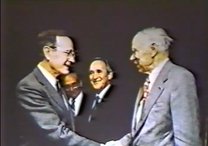
00:04:04 This is a picture taken when John Kennedy came out to the Germantown headquarters of the Atomic Energy Commission on February 16, 1961.
00:04:19 He'd been President less than a month.
00:04:22 Dr. Seaborg, while working with G.N. Lewis at Berkeley, began collaborating with Joe Kennedy,
00:04:28 who had recently completed his thesis at Berkeley.
00:04:31 This was in 1938-39.
00:04:35 We discussed the work in Germany by Hahn and Strassman and Meitner,
00:04:42 in which they had bombarded uranium with neutrons and formed these radioactive isotopes that they thought were due to transuranium elements.
00:04:51 We, Joe and I, I can remember sitting around for hours with him at the Varsity coffee shop on Telegraph Avenue
00:04:59 and trying to figure out what's going on here.
00:05:03 This doesn't look right.
00:05:04 I mean, you get all these negative beta particle emitting isotopes, you know, one after the other,
00:05:13 and they're all transuranium elements in parallel decay chains,
00:05:18 so you had to have many isomers, you know, and so forth.
00:05:21 And we thought, there's something wrong here.
00:05:23 But we couldn't quite figure out what it was.
00:05:26 And then one night at the Physics Journal Club, which met in Le Conte Hall on Monday evenings,
00:05:36 word came through that Hahn and Strassman had proved that barium was formed in the bombardment of uranium with neutrons.
00:05:44 Which meant the nucleus split.
00:05:45 Which meant the nucleus had split.
00:05:47 And that was the first information that you had.
00:05:49 That was the first information I had that it had been done.
00:05:53 And then, of course, it occurred to me, as it did others,
00:05:56 that all of these transuranium elements must be these medium-weight isotopes.
00:06:02 January 39, and it was about the last Monday in the month that the news came through
00:06:09 and it was announced at the Journal Club.
00:06:11 Well, after that happened, it just hit like a, you know, like a thunderbolt.
00:06:17 I can remember going out after that seminar in a combined mood of exhilaration and exasperation.
00:06:29 You know, exhilaration at the, you know, just the beauty of the result.
00:06:34 And exasperation for having spent several years thinking about this
00:06:39 and not being able to make that breakthrough.
00:06:42 And interpreted these so-called transuranium elements as fission products.
00:06:48 Of course, I had many companions in this inability to interpret this.
00:06:53 I mean, Fermi and Oppenheimer and Lawrence and Macmillan and Alvarez and Bohr and everybody in the world.
00:07:03 But...
00:07:04 So you walked the streets of Berkeley thinking about that?
00:07:07 I walked the streets of Berkeley literally for hours.
00:07:10 Really?
00:07:11 Just winding down, you know, a combination of saying,
00:07:15 my God, how could I be so stupid that I would have thought of this?
00:07:19 And then, oh, but what a significant discovery.
00:07:23 You know, it's unbelievably significant.
00:07:26 You know, as graduate students, we had to give each year a talk
00:07:34 before Jim Luce's famous research conference
00:07:37 where he sat, you know, at the table there with his cigar, you know, and said,
00:07:42 Shall we begin?
00:07:43 And then first there was a talk by a graduate student
00:07:47 and then a faculty or a post-doctoral student or a finishing graduate student
00:07:53 gave a research talk on this research.
00:07:56 Well, in one of my graduate student talks there,
00:08:01 I described the, this would have been back in about 36 or 37,
00:08:06 I described these transuranium elements of Hahn and Strassmann and Meitner.
00:08:12 I studied all the chemistry and all the relationships and so forth
00:08:17 and I was sort of an expert on these.
00:08:21 Prior to the recognition of fission.
00:08:23 Yes, 36 or 37, I gave this talk in which I read all these papers
00:08:29 and described this work.
00:08:33 But then after this breakthrough of recognizing fission,
00:08:38 you realized there still must be some transuranium elements there.
00:08:41 The real transuranium elements, yes.
00:08:43 And then that's when I got started with that.
00:08:46 Actually, MacMillan and Abelson discovered the first transuranium elements,
00:08:51 element 93, formed by bombarding uranium with neutrons.
00:08:57 And they were able to show chemically that it was like uranium in its chemical properties
00:09:03 and not like rhenium like you would expect.
00:09:06 And that was done here at Berkeley, wasn't it?
00:09:08 That was done here at Berkeley in the spring of 1940.
00:09:11 And then MacMillan left for war work at MIT, radar research and so forth.
00:09:19 And I carried on the work with Joe Kennedy and Arthur Wall, a graduate student.
00:09:26 And we made our first bombardment of uranium on December 14, 1940,
00:09:31 with deuterons, 16 MeV deuterons in the Berkeley 16 cyclotron.
00:09:39 And then made a chemical separation of an element 93 fraction,
00:09:44 which we knew how to do by that time.
00:09:47 And then besides a beta decay of the 93, element 93 isotope,
00:09:53 there was a growth in of alpha radioactivity,
00:09:55 which we thought, ah, this must be the daughter isotope with the atomic number 94.
00:10:02 It was actually not the daughter of the first isotope,
00:10:05 not the daughter of neptunium-239 discovered by MacMillan and Abelson,
00:10:09 but the daughter of neptunium-238, a new isotope.
00:10:14 And then we were able to prove chemically.
00:10:18 Actually, the experiment took place, the key, the breakthrough experiment,
00:10:23 took place the night of February 23rd, 24th, 1941, in room 307, Gilman Hall.
00:10:30 And the top floor of Gilman Hall.
00:10:32 And the top floor of Gilman Hall.
00:10:34 Which is now designated an historic site.
00:10:36 Yes, it's a national, that's right, historic national monument.
00:10:43 Arthur Wall performed that oxidation,
00:10:47 and that was, it used peroxidized sulfate and silver ion as the oxidizing agent,
00:10:56 because we couldn't oxidize it with the oxidizing agents that oxidize neptunium.
00:11:01 And that way we could separate it from neptunium,
00:11:05 and of course from all the other elements,
00:11:06 and we knew we had a new element, we were pretty sure before that,
00:11:09 but we wanted to prove it chemically,
00:11:12 and that was the proof, chemically, that we had a new element.
00:11:16 And then we went on and produced the other isotope
00:11:21 by bombarding a lot of uranium, 3 pounds.
00:11:24 239.
00:11:25 239, which had escaped detection so far.
00:11:28 We produced a huge amount of neptunium-239,
00:11:32 and let it, isolated it chemically,
00:11:35 and let it degate to its daughter,
00:11:37 and then we found the alpha particle activity of the plutonium-239,
00:11:41 and then went on, Emilia Segrè joined us for this research.
00:11:45 So Segrè and Kennedy and Wall and I then took this sample of the first plutonium,
00:11:51 which weighed, we didn't weigh it,
00:11:55 but you could calculate that from the intensity of the radioactivity of its parent,
00:12:00 that it weighed 5 tenths of a microgram.
00:12:04 And then we took that and bombarded it with neutrons at the 37th cyclotron.
00:12:11 The bombardment of the 3 pounds of uranium was done at the 60th cyclotron,
00:12:16 where you have a higher neutron flux.
00:12:18 And then the 5 tenths of a microgram of plutonium-239
00:12:24 on a little platinum plate was bombarded with neutrons
00:12:28 in comparison with a known amount of U-235
00:12:31 at the 37th cyclotron.
00:12:34 And then on March 28, 1941,
00:12:37 this illustrative of how fast things were moving in those days,
00:12:41 we proved that plutonium was fissionable.
00:12:44 Which made it the most important isotope.
00:12:46 Oh, that opened, really, that aspect of the Manhattan Project.
00:12:50 It opened up there.
00:12:52 All these developments made some significant changes in the periodic table.
00:12:58 Yes, I should say so.
00:13:01 We went on from this.
00:13:05 We went on to Chicago, a number of us.
00:13:09 Kennedy and Segre, they went to Los Alamos.
00:13:12 But a number of us, Isidore Perlman and Spofford English and others,
00:13:19 went on to Chicago where they had centralized the plutonium project
00:13:23 on the campus of the University of Chicago.
00:13:27 They called it the Metallurgical Laboratory.
00:13:29 They were looking for a name that would be misleading,
00:13:33 that would describe something that was not going on there.
00:13:36 But, of course, it wasn't very long before we were doing metallurgical work as well.
00:13:41 This in 1942?
00:13:42 This was in 1942.
00:13:45 We continued working throughout 1941 at Berkeley,
00:13:50 studying by the tracer technique the chemical properties of plutonium.
00:13:54 We learned how to separate it by using oxidation reduction cycles,
00:13:58 the upper and the lower oxidation states.
00:14:00 Never having enough to see.
00:14:01 Never having enough to see.
00:14:03 That's right, up until now.
00:14:05 Even that five-tenths of a microgram that we used to demonstrate the slow neutron fission ability
00:14:14 was in rare earth carrier material.
00:14:16 That was the huge amount.
00:14:18 That was the huge amount, yes.
00:14:20 But with Pearl Harbor, the Manhattan, well, the predecessor to the Manhattan District Project,
00:14:30 it was in the Office of Scientific Research and Development, the OSRD at first,
00:14:36 was organized, and that organized the laboratory at Chicago,
00:14:41 the plutonium project laboratory, the Metallurgical Laboratory,
00:14:45 and the laboratory at Berkeley where Lawrence was separating U-235 with the electromagnetic separation,
00:14:54 and the laboratory at Columbia where Urey and Libby and others were working on other methods
00:15:01 for separating U-235, eventually developing the diffusion, gaseous diffusion process.
00:15:08 So in April of 1942, I moved to Chicago with a couple of colleagues,
00:15:17 arriving in Chicago on April 19th, 1942, my 30th birthday.
00:15:23 And then we went to work in Chicago.
00:15:27 We were given a laboratory on the top floor of Jones Laboratory.
00:15:32 And there we began to work on the chemical processes for the separation of plutonium from uranium,
00:15:40 which would have been irradiated in chain reactions to produce plutonium in fission products on a large scale.
00:15:48 So it was to separate plutonium from half of the periodic table.
00:15:51 That's right, yes, and we hadn't seen it yet.
00:15:54 And dangerously radioactive material.
00:15:56 Yes, very radioactive material.
00:15:58 It was our assignment to work out a separation process that could be operated by remote control
00:16:05 through, you know, ten feet of concrete and some lead shielding.
00:16:13 But at this time that you were developing this process for separating plutonium,
00:16:18 it was really at the wrong place in the periodic table.
00:16:22 Yes, it was misplaced in the periodic table.
00:16:28 Should we show that?
00:16:29 I think that would be a good thing to show,
00:16:33 and I think a good way of showing that would be to use the film that I made with my colleagues,
00:16:44 Stan Thompson and Burris Cunningham and Albert Caruso,
00:16:48 on the transuranium elements as part of the chem study series.
00:16:55 This is the periodic table as it looked before 1940.
00:17:00 The rare earth elements, or lanthanide elements, were fitted between barium and hafnium as they are today.
00:17:11 But thorium, protactinium, and uranium were believed to be related to hafnium, tantalum, and tungsten.
00:17:21 The transuranium elements, or elements after uranium, were expected to fill out this role
00:17:28 and to have properties that resembled these elements.
00:17:34 However, when neptunium and plutonium were discovered,
00:17:37 their properties were found to be much more like uranium than like rhenium and osmium.
00:17:44 The proposal was then made that transuranium elements formed a uranide, or uranium light series,
00:17:51 and that the undiscovered elements 95 and 96 should be like uranium in their chemical properties.
00:17:59 And it was on the basis of that hypothesis that we went on to try to synthesize and identify elements 95 and 96
00:18:11 at the Metallurgical Laboratory of the University of Chicago.
00:18:15 But again, it was an erroneous hypothesis.
00:18:22 You recall from that last periodic table showing the uranide series
00:18:28 that the deduction seemed to follow that elements 95 and 96 would have chemical properties like plutonium and neptunium and uranium.
00:18:41 At the Metallurgical Laboratory, I enlisted the help of Albert Giorso
00:18:47 and two young bachelor's chemists, Ralph James and Leon Morgan,
00:18:57 to take material that had been subjected to transmutation reactions,
00:19:03 and in the case of element 96, plutonium that had been bombarded with 32 MeV helium ions at Berkeley,
00:19:11 and in the case of 95 and 96, plutonium that had been bombarded with neutrons,
00:19:20 first at the Clinton Pilot Plant Laboratory at Oak Ridge, Tennessee,
00:19:26 at the Clinton Laboratories, as they were called,
00:19:29 and then later at the Hanford Laboratory where the higher power reactor was built.
00:19:34 And using these sources, we tried to identify any possible isotopes 95 and 96 that might have been produced.
00:19:45 Making that assumption that they were going to be like uranium.
00:19:48 Making that assumption that they were going to have an upper oxidation state, a plus 6 state,
00:19:53 like uranium, neptunium, and plutonium.
00:19:57 Well, when we did that, using material that had been subjected to transmutation reactions, we didn't find anything.
00:20:07 And in retrospect, we were just thrown away the fraction that had the 95 and the 96 in it.
00:20:14 We found 96 actually before 95, that is from the alpha particles, the helium ions,
00:20:20 on plutonium bombardment in the Berkeley 60 encyclotron.
00:20:25 And I was puzzling what was wrong.
00:20:29 And then suddenly, almost, I'd say suddenly, one day in July of 1944,
00:20:38 I got the idea, oh, we have this all wrong.
00:20:44 The periodic table really is basically wrong.
00:20:48 And that thorium and protactinium and uranium should be removed from the body of the periodic table
00:20:57 and put down at the bottom to start a second rare earth series, which I call the actinide series.
00:21:03 And then if you do that, as you count over, you'll find that 95 and 96 are analogous to europium and gadolinium.
00:21:15 You have a chart that shows that.
00:21:17 Well, actually, this is the chart where I published this notion.
00:21:24 I took and removed, not quite, and I'll come back to this,
00:21:32 the uranium, the thorium, protactinium, and uranium from where they were there
00:21:42 and put them down here in the periodic table, thorium, protactinium, and uranium.
00:21:49 And then, of course, neptunium and plutonium would come here,
00:21:52 and 95 and 96 would come here, and 95 would be chemically like europium,
00:21:57 and 96 would be chemically like gadolinium.
00:22:01 And when we used that theory and devised chemical separation procedures based on that hypothesis,
00:22:09 then we were able to identify first element 96 and then element 95.
00:22:16 And then, of course, an important aspect of that was that then you knew where 97, 98, 99,
00:22:24 and all of these would come, you see.
00:22:26 They would finish out the second rare earth series,
00:22:28 and all you had to do was count 97, 98, 99, 100, 101, 102, and 103.
00:22:34 If you could count, then you knew where this series ended.
00:22:38 Now, I want to make two comments about this.
00:22:40 I didn't quite have the nerve to put in those numbers.
00:22:43 You'll notice this is just a reproduction of this periodic table
00:22:48 as I published it in the Chemical and Engineering News in December 1945,
00:22:53 you see, after the war when it could be declassified.
00:22:56 But I presumed that people could see the analogy there.
00:23:01 And then, secondly, I didn't quite have the nerve to take these out completely
00:23:07 from where they were before, so I put them in there in a half-baked mantle this way.
00:23:12 And I want to tell you why I did it that way.
00:23:15 I asked a number of my chemist friends, eminent chemists,
00:23:20 and I won't name their names.
00:23:25 Well, I said to them that I was considering publishing this periodic table,
00:23:30 you know, just throwing away the standard periodic table
00:23:35 and sort of starting over in a sense.
00:23:37 And I was going to publish a thing like this.
00:23:39 And these fellows said, don't do it. Don't do it.
00:23:43 They said, you'll ruin your scientific reputation.
00:23:46 Well, I had one advantage.
00:23:48 I didn't have much of a scientific reputation at that time.
00:23:52 So this was published.
00:23:54 And this has now become the standard way of representing the elements, as you know.
00:24:02 In fact, I'm going to come back.
00:24:05 Well, maybe this is the best time to tell this story too.
00:24:11 And that is, after the war was over and I was able to get this work declassified,
00:24:22 I was scheduled to give a talk at a symposium at Northwestern University on November 16, 1945.
00:24:30 And at this symposium, I was going to announce the discovery of elements 95 and 96.
00:24:35 Now, quite by accident, I was scheduled to appear as a guest on the Quiz Kids program the previous Sunday.
00:24:47 That was Sunday, November 11, Armistice Day, 1945.
00:24:54 I was a guest, and they turned the program around.
00:25:02 And the second half of the program, they let the Quiz Kids ask me questions.
00:25:09 And questions that I would then answer.
00:25:15 And remember, this was a national broadcast.
00:25:19 And one of the kids asked me, by the way, have there been any new elements discovered at the Metallurgical Laboratory during your work here in Chicago during the war?
00:25:33 And then I blurted it out. I says, yes, there have been two new elements.
00:25:37 Elements with the atomic numbers 95 and 96.
00:25:40 And this was the announcement to the world of the discovery of these two elements.
00:25:45 Those elements not having been named yet.
00:25:47 Not having been named yet. In fact, they weren't named until six months, you know, four or five months later.
00:25:52 And they're on this chart, of course, as you see, only 95 and 96.
00:26:01 Thank you, Bob Murphy, and good evening, everyone.
00:26:03 Well, children, we have the great honor to present as our guest observer on this Armistice Day program, a most distinguished scientist, Dr. Glenn T. Seaborg.
00:26:11 Dr. Seaborg was a co-discoverer of the new element plutonium at the University of California, and he was closely concerned with the development of the atomic bomb at the University of Chicago.
00:26:22 Because the whole world is rightfully curious about the atomic bomb and its grave implications for world peace or world annihilation, it seems a very appropriate subject for our Armistice Day discussion.
00:26:35 Now, let's get roll call started. Harvey?
00:26:38 I'm Harvey Bennett Fishman. I'm 15 years old, and I'm a sophomore at the South Shore High School in Chicago.
00:26:43 Well, doctor, do you really think they'll be able to harness the energy of the atom and use it for driving ships or planes in the post-war world?
00:26:51 Well, Harvey, yes. I think they will. Not right away, but sometime in the future, say 10 or 15 years.
00:27:00 Richard, how about your question?
00:27:02 Well, doctor, how long do you think it'll be before some of the more stable elements will be split, that is, on a practical scale?
00:27:11 Oh, on a practical scale. They've been split on a small scale. On a practical scale, I don't know.
00:27:20 A new principle would have to be discovered or a new type of reaction.
00:27:27 However, it's probably... I wouldn't say that it'd be impossible, maybe in 50 years.
00:27:31 I was wrong on that.
00:27:32 Well, another thing...
00:27:33 Here it is.
00:27:34 Have there been any other new elements discovered, like plutonium and neptunium?
00:27:39 Oh, yes, Dick. Recently, there have been two new elements discovered, elements with atomic number 95 and 96, out at the Metallurgical Laboratory here in Chicago.
00:27:50 So now you'll have to tell your teachers to change the 92 elements in your school books to 96 elements.
00:27:57 We certainly thank you, Dr. Seaborne, for taking time from your many pressing commitments to be with us tonight.
00:28:02 That was the first public announcement.
00:28:04 That was the first public... Finish it, I think, if you could. It's funny.
00:28:13 Listen to the Quiz Kids every Sunday, and listen to your old friends Lum and Abner every Monday through Thursday.
00:28:19 Folks, check your family supply of Alka-Seltzer.
00:28:22 And remember, when your tablets get down to four, that's the time to buy some more.
00:28:27 This is Bob Murphy speaking.
00:28:33 Yes, that was the announcement to the world of the discovery of these elements.
00:28:37 I'd like to say that this is the first time, I guess the only time, that the discovery of new elements has been announced under the sponsorship of Alka-Seltzer.
00:28:50 Well, now, to go on.
00:28:52 Coming back to the periodic table.
00:28:54 Coming back to the periodic table.
00:28:56 This meant, then, as the years went on, that we could fill in all of these elements.
00:29:07 Let's see if I can find them here.
00:29:10 Berkelium, we knew would be chemically like terbium.
00:29:16 And experiments at Berkeley in 1949 led to the discovery of berkelium.
00:29:21 And californium would be chemically like dysprosium.
00:29:25 That's 98.
00:29:28 And then 99, which became named einsteinium, was chemically like holmium.
00:29:38 And 100, fermium, is chemically like erbium.
00:29:41 And 101, mendelevium, is chemically like thulium, and so forth.
00:29:46 We could, once we understood this, we could devise experiments using the ion exchange method that had been discovered in the meantime,
00:29:55 which was an elution, absorption elution method, using analogies to the rare earths.
00:30:06 We could, before the element was discovered, predict its chemical properties with extreme precision,
00:30:12 so that in the end you could find just a few atoms.
00:30:15 In fact, with the element 101, we found five atoms in the crucial experiment,
00:30:23 and a total of 17 atoms of 101 up to the time we announced the discovery.
00:30:30 And identified because they had just the right chemistry.
00:30:32 And they had just the right chemistry.
00:30:34 That is, the element 101 eluted analogously to thulium.
00:30:40 And we could calibrate our ion exchange elution, our absorption elution apparatus,
00:30:46 so that we knew just where ectothulium, as you would call it, would come out.
00:30:51 And that way we could make a chemical identification with just a few atoms.
00:30:56 Then, of course, you could go on, since 103 would finish the actinide series,
00:31:02 you could go on and put element 104 up here under hafnium, where thorium used to be.
00:31:12 And 105 under tantalum, where protactin used to be.
00:31:17 And 106 under uranium, under tungsten, where uranium used to be.
00:31:24 And then you'd have 107, 108, and so forth.
00:31:27 And if you count on over here, then you'd get to element 118 as the next noble gas.
00:31:33 And in the meantime, of course, people have been thinking there might be an island of stability
00:31:38 of some super-heavy elements up around element 114.
00:31:43 And element 114 comes right under lead, you see.
00:31:47 So in devising experiments to look for a super-heavy element,
00:31:50 we would assume its chemical properties were like those of lead.
00:31:56 The intervening elements having very short half-lives.
00:31:59 Yes, the intervening elements were up to 107, now, is the heaviest element known,
00:32:06 which has a half-life of a millisecond.
00:32:09 Thousands of a second.
00:32:10 Yes, or a few milliseconds.
00:32:12 And then the thought is that you'd get a new center of stability up around element 114,
00:32:19 what they call closed shells, just like you have stable noble gases, inert gases,
00:32:25 because there's a stable shell of eight electrons, closed shell of eight electrons.
00:32:30 The thought is that you have a closed shell of 114 protons and 184 neutrons,
00:32:35 a double-closed shell, actually.
00:32:37 And that would lead to a center of stability.
00:32:39 Of course, it would still be radioactive, but it wouldn't be...
00:32:42 But a long lifetime.
00:32:43 It would be hoped that instead of being 10 to the minus 10th second, say, or less,
00:32:51 its lifetime might be a million times longer, or a billion times longer,
00:32:58 or a trillion times longer, depending on which theory you look at.
00:33:03 But all of our experiments so far, and we've been conducting experiments like that at Berkeley,
00:33:07 in fact, that's part of the research I'm engaged in now, have led to negative results.
00:33:14 We think not because there is no island of stability,
00:33:17 but because the reactions that you use, which is to bombard heavy actinides with heavy ions
00:33:24 or heavy elements like lead with heavy ions, do not occur.
00:33:29 Or if they occur, in a sense, but then the product, instead of staying stuck together,
00:33:35 fissions, undergoes the fission reaction.
00:33:39 You're trying to leapfrog...
00:33:41 That's right. You're trying to leapfrog above the area,
00:33:50 which you might call the sea of instability in between,
00:33:54 beyond element 106, 107, and so forth, up to maybe 114.
00:33:59 Although it isn't a matter of hitting 114 exactly,
00:34:05 there's a spread of increased stability in that neighborhood,
00:34:10 and that's why we call it an island of stability.
00:34:13 And then, finally, a periodic table that even goes beyond that.
00:34:19 We finish up at 118 here, and then start over again at 119 as an alkali metal,
00:34:28 and 120 as an alkaline earth.
00:34:30 And then at 121, a number of us have predicted that there should be another rare earth series,
00:34:36 and that would be down here.
00:34:39 Whereas this rare earth series, the normal light rare earths, called the lanthanides,
00:34:45 because there are 14 elements following lanthanum, have chemistry like lanthanum,
00:34:49 have 14 elements, and the actinide series, the 14 elements following actinium,
00:34:55 that we've been focusing on, have 14 elements,
00:34:58 because there are 14 places in an inner electron shell.
00:35:02 There are, predicted here in a series that I've called the superactinides, 32 places,
00:35:09 because there would be the 14 f-electron places, and then 18 g-electrons,
00:35:16 and they would be filled in a co-mingling fashion,
00:35:19 and so then you add to 121, which would be sort of your actinium,
00:35:27 32 inner elements, inner electron elements, getting you up to element 153,
00:35:35 and then you go back into the body of the periodic table again here,
00:35:41 under hafnium with element 154,
00:35:45 and then you go on up this way consecutively until you get up to element 168,
00:35:50 which would be your next inert gas, or noble gas,
00:35:55 or really maybe noble liquid,
00:35:57 because the predictions are that the boiling point would be above room temperature,
00:36:02 and all of this has been confirmed.
00:36:04 This is a rather simple-minded extrapolation,
00:36:07 but this has all been confirmed through ab initio first principle calculations
00:36:15 involving the laws of atomic structure,
00:36:18 now made possible with the high-speed computers,
00:36:22 and these lead to the same conclusion that these elements are fitted in this manner
00:36:28 with some small deviations.
00:36:31 I mean, little details that deviate,
00:36:37 but that are not worth bothering with when you're trying to represent it
00:36:42 in an overall manner in a periodic table.
00:36:44 We need a breakthrough to get to the incremental production of these elements.
00:36:49 Yes, well, I'm glad you pointed that out.
00:36:53 Actually, you can't get up to these because the nucleus is not stable, you see,
00:36:58 and also because we have no reactions where we can put ingredients together on Earth.
00:37:03 I'm not saying that maybe out in some star
00:37:07 or one of these new entities they're discovering,
00:37:13 neutron stars and so forth, you might not do it,
00:37:17 but it doesn't look likely because we don't have the reactions,
00:37:22 and then, of course, basically because, and this applies anywhere,
00:37:27 because the nucleus isn't stable enough.
00:37:30 And I think the best we'll be able to do is to produce elements in this island
00:37:37 of stability around element 114.
00:37:39 Beyond that, the half-lives are just too short.
00:37:43 I received the Nobel Prize in December of 1951,
00:37:50 not for the discovery of the transuranium elements, by the way,
00:37:54 because Fermi had received the Nobel Prize for that.
00:37:58 He had bombarded, as I mentioned briefly earlier,
00:38:03 Fermi and Segre and Pondercarvo and co-workers in Rome in 1934
00:38:10 before Hahn and Strassman and Meitner had bombarded uranium with neutrons
00:38:15 and found radioactivities which they assigned to transuranium isotopes.
00:38:21 And then when Fermi received the Nobel Prize in 1938,
00:38:25 he was cited for this along with other work.
00:38:28 So I was cited for the chemistry of the transuranium elements.
00:38:32 Here's a picture which you might take a look at.
00:38:36 Yes, that is taken on December 10th, 1951,
00:38:43 when the then king of Sweden handed me the diploma and medal
00:38:51 that goes with the Nobel Prize in chemistry,
00:38:54 which I shared with Ed McMillan.
00:38:56 He'd been involved in the discovery of the first transuranium element, element 93.
00:39:01 Neptunium.
00:39:02 Neptunium.
00:39:03 And by this time we had discovered plutonium-94,
00:39:09 americium-95, curium-96, berkelium-97, and californium-98.
00:39:15 Always with a distinguished scientist such as yourself,
00:39:19 it seems that everything proceeds perfectly beautifully, just as planned.
00:39:25 There probably were some big disappointments along the way, weren't there?
00:39:29 Well, I told you about one, the failure to recognize fission.
00:39:34 I mean, I still worry about that.
00:39:36 I still wake up at night and wonder why I was so stupid.
00:39:41 Also, you see how I was misled by the periodic table several times,
00:39:50 going in the wrong direction until finally I was able to figure out
00:39:56 how to use the periodic table correctly.
00:39:59 And what was a great thrill in your life?
00:40:02 Is there any particular event that...
00:40:04 Yes, it would have to be the recognition of the change in the periodic table,
00:40:08 the actinide concept,
00:40:10 and the almost immediate verification of this
00:40:16 through its application in the identification of elements 95 and 96
00:40:23 following their synthesis.
00:40:25 That would have to be it.
00:40:26 I would say, from that point of view,
00:40:28 I was more thrilled by the discovery of elements 95 and 96
00:40:31 than any other elements, including plutonium.
00:40:33 Because that opened the doors, didn't it?
00:40:35 Yes, that opened the door and it was...
00:40:40 somehow it revealed the truth about the periodic table.
00:40:46 What do you see as the frontiers in your field now?
00:40:51 Where are the unknowns that you're looking for?
00:40:55 It depends on how you define my field,
00:40:57 but if you defined it as nuclear chemistry or low-energy nuclear physics,
00:41:02 I would say heavy ion research,
00:41:05 including the continued search for the super-heavy elements.
| Property | Value |
|---|---|
| Creator of work | |
| Place of interview | |
| Format | |
| Genre | |
| Medium | |
| Extent |
|
| Language | |
| Subject | |
| Rights | In Copyright |
| Rights holder |
|
| Credit line |
|
Institutional location
| Department | |
|---|---|
| Collection |
Related Items



Cite as
American Chemical Society. “Reflections by an Eminent Chemist: Glenn Seaborg.” Dvd, 1981. American Chemical Society Audiovisual Collection. Science History Institute. Philadelphia. https://digital.sciencehistory.org/works/r4p0r0w.
This citation is automatically generated and may contain errors.