
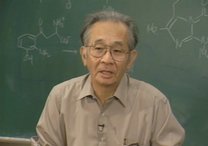
Koji Nakanishi interviewed by Leon Gortler (unedited footage), Part 7
- 1987-Sep-20

These captions and transcript were generated by a computer and may contain errors. If there are significant errors that should be corrected, please let us know by emailing digital@sciencehistory.org.
Transcript
00:00:00 What was I saying? I was saying that. What was the last thing?
00:00:07 Wait a moment, wait a moment. I was saying that.
00:00:13 Oh yeah, I see.
00:00:30 Imagination. Could this be translated into organic problem and so on?
00:00:36 And also, you have a very broad mind and also a very critical one.
00:00:44 When you read papers, don't think, don't accept the things written there for granted.
00:00:54 And I think it's trying to retain, I mean, this is all I've used.
00:01:03 Okay, I can start from there.
00:01:24 Also, when one reads a paper, I think it's important to not only to understand the paper,
00:01:40 but also to retain some information, take an active attitude, trying to extract an information
00:01:49 which will have a positive influence on the person's research at that particular time.
00:01:58 And that is another thing. And also, as it becomes more and more interdisciplinary,
00:02:07 I think one should strive to look at things from various angles in a very broad manner.
00:02:14 Otherwise, you cannot do it. You see, even if two people, A and B, collaborate,
00:02:21 even if it is interdisciplinary, they have to touch bases at some stage.
00:02:26 And this can only be done if people have a broad, open mind.
00:02:30 And this is what I think is a tremendous advantage of the education system in this country
00:02:38 compared to, in particular, Japan. And this country, you have, in the States,
00:02:46 you can choose courses and it's not a set menu, but a la carte, this and that and that.
00:02:54 But in Japan, it's not like that. It's more like a set menu, plus there's not enough mixing of blood.
00:03:00 And that is one tremendous advantage that people in this country have.
00:03:07 And also, there's very fair competition.
00:03:11 And people who manage to do good work, outstanding work while they are young,
00:03:18 they immediately get recognized, independent of what school they come from.
00:03:22 It's not even discussed. It's solely on a fair play.
00:03:27 And in many other countries, it's not necessarily so.
00:03:31 And that is a very healthy situation in this country.
00:03:37 I wonder what else. Let me just stop it for a second.
00:03:47 Okay.
00:04:04 Another point maybe I should mention is the importance of lab techniques.
00:04:13 And, you see, discussion, in particular in interdisciplinary areas or whatever,
00:04:20 discussion is glorified. But the thing which is very difficult
00:04:26 is to prove that a negative result is really negative.
00:04:30 And in order to do that, you have to have very good lab techniques to be confident about what
00:04:37 you're doing. And about the micro scale, I don't worry.
00:04:41 Many students ask, and how come you can do things on a micro scale like that,
00:04:46 which is in most cases invisible. But if you're forced to do that,
00:04:51 practically anyone can do this. But it is to have good techniques,
00:04:56 which means clean and reliable hands that you know that your results are correct
00:05:02 and not to be sloppy. And this constantly
00:05:07 depends on the constant effort on the side of the students,
00:05:12 in addition to having this broad concept and liberal mind and dynamic, all of these things.
00:05:20 But I think, plus a creativity, imagination, well, it's said quite often.
00:05:27 But so have good hands and a sharpened antenna and hard work.
00:05:33 OK, Koji, thank you very, very much. It's really been a delight.
00:05:37 And I appreciate your talking to me. Thank you very much.
00:05:43 Thank you.
00:05:57 OK.
00:06:01 Thank you very much.
00:06:03 OK, Karine, will you give us a brief memory about the
00:06:05 Walt Whitman-Leaptor lecture today?
00:06:08 All right.
00:06:10 Can you imagine as someone who listened to you,
00:06:13 actually listening to me, focus here,
00:06:15 it's a flashback or a flashback that goes to that lecture earlier,
00:06:22 close the door and pick it up again?
00:06:24 No, it's fine, let's just take two.
00:06:26 One more?
00:06:28 Yeah, one more.
00:06:36 It's fine.
00:06:38 Thank you.
00:06:40 OK.
00:06:42 OK.
00:06:52 Less than 60 minutes.
00:07:02 OK?
| Property | Value |
|---|---|
| Creator of work | |
| Format | |
| Genre | |
| Medium | |
| Extent |
|
| Language | |
| Inscription |
|
| Subject | |
| Rights | In Copyright |
| Rights holder |
|
| Credit line |
|
Institutional location
| Department | |
|---|---|
| Collection |
Related Items

Cite as
American Chemical Society. “Koji Nakanishi Interviewed by Leon Gortler (Unedited Footage), Part 7.” U-matic (tm), September 20, 1987. American Chemical Society Audiovisual Collection. Science History Institute. Philadelphia. https://digital.sciencehistory.org/works/x4fwlwc.
This citation is automatically generated and may contain errors.