
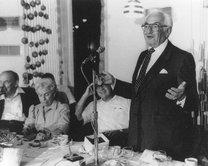
Oral history interview with Sidney Edelstein
- 1987-Aug-31 (First session)
- 1988-Feb-24 (Second session)
Oral history interview with Sidney Edelstein
- 1987-Aug-31 (First session)
- 1988-Feb-24 (Second session)

In this interview Sidney Edelstein begins with his family life in Chattanooga, Tennessee, and includes his early education and experiences at the Baylor School in Chattanooga. He describes his undergraduate career at MIT, his interest in cellulose chemistry, and recalls his first employment at the Dixie Mercerizing Company in the midst of the Depression. The interview continues with Edelstein's early entrepreneurial activities, and his term as an AATCC Research Associate. The formation of Lamede, Inc., and Edelstein's position as research director at Hart Chemical Company are discussed in detail. Edelstein continues with his work with the Army Quartermaster Corps during World War II, and difficulties with the Sylvania Industrial Company. The second section of the interview begins with the formation of the Dexter Chemical Corporation, and continues with the company's development, first products, sales figures, subsidiaries, and international operations. Edelstein explains his interest in the history of dyestuffs, including the articles he wrote, and the benefit of history to the textile industry. The interview continues with Edelstein's key role in the history of the American Chemical Society Division of the History of Chemistry, and focuses on the personalities and operations in the early days of the Division. The origin of the Dexter Award is described, and the first recipients discussed. The interview concludes with Edelstein's philanthropic activities, and the Edelstein Center at the Hebrew University.
| Property | Value |
|---|---|
| Interviewee | |
| Interviewer | |
| Place of interview | |
| Format | |
| Genre | |
| Extent |
|
| Language | |
| Subject | |
| Rights | In Copyright |
| Rights holder |
|
| Credit line |
|
About the Interviewers
Jeffrey L. Sturchio is president and CEO of the Global Health Council. Previously he served as vice president of corporate responsibility at Merck & Co., president of the Merck Company Foundation, and chairman of the U.S. Corporate Council on Africa. Sturchio is currently a visiting scholar at the Institute for Applied Economics and the Study of Business Enterprise at Johns Hopkins University and a member of the Global Agenda Council on the Healthy Next Generation of the World Economic Forum. He received an AB in history from Princeton University and a PhD in the history and sociology of science from the University of Pennsylvania.
Arnold Thackray founded the Chemical Heritage Foundation and served the organization as president for 25 years. He is currently CHF’s chancellor. Thackray received MA and PhD degrees in history of science from Cambridge University. He has held appointments at Cambridge, Oxford University, and Harvard University, the Institute for Advanced Study, the Center for Advanced Study in the Behavioral Sciences, and the Hebrew University of Jerusalem. In 1983 Thackray received the Dexter Award from the American Chemical Society for outstanding contributions to the history of chemistry. He served for more than a quarter century on the faculty of the University of Pennsylvania, where he was the founding chairman of the Department of History and Sociology of Science and is currently the Joseph Priestley Professor Emeritus.
Institutional location
| Department | |
|---|---|
| Collection | |
| Oral history number | 0075 |
Related Items


Interviewee biographical information
| Born |
|
|---|---|
| Died |
|
Education
| Year | Institution | Degree | Discipline |
|---|---|---|---|
| 1932 | Massachusetts Institute of Technology | BS | Chemistry |
Professional Experience
Dixie Mercerizing Company
- 1935 Textile Microscopist and Research Chemist
American Association of Textile Chemists and Colorists
- 1935 to 1938 Research Associate, University of Chattanooga
Lamede, Inc.
- 1938 to 1939 Vice President and Director of Research
Hart Products Coporation
- 1939 to 1945 Vice President and Director of Research
Dexter Chemical Corporation
- 1945 to 1985 President
- 1985 to 1989 Chairman of the Board and Chief Executive Officer
Honors
| Year(s) | Award |
|---|---|
| 1956 | Honorary DSc degree, Lowell Technological Institute |
| 1959 | Fellow, Textile Institute (Great Britain) |
| 1960 | Fellow, Society of Dyers and Colourists (Great Britain) |
| 1970 | Honorary citizen of Biella and Venice, Italy |
| 1987 | Honorary PhD, Hebrew University |
Cite as
See our FAQ page to learn how to cite an oral history.
THACKRAY: Could you tell us something about your family and their background in Chattanooga?
EDELSTEIN: My father was born in New York. His father and mother immigrated to Chattanooga when he was three years old, sometime around 1890. I was born in 1912 in Chattanooga, Tennessee, when my father was about twenty years old, so it would have been 1890 or 1892 when he went to Tennessee. His father was an immigrant from Lithuania who came over at the time of the big Jewish immigration from Russia and Poland. He came not knowing the language, and ignorant. The family name was not Edelstein, but something like Hode or Hodes. Immigration in New York acted with the typical impatience of immigration officers. They didn't quite get the name, so they told my grandfather, "Take a good American name--Edelstein." Somebody else had had Edelstein. So that's how we became Edelstein. It has no relationship to the original name, which was a simple, short name.
My mother was born in St. Louis, also in the 1890s. Her father and mother were similar immigrants who came from a certain area in Lithuania. They moved to Knoxville, Tennessee, when she was a young girl. Later she married my father in Chattanooga, Tennessee, and I was born in Chattanooga in 1912. I was the first-born of a large family. Of course, as the first-born, I was expected to be special--which I wasn't!
THACKRAY: What was your father doing in Chattanooga?
EDELSTEIN: My father "graduated" after the third year in grammar school and then the poor family sold newspapers. Inherently he was a smart businessman and an entrepreneur. He opened a pawn shop and became a big pawnbroker in Chattanooga. Basically, his family had no special line of education. They were just ordinary poor people.
On my mother's side there's a little different story. There is a record of technical expertise, especially engineers, going back into Russia for a number of generations. At least I know that by hearsay. My mother's brothers became well-known engineers. One was an inventor of many new things in the field of movies. For example, he developed the technique of using the bouncing ball as a way of synchronizing things. He also developed the stereoscopic movies that were first used way back, as well as many other principles within the movie industry. He was a well-known inventor in the field of optics, and held many patents. (I'm going back to the 1920s.) Other brothers were well-known engineers who built the big airport here in New Orleans as well as many other things. So there was a tradition of technical interest on that side of the family.
Furthermore, on the chemical side, my mother was a very famous cook in Tennessee. She was known all over the South as a creative cook, and had an ability to develop recipes of many types, from European to almost anything you can imagine. She was well-known from that standpoint. So perhaps my "cookbook chemistry" came from that side. [laughter]
THACKRAY: Where did you go to school?
EDELSTEIN: I went to the grammar school in Chattanooga through the fourth grade. Apparently I was both a precocious and a troublemaking child. There was a well-known prep school outside of Chattanooga, and some people suggested to my parents that the only thing that would keep me from going to hell would be to send me to this prep school--the Baylor School. At the time I entered the school in 1921 I should have gone into the fifth grade. But they didn't have a fifth grade so I went into the sixth grade. I was the only Jewish student in this school at the time. It was considered a fine school. Basically it was a school of the Episcopal church. That was the atmosphere at the school.
THACKRAY: Was your family religiously devout? Was your family being Jewish much of an issue at this time when you were entering Baylor?
EDELSTEIN: Well, my family was very interesting. My father was an uneducated person, but a bright man. My mother was an educated person. She was a high school graduate, and in those days it was almost like getting a Ph.D. today. She was a very liberal, forward-looking person who believed in the new ideas of Reform Judaism. My father was brought up in the regular Orthodox Jewish outlook. However, my mother believed in Reform Judaism, which was a breakaway from the rigid beliefs. Furthermore, she was another screwball in that she was an ardent Zionist, even as a young girl back in 1910. I grew up in what was a very mixed and peculiar kind of environment. I was forced to go to the Orthodox service, study their traditions, and be bar mitzvahed at the age of thirteen. At the same time I also went to the Reform movement, which was more like an Episcopal church than a Jewish synagogue.
Incidentally, the Reform group of Jews in Chattanooga were started by the Jewish immigrants from Germany in about 1848. This included Adolph Ochs, the founder of the New York Times, and his family. Adolph Ochs married the daughter of [Stephen S.] Wise, the founder of the Reform movement from Cincinnati. This Reform Jewish movement was the most outgoing in moving away from all the Jewish traditions. These German Jews looked down upon the Jews from Russia, from Lithuania, and from other countries. So here I was, a real bastard type of person. My mother believed in their principles, but not in their ideas. They were against Zionism. They were for the idea that Jews were just a religious people and had nothing to do with race or background or anything else. My mother believed differently. My mother believed that Jews were a special people that had a tradition. She believed in Zionism and the idea of Israel. She did not believe in the Orthodox rigidity. So I grew up with all of this, and had a chance to make a choice.
THACKRAY: That was quite a background to have as you entered Baylor.
EDELSTEIN: Well, I was a screwball, and quite different. We just didn't fit into the regular picture.
THACKRAY: Did your scientific interests begin to come out at Baylor?
EDELSTEIN: Well, by the time I was eight years old I was experimenting with chemistry just like my mother was experimenting with her cooking. I loved to experiment with chemicals. That was the atmosphere that I had. So from the time I was seven or eight years old, when I had my first little chemistry set, chemistry was my thing.
Baylor was a school that fortunately allowed students to be themselves. I had trouble there very early. I was expelled from the school for raising hell and causing trouble. Fortunately the headmaster appreciated people being different or special, and I was taken back into the school. It wasn't long before I was even given the keys to the laboratory so I could do some work in chemistry. So while I was a troublemaker and expelled in the early days, I realized that I might as well get good grades if I wanted to get into college. So I began to work at it. It was a great school with a great liberal tradition. I don't think the people at Baylor realized that the school had such a liberal tradition, but it did. They didn't quite understand what they were doing, but that is the way it was. If I'd have gone to the public school of Chattanooga, Tennessee, I would never have been able to get into a college like MIT directly from high school. I couldn't have passed the exams. I wouldn't have been able to do anything.
THACKRAY: Was there any particular member of the Baylor faculty who struck you as being outstanding?
EDELSTEIN: The outstanding person at that time was the headmaster, Alex Guerry. His father was sort of famous because he was an Episcopal bishop somewhere in the South. Alex came from a good family. He eventually became president of the University of Tennessee at Chattanooga, and later was chancellor of the University of the South at Sewanee, Tennessee. He died as a young man, but he was a man of vision. He took a particular interest in me. He used to beat my ass for being bad, but kept me going. (I don't know whether you want this recorded, but it is true! You need this to get the flavor of what I'm trying to tell you.)
STURCHIO: That's important. Do you recall what books you were reading when your interest in chemistry started?
EDELSTEIN: Well, in the early days, I was interested in all sorts of books. I was a book guy. At the time I was three years old I used to go to the public library. I loved to read, and I read things way beyond my age level. I was interested in geography, history, and everything under the sun. As far as chemistry is concerned, of course I began to read these early popular books on chemistry. I've forgotten many of them, but I do remember Slosson's book on chemistry (1). I was thrilled with the whole viewpoint of "knowing". When I was about thirteen or fourteen I just knew I would win the Nobel Prize in chemistry someday.
THACKRAY: How did MIT come into the picture?
EDELSTEIN: Well, I went to MIT. You see, the idea of being a scientist was not a typical thing in a prep school. Certainly my family and friends didn't know what the hell I was talking about. I was interested in MIT because I was either told by someone at school or I read somewhere that MIT was the best technical school. At that time, I was thinking about chemical engineering. I didn't distinguish between chemistry and chemical engineering. But I was thinking of chemistry in terms of being able to do useful things, not just in terms of theoretical things.
I was told, "Oh, that's a great school. That's the hardest school and the best." So I said, "That's where I'm going." Nobody at Baylor knew anything about MIT, so I wrote off for the catalog and other information. Incidentally, I was only fifteen years old when I was a senior at Baylor. Then I found out that in those days you had to take something like fifteen exams to get in. You had to take exams in almost everything to get in. You had to take the college boards in each of the required courses, such as math and languages. At the time I was graduating I found out that you had to have either three years of German, three years of French, or two years of French and two years of German. I had two years of Spanish, two years of French, a year of German, and a year of Latin, but nothing quite like the actual requirements. I didn't have the required courses for entrance, but I said, "Well, I'll take the three-year college board exams." Then I found out that you had to have both physics and chemistry. I had chemistry but not physics. After I graduated, I took two weeks of summer school with the professor of physics. I read the book, did the experiments, and then took the exam. I passed the physics exam after studying two weeks. So I passed these damned exams. In those days, if you passed the exams they didn't argue with you about whether you really took the courses or not. So, that's how I entered college.
STURCHIO: Where did your classmates at Baylor go after prep school?
EDELSTEIN: They mainly went to southern schools. The highest- ranking college selected by my classmates was Vanderbilt. But they didn't go to any of the northern schools. In those days there weren't too many people at MIT from the South. There were only a few from scattered southern locations. It was a different world.
THACKRAY: What did your parents make of this?
EDELSTEIN: They said, "That's where you want to go? That's what you want?" They didn't know anything about MIT. What could they have known? Here we were in Tennessee, and we'd never been to Boston. I was fifteen when I started as a senior at Baylor. When I graduated, I had just become sixteen. To gain entrance to MIT, you were supposed to be seventeen. So I put down seventeen. And that was that.
THACKRAY: You said you were the first-born. Did you have brothers or sisters?
EDELSTEIN: I had a sister. Of course, I had many cousins. My father had brothers and they had children. My mother had brothers and sisters and they had children. I was the first-born in both of these families. And I was a troublemaker, always causing trouble. There is an interesting event that happened in my senior year at Baylor. I had the keys to the laboratory since I was a prize chemical student. When it came time for the spring holidays I decided I'd make some fireworks to celebrate. So I took a couple of boys down with me to the laboratory, and prepared some fireworks, or what I thought would be fireworks. It blew up just when I was mixing them together. It blew the windows out, and blew up that part of the building. Several of the other boys and I were knocked out. We were brought to the hospital bleeding and burnt from head to toe. We were big heroes when we were in the hospital! It was one of the local hospitals in Chattanooga. Even after all these years, I'm still famous as the guy who blew up the laboratory building at Baylor! [laughter]
I graduated from Baylor in 1928 and entered MIT in the fall of 1928.
THACKRAY: Can you describe your first experiences at MIT?
EDELSTEIN: It took a very long train ride to get there. I'd never even seen pictures of the place, which was so large with all these buildings on the river. It was all very exciting and very wonderful to me. I came in early to take a course in trigonometry, which I felt I needed. I wasn't too good at trig. So I just went up to MIT a couple of months ahead of time and took a summer course in trigonometry. I lived in a dormitory for a month or two, but I was sort of lonesome there. I didn't know what the hell was going on. I joined a fraternity in my freshman year and moved into the fraternity house. I liked this because I was with people. I felt that I wasn't alone so much. My big disappointment at MIT was that nobody in the school really seemed to care about you. While I was a smart student at Baylor, I found I was now surrounded by other fellows who were also very smart. The work was very, very hard, and there was a lot of it. And I wanted to play around a little bit. It was very difficult to do both. I got by the first year, but of course I went out raising hell. I was always tired and couldn't get up in the morning.
[END OF TAPE, SIDE 1]
EDELSTEIN: Now, this was an interesting time in history. We're now talking about the fall of 1928 when the country was in the great boom. Everybody was making money and everybody was dealing in stocks. There were going to be two chickens in every pot and four cars in every garage. Hoover became president in 1928. I remember seeing him drive by MIT and we all waved at him. My parents were fairly well-to-do, and they could afford to send me to MIT. I had a charge account at the MIT branch of the Harvard Coop [Harvard Cooperative Society]. I could go in and charge clothes or anything else that I wanted. I remember that right away I felt I had to dress in the way that all the other MIT and Harvard big shots were dressing. That was a long, dark blue overcoat, a derby hat and spats. Imagine that! [laughter] That was the epitome of it.
I remember going in to get the derby hat at the Harvard Coop. No sooner had I signed the bill and was walking back across the Charles River on the Harvard Bridge when the goddamned derby hat blows off into the river! [laughter] Shortly after that I went back to get another one! It wasn't long before I got a call from my father, "What the hell are you buying two derby hats for? What's going on?" [laughter]
That was the beginning of college, in the fall of 1928. Then, in 1929, everything happened. Everything changed, and there was a different atmosphere.
THACKRAY: Did this result in people dropping out of college?
EDELSTEIN: At MIT in those days, there were an enormous number of guys who flunked out of school. They just couldn't make it. It was tough because nobody bothered with you, no professor gave a damn. This was it--you passed or you flunked. If you flunked too many classes you were out. They cleaned out the class. I think fifty or sixty percent of the freshman class was thrown out. It wasn't a question of money.
Now, let me give you a little bit more about MIT. In those days, the professors were just professors. They may have been brilliant. Some of them were doing some research, but they all taught freshman courses. Apparently they didn't give a damn about who in the hell was in there or what they were doing. It was just a routine job for them. Whereas at Baylor, the teachers were concerned. They would ask you questions, and they would talk to you. At MIT you had no contact with anybody. You got only what you read in the book. If you listened to the lectures, they were very bad. Frankly, as time went on, I found that in the whole school during my undergraduate work, it was meaningless as far as developing any relationship between the students and the professors. They just didn't care. They didn't bother, and you really learned on your own. They didn't teach you. You just learned it yourself. Whatever you learned you got from the books. It was very, very disappointing. For all my life I've held a grudge against this school for being a lousy school as far as teaching or caring about people is concerned.
THACKRAY: Did you have any family or friends in the area? It must have been very lonely.
EDELSTEIN: I joined a fraternity. I was always able to get along by myself. I was even satisfied with being alone, and I always got along one way or the other. I was not too lonesome. I enjoyed being away from home and doing my own thing, which was pretty wild in many ways.
I want to tell you a story that isn't too long. Prohibition was in existence at that time, and by my second year I had set up a whole operation in the fraternity house. I used to make home brew at those times. (Do you know what home brew is?) You could make beer. It was against the law to sell it, but theoretically you could make it for your own use. You could also make wine and a few other things for your own use. But I made it for business. So up in the attic of our fraternity house I used to make home brew. You could order different kinds of grape juice in five, ten, or twenty gallon barrels that were all set for fermentation. All you had to do was pull off a rubber stopper on the thing, and it would ferment and age into wine. So I made all sorts of red and white wines.
STURCHIO: Chemistry in action!
EDELSTEIN: Oh, yes. In my third year I used to arrange to get ethyl alcohol from the organic lab, and I managed to use that to make different liqueurs. I had a regular business with the fraternity house.
THACKRAY: So you were pretty keen on chemistry still?
EDELSTEIN: Always chemistry. Always chemistry.
THACKRAY: Didn't you meet Mildred at this time?
EDELSTEIN: Well, it was my junior year. I didn't like the girls I had met up there. I was a southern boy. A fraternity brother of mine said he knew a gal from the south whose sister lived near him, and maybe I'd like her. So he arranged for a blind date. Mildred was a blind date and before long I was hooked. [laughter]
THACKRAY: Was she at college as well?
EDELSTEIN: She was going to Burdett College, a secretarial school in Boston. Her family had moved up from Virginia and was living in Lynn, Massachusetts. She had a sister who lived in one of the towns near Cambridge. That was in the junior year, and it sort of screwed up all my running around!
THACKRAY: When did you graduate?
EDELSTEIN: I graduated with a B.S. in June of 1932. It was the very, very lowest point of the Depression. By that time my family couldn't afford to pay my tuition. I managed to get along by working somewhere or other to get by. Mildred and I, stupidly at the time, got married in my senior year. We had nothing. Her parents had nothing. My parents had nothing. And I had nothing.
THACKRAY: So what was the plan? [laughter]
EDELSTEIN: Find a way!
I want to make a couple of interesting remarks about MIT at that time. We had a lot of famous names. When I started I was enrolled in chemical engineering, but I realized that I really didn't want to measure pipes and build machinery. I was interested in chemistry. So at the end of my freshman year I changed to the course in chemistry. I went to MIT because of chemical engineering. That was my original idea. But I realized that was not for me. I'm a cookbook chemist, and not a mechanical one. I still took courses in the subject. I had to take courses like industrial chemistry from the famous [Warren K.] Lewis, who was supposed to be the real founder of chemical engineering. I remember that Lewis was a big talker and a big promoter.
One time in my junior year he gave a lecture on cellulose. I was interested in cellulose chemistry and I was reading the latest journals and the latest research. I'll always remember this--burnt my ass up. In writing an exam there were certain questions about cellulose. I wrote the latest knowledge, and I was flunked on that. I argued with the instructor (or whoever graded the paper). I said, "But this has been proven wrong! This is not what the journals or research articles show." And he said, "That's got nothing to do with it. What the lecture gave, that's what you're supposed to put down." I said, "The hell with this shit!" [laughter]
STURCHIO: Were you reading the work of Herman Mark, Kurt Meyer, and Herman Staudinger?
EDELSTEIN: Yes. Sure. Basically, I thought MIT was a lousy school in terms of instruction. They may have been famous people in research, and as far as graduate work was concerned they may have been great. But then I did research for a year and I found that they didn't know any goddamned thing about that, either.
STURCHIO: Who were some of the other professors you had contact with? Are there any other anecdotes that come to mind?
EDELSTEIN: You had to take one course as a senior, no matter what else you took. It was a course in the history of chemistry, which was unusual. The professor was Tenney L. Davis. He was a sourpuss. This course was given on Saturday morning. Now here I am married, and I've got to get up and go in to take the class. When I first went in I thought, "Why the hell am I taking this?" The thing that got me is that this guy Davis used to bring in old books concerning the history of chemistry. I mean, it might have been a 1770 edition by Priestley, or something like that. Whatever it was, I used to go up and look at them. The very idea that these things existed got me completely interested in the goddamned field. It was a strange thing, which has remained with me until today. It came through taking this course with Tenney Davis. It wasn't because of what he said, but because of what he showed me I could feel. If I can feel and smell something, then I'm hooked. So that was a very special thing. He was a sourpuss guy.
No professor that I had in those years was inspiring. There was [James Flack] Norris. I had him for lecture in organic chemistry. He was a well-known guy. There were a number of others, but I've forgotten some of their names. Lewis was a good showman. I had a math teacher who was a crazy nut. He was Norbert Wiener, who later became famous as one of the early leaders in cybernetics. He was an absolute nut. He didn't know who he was teaching. He'd start talking and lecturing in the corridor, before he entered the classroom. He would lecture and then walk out. They were a bunch of nuts; they weren't teachers. [laughter] There was Miles Sherrill, who was a pretty good teacher of physical chemistry. He was a student of Arthur A. Noyes who worked at Caltech at the time. Years later he was friendly, and gave me some of his personal possessions. For example, he gave me the slide rule that was presented to him when he got his doctor's degree in the 1890s from a German university. You know, I have a lot of these things that have a human relationship. I got these things not because I was a good student, but because later, I was interested in the history of chemistry. There were a number of others who at the time were considered big shots, but they weren't Nobel prize winners or anything like that.
THACKRAY: So Tenney Davis kindled your interest in history. Your interest in cellulose also started at this time.
EDELSTEIN: That was done on my own.
THACKRAY: Did you do any research as an undergraduate?
EDELSTEIN: MIT had a peculiar setup in their courses, but particularly in chemistry, which was Course V. At most schools you don't really do anything, although you might play around and do a few weeks' work on something for the B.S. degree. At MIT they used to let you do a month or two of research in most of the courses. But in Course V they allowed you (if you wanted) to do your whole last year as research, and take only a couple of courses.
So I got permission, with a lot of argument, to do research in a certain facet of cellulose chemistry. Now, when I went to the chemistry department, they thought it was organic chemistry and that I wanted to make a new compound. I said, "No, that isn't what I want. I want to study the colloidal behavior of cellulose under certain conditions." "Well," they said, "that's physical chemistry." So I talked to the department of physical chemistry, and they said, "We don't do anything like that. These are not definite compounds. The only place that does this kind of foolishness is the department of chemical engineering!" That is very interesting. So I argued with the chemical engineering department and they said, "All right. You're not a student in this department, but we'll let you do it." So I was given a laboratory with an office and the whole works. I spent my last year doing research on the action of cellulose and its colloidal properties in the presence of strong alkalis. Now, it turned out to be very important later on because it led to a lot of patents.
The behavior of cellulose in strong alkalis, such as 15-20% sodium hydroxide, was a very important technical field because it is the basis of the mercerizing of cotton. In Chattanooga, Tennessee, where I started, there were two of the largest yarn- mercerizing plants in the world. They were using strong alkali to treat cotton yarn, thereby changing its chemical and physical properties. To me, that seemed like an important and exciting thing.
From the little bit I'd read, it was obvious that not much was known about what was really happening in the process. Also, there was a company in Tennessee that was making enormous quantities of what they called chemical cotton by taking the cotton linters and treating them again with comparatively strong caustic solutions under pressure to change the viscosity. The whole field intrigued me, and especially the fact that nobody really knew why things happened. They did everything empirically. My idea was to study theoretically what was happening. What is the reaction? What is going on? There was a lot of literature coming out at the time, mainly from Europe. Remember, if you put cellulose in strong caustic soda at room temperature you swell it. So it was a matter of studying the changes in viscosity. Then I wondered what would happen if you could put this in solution and study the individual particles. At that time, around 1931, somebody had shown that if you stirred cellophane, which was partially degraded cellulose, into cold 10% sodium hydroxide at a temperature of zero to three degrees Centigrade, it would dissolve. So I said, "Well, here's a way of studying cellulose particles, almost."
I did two things which turned out to be very interesting. I said, "If we want to see the effect of viscosity changes in cellulose at different strengths of caustic soda at different temperatures, we've got to get away from these mechanical properties, too. How can we cut pure chemical cotton linters so that we prevent the physical shape from affecting its properties?" Well, there was one way. That was to grind it. Well, how did you grind this goddamned stuff? You can't. If you put it in water and place it in a ball mill, you begin to hydrate it, and that changes the chemistry. So I got the idea that if I took this cellulose and put it in a ball mill with 100% alcohol, it couldn't hydrate. And mechanically, you could beat the hell out of it. So I took cellulose and I ran it in ball mills. I think it took maybe a month until I finally got it. I used to take out samples and examine them under a microscope. I was looking for the biggest particle size that was less than the diameter that any fiber could be. I figured that by that time, I'd cut it down.
Well, lo and behold, when I'd beat it long enough, I ended up with a completely different type of chemical. Remember, there was no chemical change, only the mechanical size. When I took this sample and filtered off the alcohol, it was like a solid rock. I had to grind it to get it into the original particle size. It had peculiar cohesive properties. It had solubility properties which were different. Now I had two things to do. I could study the viscosity changes without cooling it down. Or, I could cool it down below three degrees in this strong caustic soda, and having it in solution I could study the viscosity changes due to this.
At the time there was a big theory on Donnan's equilibrium. There's no use going into all the physical chemistry of how one hydroxyl group absorbed and reacted and then another in a different swelling phase. I calculated curves and did all this strictly from a theoretical point. There were two important things. One, is cellulose cut up enough to be a different chemical whose properties are different? Two, if you put cellulose in solution what would you get? I played around with this in the laboratory. Incidentally, I put cellophane into solution, and I could recoagulate it into cellophane sheets, removing it from the caustic by heating or neutralizing it. So I got a lot of side information. That was my research thesis. Nobody ever read it, but it was published (2). And it showed to my satisfaction how at certain strengths and certain temperatures, the second hydroxyl began to react with water. At the same time there was a big interest in cellulose as a food item. There was the idea that cellulose, which today is a big fiber business, should be a useful item of food. I figured that this powder, this way of obtaining cellulose from the fiber form, could be a useful food additive for a supplement to the diet. I even had my wife mix it with flour. We'd make biscuits and similar things out of it. It was tough. While I was still in college I even applied for a patent, but it was never granted, and I never pushed it through. The patent was for grinding and cutting cellulose to this particular form, and using it because its structure was flour-like. You could mix it in very easily with flour and make things out of it. At that time nobody seemed to be interested in the diet. Today, it might be useful.
Incidentally, there was somebody at American Viscose who later carried this thing further. He became well known and received many prizes for new forms of cellulose which he called crystalline cellulose as opposed to non-crystalline cellulose. The other cellulose later became the subject, with modification, of many patents. It was a key chemical in World War II, allowing the Allied forces to make the textiles that they needed. That turned out to be a big thing. But this was my so-called bachelor's research.
THACKRAY: You were obviously pretty happy in the lab. What happened after graduation?
EDELSTEIN: I graduated with a bachelor's degree and that's all. I didn't go on for a Ph.D. because I didn't have any money to go any further. I also had a wife and a marriage to think about.
[END OF TAPE, SIDE 2]
EDELSTEIN: I graduated in 1932, in the terrible Depression. I didn't have any money. My wife's family didn't have any money. I wanted a job, I wanted a job as a chemist, and I wanted to work in things I was interested in. What the hell was I going to do? There were no possibilities anywhere in the North. Everybody I knew--even the professors--was being fired. The only thing I could do was to go back to Chattanooga. At least I had my parents, and I worked out that we could live with them for a while. And Chattanooga was the center of cellulose work. So I figured, what the hell, I'm the only guy in the United States who probably knows anything about cellulose. That should be a place to go. So I borrowed enough money from my father to get us back to Chattanooga, and we went to live with them. For a few months I worked at his store to earn a little living. There is another thing that happened at MIT to develop my interest in cellulose. There was a professor in the mechanical engineering department who was giving courses in textile fibers. With my interest in cellulose I figured I should take the course. I took his course in textile microscopy and the techniques were a completely new thing that was being done in the United States (3). His work was beginning to receive some publicity in the textile industry, and in some of the journals.
In Chattanooga, I went every week to see the heads of different mercerizing companies and other companies that were doing work with caustic and cellulose. I would go over my background and say that they should hire me to do some work in microscopy. The answer always was, "We're letting people off. We're only operating one day a week. We can't afford to do it." Every week I'd get all dressed up, and every week they would say no. I would also see the high official in the company. Finally, after about three months, I went again to the Dixie Yarn Company. The president of this company said, "You know, I've been reading about this microscopy of fibers. I'm going to give you a chance." So I was hired at the grand sum of nine dollars a week to set up a laboratory on textile microscopy and find what it could do for them. That was my start.
They had very limited equipment. They had a microscope. It wasn't the right kind, but I could do something with it. The big problem they gave me was the fact that they had uneven mercerizing. When the yarns were dyed, they would show uneven dyeing. I spent a number of months, using all the techniques I had learned, looking at the fibers. I examined them in every way, but I couldn't find anything that could be distinguished in solving the problem.
Then they decided, "Well, you know, rayon is the big thing today. Why don't you do research so that you can make cotton look shiny like rayon?" So I did a number of things. For example, I had a continuous process for converting the surface of cotton yarn into viscose rayon and then changing it and getting luster. I had a thousand and one things! Many of these things were subsequently the subject of later patents by other people. This included using sulfuric acid and other chemicals to burn off the hairs. Every time I'd work out a process, I'd take it to the president and he'd say, "Well, we don't want to start. We don't want to change." That lasted for a couple of years and I realized that they really didn't want any results.
I got permission to work in the dye house and then in the whole operation so I would learn more. My interest was to learn. I got permission to do this work, and was put in charge of the mercerizing department. I had a little laboratory where I set up tests for better control of all the baths. For about a year and a half, I was allowed to work from six-thirty in the morning until five in the evening, doing that as a chemist. Then I was allowed to work from five until midnight as a dye worker on different machinery. I was allowed to work with color matching. I worked for twenty cents an hour, or something like that. It wasn't very much. For about a year and a half, as a chemist, I would say I got about four hours' sleep a night. Saturday I only worked half a day, matching colors in the morning. In the afternoon I worked in my father's store to make a little extra money to get by. In about three years I learned all the information that would have taken other people twenty-five years to pick up. I knew yarn dyeing in every aspect, from A to Z. This was from 1932 until about 1936.
In the meantime, I was involved in a couple of other things. I'm always interested in a little side venture. I'm always an entrepreneur. Two things came along. I was friendly with the people at the University and they had some courses for adults. Because it was a big textile town I talked them into letting me give two courses: a course in textile microscopy, and a course in textile fibers. I got a certain portion of the fee for these night courses. My course was given advanced publicity, and the night that it opened, the first night for people to come, it snowed! That was something unusual in Chattanooga. The only person who came was my wife, and she was along to keep me company! Eventually the snow stopped and a number did enroll. I gave these courses for several years. I had a number of well- known people, heads of industry and everything, in these courses.
Now, I had another idea. This was still during Prohibition time. Chattanooga and the surrounding area was a big area for mountaineers who made and sold their own moonshine whiskey. The problem was that they made this sugar whiskey. They bought the sugar from these supply companies in town, usually called "bottle and barrel supply." The whiskey or the alcohol they made was very raw. So I worked out a quick aging process for this stuff, and used coloring and flavors. Now I was working at the Dixie Yarn Company, so I could get free food coloring and free samples from the dyestuff companies. I used to make it up in little packets. Do you remember Seidlitz powders? Druggists used to sell these powders that were in little paper folders. There were several packages in my quick aging process. One was a package of potassium permanganate. The other was a package of sodium bisulfite. These moonshiners would take five-gallon crocks of this freshly distilled stuff and they'd add the permanganate to it. It was just enough to be converted into MnO2, and the black MnO2 would settle out. This was all of the bad stuff in the liquor coming out. Then they drew it off and added just enough bisulfite to neutralize it. I had other packages containing color and flavor. There was Scotch whisky, bourbon whiskey and others. The bottle and barrel supply company used to get five dollars for a whole outfit. I'd make it up for two and a half dollars and they'd sell it for five.
To improve my income, I also made a corn and athlete's foot medicine. In those days I used to make it up in the back yard of my family's house. I had a medicine man who used to travel around to the fairs in Tennessee, and he would sell it for me. It was very good. Now remember, I'm about twenty-one or twenty- two years old at the time I'm running these businesses. You see, if you know chemistry, you might as well make use of it. What good is it if you just know it and you don't do something with it? That's the way I used to feel.
STURCHIO: How did you get the idea for the athlete's foot remedy?
EDELSTEIN: Well, I figured it out reading some old recipes in some old books. I figured it'd be good. It worked pretty well. It really was meant as a corn remover, but it was also effective as an athlete's foot remedy. In fact, it was so good that a big surgeon in town got hold of it. It was the only thing he could use to cure athlete's foot, including his own. So he came to me for the formula. I said, "I'm making money on it." He said, "But I only want to use it on my patients." So I said, "I'll make a deal. Let me come and watch your operations." He was an orthopedic surgeon. He was cutting off legs. So it was agreed. I gave him the formula which he set up and used for his patients. In the meantime I used to go once every couple of weeks and watch some of his operations at the hospital! It was just for fun, just for the knowledge. It sounds crazy, doesn't it?
THACKRAY: You've obviously got a strong entrepreneurial interest.
EDELSTEIN: Yes, but who normally wants to watch medical operations?
THACKRAY: You also had a lot of curiosity. What took you out of Dixie Yarns?
EDELSTEIN: I got these courses going at Chattanooga University, but there wasn't any chemical society there. So I decided to start my own chemical society. I sent out letters, and a number of people came. I had myself elected president. It wasn't affiliated with the American Chemical Society. I ran this organization for a couple of years, and then we became a part of the American Chemical Society. In the meantime, I got to know all the people who were in chemical work in the area, and I got them together. This was about 1934.
Now, in 1932 and for several years thereafter the American Association of Textile Chemists and Colorists [AATCC] received a large amount of money that came from a sort of textile foundation that had been set up by the government with the money that had come from the seizing of the German dye industry. I think it was called the Textile Foundation. They had money for research on textile chemical projects, and there were several started. There was one research project on cellulose, but I wasn't involved in it. Then they started this damn thing that Milton Harris got involved in. Do you know the name of Milton Harris? He was a big promoter and at one time he worked for the National Bureau of Standards. Then there was another project in New England on the printing of textiles.
Some of the people in the Chattanooga area decided to apply for a grant to study mercerizing. So the money was approved for that project. I was picked to direct the study, even though theoretically applications were to come in from all over the country. Naturally, I did it. Nobody could have been more qualified for the project than I was. This was about 1936. It was to be administered by a research committee of the AATCC. I was entitled to pick where I wanted to do the research. I decided that the best place would be in Chattanooga, and I went to my friend who had been the head of Baylor School when I was there. He was now head of the University of Chattanooga, which was part of the University of Tennessee. And he said, "We would love to have this work. We'll give you a laboratory and we'll even put up additional money for equipment." So I then became a research associate of the AATCC to work on mercerizing. I held this position for about two years, from 1936 to 1938.
Now the question is, what do I work on? There were many possibilities. The first thing I felt was important was that there was no established test that would determine whether or not cotton had been mercerized. Why was that important? Well, at that time, there was a big tariff on Japanese shoestrings. If they were mercerized it would bring in a higher tariff than if they were unmercerized. This was all black-dyed yarn. The old way to tell was to look at cross sections of the fiber and see if they were swollen. But if they're dyed black, and if they're only a little bit mercerized, you couldn't tell. So I felt there had to be an absolute chemical test. I developed a method based on the absorption of barium, and it later became the official test (4). That test settled it once and for all. That method made the Japanese pay a lot of duty. You see, they were mercerizing it, but they were not mercerizing it well. They were putting it through the caustic but not really getting a good effect. This test could unquestionably prove mercerizing. The barium test is still used today as the test for mercerizing. It is a test used by many people; even our laboratory does it for a lot of clients. It is a very useful test because it gives some idea of the degree of reaction of the caustic. It was based on scientific thinking instead of just some subjective thing. There is no question about it. It is a proven thing.
We went on to study many other aspects and settled, I would say, ninety-eight percent of the superstitions that had grown up in the trade and in the techniques which were handed down but had no scientific basis. For example, most of the plants had big ice-cooling machines to cool the caustic soda down because in Mercer's original patent he showed that if the caustic you used was cold, you got more shrinkage. I went on to show that the shrinkage had no relationship to this effect and that with the strengths they were using, the temperature was only slowing down the reaction. So I gradually got the word around, and as time went on they threw out all of these expensive cooling machines. There were many other things like that, and it was all based on the plain, simple studying of facts, instead of guessing.
While I was doing this work at the university, I became friendly with the head of the chemistry department and his assistant. One day some people came into town who wanted certain tests made on some wool grease or lanolin they were using in a process. One of the assistant professors said, "Look, I don't have time to do this, but maybe Edelstein can help you out because he's doing that kind of research." So they brought them to me. What they were doing was very simple. They were making a rust preventive which involved a pretty good grade of wool grease or lanolin dissolved in Stoddard solvent. They were selling it for very fine metal saws. You put it on the metal and tempered it. Once in a while some of their product started to etch the metal. It didn't allow it to rust, but it actually etched the material. They wanted to know what it was.
I said, "Do you have any samples of lanolin that you're buying?" "No." So I said, "Look. The first thing we've got to do is find out what you are using. I'll set up a test and charge you so much per sample. I'll analyze these samples, mainly for fatty acids." I found that as long as their formulation had less than .5% fatty acids, it wouldn't etch. I had little plates that I used to test for etching. But if there was more than that it began to etch. Some of the lanolin they were buying had 4 or 5% fatty acids, which of course would start to etch. It was very simple to set up standards for the lanolin.
Now I got an idea. Here they're bringing this goddamned lanolin in from Germany and from England. At the same time, there was an enormous woolen mill in Chattanooga. They're scouring wool, and I read in the newspapers that the city and everybody is complaining because they're dumping this stuff from the scour (which contains the wool grease) into a creek. As a result it's stinking up everything and polluting the creek which runs into the river. I said, "This is a goddamned shame. Why should this company here in Chattanooga be bringing in this lanolin when all of this stuff is being dumped into the river." So I said, "You know, let me look into this thing. Maybe we ought to go into business." Well, I didn't know my ass from a hole in the ground about recovering lanolin, so I began to study the books. I went out to the plant and got these liquors from the woolen mill. I found that the content of lanolin was not too high. In other words, there was too much liquid to centrifuge the lanolin out. I had to find some way to coagulate it. If you coagulate it, it floats on top and then it can be treated. In the meantime, another very interesting thing happened. You know, in a little town, the university chemistry department is a center for everybody with a mineral or chemical problem. But the professors didn't want to bother. One day a man walked in with a question, so they sent him to me. I was always glad to listen. He said, "You know, I got this white powder here which I got from a hole down in the ground where I happened to fall through. There's a whole lot of this white stuff. It must be good for something." I said, "I don't know, but I'll take a look. Let's see." So I examined the stuff and I looked at it under the microscope and I played with it. What was it? It was a particular type of tripoli. Tripoli is a silica. This is not like diatomaceous earth, which is very light. This was a heavy silica, but was supposed to have pretty good absorbing power. Just for fun, I said, "Maybe this will absorb the goddamned wool grease." So I got the wool solution and experimented. I don't remember the exact procedure, but I put in a small amount of this tripoli and the acid. The next thing I know, I see it settle down. All the grease is going down. The goddamned stuff settles into a solid mass, and the grease was absorbed into it. So this was a way of taking the lanolin out from the crude material. All we have to do is put in this kind of tripoli, acidify it, and throw out the solid. You've got a fairly concentrated thing you could centrifuge out.
I worked it out in different ways and then I made a deal with this guy to mine his tripoli. I even set up a company. I went out of the other business and got a lot of people to invest in this company. We built a plant from scratch to make lanolin from this mill waste. I made an arrangement with the mill to run a pipeline from their place all the way up to our plant. We rented a building from them about a mile along the railroad. It was a very complicated setup. We applied for a patent to do everything from extracting the wool grease all the way down to making lanolin. This company was called Lamede, Inc., and it was located in Rossville, Georgia, on the edge of Chattanooga.
Unfortunately, there was one thing I wasn't smart enough to check. They began to wash different grades of wool. They began to wash what was known as pull wool. Pull wool has a low grease content because a lot of it is washed out in the pulling operation. So we began to run into a lot of problems with our source of material.
At the time we started this I met an engineer who was a fellow much older than me. He was the chief chemical engineer who set up the famous Copperhill-Ducktown operations. In 1910 or 1912, the big copper mines in Copperhill and Ducktown, Tennessee, were roasting the ores. SO2 was blowing over into North Carolina and killing the vegetation for hundreds of miles around. It was a very famous case. North Carolina sued, I think, and it went all the way to the Supreme Court. They were forced to stop the SO2 production. So they started to convert the SO2 into sulfuric acid. By the time I came along the sulfuric acid was a bigger moneymaker for them than the copper. This was a very famous case. Now, the guy who had been the big shot on that change had moved to Chattanooga and was semi-retired. We met at an Engineers' Club meeting. We got to talking and he wanted to go into partnership on this lanolin deal. Theoretically he offered to put up some money to start the company.
[END OF TAPE, SIDE 3]
EDELSTEIN: Now here is the interesting thing. When we applied for patents, he was putting up the money for the patent attorney. And, I'd find that he was on the patent as a coinventor with me. Edelstein and Lamoreaux. Now, these were all things I had invented before I met him. As time went on the company ran into a lot of problems. I felt things should be done in a certain way. Either they did it my way or else I was going to get out. In the meantime, I wanted this guy out because he was not doing anything. To make a long story short, the key to the operation was in the patents, and the patents were assigned to the company. I figured I had one way of fixing the son of a bitch. I wrote a letter to the Patent Office and told them exactly what had happened. It was very strange because you would never think of this happening. They wrote back and said, "Look, if you're the only inventor then you just file the same thing as the only inventor, ask for interference, and claim that it's your patent."
So I did all this on my own. I studied patent law in a friend's office and we did this goddamned stuff. The thing was called to court, and a date was set for a hearing on this interference. It was Edelstein versus Edelstein and Lamoreaux! They all knew it was mine. They all knew they were going to lose it, so they came and bought me out. They gave me quite a few thousand dollars to let them have the patent license. I was glad to get the hell away from the thing. That was my severance with the company. I can go into what happened later with the company, but I'm now out of it.
THACKRAY: When did this happen?
EDELSTEIN: This is the end of 1938. We went to court in 1939.
THACKRAY: It was about this time that you decided to come up North.
EDELSTEIN: I realized that this business was not for me. Incidentally, the son of a bitch tried to tie up my money by claiming that he had lent me all the money that he had paid out for the patents. He tied up my money, but I finally won. Subsequently he was running for the position of city manager. When he came up for election it turned out that this justice who had heard my case was one of the members of the board. He got up and said, "I know this son of a bitch. He was trying to do a job on this young guy in front of me in the court. He isn't going to make it." [laughter]
Anyway, there were a bunch of patents. I don't know if they were ever granted or not. I think the ones on lanolin were. The business was carried on for a number of years. Some other people bought it. That was more or less my end with lanolin manufacturing.
THACKRAY: But it had whetted your appetite for invention and innovation.
EDELSTEIN: Well, there are some interesting things. While I was waiting for this to be cleared up, I spent about six months without any job as such. I put ads in Chemical & Engineering News. I went up to an American Chemical Society meeting in Boston and interviewed for jobs. I wrote to people I knew. Remember, this was still the Depression. They said they were just worried about their jobs, and that they didn't have one for me.
I'll tell you a story about this. I want this down in the record so someday the sons of bitches can read it. I was called in for an interview by the Sylvania Industrial Corporation. Sylvania was an offshoot of Du Pont. It was involved in cellophane manufacturing. Because of antitrust legislation many companies had to throw off certain segments of their operations. Du Pont threw off this Sylvania Company because of their involvement in cellophane. Cellophane is a kind of generic name. They had it from every angle. Anyhow, at that time the Sylvania Company was interested in doing some research which later I found out was on cellulose ethers soluble in caustic soda. We talked and after they met me they said (I'll tell you what I found out, later [see page 25]) that I didn't fit into the job.
Then I was called into a couple of other places. The only place that offered me a job was a little company called Hart Products Corporation. They were making textile chemicals. Now I had a pretty good name because I had written these papers which were the official publications for the AATCC on mercerizing. So I wasn't an unknown in terms of doing research or technical things. GAF offered me a job, but it was still a German company and I was a Jewish boy. It was a pretty good deal at that time-- a hundred dollars a week. This Hart Products was a small company. The owner of the company was a Jewish fellow who graduated from MIT in 1915. They had a good name and had developed a lot of methods for the study of sulfonated oils which were used in textiles and leather. He had published a number of articles. It sounded good. This guy offers me a job and says, "I'll give you fifty dollars a week and two percent. You can be the director of research or development of new products or whatever you want to call it. You get two percent on anything developed under your work." That's what I wanted.
I had come to New York and met with this guy at his offices in New York City. I didn't see the plant. He was a bachelor and entertained show girls. He had a big fancy apartment on Riverside Drive. It all seemed very attractive to me, mainly because of the deal that he offered. So I came back to Chattanooga, called up Mildred, and we moved. I took the job and we moved the hell out of Chattanooga. I found a place in Elizabeth, New Jersey, for us to live. And then I went out to see the goddamned plant. I saw the office in New York first, and then we went out to the plant. All he had was a chicken coop! There had been a little farm there. There was a barn in which he had the chemical plant and there was actually a chicken coop which he'd made into a laboratory. He had half a dozen chemists working, and they'd done good work there! [laughter] And I started to say, "What the hell have I done? I've moved all the way up here for this?" Then I said, "No." But I told Mildred. And I said, "What the hell's the difference? If they do good work, then it's a chance for me to do even better." So I stayed with the job.
Now after a week, I found that the owner, the head of the company who was a chemistry graduate from MIT, was coming out every afternoon, watching what we're doing and showing me how to work. I said, "I'm not going to put up with this shit." So I went to Mildred and said, "Mildred, I think I've made a mistake. I was supposed to be hired as the head of research. Instead, I find that I'm just an ordinary guy working in the lab. I'm not going to do it." She said, "Well, you do whatever you think. If we have to go back to Chattanooga or whatever we have to do, you do it." So I went in to see this guy. He's a little-bitty sharp guy, and I'm still a kid. What am I? In 1939, I was twenty-six, twenty-seven, or whatever it was. I had moved out now, all the way to New York. I had given up my previous job, and there were big farewell parties in Chattanooga.
So I went in to see him. He had a big chair and a big desk sitting up there, so I looked for a chair that was higher up. I sat higher than he was, and I said, "Look, you hired me to do this and that. You can take the job and stick it up your ass if you're going to tell what to do and how to do it. I'm capable. That's what you hired me for." He said, "I don't mean it. I don't mean it. I won't do it anymore!" [laughter] From there on everything changed, and a lot of real developments were beginning. I found he had a number of good guys working there. Their viewpoint was mainly in compounding chemicals. I found that their big business had been copying other people's stuff. They were expert analysts, but they had no idea of how to create anything because they didn't know what was going on in the field. Yet I had worked all of these years in textiles. One of their important customers was starting a new mercerizing plant. I did work on a chemical assistant for mercerizing. Very quickly I developed a new method for their mercerizing system so they didn't have to boil out the goods, make the goods wet, go through and absorb and all of that stuff. I went down to the textile plant and installed everything and set it up because it was a different world for them. Within a couple of years, I ended up having a ten percent interest in the Hart company. I was vice president and in many ways was really running the operations. This happened because within a couple of years the war came along. Remember this was 1939. By the time the war got started eighty or ninety percent of all the company's products were things that were developed under me.
Now we get to what was a key product. In 1940 or 1941 (I forget the exact year) I got a call or letter from one of the guys in the Army Quartermaster Corps in Philadelphia, saying that they're trying to set up standards for mercerizing. They had mercerizing as part of their specifications for uniforms, and they asked if I would help them on the tests. They knew I had developed these tests. I said, "Look, I'll be glad to. Not only that, I'll come down and talk to you." I figured what the hell, you never know. So I went down and showed them what to do. They invited me and a couple of other guys to lunch. Each of these men had different departments. One was mercerizing, one was feathers, another netting. You knew they were in charge. So four or five of us go to lunch, and we're talking. And one guy says to me, "You got any ideas? We've got a problem with this mosquito netting. We're working with cottons and we're getting this terrible shrinkage. We don't have control." I said, "Well, let's go back to your office and show me."
We went back to his department and he showed me tricot net. Tricot was a fabric that was known as a warp knit. It was used mainly for women's lingerie. The tricot knitting machine was very complicated. It was called a flat knit, and there were a limited number of them in the United States. It's a long machine with knit needles all along it. It was very special. He showed me a piece of this tricot fabric and said, "You know, there's this mill making this material. The shrinkage is not supposed to be over twenty-five percent, but they are getting forty to fifty percent. Just think of this in each direction. When it's open, they stretch it out and put starch on it. You see, it's to be used for just plain mosquito netting. When it's washed it shrinks to nothing. Even if it just got wet, it shrinks to nothing. We would accept it if it was a total of twenty-five percent. That's still not good, but at least we would have hope. We can't do this." So I said, "Look, have you got any of this netting? I've got an idea. It's untreated." Now I remembered my cellulose solution from MIT. I figured that stuff wouldn't wash out. It could hold it. So I went back to the laboratory, took some of this net and pulled it out on a little frame I made with pins. I squeezed it through a cellulose solution. I made up some cellophane solution in caustic by cooling it down. (I used cellophane at the time.) I squeezed the tricot through on a wringer and pulled it out on the frame. Then I did the same thing with just some starch on it, and put it on the same frame. I dried both, and took them out and washed them. The stuff that I made my way didn't change. It stayed the same. I boiled it again and it didn't change. The heat had coagulated the cellulose, but the fibers were wrapped in cellophane. I said, "I've got it. This is the way of doing this."
Now the problem is, how do you make it practical? So I went to this guy and he said, "Wonderful. Wonderful. I'll arrange for you to go over to this mill." Now I've got to make this goddamned stuff. What am I going to use as cellophane? I can't just buy sheets. It's coated, and it would have to be cut up. I remembered that the original article described how you dissolved rayon in caustic soda. (It was originally a way of dissolving rayon as a test.) I found some waste rayon, and cut it up with scissors into little pieces. I mixed it in cold caustic soda and it dissolved quickly, almost before I even got it too cold. It went in beautifully. I made up a few gallons of this, and didn't even need a lot of coolant. I went to the mill and put some goods through and it's wonderful. The army said, "We'll go with it, we'll use it. How in the hell did you make it?" I said, "Well, I'll buy this goddamned rayon." I got some more, and this time it didn't work. It wouldn't go into solution.
Now I have to analyze everything, and get some more of the other sample. What the hell was the difference with the other rayon? The only thing I could find was that the first rayon I used had been delustered with zinc oxide. ZnO can be used as a delustering agent. So I went back and studied all the patents, the original information. This is where you use history, because I found in Mercer's original patent that if you add zinc oxide to the caustic soda, it greatly increases the swelling. I said, "This must be the answer. Now, I've got a simple thing. I'll take zinc oxide and get plain rayon." The only trouble was that rayon was scarce because the war was going on. I then decided to get sausage casings because they used cellophane to cover the sausage. But cleaning up the sausage casings caused a mess. Then I went to Rayonier because they were making chemical celluloses from wood pulp. I took that and cut it up and I found that even with the zincate, it didn't really dissolve.
Now I figured there was only one angle. You've got to cut it back into these fine particles, like I did when I made the cellulose research at MIT. It was so finely cut that it lost its fiber properties and you only worked with the chemical side. Then I found a way to do that. I found that there was a company that made what was known as rayon floc. And I got them to cut and make this into floc, which was a fine powder. I took this cellulose, and then it became soluble in my sodium zincate solution. Now I had a commercial way.
The only problem was that the viscosity of these solutions was very high. I wondered how I could reduce the viscosity of this thing because it was important for the different applications on textiles. Well, the next invention was a very simple thing. Cellulose in this very fine form is quite reactive to chemicals. So I found that with small amounts of peroxides and water, and this finely divided cellulose, I could get any degree of viscosity I wanted. It depolymerized by slight oxidation. To make a long story short, I ended up with a bunch of patents on treating the cellulose in cut form with different amounts of peroxide to control the viscosity, solutions of using zinc oxide in caustic soda to dissolve cellulose, and many modifications of this (5).
Now, it didn't seem like a big deal at the time, because after all, the amount of netting that was being used was fairly limited. Now, there's a war in the Pacific which is becoming big. And there weren't enough tricot machines in the world to make anywhere near one-fiftieth of the amount of netting needed for head nets and other items. What can you do? Well, the theoretical answer was in these large numbers of lino looms. That's the kind that make cheap curtains by weaving rather than knitting. To make a long story short, our chemicals gave the answer. They were making a certain amount of lino fabric for nets, then treating it with the Haberlein process in the two mills where they had equipment for this process. This was the action of sulfuric acid partially dissolving the surface and making some soluble cellulose. My cellulose solutions allowed any plant and everyone that had just normal equipment to process the fabrics.
Now, along came the need for camouflage. They needed colors that were resistant to infrared photography. They also needed to have fabric resistant to mildew. We developed many things, so that at the height of the war these goods were passed at the rate of one hundred and fifty yards a minute through a solution containing pigments that were mainly based on phthalocyanine blue and others, a mildew agent, and my cellulose solution. This was all done in one pass. It went through an acid coagulating bath, was washed continuously, and came out dyed. The Allied forces were able to obtain over a billion yards of goods that they could never have obtained without my inventions.
Now, I've got to tell you another thing. This is where the Sylvania Industrial Company comes in again [see page 21]. In the early days of the war Sylvania Industrial had gotten some patent rights from [Leon] Lilienfeld, an Austrian chemist who worked with cellulose ethers. One of his cellulose ethers was soluble in caustic soda. My process involved not weakening the cellulose so that it dissolved, but increasing the swelling power of the caustic soda by the addition of zinc. The Lilienfeld process made a new soluble compound out of cellulose. (Now that's the problem for which Sylvania had theoretically looked at me in terms of working on in the early days. But they didn't feel I was capable.) Now, Sylvania came along to where we were selling our cellulose zincate solution, and came in with their cellulose ether. Now, at a couple of places, maybe their price was a little better or maybe their stuff flowed a little better, but it would work similarly to our material.
In the meantime, I had a tie-up with a big company making pigments. What the hell is their name? Aridye was their name at the time, but they were part of one of the big pigment and printing combines. It was agreed that they would disperse pigments and make required shades in my cellulose solution, and I would call them in to sell their stuff along with ours. Then I found out that they made a deal with Sylvania. Sylvania said to them, "We'll pay you so much commission on every pound of our stuff that's sold." So every time we'd brought them in to our customer the next thing we knew, they got Sylvania's in.
Well, when we got through, we had enough angles that we beat the shit out of them. I mean, we were better salesmen and better technicians and everything else. I don't care if this goes in the records. I got a call from Dr. Emmerich, a big, tall German son of a bitch, who was chairman of the board of Sylvania Industrial. "Young man," he said, "you know, I think we ought to talk over this sales business." Remember, I'm still a kid, and very innocent on the surface. So I said, "I'll be glad to talk." He said, "Would you mind meeting me?" They had a big office in the Lincoln Building in New York. That was their New York headquarters.
In the meantime I had become a little friendly with a Sylvania patent attorney who told me why they had earlier rejected my application to work for them: they didn't want any Jews in the company. (This was long before any of the patents.) I met with this bastard [Emmerich], and we went from one office to another one, then to another one. Now remember, this is a big tall guy who was in his sixties. After we went into about the tenth office, he closed the door and said, "You know, there's no reason to have any fights about this cellulose stuff." And I said, "No. I don't want to fight." "Well," he says, "you know, we shouldn't have all these people coming in and competing for the business." I said, "That's true. You went out and bought up patents that you thought would interfere with mine. You're going around telling people that you've got other patents that affect mine." (Which they did in some half sort of way--there were a bunch of other patents that Du Pont had that Sylvania now had the rights to. These were mechanical patents regarding the use of ice in the manufacture.) I said, "Well, you've caused a lot of trouble. I can't work, what am I going to do?" "Well," he said, "We'll work it out. We'll get you all those patents." So I said, "I can't. I'm not going to pay for them." "You can have all of them for a dollar a year." I said, "All right." He said, "Now we've got to keep the price right." I said, "Well, you've shown people where your stuff is better than mine. I can't sell mine at the same price as yours. I'd be out of business. Yours is so much better!" (Smart ass son of a bitch, you know.) "What do you think you have to do in order to get along with your stuff, which isn't too good?" I said, "I've got to be able to sell it for about twenty-five percent less." Now my stuff was so much cheaper to make that if I wanted to I could have sold it for fifty percent less, because they had to make ethers while mine was simple cellulose.
So he agrees and we shake hands on this deal that I can go out and sell at twenty-five percent below theirs. At the same time they won't change their price, they will give me all the patents, and they won't let anybody else interfere. So I shake. "Well," he says, "you know, I'm glad we've worked out this deal." I knew we were violating all the antitrust rules. We had no right to do that. Now it's too many years later to do anything about it. But, actually it was wrong. And remember, this was a big subsidiary of Du Pont, although theoretically they didn't own it.
[END OF TAPE, SIDE 4]
EDELSTEIN: So I said, "You know, it's a pleasure doing business with you, Dr. Emmerich." He says, "Well, yes. I'm glad it worked." I said, "You know, you could have had all this for nothing." "What do you mean?" I said, "Your company had me come up and apply for a job to work on this." "Why, what?" I said, "But you didn't want any Jews." I said, "My pleasure, wish you luck, good-bye." [laughter] We ended up with every nickel's worth of business. They had none. We had every bit of the business. Every bit. With him, his life didn't change, but with me it meant everything. So that's part of the story.
THACKRAY: This was all still through Hart Products?
EDELSTEIN: Hart Products. Now, there was another thing. Now I needed a company, because this Aridye company is screwing me up. I need a company for pigments. So a guy walks in my office one day who had been screwed the same way. And I said, "Buddy, you're the guy I'm looking for!" The guy had a little paint company that was a family venture. So we set up a company called the Celludye Corporation (this was during the war), and we made pigments which were ground in my solution. I was the technical director of this company, too. The deal was that my company, Hart Products, would receive a fifteen percent commission on the sales. And I worked out with the owner of Hart that I got half of it, because they didn't do anything. I did all the selling. So I got a seven and a half percent commission. But I want to point out that there's another deal that I think was important. When I was in Hart Products and I applied for patents on this cellulose solution, the patent office brought up some kind of interference that related to dates. The only way I could push these patents through was to show that I had dated notebooks from MIT, before I was at Hart. That they accepted, and the patents went through. Now I went to Hart and I said, "Look, I want six percent commission on the cellulose solutions." He said, "But the agreement was that you get two percent under anything developed." I said, "This was developed before I came here. If you insist that it was done here, and you want to use these dates in a fight, then the patents won't be granted." I got my six percent on that and I collected a lot of money.
The production was so enormous that we had to install reaction vessels in different big textile plants to do it. We furnished them with the prepared cellulose and they would get tank cars of caustic solution containing sodium zincate. I had Wyandotte manufacturing what I called the CAC solution in tank car quantities. Catalytically activated caustic consisted of 37% sodium hydroxide with 13% zinc oxide dissolved in it. That was shipped in tank cars to a number of these textile plants. We also made a lot at our plant in New Jersey.
But the main thing that I made in those days for these big plants was cellulose in one hundred-pound drums. They would pump in so much of the CAC solution, and so much ice, so much water, and throw in so many drums of this stuff and then make several thousand gallons of the finished solution. They would go out and run it through the machine. It was big business. Thousands and thousands and thousands of drums of this stuff were made. I was a big shot with the quartermasters of all the Allied forces. They used to kiss my ass when I'd fly up to Ottawa for meetings.
THACKRAY: Could we continue up to the beginnings of the Dexter Chemical Corporation?
EDELSTEIN: The war was going to end in 1945. By then most of the company products had been developed by me. I was the vice president. I had an expense account, a car, making good money, and there was no question on whatever I wanted to do. But I didn't like the setup of the company. I didn't think they could see the future in many things. So I decided I'd rather open up my own company and get out of Hart. Then I could do things the way I thought they should be done. It wasn't so much in development (I could do that), but in the way you sold and the way you did business. I felt there was a different type of business for me. A lot of Hart's business was developed on special friendship and a certain amount of other special things which was not what I was after. So I went to the owner of the company. Remember I'm a stockholder and a vice president, and I said, "Look. I'll give you back the stock that you sold me at a very low price at the same price I paid for it. I want to get out and go on my own way. I want my patents. The war is over, and there are other uses. I want my patents to go with me. You can't use them. You have no need for them. I just want to get out clean. I want to take what's mine and get out. What's yours I'll leave. I want to get out and still be friends." He tried to bargain, saying, "I'll give you this, I'll do this." And I said, "No. It isn't a question of money. I just want to be on my own."
He had brothers in the business and others, and they were all jealous of me. Sooner or later, I knew it wouldn't be nice. One brother came and talked him out of it, saying that he didn't have to be afraid of me and he should do what he wanted. I said, "All right, I'll fix you." There were a couple of legal things and I got out of it under my conditions. It cost him a little in lawyer's fees, but it wasn't much. I got out of it and started my own company, the Dexter Chemical Corporation. That was it. I just didn't want to be a part of someone else's operation. What was mine I wanted. The patents had originally come before I joined Hart. I wanted them. I wanted to work further in the field. So that was the story. I went out with my stuff and started Dexter. And that's a long story too.
STURCHIO: What year was it that you left Hart?
EDELSTEIN: 1945. When the war was over, I officially quit. Within a week of the atomic bomb being dropped on Hiroshima, everything was over and I tendered my resignation. I wouldn't stay and that was it. Dexter was officially founded a couple of months later, in November of 1945.
THACKRAY: In looking backwards you've really had two apprenticeships: one in lanolin and one in Hart Products.
EDELSTEIN: Well, the lanolin was small. I learned a lot. There are many things other than just an idea. The big thing is not the idea, but being able to have guts and brains to do something with it. That's what I learned how to do. And it takes a lot of guts to stand up to a lot of people on many of these things. That's something else I learned, and I learned that as a young person. So that's it.
But we haven't talked about history, which is another interest of mine. Of course, I was very much involved in that all the time. I'm very proud of Dexter because we have been in the forefront of the development of many new ideas. There were many things for which I either employed inventors or was inventor or half inventor or let the others be the inventors even though I originated the idea. Many completely new fields opened up this way.
THACKRAY: Well, maybe we can have a whole additional section on Dexter and on history.
EDELSTEIN: All right. I think we need another one. If you're interested?
STURCHIO: Oh, yes. This has been very informative and very interesting.
EDELSTEIN: Well, it's interesting. I look at a lot of good technical people, but they don't see where in the hell to go or what to do with it. They don't grasp it. Even today I sometimes have to fight my own people to say, "This is a real opportunity. We'll move this way." It's my money, and yet they're nervous!
THACKRAY: You've had a unique gift for that.
EDELSTEIN: Oh, I don't know. Maybe these things are in your genes. I think I have some of my father's genes in me. He was a very, very good businessman. He saw every little angle. He could really follow everything through. And on my mother's side, they were pretty good technicians.
STURCHIO: Well, thanks very much.
[END OF TAPE, SIDE 5]
INTERVIEWEE: Sidney M. Edelstein
INTERVIEWER: Arnold Thackray
LOCATION: West Palm Beach, Florida
DATE: 24 February 1988
THACKRAY: Sidney, would you please describe the origin of the Dexter Chemical Corporation?
EDELSTEIN: At our last meeting I talked about the end of my association with Hart Products. I also spoke, parenthetically, about how someone wanted to go into the pigment business with me. This resulted in our setting up a company called the Celludye Corporation, where I was the technical director and Hart was the sales agent. But I didn't give you his name and explain this gentleman. It is now time to talk about it because this was the beginning of Dexter Chemical.
His name was Joseph Evans. His family owned a small paint plant in the Bronx and Joe was interested in getting out of just making paints. We worked closely together in setting up the Celludye Corporation and Joe Evans and I became very close personal friends. Joe was the eternal, outgoing salesman type. He was a wonderful, handsome guy who could play the piano, but he was not a chemist in the normal sense, and he was not a business- man. I felt that I was more the retiring chemist inventor and that it was natural if we became associated together. We each offered what the other needed, or so I thought. Over almost a year of association we often talked about the fact that together we could run a specialty chemical company, devoted particularly to textiles, which would transcend anything that was being done at the time.
So we started the Dexter Chemical Corporation as a joint enterprise. We each had certain things to offer. I had a real knowledge of the business and technical ability. Joe's family had a building where we might take over part of it to manufacture chemicals. You must remember that at the end of World War II, manufacturing was in a state of flux. There weren't many buildings available, and equipment was quite difficult to obtain. He wanted to get out from under just the paint business and I wanted somebody who could go out and help sell and make a nice front. About a month before the end of the war, which we knew was coming, we more or less agreed that we would set up a little company and I would leave Hart. (I described how I left Hart in our previous meeting.) Dexter Chemical Corporation was incorporated in November of 1945, approximately a month or two after World War II ended. Joe Evans and I each owned half the company. We flipped a coin to see who would be president. Fortunately, I won and became the president. Joe Evans became the vice president. We worked out a deal with his family paint business in which we would take over part of their plant and put in our own equipment. In exchange, we would pay them a percentage of our business for rent and for furnishing the labor to manufacture our chemicals.
This seemed like a nice way to start. We each put in $15,000 to invest in the business. A little later we needed another $10,000. So the total investment to start Dexter was something like a total of $50,000, with each of us furnishing half. Now, it was impossible to get new equipment. We went out very quickly and bought broken-down, secondhand equipment. We had it remade, redesigned and modified so that we could quickly get into the manufacture of chemicals. We were going to start by making the same type of chemicals we had been making at Hart.
THACKRAY: Did that mean you would be in competition with Hart?
EDELSTEIN: More or less. When I left Hart there were a number of things that happened. Firstly, ninety percent of the products that Hart was selling at that time were chemicals that I had invented because of the war. Secondly, the company depended on me. They had made their money. I kept it going. We finally settled the whole thing, and I left the company, taking along with me my patents and any processes on my chemicals. There was no argument on that.
Now we would start off making chemicals similar to those I had developed, and standard chemicals that were available. Before long the chief chemist who had been at Hart called me up and said, "Sidney, if you are leaving I don't want to stay at Hart. I want to come with you." So we hired him to come as a chemist. The same thing happened with a couple of the salesmen that we had worked with: "If you are leaving, I'm not staying. I want to come with you." So Dexter started with two salesmen that had been employees of Hart Products. I had a chief chemist that had worked very closely with me. It was also very fortunate that a couple of the salesmen had certain businesses which inherently they held because of themselves. So we had something to start the business with. But we had more than this. We had certain principles which I set up. Frankly, my partner followed me in whatever I felt because he was new to the field and I had many years of experience.
I felt very strongly that the textile chemical specialty industry had suffered from a number of things. Firstly, there was not enough true, creative scientific work being done by the smaller companies. I felt I had done a great deal of it during my work at Hart with the development of these various things for the war industry. I felt that this principle was an important one. Secondly, the textile chemical industry, the specialty type of industry, had been based more on salesmanship of the kind that I had met--we won't say graft, just expensive entertainment-- rather than the true, absolute quality of technical service. We felt that the future of the industry could not depend on whether a person was entertained, or whether he liked the salesman. It would have to depend on whether he could get good products and good service and real technical assistance within the plants.
First of all, we started on the principle of research for the development of new and useful chemicals for the textile industry. Incidentally, all we were concerned about at the time was the textile industry. Secondly, we had technical service. In other words, we wanted to have experts who could go in and help these plants by working in the mills with our chemicals or any other chemicals that were needed. Thirdly, we had efficient service. We wanted to give the customer the material when they needed it, and be concerned about the customer. Now this didn't mean that we didn't believe that we had to have good salesmen. We knew that no matter how good your product was, if a person doesn't want to do business with you, it won't make any difference. So we felt that we would have a different type of, shall we say, salesmanship. It was not based on graft but on friendliness and on the kind of company they were dealing with-- our reputation. (Later on, history plays an important part in this.)
THACKRAY: Were the textile companies still very much in the North at this point?
EDELSTEIN: No, they were in the North and the South. At the end of the war, a number of big companies were in the process of moving South. Many of the New England companies were building plants and getting ready to move South. But at the time, all of the plants were static. In other words, during the war they weren't moving or building new plants. Even though a number of the New England plants were moving down South at the time Dexter started, New England was still a very important place for us to do business. In fact, it was almost one of our most important places, but the South was also very important. I can explain what happened later.
Let me talk about the beginning of the company. I don't mean to take anything away from my partner, but I was the leader and he followed along, simply because this was my field. I had different ideas and he supported me in anything that I did. I felt that here were two very young people starting a company. A big part of our business was going to start off in the North because the two textile salesmen that came to us from Hart were doing their business in New England and the North. So we felt that people, particularly those in New England, would not look with too much favor on a company that started from a couple of young fellows who basically were not New Englanders, even though we knew a lot of the people there and had worked there.
So this is where my own personal feelings for public relations and promotion came about. Without any real money, we hired an advertising agent and a public relations staff. We didn't have enough money for us to draw salaries. But we felt that we had to make a splash and make ourselves appear as if we were people or a company that had been around.
This brings us to the name--what were we going to call the company? We were not going to call it the Edelstein Chemical Company or the ABC Chemical Company. I said we had to pick a name that had a feeling for continuity in the United States and perhaps New England. So I sat down and made lists of names. Where do you get names? I used a lot of historical things. I had a list of names of famous chemists. I had a list of names of the first professors of chemistry at different American institutions. I had some ancient names like Galen and Plato.
The requirements for the name were manifold. It must give a feeling of a name that has been around for a long time in the United States and particularly in New England. It can't be a name that is used by hundreds of companies. It must be easy to spell. It must be a name that can be converted into trademarks easily. You don't want a name that starts with X or Y or Z because you'd be at the bottom of the list. You want to be pretty early in the alphabet. You want a name that can be easily spelled.
Out of thousands of words and names on the list, the name that met the most of the requirements was the name Dexter. How did we get this name? Aaron Dexter was the first professor of chemistry at Harvard. I didn't pick him because he was the first professor. It was because from my list his name would fit most of the requirements. Firstly, Dexter is a nice old New England and English name. Secondly, many corporations and chemical companies were not involved. Thirdly, Dexter has a wonderful meaning. Dexter means right-handed, so right away we had a symbol for our company: "Industry's right hand--Dexter." It is easy to spell. You can make a lot of trademarks, names like Dextrol, Dextraset, dextra this and so forth. That met all the requirements. So Aaron Dexter was the patron saint of the Dexter Chemical Corporation. That's how the name came about.
Right away we ran full-page ads in color [about 1946]. We didn't say that a new company was formed or anything like that. We started to talk about the Dexter Chemical Corporation and the things it did. People began to think almost as if it had been around for a long time. It seemed to work and we used it.
THACKRAY: Where did your first orders come from?
EDELSTEIN: The company was organized in November and by December I was shipping to an old customer and friend of mine down South a fairly large quantity of a mercerizing penetrant that I had developed. In fact, I don't think our equipment was quite ready and we made our first shipment in a paint mixer. It was just simple mixing of the chemicals.
There are some interesting stories about this particular chemical and I think we can divert a little bit. This chemical, called Dypenol, was a special mercerizing penetrant. It was based on a particular cresylic acid that had to meet certain conditions, and certain other ingredients were added to it. But about 90 to 95% of the base material was a particular cresol, or cresylic acid, as we called it. Now the only place where this material was made that met our requirements was in a big Monsanto plant in Wales. It came from coal tars. We could buy a particular grade that met our specifications. This was one of our first chemicals, and very quickly we had gotten in touch with the local salesman for Monsanto who handled this type of stuff. He was a good friend of ours because I bought certain of these cresylic acids when I was at Hart, making my product from them.
Now, we felt that we had a chance to get ahead in this market. Hart had turned over to me the name and everything concerned with this mercerizing penetrant. I owned the trademark. I was well known throughout the mercerizing industry for the work and test methods I had developed. During my time at Hart I bought cresylic acid and became, I thought, an expert on the fluctuations of the price of this material. It could vary from $.60 to $1.50 per gallon, depending on world conditions and certain other things. I developed a good feel for telling when it would rise and when it would come down.
I thought there was a chance to make some real money at that time because the cresylic acid was selling for something like $.75 a gallon and I felt from certain of my calculations that within a month or two the price would go up to maybe as high as $1.50 or $1.60 per gallon. I thought it would be wonderful if we could buy a lot of the cresylic acid, but we didn't really have credit or money for that. After all, the company had a total of $50,000 invested in equipment and other items, and it had spent something for print advertising. So we didn't have too much in the way of assets. The only assets that we had were our brains.
I got in touch with this salesman and said, "Look, we'd like to buy a whole boatload of cresylic acid from Monsanto in Wales." And he said, "The problem is going to be with their credit manager." So I said, "Look, we have to manipulate it some way. You have to talk him into it. You got to show him. Besides, look at the commission you are going to make on this." Somehow he managed to talk this credit manager into allowing us to buy a whole shipload. Now that meant that we were buying it F.O.B. England and we were responsible for this damn stuff. After they accepted the order and told me that the order was officially being shipped to the docks, my partner and I and the salesman had a couple of drinks to celebrate. We were buying it at $.68 a gallon and I knew the price was going to double or triple. We were happy. They gave us the credit and it ran into hundreds of thousands of dollars.
Then something happened that I never figured on, because I thought I was smart and could figure everything out. In England they had a dock strike that was the longest dock strike that ever happened there. It lasted for months and months and months. We owned all this cresylic acid, and it is sitting on the docks. We owned it F.O.B., and while it was ours, it was over there. They are not responsible for it. In the meantime, the prices in the Oil, Paint and Drug Reporter started to go up. It went to $.80, $.90, $1.00, $1.25, $1.50. We have this damn stuff sitting there, and we can't ship it. We didn't know what the hell we should do. We held off on paying, and they gave us a longer time because it was sitting there.
Finally, the strike ended and the stuff was shipped. In the meantime the price started to drop very quickly. The quotations changed while it was on the boat coming over. In the meantime, the official price went down to about $.80 when the stuff was about two days away from New England, and we had bought it for $.67. I knew that as soon as it landed the price would drop to $.50. I contacted Phillip Brothers Chemical Company. They were big exporters and importers and we were very friendly with them. I talked to the head guy who was a young fellow I was good friends with. I said, "Look, we have all this cresylic acid. The Oil, Paint and Drug Reporter says it is $.80 and I will sell it to you for $.75. Do you want to buy it?" "Where is it?" he asked. "It's on the boat." So he said, "All right, I'll buy it," and he takes it off our hands. By the time he gets it the price had dropped. Later I bought all of it back from him at about $.50 a gallon. We still meet after all these years (it's now over 40 years), and we laugh about it because we have done a lot of business together since then. I think it is an interesting example to show that no matter how smart you are, no matter how much you watch everything, there is always something that can go wrong. It happened, and we were lucky. We didn't deserve to get out of it. It was just another piece of luck. How is that for a story?
THACKRAY: That's quite a story.
EDELSTEIN: It is, and it's all true. Now, let me get back to Dexter. Dexter began to make very good standard chemicals in the field. We were particularly good at our mercerizing chemicals, and we offered special service. I would even go and spend a week or two in a plant, making their equipment work and helping them out. I would say that our first year went along on the expected path. Industry began changing, and some of the plants in New England started to move South. At that time we added a third salesman to cover our chemicals in the South.
Let me say something about the financial side of Dexter for its first two years. You must remember that my partner and I did not draw salaries. Naturally we had to pay salaries and expenses for those people who were working for us. We were fortunate in that we didn't have to pay labor unless we did business because we had a deal of paying 10% of our sales to the paint company in whose plant we were working. That helped us move along. Nevertheless, with the big splurge at the beginning for public relations and advertising, we were running behind the first six months to one year. We were able to establish some bank credit, and we could borrow somewhere in the order of $20,000 - $25,000 to help us until we could get into a break-even position, and that didn't take long. By the end of our second year we were paying ourselves small salaries and making a little bit of money. From then on until today, the company has operated on its own money. While Dexter has open credits we have never really used bank credit to amount to anything. We use it only for temporary things like taking care of customers who need extra credit, and things of that nature. But the company has been built up from internal earnings. I think that gives you a reasonable picture.
THACKRAY: The initial expertise is what you were bringing with you after the wartime experience.
EDELSTEIN: There were additional things that came along very quickly, and I will brag a little bit about them. I felt that I could always see a place where something could be done.
[END OF TAPE, SIDE 1]
EDELSTEIN: Did you ever see this little booklet about Dexter (6)? This also describes the beginnings of the company.
THACKRAY: You were publishing things like your barium activity number determination as a test for mercerization (4). Did they connect directly to your business?
EDELSTEIN: Oh, yes. Many of the papers I had done on mercerizing were directly related to our expertise in the field of mercerizing, and we sold chemicals for mercerizing.
THACKRAY: So were you working in the lab? How did you spend your time?
EDELSTEIN: In the first years of the company, I did the following: 1) I worked with several of our chemists in the laboratory developing new products. 2) I went to the plants to see that the products worked properly. 3) I handled the public relations. 4) I would write technical letters to the customer.
In the early days of the company I used two titles so I could play any part that I needed. I was the president and I was the technical director. It depended on the problem. If I went with my salesman to New England to work on a technical problem, he was the vice president and New England sales manager and I was technical director of the company. So when things came up about prices or costs or anything like that, my answer would be, "Look, I'm the technical man. My job is to work these things out technically." If I went to another place and was just making a general sales call and was promoting the company, I was the president. If something technical came up and I wanted a chance to think about it, I would say, "Look, I'm concerned. I'll talk to our technical expert." I had to wear all these hats. I didn't always want to give the final answer on anything at one time. I needed a chance to change my feeling and listen and think it over.
THACKRAY: You said that your chief chemist came with you from Hart. When did you go beyond having one chemist?
EDELSTEIN: Within a year we had several chemists.
THACKRAY: So you emphasized the laboratory capability of the company.
EDELSTEIN: Yes. The lab was always an important part.
We also tried to get salesmen that were not just salesmen, but also technical people. They could both make the customer want to buy and also work in the plant as much as possible to give them technical service. But with many specialties, especially the mercerizing, I was the technical person. I was considered the country's or world's expert in the field of mercerizing. I would give seminars to a whole mill. They would bring in all their people connected with the various aspects of their processes, and I would review their equipment and help them do everything. That was also public relations. It might end up that they didn't even buy any mercerizing penetrants. In fact, I remember visiting plants and saying, "You're doing such a fine job, it would be a sin to change anything." Well, they appreciated that, and were willing to trust us with other things where we could really do something for them. That's always been a part of our business. Some of our key developments were not the same as other companies. By the developments in public relations and proper handling in advertising we made them bywords in the industry. When Dexter started it had two key types of chemicals that were completely different from anybody else. One was the cellulose solutions. After the war, they were not needed because the whole field was different. We were expert in the standard chemicals and processes, but all we had to offer was our superior working ability and maybe a little better technical knowledge. We weren't making unusual and different chemicals. We made our chemicals more carefully, and we controlled the quality, but they were not greatly different.
Dexter originated a number of new, unusual and different approaches to the field. It started first with the textile field, but it also fitted into pulp and paper, paints and many other areas. One of the first of Dexter's big developments was in the field of phosphated surfactants. Dexter was a pioneer, and became acknowledged as the world leader in this field. It started in the following way.
One day a salesman sent us a sample of a chemical which a mill was using that he said was different from what it was supposed to be. He asked if we would take a look at it. We examined the chemical and found that instead of a sulfate (as a sulfated oil or sulfated alcohol), it was phosphated. While that product had no unusual properties, it seemed to be very stable and different. I said, "We ought to take a look at it. Why must we only make sulfate? What is wrong with using phosphoric acid and making the phosphate."
So we started a study of the process and found that treating with phosphoric acid, like you would use sulfuric acid, didn't end up in any unusual properties from our standpoint. We were looking for wetting, dispersing, and detergency properties. We were the earliest to not use phosphoric acid but P2O5, which really works. We found that certain non-ionics and certain long- chain alcohols showed certain unusual wetting and dispersing properties. We also found that these chemicals were more stable than many of the sulfate-based products already on the market. We felt that we could offer a new type of chemical with properties that could be manipulated in many directions.
Our first product was called Barisol-BRM. Barisol-BRM was a phosphated complex alcohol that showed good wetting properties with extreme stability over a wide pH range. It seemed to have some very good dispersing properties. It also had good dye- leveling properties. It became a key item. We advertised it, and we had mills using it. It gave them a sort of insurance in many of their operations that they never had with the other surfactants that they used.
THACKRAY: Did you introduce this in the 1940s?
EDELSTEIN: Yes. As time went on we developed a whole field of phosphated surfactants under the name of Strodex. These surfactants first had uses in the textile industry and then in the pulp and paper and paint industries. Today they are widely used in many industries. The Strodexes were based on a synergistic effect of a phosphated long-chain alcohol and a non- ionic surfactant. They were phosphated together as units and formed a very peculiar type of complex. We could draw structure pictures and show that something was happening, and they were different than if you just mixed a couple of these things. We had the patents (7). They finally expired a little while ago, but they built up a big business for us.
The interesting thing about these products was that there were three properties that fit together almost like a triangle. That is, the three properties were fixed in the same way you can take three nails and tie them together with string to make a triangle. You can move the nails in different ways, but the three corners are determined by the string. If you pull on one corner, you have to let up on the other.
One corner of this triangle was wetting. Another point on the triangle was dispersion, and the third point was emulsification. I distinguish between dispersion, or keeping solid particles like pigments in suspension, as opposed to keeping oil droplets in a normal emulsion. We learned the technique of phosphation, and that by varying the lengths of the chains in both the alcohol and the non-ionic surfactant, we could increase the wetting property by giving up some of the dispersion property. But, we would always keep the three properties and could adjust them to fit particular industries. This is how we developed a whole group of products.
Actually, we were known as the leaders. Our competitors didn't even try to get near us until our patents finally expired, and then they would try to copy a product. They do that some now, but we still have a big business. We found that these properties were needed in every industry because there are different degrees of emulsification, wetting and dispersion needed in different industries. There isn't any paint company that isn't using Dexter Strodexes. All of the biggest paint companies are using them, and have done so for years. It makes the paint more stable, it has a better color yield, and it flows differently. They get all kinds of things in the formulations which they could never do with any other product.
THACKRAY: Who were your rivals?
EDELSTEIN: They were always small companies. Frankly, our biggest rivals were never the large companies. Du Pont and the others were generally not our competitors because they were interested mainly in enormous quantities of bulk materials. In the field of phosphate surfactants, our only competitor was GAF. GAF never really made the things that were under our patents. They made simple phosphated non-ionics that were listed as such. They always admitted that our patented formulations were different and they could not achieve the same results. In the textile industry we had one large company who was a competitor against our phosphated Barisol, and that was Sandoz. They had a modified structure, but it could never quite achieve the properties of our products. We would knock them out almost everywhere where they were selling their particular chemical in the textile industry. In general, our competitors were the smaller companies who sold their chemicals, not because they were good, but because they were buddies with the plant superintendents. Technically, I always felt we never had any real competition.
THACKRAY: Does that still continue today?
EDELSTEIN: Yes, I believe so. The better smaller companies were bought up. Those that were technically fairly good were bought up by the German companies. Dexter now is in its 43rd year. On our 25th anniversary the advertising that we ran said that Dexter was the only independent American company still dedicated to doing these things [see following page]. The others have disappeared. We've kept it that way. We've had many offers through the years, but who needs it? All these big companies generally do is destroy what you had, and it disappears. Then the good things that you had cease to exist.
THACKRAY: What was the size of the company in sales in 1950?
EDELSTEIN: The company was very small, if you look at dollars. Today it is in the order of $25 to $30 million. In the early days it was $5 to $8 million.
THACKRAY: Do you know when you passed $1 million or $10 million? Were you aware of such milestones?
EDELSTEIN: More or less. The important thing to me is that the company has always been based on what it does and what it makes and not on its volume. Our company could do hundreds of millions of dollars a year if we wanted to simply turn over money. Dexter is one of the most profitable companies. When we do $25 million a year, we make the same profit as other companies that do $150 million a year.
THACKRAY: Was this because of performance knowledge?
EDELSTEIN: Performance, and we get paid. We are known as the Cadillac of the industry. Our products and services are expensive, but we have the results. I refused business. I am not interested in being a banker to a company. I'm interested in getting paid well so I can have money to give to different things, and to pay our people well. People pay for our products. We have what is known as a high added value.
THACKRAY: And you had that from the first day?
EDELSTEIN: Yes, from the first day. I would not operate any other way. Our markup and our price are much higher than any of our competitors. That is my principle. If you are a specialist, you are entitled to it. That's why I don't like it when people ask me, "What's your turnover?" Bullshit. There are companies that turn over hundreds of millions of dollars and they do well to make a couple of millions of dollars. That is stupid, by my thinking.
THACKRAY: Was the growth very rapid in the early period? Has it been more or less continuous, or has it gone in spurts?
EDELSTEIN: The growth has been slow and continuous. It has grown as we added new things and new industries.
THACKRAY: You obviously started in textiles. Can you detail the succession of other industries that you moved into?
EDELSTEIN: At first it was textiles. But then we went to different types of textiles and different parts of the country. If we talk about dollar volume it is one thing, but if we talk about profits, what we have accomplished is another thing. Our customers would ask us to sell other certain things that they buy. We could sell hundreds of millions of dollars of materials because they know we would watch over it. But it doesn't pay us. For what? It doesn't mean anything. Our improvements have been with expanding the territories and with expanding to the new chemicals we've added. The phosphated products allowed us to move into the paint industry. We didn't have anything for the paint industry until we had that. Today a big industry that we are moving into, and that we will become enormous in, is the processing of garments after they are made, rather than the actual textiles.
THACKRAY: Could you explain that a little bit more?
EDELSTEIN: For example, the big thing today is denim. Denims were normally made by large textile mills with 70% of the weight of the fabric as warp (that's the lengthwise threads in a fabric) and 30% was filling. The warp was dyed with indigo in long machines, starch was added, and it was woven into this blue fabric that came out stiff as a board. When it was washed it lost its color. One of the styles that came along was the washed look. Even the mills said they would have to wash it. These people didn't know what to do. We're experts in cleaning and washing so we developed techniques that would accomplish that. Now they want special effects that come from washing with stones. We developed a chemical way of doing it. It has become a big industry, and many of these effects, including colors, finishes, and preparations, are done after the garment is made, rather than starting from the fiber. That's a new field that is very important to us. We're among the top people because of our forty years of expert knowledge, something that doesn't exist in the average laundry or wherever they would want to do it to start off. That is one area of expansion for us.
A number of years ago resins became very important to get wash-and-wear and other effects on textiles. A lot of the companies were in it. They were selling ordinary urea- formaldehyde resins and other products that anybody could make at a low profit. We decided to move into the field, but with something special to produce a real profit. We studied the literature and decided to use the uron structure, which had only been written up in a theoretical way in a Japanese journal. We studied and developed it into a practical method.
THACKRAY: What brought it to your attention?
EDELSTEIN: We were constantly reading the literature, trying to find structures and formulations that would be different.
THACKRAY: You make it sound very easy.
EDELSTEIN: Well, it wasn't. It took a lot of work. It took two years to develop the uron structure into something practical. For many years we sold tank cars of uron resins which were very resistant to breaking down with chlorine and had many other special properties. If you followed the formula the way it was made in this journal article, it would cost between ten and twenty dollars per pound. We were selling the damn stuff for something like $.20 a pound in commercial quantities.
THACKRAY: Was that in the 1950s and 1960s?
EDELSTEIN: It probably was. [END OF TAPE, SIDE 2]
THACKRAY: By the mid-1950s the company was considerably diversified.
EDELSTEIN: Yes. By then we were also selling to the pulp and paper industry. We had a separate sales division because many of the things that we knew from the textile industry naturally fitted into pulp and paper. Some years ago we disbanded the pulp and paper division because we found that the bulk of the materials being used in the industry were what were known as defoamers. Although we felt we could make better ones, they were being sold in large quantities by the big oil companies. They were based on mineral oils and related materials and it just wasn't profitable for us to furnish the kind of service that was needed to compete. So we decided that while technically we could do the job, it was not a lucrative industry for us.
THACKRAY: How extensive did you get in this area?
EDELSTEIN: We were in it for quite a number of years. We had a number of salesmen, and we did a lot of good work, but we felt it was not worth our continued development and attention. We still look into things from the standpoint of, "What do we get out of it?" It wasn't just for volume. We were selling carload after carload of these defoamers, but so what?
THACKRAY: And you, Sidney, were ranging all across the board from the laboratory work to the commercial decisions.
EDELSTEIN: That's right. Shortly after we started Dexter, my partner became ill. Within the first year he had a heart attack, but recovered. He and his family suffered from some kind of congenital heart and circulation problem. The nearest thing I knew was that he had a variable pulse. The heartbeat would change very quickly. He had a young sister who would black out and eventually she died from this. His younger brother also died from this. My own partner was kept alive by some very outstanding doctors and certain drugs. Some 25 years ago he had a massive stroke and died after a few months. During most of the time he was apparently having very small strokes which meant, from my viewpoint, that he really was not able to do too much in the business. So as far as I was concerned, he was an active partner really only the first five years of Dexter. From there on, it was a different story. Our agreement was such that he stayed on for a number of years. I finally worked out an arrangement with the family where I took over and bought them out. He was a very wonderful guy, but unfortunately the illness interfered with his participation. So after the first five years he had very little part in the operation of the company. We had to keep his name as director of sales, even though he could never go out or travel. Those are the facts.
THACKRAY: So, in practice you were very much on your own.
EDELSTEIN: Always. Even in the early days I would say, "This is what we'll do."
THACKRAY: Did you ever think of getting in another key partner?
EDELSTEIN: I didn't want any partners. But I was concerned about bringing people up within the company. Leo Goldberg, who is now the president of Dexter Chemical, never had another job. He came to work with us as a kid out of the marines at the end of the war. He was hired to wash bottles in the laboratory. He was recommended to me, but he had only graduated from a technical high school in Brooklyn.
THACKRAY: So he wasn't a chemist as such.
EDELSTEIN: No. He came to work for Dexter simply as a boy who had a feel for technical matters. He was a marine, and a nice looking boy. After a while, I could see that he was the kind who didn't watch the clock, and who was a worker. I insisted that he get a degree in chemical engineering. He got that degree from Brooklyn Polytechnic by going at night. I think it took seven years, but he got the degree and learned the chemistry. Today he is the president of my company, and eventually he will be my successor.
One of our vice presidents whose name was Azel Mack came from another company and stayed with us. He was an MIT graduate, class of 1915. He was vice president and manager of the New England Division. When he wanted to retire we kept him on at a full salary until he died in his 80s. This is the kind of company Dexter is.
THACKRAY: What is the internal organization of the company? How many chemists do you have in the lab?
EDELSTEIN: Let me try to get to that. The company expanded and had subsidiary companies or separate companies in several countries. However, they were all owned by Dexter.
THACKRAY: When did you start to do this?
EDELSTEIN: This essentially became a hobby with me. I was always interested in other parts of the world and doing business with foreign countries. Our first real adventure was in 1947, about two years after Dexter was organized. I was approached by a representative of a very large company in Argentina. They owned textile plants and other types of plants in Argentina and elsewhere in South America. They wanted to manufacture our type of chemicals. Well, I looked into it and found it very exciting. The proposition was simple. There would be no investment on my part. They would build a plant and do everything according to our instructions. We would help them and give them advice, and they would pay us ten percent of their sales. Period. That was the final deal I made.
I spent time in Argentina, and I had some of their key men up to New York. We designed a plant based on what we were doing. In fact, it operated for a number of years. It started in 1947. It was doing extremely well because they owned a number of textile plants in Brazil and Chile and in Argentina. They were tied in with Du Pont in manufacturing rayon, so we had a good market to start with. I used to go to Argentina and have a wonderful time. I had all the money I wanted to spend. (I could tell you a lot of other stories but I won't.) It was a lot of fun and a beautiful place in those days.
The only thing that happened is that Juan Peron came into power soon after we started making this money, and we couldn't take it out of the country. We had to deposit the money in Peron's bank and he took away about fifty percent of it. That venture was very successful over a number of years. When we started earning money the peso started off at ten to the dollar. By the time we were able to take it out, it was thousands to the dollar. The only thing I got out of it was the fun of going down there and having all the money to spend before American tourists came to ruin the place. So that was the first one which lasted for a number of years.
The other one was a joint effort in Mexico which followed about two or three years later. This was a semi-manufacturing arrangement. We made certain chemicals in a very concentrated form and shipped them to this company in Mexico. We helped them and they sold them under our name in Mexico. That went on for about twenty-five years. It was profitable. Mildred and I were close to the people and we enjoyed Mexico.
The next big operation was in Israel and that goes back a lot of years, to 1968.
THACKRAY: After the Six-Day War.
EDELSTEIN: It was right after the Six-Day War. I was approached by an American financier who had a lot of operations in Israel. I knew him very well. Why shouldn't we start up there? After all, there's a textile industry there. Why shouldn't we make the chemicals there? He was the main stockholder in a very big company that had sales divisions in Israel, and I agreed to start with a joint sales effort. We started by bringing chemicals over to Israel. But that was not very good, and I didn't think that being part of a big company was the answer because we were held back.
We got out of the arrangement in a friendly manner, and I started a Dexter subsidiary. We started by still bringing over chemicals, but having our own technicians. I could bring over American technicians. Then we decided to buy land and we were going to build a plant. But as time went on it became too complicated to build the plant. Fortunately, Consolidated Foods owned a subsidiary company they had purchased. Oxford Chemicals, which started in Atlanta, was in the business of making sanitary chemicals. They had built a beautiful plant in Israel. It was a very big plant on ten acres of ground, and had special rights from the government. It was completely unsuccessful. They should never have gone into it because they didn't know the country.
To make a long story short, we bought this company in a very good deal. This gave us a beautiful, modern factory of about 40,000 square feet, including some equipment and the land. We also took over the international business of Oxford Chemicals for certain parts of the world. We started Dexter Chemical International or Dexter Chemical of Israel and it was quite successful for a number of years. In fact, one year it won the government award for the outstanding exporter and manufacturer of chemicals. We shipped our chemicals into Europe, mainly Italy, Spain and Greece. We also started to ship into Iran, South Africa, and Hong Kong. In some of the places we would ship concentrates and they would simply dilute it.
It did very well, but then we decided to make it a publicly held company. Instead of being a subsidiary of Dexter it became a publicly held company about six or seven years ago. Dexter kept eighty-five percent for certain very good tax advantages in Israel. The company was doing very well until the inflation got to be a few hundred percent. During that period it was impossible for Dexter U.S. (which is me) to really know what was going on. In fact, in the last year of inflation, because of that business, we had three accountants, all of whom were outstanding. One claimed that I broke even that year. Another claimed I made $400,000, while the third claimed I lost $250,000. Because of these problems I decided it was time to get out. So we sold Dexter in Israel to a large Israeli company. We agreed to help them. We gave them formulas and allowed them to keep certain of the international customers.
THACKRAY: When was that?
EDELSTEIN: We sold it to them about three years ago. It still exists as Dexter Israel, but we only wish them well and try to help them whenever we can. We are not involved. We do ship them certain concentrates that it is not easy for them to make there. The relationship is a very friendly one.
We also started a company in Iran but we got out just in time when the shah was deposed. We had a company in South Africa for several years but I saw the handwriting on the wall with the feeling in America about South Africa and we sold that company. It wasn't an enormous deal but it was a company, Dexter South Africa. We also had a sales company for a number of years in Great Britain called Dexter Technical Services. They did quite a bit of business with most of the chemicals coming from the Israeli plants, although a small amount came from the U.S. I sold the sales company back to some of the people there.
Frankly, the United States market is big enough. Remember, that in my will the company is left to my foundation, and it doesn't need to be encumbered by all these outside arrangements which in the long run were never big moneymakers. They were good for publicity, and they were fun, but it is better to put the efforts here. That's the story. Today we have no foreign subsidiaries. As a whole, we refuse foreign business. We tell them to get in touch with the Israeli company if they want to. We still do business in Canada. I had a tremendous amount of fun, and met a lot of people I would never have met if I hadn't been in the business. There are some things you can only understand by being there. I could tell you stories about Iran, for example, that are unbelievable.
THACKRAY: Let's just stay with the company a little bit more. If we look now at the company in the recent past, can you characterize the fields?
EDELSTEIN: The company is expanding. There is a subsidiary company in the biochemical field that is particularly concerned with a way of controlling psoriasis. For the most part research is being carried on in Israel as another side interest of Dexter U.S. It looks very interesting.
THACKRAY: What are the areas of operation of the company in the U.S. in the 1980s?
EDELSTEIN: There are three areas of operation for the company in the United States. There is the normal textile industry, the garment-processing industry, and there are broadly based industrial chemicals.
THACKRAY: Is that paint?
EDELSTEIN: Industrial chemicals includes paints but there are other areas as well. There are a certain amount of cosmetic chemicals. We developed certain chemicals for the phosphate treating of metals. So it is a rather broad-based industrial field. I would say our business right now runs forty percent general textiles, forty percent garment processing and twenty percent industrial chemicals. The big expansion I see is in the garment processing and in the industrial field. After all, the normal textile industry in the United States went backwards, so if we were able to stay up, that's a lot. But, they need more quality so our business is better off. They can't afford to do it the way they were doing.
THACKRAY: How many technically qualified people does the company employ in sales?
EDELSTEIN: It is sort of a hard distinction to make between outside technical servicemen and salesmen because they are both the same. The technical service people will travel to more locations and the salesmen tend to stay in a territory. But they are all technical people. Let me count them up now. I would say that we have approximately thirty-five outside field people.
THACKRAY: How many do you have in the lab?
EDELSTEIN: I would say we have fifteen to twenty in the labs.
THACKRAY: Is the manufacturing all done in the Bronx?
EDELSTEIN: We have a subsidiary plant in Newark and we have laboratories, warehouses and a modern manufacturing building in Charlotte. The bulk of the heavy manufacturing is done in the Bronx and Newark.
THACKRAY: When you were thinking about the future of the company, what led you to decide on a foundation structure rather than selling the company?
EDELSTEIN: That's a very simple thing and I have my own particular feeling about it. The sales of the company are very profitable. It makes quite a few million dollars and it pays quite well to the people that work there. I have nobody in my family at the moment that wants to take over and continue the company as such. There were three things that I felt were important. I felt I owed it to the people who are presently a part of the company to preserve it and keep it going. I felt it was for the good of the trade to keep a company like ours going. I felt that neither my wife, my daughter or my grandson should have the kind of money for their own personal use that comes from a company like this. They are all well taken care of and they have no problems for the future outside of the company. Therefore, I felt that the best thing I could do was leave the company to my foundation. The people that have to run the foundation would be mainly my family. It gives them the obligation of seeing that things are done right without using the money for themselves. I think it will make them better citizens to do it that way. That's the idea--those three things.
You must remember that the company is a small, close-knit, family. When I say family I don't mean actual relatives, but because everybody knows everybody. For example, the president of my company has been like part of the family for forty-three years. At the present moment the foundation and the board of directors of the company are the same. While I am alive I am on the board. My daughter and my son-in-law are members of the foundation. The man who is the president of the company, who has been with me since the beginning and doesn't know any other thing but me and the company, is a member. My attorney, who has been with me and the family all these years, is a member. And the gentleman who has been the president of the prep school I went to and is an ex-Presbyterian minister is a member of the board. And these are all people oriented towards education, towards charity and towards good work. My family has been taught that and the other people know what I want, so I think it will continue. That's the idea of it.
There is one point in product utilization that I haven't mentioned. There can be good cross-fertilization from one industry to another. Sometimes a person in one industry doesn't realize that something that is working there might also fit another industry for a different purpose. I have a special one I want to cite.
While there have been several of these in Dexter (for example, the phosphates and the paint industry), there is a very specific case that indicates how attending meetings and listening to other people in what seem to be fields far removed can help and be useful. I'm specifically going to refer to a particular product. From the time it started Dexter was making a special highly sulfated castor oil which was made by a very special process so that it developed properties different from a normal sulfated castor oil. This chemical had an extremely high SO3 content. It was stable in strong salt solutions and strong caustics. Dexter got the idea from Hart Products when I was at Hart and our chemist was there. We developed the manufacturing technique to a greater extent so we made an outstanding product. This product was sold and used by us in the very fine worsted textile industry because this chemical seemed to form a loose compound with the protein of the wool fiber and protected it from being broken down.
[END OF TAPE, SIDE 3]
EDELSTEIN: For example, in the bleaching process it tended to preserve the strength and the elasticity of the fiber. Since it was held on as a loose chemical compound, it gave a certain nice feeling and smoothness and lubricity to the finished wool. That was in the fine worsted industry for wool.
Now, I used to attend the Gordon Research Conferences on fibers. One time I started talking to an ex-skin cancer expert who had just become vice president and head of research of the Clairol Corporation. We were talking about hair, and I said, "You know, hair and wool are very similar. After all, it's the same kind of a fiber. We're manufacturing a chemical that prevents wool from being degraded and broken down when it is bleached or treated. Maybe it has some use in hair." He said, "A big part of our business is treating hair with oxidizing agents before the dye is added, and there is a problem of the hair breaking down." So I said, "Why not try this and see." He said, "Fine." After a year of research he found that it did do some of those things for hair. In this type of an industry it takes a long time to get the final product. In this case the product had to be made free of certain lead and other impurities, but gradually this became an important chemical. For many, many years it was a prime ingredient in a number of the most famous women's hair preparations.
It would not have come from work in textiles and fibers if two things had not happened. If I hadn't realized that there was a similar situation in another industry and if a guy like me who was running the business didn't attend some research conferences that were mainly theoretical, this would never have happened. This happened very often. Similarly it happened in the paint industry, although I can't describe a single case like that with Clairol and the hair-dyeing company. That's an interesting story and I think people should look very often at cross movement. It was a big item for them, and it still is an item that is important with us. Starting with this we have developed other chemicals for them as well.
THACKRAY: I was going to ask if that led on?
EDELSTEIN: Yes. It led to other developments, but I don't want to discuss them in detail. This is an example of how we used our knowledge of fibers from the textile industry to modify and adapt them for human hair.
THACKRAY: Do the technical people that you have in the field focus in one area of your operations?
EDELSTEIN: No. Most of them tend to focus in a territory, although we don't have men selling industrial chemicals working in the textile industry. That has separate sales and separate people. But their job is to constantly bring us what is happening in the trade and come back with what is needed. A big part of our work is trying to find out how to work out things that are needed in the industry.
THACKRAY: Where do you look for people who have that technical background and that particular form of curiosity? It's an unusual mix.
EDELSTEIN: Generally they are not easy to find. Some of our people work out and some don't. In general, the type of person we're looking for is a person from the textile industry who has studied chemistry or chemical engineering and then gone to work in a mill where he has to solve problems. Some of the smart ones come out of this experience with a real feeling of what to do. It is rare that anybody who works for us hasn't worked in the field.
THACKRAY: So you recruit people after they have been out there for a number of years.
EDELSTEIN: We try to get young people. After a person has been in the mill for four or five years and shows promise we may try to hire him. We may have been tipped off about him. That's the way it goes.
THACKRAY: Let me change the subject. Can we talk about your interest in the history of dyestuffs?
EDELSTEIN: Well, my interest in the history of dyestuffs did not come before my interest in the history of chemistry. It simply was a natural subsection of my interest in the history of chemistry. My interest in the history of chemistry came from an interest in old things and old books.
When I was at MIT taking a bachelor's degree, I was forced to take a Saturday course in the history of chemistry which was given by Tenney L. Davis. I was already married and the idea of going in on Saturday morning just to listen to the history of chemistry seemed awful to me. But I was afraid I might not get a degree if I didn't take it. So I went in and was almost ready to sleep through the class, because we were often out on Friday night. It wasn't until Tenney Davis brought in some old chemical books that all of a sudden I woke up and developed an interest. It wasn't because it was chemistry, because I was already involved in chemistry. Rather, they were old things which were available and which happened to be concerned with chemistry. So it started that way.
THACKRAY: If I am correct, your earliest interest in the chemistry of dyeing arose out of your interest in the history of chemistry which arose out of your interest in history.
EDELSTEIN: It began very early because I was involved in the textile industry. Obviously dyes and dyeing would be an important part of that. I also found that no one really studied dyes and dyeing like they had other aspects of the history of chemistry. I felt this was a wonderful, exciting thing for me, and it was a useful tool for bringing up the self-respect of the dyer, the so-called textile chemist. I feel that the history of the techniques of the profession are very important for the good of the profession, not just for the specialists who are interested in it.
When I started out in the wet-processing textile field, the person who was concerned with the chemical side of the wet- processing of textiles was rarely a chemist or rarely called a chemist. Usually he was the dyer, which meant that his expertise was in the matching of color and the picking of dyes to give particular results. For some peculiar reason, the profession, while important and often well-paid, had fallen into disrespect. It was much nicer to be a chemist or a scientist than to say you were simply a dyer. Many dyers were very excellent technical people.
In my own early study of the history of dyes and dyeing, it seemed important to me that in France, one of the biggest accolades that could be given to one of their great chemists was to make him chief dyer of the Gobelin Works. For example, the great chemist Michel Chevreul, who did so much in the development of organic chemistry and the laws of color harmonies, finished his career as the chief dyer of the Gobelin Tapestry Works. Thus I felt that history could be used in several ways for helping the ordinary dyer in the plant. Firstly, if he saw some of the origins of dyes and dyeing and realized how it actually was responsible for the earliest chemical industry in the world, then he would feel stronger and have more respect for his own profession. Secondly, I felt that the average technical man had no real interest outside of technical matters. One way to get him into the field of liberal arts or economics or general history or whatever you might want to call it, would be to introduce it through his own profession. So my real interest in the history of dyes and dyeing was threefold. Firstly, it satisfied my own great interest in the history of a field that I was close to. Secondly, it offered me a way to build the respect of the dyers and indeed the outside world for the dye industry and the profession. Thirdly, it offered a way to introduce some of the dyers into a whole world that they had never paid attention to.
My way of doing this was by writing a series of simple papers that dwelled on some mundane things that were happening daily, and bring the dyer into the history of some facet of his profession. I got the American Dyestuff Reporter, which was the official organ of the American Association of Textile Chemists and Colorists, to agree to publish over a number of years articles that I would write with this particular group of ideas in mind. What I found was a greatly increasing interest by the average dyer in the field of history. Not only did I write papers, but I gave talks and I presented the same type of information to various groups all over the United States.
THACKRAY: Did this begin in the 1940s?
EDELSTEIN: Yes, and continued through the 1960s. For example, if I was invited to give a historical talk to the Textile Chemists whose section headquarters might be in Greenville, South Carolina, I talked a great deal about Samuel Cooper, who wrote one of the first books on textile printing in the United States and was buried in the cemetery of the church in Columbia, South Carolina (8). Now, Thomas Cooper was also important in politics, but this was a way to bring some recognition to men who had never heard of Thomas Cooper. They didn't realize that he had been president of the University of South Carolina, and they seemed to be thrilled about the connection between somebody important like that in the history of the United States and in their own profession. I cite this as just one of many examples.
In some of the New England towns where there were important textile customers, the Unitarian Church was an important church for some of the chemists and dyers in the town. I would manage to be invited to speak to them about Joseph Priestley and the history of chemistry and the history of their church, in their church--all of which gave them a very different feeling about their profession.
There was a fallout which was a very important thing for Dexter, but was not my original idea. Dexter became very well known around the country and in the industry for historical matters. Furthermore, our competitors would bring up the idea that anytime an article would appear by Sidney Edelstein, Dexter Chemical Corporation, Dexter was getting free advertising. They wanted to know why the company was getting this. But the editor, who was honest and realized that something useful was being done, said, "Fine. You write articles like Edelstein does and Dexter presents, and we will be glad to publish them." The point is that nobody else was around who could or would do it.
The interest in history became such that after a few years of talking and writing about the history of dyes and dyeing, the AATCC sent their officers to speak to me about a real history of the association. Their records were not in shape, so I agreed to take over a committee for this. I actually became an archivist. I went to some of the original founders of the association, sought out letters and other documents and finally set up an archive which is now part of the big exhibition at their national headquarters in the Research Triangle Park [North Carolina]. There was much interest in that. At the annual conventions, when different companies had booths trying to sell their chemicals, Dexter said, "We don't have to do that. We would be glad to set up a booth showing the beginnings of the association, the archives, and some of the books that dwell on the history of our industry." It was one of the most popular exhibits around. What could be better advertising? All this was a fallout from the history of the profession.
Now, this type of thing became popular to the point where the Lowell Textile Institute (today it is the University of Lowell) realized that this was possibly a way to introduce liberal arts to their students who were studying dyeing. In other words, introduce history through their courses in dyeing. This was tried, and I worked with them in developing it. For example, Napoleon offered a prize for a red color to be made a certain way. Why? Because there was an embargo on stuff from France and they couldn't get things from Mexico. It finally fell apart, but the principle is still correct. We could not find enough people who were chemists and taught dyeing who had sufficient background or interest to get into these other aspects.
And that, to me, is a great failing that exists even today-- the use of history in science. It is not just the history of the chemistry, but the use of that history to introduce other topics. A person who is broad in his education can do it. That means that many of the professors of dyeing, chemistry, physics, etc., should take charge of a group of the younger people entering the professions to get them on the right track. We should be providing a liberal education. The worst thing in the world is to have a chemist be only a chemist. This is a push, I am saying here, for a person who has both chemistry and the history of chemistry. The unfortunate thing is that many of the historians today don't know a damn thing about the science. I still preach this and I still try to make little attempts in certain places to do it.
The history of dyes and dyeing has been a wonderful promotion for the name of the company. Dexter has always promoted historical matters because we are the only ones that have been accepted to do it. No one else dares do it. For a long time the Edelstein Library was called the Dexter Library. We had beautiful prints made up of different historical items, and I can go around today into many laboratory offices all over the United States and see these historical prints that Dexter made hanging on the wall [for example, see following page]. They are proud of it and interested in it. We are known as the historical company. There have been competitors and other people who have wanted to run historical ads and I have agreed to send them engravings or whatever they wanted to use in their ad. They always gave credit to the Dexter Library.
THACKRAY: Can you expand on your research interests within the history of dyestuffs and dyeing?
EDELSTEIN: The history of dyes and dyeing led me into another field. For example, in my early studies in the history of dyes and dyeing, I began to wonder how we know that what they wrote was really so? The only way was to look at artifacts from the period. This leads to the use of analytical techniques in modern chemistry to study some of these things. Dexter has always been willing to help people, and to do laboratory work and use our chemists for historical artifacts. It costs a lot of money, but we have done it free of charge.
Sometime around 1960 I was in Israel and was invited to the Hebrew University for lunch. At that lunch was a professor of botany who said to me, "I know of your interest in the history of dyes and dyeing. Professor General Yadin has discovered some ancient textiles in the Bar Kochba caves. They were brought to me and I can analyze some of the seeds that they find, but I don't know anything about any of the dyes. They need to know something about how these dyes were made. What about it? Will you do it?" I said that I would be happy to.
At that time, there were no exact methods for the analysis of dyes on ancient textiles. There was no complete way, just little pieces of things. With our chief chemist (who is now our technical director) we developed some techniques so that we could determine the dyestuffs and mordants with absolute certainty. We did this by infrared comparison, but the greatest difficulty was extracting the materials out and getting them in a form so that we could get exact infrared curves. Now that particular piece of work was astounding to me, because we found that in the year 135 A.D. they were using dyeing techniques which according to our books had only come into prominence in France in the seventeenth century. The specific color was black. Black had always been a key dye.
[END OF TAPE, SIDE FOUR]
EDELSTEIN: The old-fashioned way of making a black dye, thought to have been used for thousands of years, was to take iron salts and react them with nutgalls or sumach or some other sort of substance that made a black dye. In the seventeenth century the French, under the great Minister Jean Colbert, made a great thing about the grand dye, the bon teint, or the black dye, which was to be done in one specific way. The goods were to be dyed first with a heavy base of indigo or woad and then it was to be topped off slightly with a red dye and then slightly with another dye. But the base was important, because if the top dye came off, there was still a heavy, solid indigo base. That was considered to be a great dye which stood the test of time. Here we found samples of woolen fabrics dyed in exactly the same technique. We are not going to argue as to whether they were of Jewish origin or Roman origin. That's not the point. The point is that it was done fifteen hundred years earlier than we thought.
One of the samples from the Bar Kochba caves was of purple wool which had been made into a tassel and which was attached to a needle. It was in a woman's little leather bag. When we found it we said, "Oh, my goodness. Here is a sample of the true purple that was equivalent to the Tyrian purple." According to all the writings it should have been brominated indigo. When we analyzed it we found that there was no bromine and no brominated indigo. It was simply indigo, topped off with a red which came from cochineal or kermes-berries.
That got me interested in the whole subject. I began to delve into the whole story of the relationship of the Jews with dyeing this tassel on a garment they wore. I learned that the purple had to be made according to certain ways. I won't go into the whole story of the publication of a book and the thesis of a great rabbi, but we needed to solve the problem of what colors were obtained from which sea animal. One color had the Hebrew word tekhelet, which was thought to mean a blue. Another was called argaman, which was thought to be on the red side. What were they talking about? We had all this data. Then I decided that there was only one way that this could be done. We must have marine biologists who also do underwater archaeology. We must have chemists. We must gather these different sea animals, raise them, study them, and take the dye from them. We must see the kind of colors they produce. And, we must see how they relate to the laws laid down by the ancient Jews.
We actually did it at the Maritime Center at Haifa University. It was several years of work. We had marine biologists. We had an underwater archaeologist who also brought up certain shards and pots from places where they were doing this dyeing, and we analyzed the dye. We made dyes from the secretions from all these different animals. We analyzed them. The final answer was very simple. In only one species the male secretes plain indigo while the female secretes brominated indigo. In all the others both the male and female secrete brominated indigo, which is purple. Indigo is bluish. There was no question that the answer was very simple. It was all done by modern research to determine that the tekhelet, which is the blue one, is made from a particular marine animal, the trunculus. We have dyeings in the book (9). You can see the bluish one against the other. The argaman is the other and that's the answer. There was so much of an argument with the various shades of Tyrian purples because they didn't know which sea animal they were dealing with, and they knew they could get different shades. Here it is a matter of putting together history and research. I think the future of archaeology and many parts of history is in actually doing all of this and not just looking at the books and the manuscripts.
Did you send the book for review? If they only realize the importance of it. It's all sold out. There are no more copies of it. They sold out the whole edition right away.
THACKRAY: Yes. It was sent to a good person.
EDELSTEIN: There is one other thing. We heard of a tribe of Indians in a very remote mountainous area of southern Mexico that once a year sent several men in the tribe down to the Pacific to get a certain mollusk. They used this to dye yarn purple and weave it into religious garments.
I had two expeditions in Mexico, and was helped by a large archaeological museum. The purpose of one of the expeditions was to find these Indians, live with them in their village, and go down with them to the Pacific to collect the mollusks. We made dyeings like they did and brought them back and analyzed them. We also brought back this religious garment too. The dye was 6,6'-dibromoindigo. The purple fiber was woven into a special garment that the women used for a wedding or celebrating the birth of a child. I lived with them for a week before we could get one old lady to sell us one of them. It was a rough, primitive area. We slept on the ground. We couldn't wash. The stream was a mile away.
THACKRAY: When was this?
EDELSTEIN: In the 1960s. Then I had another expedition.
Now I'll tell you one other thing that is interesting. I get all excited because it was so much fun. When we analyzed this false purple, our analysis indicated that the insect red that they used was a cochineal and not a kermes. Now we know the date of these fabrics as 135 A.D. or earlier. Yet cochineal, with the particular cactus plant that it grew up on, was not introduced into that part of the world until about 1870. That Nopal cactus never grew there. It was first introduced into Morocco by the French in the 1870s because they wanted to raise cochineal on it. Thus the exciting question is how this plant and this insect were grown almost two thousand years earlier. Where did the Romans get it? Did they come over here?
Now, I heard that there was an interesting place twenty miles out of Oaxaca, Mexico. They are still raising Nopal and collecting cochineal, drying these insects and grinding them for their own color making. So I organized an expedition to Mexico to this place and I had top photographers take many pictures.
Later I traveled for quite a few weeks as an American Chemical Society tour speaker. I talked about these expeditions, and brought along a lot of the fabrics from the Bar Kochba. (I have a complete collection of all that.) There was tremendous interest in it. I'm trying to show you that sometimes you can't just sit in the library and know the whole story.
Furthermore, we would be able to tell movements by the analysis of these fabrics because they got different colors, particularly with the red. The main red they used in most of their fabrics was really alizarin derived from the plant which gives alizarin. But they got different shades by using alums of different impurities, and we analyzed them. We could trace things because certain alums were found only in certain places in Asia. This is a wonderful field.
THACKRAY: Perhaps we could turn now to the American Chemical Society's Division of the History of Chemistry and your involvement with its activities. When did you become active in the division?
EDELSTEIN: Let me give a little background first. As I mentioned before, I began my book collecting in the history of chemistry around 1940. I really knew very few people, other than a book dealer or two, who were involved in the history of chemistry, although I had the books written by Smith and some of his associates. During 1942 or 1943 I visited the Smith Library at the University of Pennsylvania. Eva Armstrong, who had been Smith's secretary, was running the library. Eva Armstrong was familiar with books such as first editions of Boyle. These were works that cost Smith $2.00 or $3.00, and when I would check with her on prices, when some of these same works could be bought for $20.00, she advised me that they were terribly overpriced. The only other person that I became acquainted with at the time was Herbert Klickstein, the young fellow who worked with the division on this bibliography of Lavoisier and who was at the University of Pennsylvania (10). I think it is important to mention him. Sometime in 1942 he walked into my office in New York. He had heard of me as a book collector. He was a very young man at the time and he also was interested in book collecting and the history of chemistry. At that time he was the only outside person that I knew personally who was working in the history of chemistry.
Now, I was a member of the American Chemical Society, and I was told by either Klickstein or Eva Armstrong that the Division of the History of Chemistry was holding a meeting at the national meeting of the ACS in Philadelphia, probably around 1947. So I made sure I attended this meeting. The meeting of the Division of the History of Chemistry was simply a matter of a few people who didn't seem to quite know what they wanted. They didn't have an officer, they didn't have anything. The only other person I remembered at the time whose name I had seen was Henry Leicester. As near as I can remember it was proposed that they elect a president of the Division of the History of Chemistry. They elected Henry Leicester as president, and I offered to serve as secretary. There were a few old timers there but they were not active. Smith was dead at the time. The only member of the old timers who may have been at the meeting was Ralph Oesper. He was really one of the last active men from the original Division of the History of Chemistry.
THACKRAY: Was Tenney L. Davis at the meeting?
EDELSTEIN: Tenney L. Davis was not at the meeting, but he was alive then. There may have been one or two others, but it seemed as if there was nobody really taking part in doing anything about the division. Between Henry Leicester and myself we kept the division going. It was about this time that Leicester and Klickstein started a journal called Chymia.
THACKRAY: The history division was a co-sponsor of that.
EDELSTEIN: It was sort of a co-sponsor, but basically it was a publication that was done by Klickstein and Leicester. The University of Pennsylvania offered some services, although I think these two fellows really did all the work. I remember that they talked me into writing a paper for the first issue of the journal (11). This was my first real critical type of historical article. I think this was about 1948, the same time as we were reorganizing the Division of the History of Chemistry of the American Chemical Society.
THACKRAY: This was your article on Priestley?
EDELSTEIN: This was an article on Priestley settling the water controversy. It seems that with the publication of Chymia and with several of us beginning to work in the Division of the History of Chemistry, there was renewed life. About ten to fifteen people who had been working in the field soon came forward. A number of them wrote articles for the first volume of Chymia and before I knew it, we had a small, active corps of people in the division really concerned with the history of chemistry. Now, the division was small. I don't remember how many members we had, but I would guess we had twenty-five or thirty, maybe up to fifty after a year or two. The dues were theoretically $1.00 a year, which some paid and some didn't. But we still kept them on as members.
THACKRAY: Who were the key people in that group? Can you name some of them? There were Leicester and Klickstein, of course.
EDELSTEIN: There was Florence Wall, who was a cosmetics chemist. Ralph Oesper, of course, was there. Denis Duveen had come over as an immigrant with his bibliography and he became a member. There were a number of professors of chemistry who became very interested in having a place where they could talk about the history of chemistry or write about it. There was someone at Lehigh. He was very active in the history of chemistry. I don't know whether he is still alive or not. There was a Russian lady who worked at the Library of Congress. She was a Russian translator but she wrote on Russian chemistry. There was a father and son who were professors at Lafayette College. They both presented papers in the history of chemistry and were early members of the division. There was a professor at the University of San Francisco. He just died last year.
All in all, within a year or so there was a nucleus of between fifteen and twenty people who were really concerned with the history of chemistry. They presented papers regularly. At each meeting of the division, which was held in conjunction with the American Chemical Society meetings, we had a luncheon and a get-together of the members. Theoretically, the division paid for it. I mean, they were not charged. Actually, I paid for it.
THACKRAY: You were attending?
EDELSTEIN: Oh, yes. I was attending. I put together the programs, pushed people to write papers, and made sure they followed through. There were people who were sort of reticent about it and I would tell them, "Gee, your paper would be of importance." So I kept them all going. I was a little bit of a papa and a nursemaid for quite a number of years to keep the division going. There really was not too much interest from the outside world at that time. Another man who was very active from the very beginning was Wyndham Miles. After a few years, a number of the other well- known people came into the division, including Aaron Ihde. He was one of the presidents. You know, that history on the occasion of the 25th anniversary of the Dexter Award has some of this in it (12).
We also had several chemists from Europe who came every year and presented papers. There were a couple of brothers and a sister from France that came to the meeting and presented papers to our division. At one time we had an interest by an historian of pharmacy. He attended some of our meetings in the early days, particularly when they were held not too far from Wisconsin. He seemed to have an interest, but he was not a regular member. I became a member of his history group and tried to help them. I also tried to get the division together with them. Three or four years after it started, Sister Saint John Nepumocene was also very active. It was interesting in that these fifteen or twenty regular members of the division gave papers, came to meetings, corresponded, and kept together. It was very nice, like a little family with each member from a different world.
We began to give special symposia in our division on different subjects. That drew in people, but comparatively few remained and got involved in the membership of the division. I would say that for many years, the division consisted of this basic nucleus with maybe four or five newer, younger people becoming a part each year. That's the way it went for a number of years. In a way we were a little group separate from the American Chemical Society, even though they were helpful as far as arranging meetings. I used to attend meetings of the society's divisional representatives, and we were really not in the mainstream of the American Chemical Society. Yet, as I look back, there was no professional historian of science or chemistry. For the most part, they were professors or teachers of chemistry, and only a few came from industry like I did. Most were from the academic world and the history of chemistry was a side issue, but a real love of all of them.
Of course, there are a lot of funny incidents that I could mention, but I don't think they belong here. There was a certain amount of politics that came in, particularly after the Dexter Award started.
THACKRAY: Can we talk about the Dexter Award?
EDELSTEIN: I introduced the Dexter Award and named it after my company because I felt quite early that there should be something to recognize people who did good work in the history of chemistry. There was nothing in the whole world like it for the history of chemistry. There may have been a few awards for broad things in the History of Science Society. The first recipient of the Dexter Award was Ralph Oesper. At that time it was more of a matter of an honor than it was a matter of money. I did not think of putting a lot of money into the award. The first prize was a special award plaque which in itself was an expensive thing to have made each year. The first award was a $500 prize which we felt at least was enough for the recipient to pay his railroad fare to the meeting. In those days, nobody was very well-to-do, especially the professors. After a year or so I decided to raise the award to $1000. I got a letter from Oesper saying it wasn't fair, and that since he only received $500 when he got the award, we should give him another $500 to make up for it. [laughter]
Frankly, I think the Division of History of Chemistry kept alive an interest, pretty much around the world, in the history of chemistry. My acting something like the secretary of the Communist party really ran the show. By remaining as secretary I could keep things together. I could get people to write papers and keep it moving. I was offered the position of chairman, but I said then I would have to refuse. As secretary I could help with my office and my own secretary. I set up a whole section in one of our offices in which all the archives and papers of the division were kept. My secretary, who was there from the beginning, knew each person and knew their idiosyncrasies and knew them as well as I did. She also helped keep the division going very well.
THACKRAY: You continued in that office for many years.
EDELSTEIN: I continued for about twenty or twenty-five years. The office was a powerful office because I could put together a program and push the president who would leave it up to me because nobody else was going to do the work. But there seemed to be a little jealousy after the division began to have some prominence and after several years of Dexter Awards. I got worried about the jealousy when I suggested that a certain person whom they picked for the president of the division was not the kind who would help at all to keep things going. He did not know anything about it.
[END OF TAPE, SIDE 5]
EDELSTEIN: My interest was not to move or be president or get any publicity, but to keep the division going. So it reached the point where I resigned. Unfortunately, they picked Sister Nepumocene to be the secretary. She was a good friend of mine and we had her come to New York for several days. My secretary went over all the files, and then sent them down to her at the college where she was teaching. Apparently the Sister was getting a little senile. She acted as Secretary for a year or two and frankly didn't know what she was doing. And all the files that we had preserved from the beginning of the division, the letters, everything that had carefully been put together, just disappeared. They didn't know what the hell happened.
THACKRAY: So you didn't retain anything?
EDELSTEIN: No. It all was sent to her, and then it all disappeared. It's a terrible thing. I still feel badly, even today. I won't mention the name of who was responsible for this because later they were sorry. I still continued to help and do everything I could.
There was a similar situation with the Dexter Award. There were a lot of wonderful, outstanding candidates, but nobody sent in any information on them. I took it upon myself to push every year for a number of worthy candidates, and got somebody to send the information in. For example, until I pushed for it, nobody ever put up the names of the three outstanding Englishmen, James R. Partington, Douglas McKie, and John Read. Using my power, there were people that I insisted on. I asked them to give a full accounting, otherwise it would have just floated away. The fact that the Dexter Award began to have mostly outstanding people who really meant something helped the division and helped the award.
You cannot do everything by letting everybody decide everything, because nobody will decide anything. There always has to be a person who looks after and pushes and does things. I am proud of that. If I hadn't done all of this we might not have a viable division, with a number of people and a lot of activities. Well, I think the politics are important. I think the matter of changing the secretary too often is very wrong. A president can be changed because he simply is an honorary person who can bring new ideas. But the secretary is the one who, over a period, knows the members. After all, it isn't a ten thousand- member unit. It is small. He can help and push and keep things going much better. I think it is a good thing not to just automatically change a secretary every two or three years. Let him stay five years or eight years if he is a good man. If he isn't any good, then get a new one. But the only continuity can come through the secretary because he has the details and the mailings.
The Dexter Award has done very well. I think that practically all of the people who have been picked deserved it. Many of them have been picked at the right time, when they needed a certain encouragement for their own work. It was the right time for Duveen. It was the right time for you to get the award. It was the right time for the Englishmen to get it. I am very proud of that.
THACKRAY: What gave you the idea of creating the Dexter Award?
EDELSTEIN: I just felt that there should be some type of recognition.
THACKRAY: It was a marvelous boost for the field.
EDELSTEIN: It was never done for the promotion of Dexter as such. Sure, I wanted my company name involved because I wanted the company to have continuity in the field. It means a lot, and I'm very proud of it.
We give a similar award, called the Dexter Prize in the History of Technology. It's given for the best book written in the history of technology during the previous year or two. People are very proud of it. The Johns Hopkins Press uses it in their advertising. They have published four or five winners of the Dexter Prize. They are an outstanding publisher of this kind of material. It doesn't take a lot of money. It is now up to $2000 or $2500. The amount is not important. But the name of the award and who gets it is important.
THACKRAY: How did you get involved in that?
EDELSTEIN: The history of technology is also important. After all, my work in the history of dyes and dyeing is a history of technology. I was interested in doing something, but the Society for the History of Technology already had a distinguished prize. I wanted to do something similar in the way of a prize for work in the history of technology. But the only thing it could be was for a book. This also has given a lot of prestige and recognition to the authors of the books selected for the prize.
THACKRAY: They are both marvelous awards of scholarship.
EDELSTEIN: Again, the money is not the answer. It is the interest in this work and the concern that counts.
THACKRAY: Can you say something about some of the winners of the Dexter Award? Williams Haynes, for instance.
EDELSTEIN: Oh, yes. I can tell you about the personality. Now Williams Haynes was a man who had written these volumes on the American chemical industry (13). I had a set and found them very useful for certain bits of information that I needed in my work about dyeing and related things in America. At least there were beginning references to things. At the time Haynes got the award he was quite an elderly man and was not really recognized or known by the historians and those who were writing the history of chemistry. And yet his books and his work had been very important. Frankly, as a matter of interest, the man that pushed his selection at the time was Wyndham Miles. Miles wrote quite a letter. He came to see me and said, "Look. People don't recognize the industrial or technical side in the history of chemistry and it is important." The Haynes books were outstanding. So Wyndham Miles sent a strong recommendation to the committee.
I was not a member of the committee, but as secretary I would give advice when I was asked for it. Naturally, I had some influence. I felt that it was also very good that he got the award then. He was quite a man, personally very different from the other members of the history division. He was a gentleman who couldn't sit still, very active, and very full of ideas. He had an enormous card index of all his references and things which he gave to me. At that time they had really all been used in his book. He was getting old and they were an enormous set of references to industrial chemistry in America.
THACKRAY: What became of that eventually?
EDELSTEIN: I don't know. I think it was passed on with the papers from the division. They probably were thrown away down at the college.
Another interesting thing connected with the Dexter Award was the fact that twice a year I would go both to Israel and to Europe. I always spent time in London with my book dealers. So I suggested to the British chemists that if possible the Dexter Award would be presented at a meeting of the Chemical Society of Great Britain whenever a Britisher won. Each time one of these awards was given in London, I (or theoretically Dexter) gave quite a party on the occasion of the award. This was true for all three of the British recipients. McKie was the third one, Partington was the second one, and my friend from Scotland, John Read, was the first one.
THACKRAY: Can you say something about Eva Armstrong?
EDELSTEIN: Eva Armstrong was given an early award because she had watched after the Edgar Fahs Smith Library. She really cared about it and kept things going there. It was a place where a person like me, or others who had an interest in the history of chemistry, could talk and could look at books. We could also get a certain amount of gossip and information from Eva Armstrong. She knew books, and she had written a few papers. She was completely devoted to the library. The Dexter Award was given to her because through the library she kept the connection between the old guard, who was Smith and his associates, and the new people. She was a little old spinster who thought that everybody was trying to charge too much for books. I gave a couple of things to the Smith Library. I had three volumes of bound catalogues that [Henry Carrington] Bolton had used in either buying books or checking prices (14). I gave them to the Edgar Fahs Smith Library. I hope they are still there. There were a few things like that. I felt that that was the place where a person could go to look up things in the history of chemistry and it was important that such things be there. Today, I would keep them myself but at that time, they went there.
THACKRAY: What about Denis Duveen?
EDELSTEIN: Denis Duveen was a man from a different world than our people in the division. I was quite friendly with Duveen. Duveen was a strange type of collector. His big interest was not so much in the history, but in books as such. Once he had put together a collection he became bored and was happy to sell the collection and start on something new. He enjoyed the collecting side. He came over here and sold his big collection of books to Cornell. I got him started on Lavoisier by talking about different issues, such as how his famous book had come out and they weren't sure which edition was first. He said, "Gee, that's a good thing to start on." Then he started to buy and build a collection of Lavoisier at the same time I was. He always liked to have a secretary or somebody else do the work.
For example, he got Klickstein to do all the work in putting the Lavoisier collection together. Or, he would have a secretary or somebody who was a specialist do the work. He was really a book collector, and not a historian in the true sense of the word. He never wrote many papers, but he deserves the Dexter Award because the Dexter Award is laid out for people who have done something special in the history of chemistry. It can be for teaching, writing, research, or any other contribution in the field. With his collecting and publication of his bibliography, he did a big thing to help push some interest in the field (10). Therefore, he deserved it. I knew him and his first wife well, but I don't think I should go into his personal life.
THACKRAY: Didn't he move to South America?
EDELSTEIN: That was at the end, after the separation from his wife. It is quite a story. Duveen wanted to go into business with me, but I didn't want to sell to bring him in. He bought a small soap plant that was making specialty soaps under the labels of some fancy cosmetic people. Apparently he built up the business quite well and sold it for a nice profit. In general he had never worked. He came from a well-to-do, famous collecting family. His uncle was Lord Duveen, and he inherited money that he used to do things with. Part of his inheritance was based on whether he had children or not, but that's a different story.
THACKRAY: There was also Eduard Farber and Martin Levey.
EDELSTEIN: Yes. I know them very well. Farber was one of the very early active men in the division. Farber, of course, had come over from Germany and as a young man had published a book on the history of chemistry in Germany (15). He always came up at meetings with very esoteric discussions about things which often seemed to be beyond most of us. But he was very active and very concerned and very much a part of the division. He was what in German you would call a "luftmentsch". He was a nice gentleman and he deserved the award for his work.
Levey was the first one to begin to do work and talk to us and present things about chemistry among the Arabs and in other parts of the world that the rest of us had never really gotten into. He was a very brilliant young man. He died too early, as a young man. He was at Yale for a while as a research associate. He was not a happy guy. He always seemed depressed about his life and his work but he was a good scholar. He had studied at Dropsie College in Philadelphia and I think also at Penn. He was able to work in a number of the ancient languages. He could read the cuneiform tablets, so he brought a whole different world to our attention. None of us in the division could work in that field. He spent time in Turkey at the great library there.
THACKRAY: Another early name there is Mary Elvira Weeks. Was she a participant?
EDELSTEIN: Yes. She came to the meetings. She was never very vocal, but the book that she wrote on the elements was just unbelievably useful for the rest of us (11). She deserved the Dexter Award for that book alone. She attended meetings and did not participate too much.
There was another lady who I think was a professor at the University of Illinois. Her father also came. She never won the Dexter Award, but she was very active. There were several old professors who came from the same school as Edgar Fahs Smith. They would come to the meetings. They must have been seventy- five or eighty years old, even in the beginning. They were very nice, and I would walk over and shake hands with them. They would come and sit, but they did not give papers. However, they had known so-and-so way back. But, they weren't active participants in the division. There were a number of other people in the division who came from the government, or were teachers, even high school teachers. I don't remember their names at the moment.
THACKRAY: Meanwhile you were still doing your own research and publishing on the side, both in the history of chemistry and in dyestuffs.
EDELSTEIN: I occasionally would present a paper before the division on what I thought were some scholarly works. That paper in Chymia was one. I wrote a paper on the phlogiston controversies from the pages of the set of publications in the Medical Repository (17).
THACKRAY: You also wrote on the blowpipe (18).
EDELSTEIN: That was a very interesting thing. That was a blowpipe that belonged to James Curtis Booth. It was a beautiful little kit. I still have it on exhibition up at Dexter. It is all laid out and explained in there.
The purchase of this kit is an interesting story. There was a dealer in New York from whom I had bought early books on chemistry, particularly Americana, for the very beginning of my collection. He was a gentleman named Murray Gottlieb. He had a stroke while he was sleeping and died at a young age. He was the first dealer that I had worked with. He would read books like Edgar Fahs Smith and try to keep ahead of me so he would know what to buy. There were plenty of things available in those days.
One day I got a call from him. He said, "Sidney, I was at an auction. It was from a descendant of James Curtis Booth. There were a number of things there. Some were interesting and some didn't fit. There was one thing that I bought that looked interesting. I don't know what it is, but it looks to me like an assay kit. I paid this for it, but I will sell it to you for such and such." Well, the price was double or triple. I said, "That's too much. With all the books I've been buying from you, you shouldn't charge me that much." He said, "Sidney, it is worth way more." But I hadn't seen it. So he said, "I'll put it in my catalogue at a lot higher price if you don't want it." I said, "Ah, you won't do that." But he did, and I bought it from him at the higher price. I learned my lesson. [laughter] On this type of thing you can't go in and say, "Well,..." because you can miss something that is unique.
After I got it I realized that it was a beautiful kit, with all the instruments that folded apart, and with small carved ivory bottles maybe a half an inch long with the chemical symbol burnt in. The case was beautifully polished walnut. It was a beautiful set of instruments. So naturally I studied James Curtis Booth. I realized that the kit that he apparently got in Europe was the type of kit that was made at that time. I don't think you could buy the whole kit. Maybe he put it together himself. If you look at Berzelius' book on the blowpipe you'll see all these instruments described in detail (19). The paper about the blowpipe kit was given at a meeting of the American Chemical Society, where I also exhibited it. There was a picture taken of me. At that time I wore a beard. I had a beard for a different reason. This was 1947 or 1948, and in those days nobody wore a beard. A man with a beard stood out as very special. You had to figure it was somebody from Europe that was special. The ACS sent a photographer and he took a picture of me standing with the blowpipe and beside me on each side was a Catholic nun. There were two of them who were interested in the division. The picture shows me there with the beard and on either side the Catholic nun.
THACKRAY: Where was this printed?
EDELSTEIN: Chemical & Engineering News (20). That meant that a lot of people saw that picture of me with the two nuns. We had an outside plumber that we used at Dexter who was a very devout Jewish man. When he came in one of the boys in the company showed him this picture and said, "Sidney has converted from being a Jew to being a Catholic." I never will forget it. He walked into my office crying, "Sidney, how could you do such a thing?" [laughter] I cut out the picture and I have it still in my desk. I look at it every once in a while and laugh.
THACKRAY: At the same time you were publishing articles in the American Dyestuff Reporter.
EDELSTEIN: Yes. That was a series. It ran for several years, almost every other month. It was the history of various aspects of dyeing that was meant to stir up interest by the individual dyer. They were good articles, even though they were written in a sort of popular style. They were always connected to some daily operation. I'm very proud of those.
I still wrote important articles on test methods and other things. We did a lot of research that related to the industry. Of course, the barium number test still is the official test of the textile chemists. An important paper published on a re- examination of wetting tests was a scientific approach to a system they were using that was giving wrong information. I didn't want to hurt the author, Carl Draves, because he developed the other tests. So I made him a co-author. He never did anything. I just put his name on the paper that showed what he had done was all wrong (21).
THACKRAY: Life must have been a little busy, one way or another.
EDELSTEIN: I had fun. Sometimes I'd invite to my house for dinner a dyer or a chemist who was interested in chemistry. He'd want to see the library and see some of these things. We would talk, and he would say, "How can you do this? Here you are running a business, you're working on making chemicals, you are traveling all over, you are writing papers on history, and you are collecting." I would tell him, "It's very simple. I don't sit and watch television."
[END OF TAPE, SIDE 6]
THACKRAY: From the middle 1960s, when you ceased being the secretary-treasurer and keeping the division going, was your own library becoming a much bigger center than it had been previously?
EDELSTEIN: It was constantly growing and growing. But, of course, I didn't have to worry about the history division so much, although on occasion I would attend the meetings. In the 1960s my philanthropic work, particularly for Israel, consumed an enormous amount of my time.
THACKRAY: Would you talk a little about that?
EDELSTEIN: I say I have had three professions. One is being a chemist and running a chemical company. The second is writing and working in the history of science, particularly chemistry and dyes and dyeing. The third was being a philanthropist, working in fund raising for different organizations, particularly those that are Jewish and in Israel.
THACKRAY: When did you first go to Israel?
EDELSTEIN: The first trip was in 1959.
THACKRAY: Were you already involved in philanthropy at that time?
EDELSTEIN: Yes. I was involved in fund-raising in my community, in matters connected with Israel, and in matters connected with colleges and education. I was also active in working for a local hospital. This has always been a part of my life. It didn't have to be just Jewish. At about the same time that I gave up being the secretary of the Division of History of Chemistry, my philanthropic work became much greater and much broader, particularly in connection with Israel. I became one of the national chairmen of one of the biggest fund raisers in the world, the United Jewish Appeal. At the time just
before and after the 1967 war in Israel, I spent two thirds of my time working and traveling in the United States. I would take different groups to Israel and bring them back. Many of them were on their first trip there. For several years I had charge of certain communities. To give you some idea of the traveling involved, I visited Portland, Oregon; Seattle, Washington; Birmingham, Alabama; Puerto Rico and the Virgin Islands. That was in addition to all the other places I went to in a different capacity. But in these cities I was the guy that kept them going.
THACKRAY: And this was in the late 1960s.
EDELSTEIN: That's right. In fact, in a number of these cases I traveled around the country in a private jet, going to see people, moving into little towns, places where you normally don't get to. This was all in campaigning for Israel. If you talk about another job, I had another job then. That was a big part of my life and it still is.
THACKRAY: How long was that especially intensive phase?
EDELSTEIN: It was for quite a few years. You have no concept of what is involved. It is interesting that Mildred and I were in Israel when the Yom Kippur War broke out in 1973. Instead of running away we stayed for many months, trying to be involved and helpful. We used to watch the planes go up and see how many came back each day. We helped with the hospital. Everybody was at war and there were no men left. We did what we could. I arranged for Dexter to buy certain special equipment that they just didn't have and sent it over to Israel by special plane. On the third day of the war when it looked like Syria was breaking through, I was up at the front. I managed to get up there where the bombs were dropping. It was a crazy thing. They said I was nuts. I got the soldiers together from the town I lived in and came back the same day. It is an unbelievable thing where you can go from your home to the war by car. Those are special things.
THACKRAY: Will you talk about your library and its development and the decision to send it to Israel.
EDELSTEIN: My library became one of the best in private hands in the world for chemistry and particularly dyes and dyeing. There were not too many great things that were missing. There was a lot of manuscript material, a lot of letters, and a lot of unusual copies that you would never expect. There were copies
that started a controversy. There were books in special bindings, or early books that were published on extra large paper or on blue paper for the king or the pope. Even if these special books had been normal, they would have been important. I enjoyed all of it. There was a copy of the Faraday book on chemical manipulation which he supposedly bound himself (22). He was a leather binder.
The library was a great love. My collection required a fairly big house, and a lot of room to keep and use it. As we got older, it was just my wife Mildred and I living in this big house. We were out of the country or away most of the time, and it was a constant worry about what could happen to the collection. We kept a housekeeper there, but there was always a possibility of rain or vandalism or something like that. We often talked about what would happen to the library when I died. I made various suggestions that my wife could arrange to have it sold through a dealer to let other people see it, and the money could be used for charitable purposes. It was a terrible worry for her and we were stuck in the house because of the library. Gradually I decided that the library should be given somewhere where it could be used while I was alive.
How did it end up in Jerusalem? You must remember my particular concern about Israel. I was always proud that the Jews are really known as people of the book. Things that are written are important treasures. It is something that has gone on among the Jews for thousands of years. I had seen libraries and books given to a number of places in this country. For example, the famous Wheeler collection on electricity, one of the greatest collections in the world, was given to the Engineers' Society. It ended up on the shelves and gradually they were taken out and most of them disappeared or were stolen. I actually bought some books that had originally come from the Wheeler collection. I can envision me doing this here and seeing the same thing happen. Who knows what will go on with a new curator? I really didn't know where to give it.
I had given certain special things to the Hebrew University because the Hebrew University also has the National Library of Israel. The Library of the Hebrew University and the National Library, which is like the Congressional Library, are one and the same thing and the University Library keeps up the National Library. The National Library has been a repository for Judaica. I had given a number of very rare things to the University Library over a period of years. For example, there were several of Newton's manuscripts on alchemy. There was a little diary of John Locke that was a missing one that really belonged in the Bodleian Library but they were very stupid about it and I decided to give it to Israel. I told them they could change it for Judaica with the Bodleian Library if they wanted to. From time to time the head librarian from Israel would come and visit me, and often I would send back some little precious thing as a present to the library.
There had been some very well-known historians of science at the Hebrew University. [Samuel] Sambursky was very famous and very well known. He used to visit me on occasion when he came to the United States. I knew that the university was involved in the history of science, not in the history of chemistry as such, but certainly broadly in the history of science. There had been some good scholars. One day I got a little book sent to me by Reuben Yaron, the head of the library, which described a number of Newton items that had been given. I think it is called the Yehudah Collection of Newtonia. He thought I would be interested since I had given some Newtonian items. And I said, "You know, maybe this is the place." I went over and spent time there. I saw how they handled the books. I saw the feeling that existed for books and manuscripts and I said, "What the hell. We'll put it here and we will use it as a nucleus for studying the history of chemistry and the sciences. I know it will be looked after within reason. I know that people care about it. There is nothing like it, and I want to make Israel the center, as much as possible, for this type of thing."
THACKRAY: When was that decision made?
EDELSTEIN: That was approximately twelve years ago. The university didn't have many funds. If I sent it there it would end up like some of the other collections that would be there and that would be looked after. People would come and use it, but it wouldn't be really promoted. So I said, "Look, I'll pay for a curator to look after the library."
It is unbelievable. If that library had been in any other place, it would not be used. It is unbelievable the amount of work that goes on there. People come and study there. We now have part of a new building, and it is used twenty times as much as it would be used any other place. And, of course, there are other great collections at the university which became a part of my library. The big Harry Friedenwald collection on the history of medicine, the Yehudah collection on Newton, and of course the great Einstein materials are there. The Einstein papers are not in the Edelstein Library, but the Edelstein Center governs the research on the Einstein Archives. So it is becoming a center for scholars to work in the history of chemistry and also in the history of science.
One of the fellows at the Edelstein Center is a gentleman who comes from England. His specialty is the beginning of the dye industry in the 19th century, starting from Perkin. He has done very good work, and he said that there isn't another place in the world where he could have material such as exists in the library. His papers are now being published here, and they are being published in England. ICI is setting up a Perkin centennial or quadricentennial or whatever it is, and they are using the resources of the library. In addition, he is out working with the high schools. He is giving talks on the beginnings of industrial chemistry, how it fitted into the history of Israel, and how it compared with European developments. The library is being used and it is important.
THACKRAY: These are a number of very strategic and impressive contributions.
EDELSTEIN: In our philanthropic work my wife and I have tried to be catalysts. It's not just a matter of giving something, but trying to start something which will be followed by many others. We built the first Community Center in Israel. It's in the border town of Kiriat Shmona. It's a famous place. All of the negotiations with Lebanon were held there. It made the town a different town. It had nothing before we built the center.
We started the Day Care Center movement in Israel. We built seven of them. Today there are hundreds of them. We started a school to try to train religious girls to get out of the kitchen and the house and do something useful. We built the first vocational high school for religious girls in Israel, which is a tremendous step. Now the girls are being trained as nurses where they were never permitted to minister to a man or to study anything about the male. Here is a first breakthrough. There will be others. These are things we try to do, and we do it. It requires a great deal of effort. The money is one thing. We have to get the money. But the other thing is to see, and to encourage and to push and to not let any of these things die. It has taken a lot of time and effort.
THACKRAY: What are your big projects at this time? Where does most of your energy go? What is it that you are hoping to see happen in the near future?
EDELSTEIN: Do you mean the chemical side?
THACKRAY: On all three fronts, in all three careers.
EDELSTEIN: I am involved very deeply in the control of psoriasis, because I suffer from psoriasis. I know all the treatments, and nothing is really effective. I have read every article. I have tried everything.
We are working with certain derivatives of fumaric acid. Psoriasis is due to the fact that cholic acid is not in the cells and is not formed enough. All of these side treatments, like using light, simply form a certain amount of fumaric acid from another acid. The big problem is forming a compound which will be absorbed through the intestinal wall into the bloodstream, where it will carry to the cells and break apart to give fumaric acid.
I presently am taking some of my own things, and we are ninety-nine percent sure. We're doing a lot of research. We have done a lot of hospital testing. We feel that we have a nontoxic substance for doing it. It is a big project that I am concerned about in every aspect. It is a real contribution. I would say that in the United States there are ten million people that have psoriasis. Another ten million people don't realize that these rashes that they have are psoriasis. I feel certain that within a year we will be ready for tests to give to the FDA. It is not a cure. There is no cure, but it will provide, without any harm, the thing that the body needs, the cell needs, to prevent psoriasis. That is a project that I personally am working closely with.
On the philanthropic side, many aspects of my work are directed to the Hebrew University. The Hebrew University is the key university of the Jewish people. It is the key to all the other colleges in Israel. It has a department of law, it has the only real great agricultural school, it has the greatest medical school and hospital. It needs help in many ways. This help is not only financial but also in direction. I am one of the governors of the university. I spend time with it. It is not only money but also movement and changes in the operation of the university. In fact, I was over there just a week ago for fund-raising. I am deeply involved in various aspects of general fund-raising because the university is operating well below the way it should. Many of the teachers have been dismissed because of money. The government doesn't have the money. Everybody has taken a seven percent cut in their salary, which is comparatively small to begin with. To me it is important to keep a great university like this going in the right way. So I am involved in various aspects of fund- raising and various aspects of arranging the university to operate a little differently and with better control.
The other thing that I plan to be greatly involved in is the Einstein papers. As you know, Einstein's will left all his papers, some fifty thousand documents, to the Hebrew University. While there is agreement theoretically with the Princeton Press to publish a big part over a number of years, all of the papers are at the Hebrew University. It is a big job to properly classify them, to put them in shape, and to guard them. We have now raised some funds for a full-time curator and an assistant curator. Einstein obviously ranks with Newton and other great shakers in the field of science. This will offer a way for scholars from all over the world to study many aspects of his work. We expect to raise a lot of money to provide for scholars. That will take a lot of time. That's my main project connected with the university. My other project, which is important to me, is to stop experimenting with golf and work out a system that fits me properly so that it could work. [laughter] That's the story. Now look, I'm seventy-six years old and I still feel young.
THACKRAY: Well, it's certainly a remarkable set of achievements.
EDELSTEIN: I feel I don't have to prove anything any more. I was always feeling I had to prove something, but now I can be more relaxed, and it doesn't worry me.
THACKRAY: It sounds as if you still have quite an agenda.
EDELSTEIN: Yes, there is.
THACKRAY: Thank you very much.
[END OF TAPE, SIDE 7]
Complete transcript of interview

The published version of the transcript may diverge from the interview audio due to edits to the transcript made by staff of the Center for Oral History, often at the request of the interviewee, during the transcript review process.