
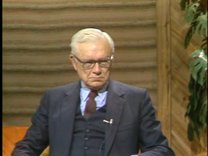
Reflections by an Eminent Chemist: Paul Flory Interview (master copy) Reel 1 of 2
- 1982

These captions and transcript were generated by a computer and may contain errors. If there are significant errors that should be corrected, please let us know by emailing digital@sciencehistory.org.
Transcript
00:01:00 Perhaps we can have a few minutes on this, maybe,
00:01:02 as we leave on this subject.
00:01:05 Well, you know, Paul, this is a general program
00:01:09 of the American Chemical Society to have, for the archives,
00:01:16 recorded videotapes of outstanding scientists
00:01:20 that are chemists.
00:01:22 And it's my privilege today to have this honor
00:01:26 to chat with you.
00:01:29 And it's my privilege to be with you.
00:01:32 Thank you.
00:01:33 I know that you were born in Illinois,
00:01:40 and I'd like to ask you a little bit about your background,
00:01:47 your family and parents.
00:01:50 Were they interested in, at an early age,
00:01:56 in making certain that you went to college?
00:02:01 Yes.
00:02:02 That was almost a, it was assumed
00:02:08 that I would go to college, as it was assumed
00:02:12 for my brother and sisters.
00:02:16 And had they a college education, your parents?
00:02:21 Well, they came from a rural background in Ohio.
00:02:27 And my mother pioneered in her family
00:02:34 to go away from home to college.
00:02:37 She actually went to Manchester College,
00:02:39 where I went years later, for a year or two,
00:02:43 and then became a teacher, a one-room school teacher
00:02:48 in the 1890s.
00:02:56 My father also became a teacher, but at that time
00:02:59 it sufficed to go to high school, which he did nearby.
00:03:04 He studied privately.
00:03:07 One might say he was self-educated.
00:03:10 He studied first.
00:03:12 He wanted to be a doctor, but gave that up.
00:03:16 And after trying various things from those new devices known
00:03:23 as telephones, installing them, he turned to become a minister.
00:03:29 I see.
00:03:29 But there was this feeling in the family
00:03:33 of educational endeavor and the importance of education.
00:03:37 That's quite clear.
00:03:38 Yes.
00:03:38 In the generation of my parents, in the generation
00:03:42 of my parents, that feeling was strong.
00:03:46 My father had been singled out by his father, my grandfather,
00:03:51 that he should be educated, because he
00:03:54 was born with a club foot, and therefore wasn't
00:03:58 very useful on the farm.
00:03:59 So he had to be educated.
00:04:02 But earlier than that, it was a farm background,
00:04:04 going back several generations in Ohio and Pennsylvania,
00:04:08 on both sides, actually.
00:04:10 So your first exposure to science
00:04:12 then was probably high school or secondary school.
00:04:15 In high school, yes.
00:04:17 In high school in Elgin, Illinois.
00:04:20 Was this a large high school?
00:04:21 Yes.
00:04:22 Large for those times, about 1,000 students.
00:04:26 And did they have experimental facilities?
00:04:29 Some, yes.
00:04:30 I didn't actually take chemistry.
00:04:32 I took general science and physics,
00:04:35 both with laboratories.
00:04:39 Simple, of course, but nevertheless,
00:04:42 both courses included laboratory.
00:04:44 It was a good high school.
00:04:46 Were there any of those teachers that
00:04:51 stand out in your mind as somewhat stimulating for you?
00:04:56 Not particularly in science, more than other fields.
00:04:59 I don't know that I had, academically, I
00:05:04 hadn't focused my interest on science.
00:05:09 Although, I was an avid reader of popular, what was it,
00:05:13 popular mechanics?
00:05:15 Popular mechanics.
00:05:16 And what was the science?
00:05:18 Popular science, also.
00:05:20 That opened my eyes to some aspects of science,
00:05:26 perhaps in a rather colored or fashion.
00:05:34 But I think it was there that I first really
00:05:38 became interested in science.
00:05:42 That's interesting, because I can
00:05:44 remember popular mechanics, I think it was called.
00:05:49 It even had some color in it.
00:05:51 And I can very well see that that might have some effect on.
00:05:59 Science fiction.
00:06:00 I went on tours of the universe through those magazines.
00:06:04 I suppose, then, that Manchester College was your choice
00:06:10 because of your mother's interaction with Manchester.
00:06:12 Yes.
00:06:13 Well, it is a religious school, the religious persuasion
00:06:20 of my family.
00:06:22 And it was sort of assumed, or I was encouraged or pressured,
00:06:25 almost, gently, by subtle measures,
00:06:29 but nevertheless, to go there.
00:06:33 And chemistry took my fancy from the start.
00:06:37 Here, I saw the possibility to realize the experiences
00:06:46 that I had through reading magazines and so on.
00:06:52 And also, an extension of my high school background.
00:06:56 Were your parents able to pay your tuition and board,
00:07:00 or did you also work part time?
00:07:02 I worked part time.
00:07:05 Those were depression years.
00:07:06 Rather, the depression years were to follow.
00:07:11 Yes, my parents paid my college.
00:07:15 Graduate school was another matter.
00:07:16 That was in the depression years.
00:07:20 But I also worked, worked summers and part time
00:07:22 during college, which was commonplace.
00:07:25 How many students were at Manchester College?
00:07:28 Between about 600, 650.
00:07:31 Would you have a compulsory chapel in the morning?
00:07:34 Oh, yeah.
00:07:34 Even a cold winter morning.
00:07:36 Even on a cold winter morning, yeah.
00:07:38 Oh, there were ways of getting out of it.
00:07:40 And I must say, I made the most of those.
00:07:47 Was the, you say chemistry interested you
00:07:51 almost from the beginning.
00:07:52 That must have meant that there was a good teacher involved.
00:07:56 Yes, absolutely.
00:07:57 There was a very good teacher.
00:08:01 Carl W. Hull, H-O-L-L, was the teacher,
00:08:08 and a very inspiring teacher in his quiet way.
00:08:15 A teacher that demanded a great deal of his students.
00:08:19 Chemistry had the reputation there of being a different,
00:08:24 the chemistry courses were considered difficult,
00:08:27 but challenging.
00:08:28 And they did attract good students, good from the college.
00:08:34 And the college has a record, was already
00:08:39 making a record at that time, an unusual record
00:08:42 of graduates going in, of graduates from the college
00:08:46 going on with graduate work.
00:08:49 At that time, in a school of that type,
00:08:51 there would be something like general chemistry,
00:08:54 analytical chemistry, organic chemistry,
00:08:56 and physical chemistry courses separate,
00:08:58 or were some of those?
00:08:59 The separate ones were general chemistry, analytical chemistry,
00:09:03 and organic chemistry.
00:09:05 There was no physical chemistry.
00:09:07 It was incorporated in a limited extent in general chemistry.
00:09:12 To a very limited extent, or it was something
00:09:14 you studied on your own.
00:09:17 And there was encouragement to extend beyond courses
00:09:21 into self-education, which I did to some extent.
00:09:29 Did your teacher himself run the laboratories too, or did he not?
00:09:37 There was a man named Martin who ran the laboratories.
00:09:44 And he, too, had qualities of inspiring
00:09:47 and students in a somewhat different way.
00:09:52 For the most part, he ran the laboratories
00:09:54 and did some of the lecturing in general chemistry,
00:09:57 but not to me.
00:10:02 Then how did it come about that Ohio State expressed,
00:10:12 were you pushed in the direction of Ohio State?
00:10:14 Definitely.
00:10:16 Carl Hull, or Professor Hull, had received his Ph.D.
00:10:20 at Ohio State, so where else was there to go?
00:10:23 Now, he wasn't so narrow-minded, but he
00:10:25 had his connections at Ohio State,
00:10:28 and that facilitated my getting in.
00:10:31 With a minimal background in chemistry, only three,
00:10:33 I'd finished my college in three years.
00:10:38 Perhaps because there wasn't much more
00:10:41 to offer beyond three years.
00:10:46 At the college at that time.
00:10:48 And Dr. Hull encouraged me to go on and graduate early,
00:10:52 go into graduate work, which may or may not
00:10:55 have been a good thing.
00:10:56 How did it work at Ohio State at that time?
00:10:59 Did you have qualifying examinations
00:11:02 or orientation examinations?
00:11:03 Oh, yes, examinations.
00:11:05 And the struggle was so difficult,
00:11:08 it wasn't certain that I'd make it beyond the first year.
00:11:12 And that was probably because of the physical chemistry
00:11:16 lack.
00:11:16 The lack of physical chemistry, and the level of the coursework
00:11:24 was inferior to that of many schools.
00:11:28 Although good, the competition wasn't
00:11:32 as keen as in a school of higher academic standing.
00:11:38 For your first year lecture courses at Ohio State,
00:11:41 do you remember any of the professors involved?
00:11:44 Oh, yes, there was Henderson in inorganic chemistry,
00:11:48 Board in advanced organic chemistry,
00:11:52 Mack in physical chemistry.
00:11:56 Those were the principals in chemistry.
00:11:59 And in the course of that year, I
00:12:01 realized how deficient my mathematics had been.
00:12:04 There was a gap in mathematics between high school,
00:12:07 where it was very good, and the mathematics
00:12:11 was very poor at Manchester College.
00:12:14 It did me almost no good.
00:12:16 So I had to catch up on the mathematics
00:12:17 through courses and private study.
00:12:22 Did you have a teaching assistantship?
00:12:24 Yes, not the first year, second year.
00:12:27 Second and third years, I believe it was.
00:12:29 And was that in freshman chemistry or physics?
00:12:32 Freshman chemistry, the first year, second year,
00:12:36 I was offered the opportunity to assist
00:12:38 in physical chemistry, which was a splendid experience for me
00:12:42 to strengthen a part of my background that had been weak.
00:12:47 Well, you're such a good mathematician,
00:12:49 at least from my point of view, that this is very revealing
00:12:53 that you had to catch up on all that math in graduate school.
00:12:58 Well, it made it more difficult.
00:13:07 I think I had a natural liking of mathematics.
00:13:11 And that would have been the view of my high school
00:13:15 teachers, I think.
00:13:16 And I took all the math I could take in high school.
00:13:19 But then there was that lapse through college
00:13:22 where I learned very little math through the college years
00:13:26 and then tried to pick it up again in graduate school.
00:13:30 In graduate school, when did you elect to do a thesis
00:13:37 and with whom?
00:13:39 Well, you know, I did a organic master's thesis
00:13:45 with Professor Bourd, the late Professor Bourd,
00:13:50 on organic synthesis.
00:13:53 I don't know whether you knew that, but it's a fact.
00:13:56 I knew you had somewhere.
00:13:57 I didn't realize it was a master's thesis.
00:13:59 I really wanted to go into physical chemistry.
00:14:02 But I wasn't sure at the beginning of my graduate career
00:14:06 with all of the deficiencies and so on
00:14:08 whether I could hack it.
00:14:11 And Professor Bourd kindly took me
00:14:14 on as a graduate student for a master's degree.
00:14:17 And then I had a great deal of respect for him.
00:14:23 And even I liked him personally.
00:14:26 So it was with some pain that I had
00:14:29 to tell him that I had decided to switch
00:14:32 to physical chemistry.
00:14:34 He took this graciously, being the man that he was.
00:14:39 And then I worked with Harry L. Johnston in physical chemistry,
00:14:45 or perhaps the closest thing we had then to chemical physics.
00:14:48 What was the thesis topic?
00:14:50 Photochemistry.
00:14:51 Photochemistry of nitric oxide.
00:14:54 That's a rather topic that's on the minds of lots of people
00:14:58 in the last 10 years.
00:14:59 That's right.
00:15:02 Have you ever looked back and compared
00:15:07 to the current knowledge of photochemistry
00:15:12 of nitrogen oxides and related what
00:15:16 you were doing at that time to?
00:15:18 What's going on today?
00:15:21 Oh, I thought about it in passing.
00:15:22 But I've left that field so far, been away from it so long
00:15:26 that it's rather remote.
00:15:29 Although, I still think that this is a very interesting
00:15:33 area, the interaction of light and chemistry.
00:15:37 Did he publish the results of the thesis?
00:15:40 Oh, yes, the thesis was published.
00:15:44 Actually, there was another paper going out of the thesis.
00:15:50 This was an area, this was somewhat
00:15:51 removed from Johnston's main line of research, which
00:15:56 was good and bad.
00:15:58 It meant that I was more on my own.
00:16:01 On the other hand, I got less tangible assistance
00:16:07 in my research from him.
00:16:10 On balance, it was probably a good thing
00:16:13 that I had to be more on my own.
00:16:18 For those people who, and I think
00:16:20 we see this in our own students, who are superior,
00:16:26 whenever that does happen, I think
00:16:28 it is true that it allows them to develop
00:16:34 some self-reliance, which you wouldn't get any other way.
00:16:40 Now, this was 1934, I assume.
00:16:42 I got my PhD in 1934.
00:16:44 1934, and the DuPont Company was interviewing, or did you?
00:16:47 Yes.
00:16:49 And they came around just like they do now, probably,
00:16:52 or not quite.
00:16:54 In a somewhat, the tactics were a little different.
00:16:58 But they came around, yes.
00:17:01 The lab director personally came around.
00:17:06 Who was the lab director at that time?
00:17:08 Arthur P. Tanberg.
00:17:13 He did his own interviewing.
00:17:14 He would not trust the personnel department
00:17:17 to interview prospective staff for his laboratory.
00:17:24 He had two things.
00:17:26 He was very good at shorthand.
00:17:30 This is an art that has passed away,
00:17:34 even from most secretaries.
00:17:36 He could take down what you were saying in shorthand
00:17:39 as fast as you could talk it.
00:17:42 So he had that transcribed and had a record
00:17:45 of everything you said.
00:17:46 Besides, at odd intervals during the interview,
00:17:49 he'd bring out something that was new at that time,
00:17:52 called a candid camera, and take your picture.
00:17:59 So they made you an offer, obviously.
00:18:01 They made me an offer.
00:18:02 And did you have any other offers?
00:18:04 No.
00:18:06 Besides, the word was out that you better go to work for DuPont.
00:18:10 If you wanted a job.
00:18:12 I was envious of many others in the lab,
00:18:15 because I actually had a job.
00:18:16 I didn't have to go to some task like binding books
00:18:23 or something else that had nothing to do with science.
00:18:25 Was this what's now called Central Research?
00:18:27 Yes.
00:18:30 Then called the Chemical Department Experimental
00:18:32 Station.
00:18:33 It's now Central Research and Development.
00:18:37 Well, now you must have immediately
00:18:39 come into contact with people in that laboratory
00:18:43 that were interested in macromolecules.
00:18:48 Whereas prior to this time, you undoubtedly
00:18:54 had some interaction with people,
00:18:58 but relatively small until you went to DuPont.
00:19:02 I didn't know what a polymer was,
00:19:04 except that when I was working with Cecil Board, Professor
00:19:09 Board, Synthetic Organic Chemistry,
00:19:14 I was also his sort of private research assistant
00:19:17 at one stage.
00:19:18 And he asked me to distill some styrene in connection
00:19:25 with some experiments that he wanted to do.
00:19:29 And he said, this styrene has a tendency to polymerize.
00:19:36 And I had some vague notions of what that term might mean.
00:19:41 It was just a nuisance.
00:19:42 You had to distill it to get rid of that polymerized styrene,
00:19:47 whatever that really meant.
00:19:50 It was something to avoid.
00:19:52 That was about the extent of my knowledge
00:19:54 of polymers at that time.
00:19:58 I was advised, Dr. Tanberg wrote me
00:20:05 one of his cordial letters before I went,
00:20:08 reported at DuPont, 1st of July, 1934,
00:20:13 that they had decided to assign me to the group headed
00:20:17 by Wallace H. Carruthers.
00:20:20 And I knew very little about this.
00:20:23 I did look up some.
00:20:26 I was told that they had published.
00:20:28 I did look at the papers.
00:20:30 I knew very little of what was in store.
00:20:34 He was the influence, the person that
00:20:41 interested me in polymers.
00:20:46 His approach was rigorous science,
00:20:52 his approach to polymers.
00:20:54 And he imbued that into his people,
00:20:58 at least if they were at all receptive.
00:21:03 If they weren't, they didn't stay in his group very long.
00:21:07 And his conviction that these seemingly complicated
00:21:16 substances, polymers, could be approached scientifically.
00:21:24 Now Hill must have been in the group, too.
00:21:26 Julian Hill was in the group.
00:21:28 He was a senior member of the group headed
00:21:30 by Wallace Carruthers.
00:21:33 I, of course, didn't know Carruthers.
00:21:35 But I am told that he was, of course,
00:21:37 a very intense individual whose intensity
00:21:46 did permeate other people.
00:21:48 I mean, although he was not an extrovert or he was not.
00:21:51 Certainly not.
00:21:51 He was an introvert.
00:21:55 He was a very cultured person.
00:22:01 His view of science, to begin with, was broad.
00:22:05 Of course, he was, I think you would agree,
00:22:09 a very accomplished synthetic organic chemist.
00:22:13 His interest and appreciation of science ranged widely.
00:22:20 He also was conversant and interested
00:22:23 in literature and music and, to some extent, the arts.
00:22:28 He was a very cultured person, very refined,
00:22:33 privately charming.
00:22:36 And talking to a small group, no more than three people,
00:22:42 he was an excellent conversationalist.
00:22:44 But if the group became larger, he shut up like a clam.
00:22:47 The classroom was an ethno for him.
00:22:50 He did not like the classroom, unfortunately.
00:22:56 He had this conviction that, yes, polymers are complicated,
00:23:00 but they can be treated and understood scientifically.
00:23:06 Well, it was an extremely important concept, particularly
00:23:09 at that time, because there were so many organic chemists that
00:23:13 were afraid of them, in a sense.
00:23:17 Not only organic chemists, Charlie, but others.
00:23:20 Just chemists.
00:23:22 Now, when and then what?
00:23:23 You stayed there about three years?
00:23:26 Four years.
00:23:27 Four years, and then went to the University of Cincinnati.
00:23:30 Carruthers died in 1937, and that
00:23:32 was one of the most profoundly shocking events of my life.
00:23:41 His sudden death, it just pulled the rug out
00:23:46 from under my hopes and aspirations and plans,
00:23:50 to the extent that I had any.
00:23:53 And that changed the situation completely.
00:23:59 From my point of view of a lowly beginning scientist,
00:24:08 it was really for that reason.
00:24:09 That was the cause of my leaving DuPont.
00:24:16 He then allowed you to think about things
00:24:25 such as chain mobility and matters
00:24:30 that would ordinarily not be the organic chemist's purview
00:24:35 in a situation of that sort.
00:24:37 He not only allowed me, he encouraged me to do this.
00:24:43 He encouraged me.
00:24:45 And the fact that his fort was a little different,
00:24:51 oh well, or let's put it the other way,
00:24:53 that my inclinations were somewhat different from his.
00:24:58 I was not a synthetic organic chemist.
00:25:00 He didn't try to make me one.
00:25:02 He felt that he wanted to have a physical chemist
00:25:09 in his group.
00:25:09 I was his physical chemist.
00:25:11 It was an extraordinary opportunity,
00:25:13 I realize now in retrospect.
00:25:16 He came to me one day, and during my first year there,
00:25:22 he was most effective in coming into the lab
00:25:25 or inviting you into his office informally and sitting down
00:25:27 and just chatting about some thoughts
00:25:29 he was having about this and that.
00:25:31 And it might range well beyond his immediate concerns
00:25:35 with synthesis mechanisms.
00:25:38 And we even got on to molecular distributions.
00:25:44 And he said, you know, this is a field, the polymer field
00:25:49 is an area where it is my belief that mathematics
00:25:53 could be applied.
00:25:54 Now, he had very limited capabilities in mathematics.
00:25:59 Mine were limited, too.
00:26:01 I mean, his even more.
00:26:03 But he had the appreciation of this, you see.
00:26:06 And he conveyed this appreciation
00:26:10 to me, that youngster in his lab.
00:26:14 That, of course, had a great influence.
00:26:17 And when I set about to consider the statistics
00:26:22 of molecular distributions and told him
00:26:23 what I was starting to do, he said, that's fine.
00:26:27 And he discussed it with me.
00:26:29 He didn't say it's fine.
00:26:30 He discussed it with me.
00:26:31 And it went without saying that he approved of this.
00:26:35 So I continued.
00:26:38 So it was your concern, then, that you would not
00:26:41 be allowed to continue in this vein
00:26:43 if without Carruthers being there.
00:26:47 I suddenly realized how much of a shield he had been
00:26:50 and how much of an influence he had been when he was gone.
00:26:54 Now, then, this position at the University of Cincinnati,
00:26:57 I don't know very much about that.
00:27:00 Well, that was a small laboratory
00:27:10 launched by one of the administrators,
00:27:16 I've forgotten his name, at the University of Cincinnati,
00:27:20 who was interested in cooperative education.
00:27:26 Students should come and work six months,
00:27:30 be six months at the university in courses
00:27:32 and some research, perhaps, and then
00:27:36 six months in an industry.
00:27:38 And, of course, the industry should pay the whole bill.
00:27:41 But this was Dean Schneider.
00:27:44 Dean Schneider.
00:27:45 So DuPont would pay for this.
00:27:47 No, no, no.
00:27:48 I severed connections with DuPont.
00:27:50 They hired me there.
00:27:51 I was a member of the staff of the basic science laboratory,
00:27:54 it was called.
00:27:55 It was Schneider's idea.
00:27:57 It's a little thing operated on a shoestring.
00:28:01 But it did provide me a small lab
00:28:04 and very little help from students.
00:28:08 But I could come in weekends and do experiments
00:28:10 and do what I pleased at least part of the time.
00:28:15 Do you remember, in a rather general term,
00:28:18 what you were then concentrating on at that time
00:28:23 at Cincinnati or had begun?
00:28:28 Condensation polymerization kinetics,
00:28:35 statistics of reaction of pairs, if you remember that.
00:28:39 Pairs on a linear chain, pairwise connections,
00:28:44 a subject that, to my interest, had
00:28:46 been alerted by our good friend Speed Marble.
00:28:53 Viscosities of melts, and then gelation theory
00:28:59 came up, which required a higher level of mathematical approach.
00:29:09 That started and largely finished it.
00:29:12 Was there anybody else interested in gelation theory
00:29:15 at that time?
00:29:16 Scarcely anyone.
00:29:17 Scarcely anyone.
00:29:19 Carothers had been interested in it.
00:29:21 And had discussed it, the stoichiometry of gelation,
00:29:30 the stoichiometry of forming a network,
00:29:35 but without the statistics.
00:29:37 And it's all important to get the statistics
00:29:39 into that problem.
00:29:43 Yeah.
00:29:45 Well, then.
00:29:46 I think probably Carothers introduced me
00:29:50 to that problem.
00:29:51 But just the stoichiometric premises
00:29:58 of forming the necessary number of intermolecular linkages
00:30:02 to have a network.
00:30:03 All right.
00:30:06 So you spent two years there.
00:30:07 Yes.
00:30:09 And then went to the ESO labs in London, I guess it was.
00:30:12 That's right.
00:30:14 The war was, the clouds of war were approaching.
00:30:17 And the outlook for universities was students and so on were.
00:30:25 Grim.
00:30:25 Was grim, yeah.
00:30:29 Well, the ESO, of course, had a great deal of input
00:30:36 into the, well, because of their patent agreements
00:30:41 with the IG Farben industry, the Boone S patents
00:30:47 were available to the community who had immediately
00:30:51 started to work on them even before 41.
00:30:55 But where did, tell me a little bit about the ESO labs
00:30:59 at that time and where you were involved in.
00:31:02 Well, there was an engineering division,
00:31:06 although that may not, there were two divisions,
00:31:09 a large engineering division interested or concerned
00:31:13 with processes, mainly processes.
00:31:18 This was called the ESO Laboratories.
00:31:20 ESO Laboratories, which was the research arm,
00:31:23 later became ESO Research and Engineering and so on, Exxon,
00:31:25 and now it's something else, I don't know.
00:31:28 And then there was a chemical division.
00:31:29 There was an engineering division, large,
00:31:31 and a smaller chemical division under Per K. Froelich,
00:31:34 who about that time was president of the,
00:31:37 was elected president of the American Chemical Society.
00:31:41 And synthetic rubber was very much under consideration
00:31:46 because of the threats posed by the war
00:31:50 and the urgency of acquiring independence of sources
00:31:57 abroad, natural rubber.
00:32:00 And there were several lines of work,
00:32:02 both on the Bunas and on the Butyl,
00:32:05 which was sort of an indigenous development within ESO.
00:32:09 Was Thomas there then?
00:32:10 Yes, Thomas, Sparks.
00:32:14 Yes, I worked with them.
00:32:16 And there was two lines, the Buna type and the Butyl,
00:32:22 going side by side.
00:32:27 And I worked to some extent on both.
00:32:30 And was there an atmosphere there
00:32:34 that was conducive to a learning process?
00:32:43 I ask this question in the vein that I often
00:32:47 tell some of my students who first go to work for a large,
00:32:54 you weren't a new student, but a company like General Electric
00:32:59 or, let's say, Smith Kodak at Rochester.
00:33:05 You're going to learn a lot more in the first two years
00:33:08 than you're going to give because there
00:33:11 are a lot of good people there.
00:33:14 I'm afraid to say that about these two labs
00:33:16 because I know them pretty well.
00:33:18 I ask the question in that context,
00:33:20 was there an intellectual environment
00:33:25 that allowed people to move in new directions and so on?
00:33:37 There was a moderate degree of freedom in research.
00:33:44 I would say, considering the pressures of the times,
00:33:51 external pressures of the national situation,
00:33:56 rather, in thinking back, a surprising degree of freedom.
00:34:03 There wasn't a great deal of opportunity
00:34:05 because we had a rather heavy burden of reports
00:34:09 and conferences and so on.
00:34:11 It was hard to find time in the regular workday
00:34:14 to do much research.
00:34:16 But there wasn't a kind of heavy hand
00:34:21 of day-to-day supervision that required one
00:34:24 to pursue a particular line.
00:34:32 For the time, I think it was a fairly good research
00:34:39 environment.
00:34:40 Bear in mind, this was essentially wartime.
00:34:42 Sure.
00:34:44 Well, then you went on to Goodyear.
00:34:48 And I don't know why I say this, but I've always
00:34:52 felt that, instinctively, from, I suppose,
00:34:58 just talking with a few people and knowing
00:35:01 a little bit about what you did, that it was a very fruitful
00:35:04 time at Goodyear in terms of many of the things you did.
00:35:09 Am I off base there?
00:35:11 I think it was.
00:35:12 I think it was a very fruitful time.
00:35:15 They wanted to start a group on what they
00:35:20 called fundamental research.
00:35:22 It was a catchphrase, perhaps.
00:35:24 But they were prepared and did hire a number of people.
00:35:31 I had a group of about eight or 10.
00:35:36 I believe there were six PhDs in the group, roughly
00:35:40 mean of during those years of about six.
00:35:45 With a lot of freedom, a great deal
00:35:47 of freedom of choice of the problems we worked on.
00:35:52 There was the, it was made evident
00:35:57 that we were, the lab director was fervently
00:36:03 hoping we'd come up with something
00:36:05 that they could cash in on, of course.
00:36:08 But there was a good deal of freedom.
00:36:10 And we worked on, I think, as some of the publications
00:36:15 will show, we were able to carry on some scientific work
00:36:19 in large measure.
00:36:22 Well, I have this.
00:36:23 I think the time was good.
00:36:24 The time was good, plus the environment
00:36:28 that they had for you and this group.
00:36:32 I just had the feeling it was a good time, a classic cliche.
00:36:40 But that may be my own.
00:36:41 But they were expecting a payout.
00:36:43 And as the years went by, the number of additional years
00:36:49 before the payout became shorter and shorter.
00:36:52 I think they got the payout, but this
00:36:54 isn't the time to discuss that.
00:36:56 That came years later, perhaps even up until now.
00:37:01 Who first approached you with the idea of going to Cornell?
00:37:07 Oh, Peter Debye, of course.
00:37:12 First, he invited me on behalf of his department,
00:37:16 or so it was phrased, to take the Baker Lectureship
00:37:21 for the spring term of 1948, which I was delighted to accept.
00:37:28 This was a tremendous opportunity, I felt,
00:37:34 to take on a prestigious Baker Lectureship.
00:37:36 The first draft as part of your book.
00:37:39 Well, I was just beginning to think about a book.
00:37:41 And of course, they said it would
00:37:42 be nice if you'd write a book.
00:37:45 Although, in the background, Debye
00:37:49 had gone there as Baker Lecturer first.
00:37:52 And he had never written a book, so he
00:37:55 set a very bad precedent in the history of the Baker Lectures.
00:38:01 So it was a bit awkward for him to put the pressure on me
00:38:04 to write a book.
00:38:06 Anyway, the book was an outgrowth of these lectures,
00:38:09 in large measure.
00:38:11 But Debye did contact you.
00:38:13 He invited me there.
00:38:16 And I was there for the full spring term,
00:38:21 coming about the 1st of February, extending to June.
00:38:26 And in spite of going to my lectures, some of them
00:38:32 and so on, in spite of all this,
00:38:36 they invited me to join the faculty.
00:38:39 So I thought it over not very long, and then accepted.
00:38:46 That?
00:38:46 To join the faculty permanently, I guess.
00:38:50 Let's see, it was in 48.
00:38:53 That was in 48.
00:38:55 And Debye was still active.
00:38:59 Oh, indeed.
00:39:01 He was the greatest moving force in that department.
00:39:06 Very active.
00:39:09 Who else would you interact with at that time
00:39:12 in the department, besides Debye?
00:39:16 Well, Debye was the only one working in the polymer field.
00:39:21 But of course, he had a core with him.
00:39:24 There was Art Bicke, A.M. Bicke, the late, sorry to say,
00:39:30 Art Bicke, who later became executive vice
00:39:36 president of General Electric.
00:39:39 A remarkable man.
00:39:43 And there were a number of many others
00:39:46 that came and went through the Debye group.
00:39:51 And I had postdocs.
00:39:54 Tom Fox came with me from Goodyear.
00:39:57 He had worked with me at Goodyear.
00:40:00 And there were a succession of others
00:40:04 there that worked with me as postdocs.
00:40:06 On the faculty, on the senior faculty,
00:40:11 it was really only Debye and myself
00:40:14 who were engaged, or engaged predominantly
00:40:18 in the polymer field.
00:40:21 Harold Suraga, a very distinguished biophysical
00:40:29 polymer chemist.
00:40:31 Perhaps that characterizes him.
00:40:34 Was a junior faculty member at the time.
00:40:35 And we interacted and actually co-authored papers.
00:40:41 And I had many, many interesting discussions
00:40:44 with Harold Suraga, an association that
00:40:48 continues to this day.
00:40:49 The, well, Harold has certainly made his own mark
00:41:01 and really does contribute to that department
00:41:07 in a very large way, anyway.
00:41:12 Excuse me, Kirkwood had left Cornell about one year
00:41:16 before I went there.
00:41:18 So I did not, was not a colleague
00:41:22 of Kirkwood in the same department, unfortunately.
00:41:28 Now, then an attractive offer came along
00:41:31 at Ben Mellon Institute.
00:41:37 I'm not quite sure you were executive director
00:41:39 or exactly how that was.
00:41:42 Supposed to head up the research.
00:41:44 I know Tom went with you.
00:41:45 Tom went with me.
00:41:48 And just how did that work?
00:41:51 I'm not absolutely certain I have a.
00:41:53 Well, that, again, the Mellon Institute
00:41:58 needed a new direction.
00:42:01 And they professed to have decided,
00:42:04 the board of the Mellon Institute,
00:42:08 that they were persuaded to turn their direction
00:42:13 to fundamental and more basic research away
00:42:18 from their time, their traditional fellowship
00:42:23 program, which was a very special kind
00:42:28 of industrial institute relationship, which
00:42:32 had prospered in earlier years, but probably, certainly
00:42:36 had outlived its usefulness by that time.
00:42:41 And they were persuaded to go into basic research,
00:42:45 fundamental research, and to abandon this.
00:42:48 But they didn't, couldn't quite, what they wanted to do,
00:43:00 the soul was willing, but the flesh was weak.
00:43:03 Well, they had the problem, probably,
00:43:04 of supporting the laboratory with some industrial grants
00:43:09 and contracts that were part of the old fellow.
00:43:12 Proprietary contracts of the hardest kind, in a way.
00:43:21 Really, the fellowships were operated as enterprises,
00:43:26 insulated, or very often insulated,
00:43:28 from the rest of the institute, but openly tied
00:43:32 to the industry, the industrial sponsor.
00:43:35 The connection there was back and forth was open.
00:43:38 The connection within the institute was restricted.
00:43:40 And that's an unsatisfactory arrangement
00:43:44 in any institution, obviously.
00:43:47 Many obvious drawbacks.
00:43:48 So the institute had to take a new direction.
00:43:52 But there were counter forces within the management
00:43:57 and all of the mellon industrial complex
00:44:06 of diverse industries.
00:44:11 How large a group was working with you personally
00:44:15 when you were at Mellon?
00:44:17 Oh, a rather small group.
00:44:18 I only had on the order of two or three people
00:44:20 working with me, because of the administrative responsibilities
00:44:24 that I carried.
00:44:27 I was determined to keep a small effort going,
00:44:30 but it was difficult. It was difficult.
00:44:34 And when it became apparent that the institute directors
00:44:38 were not prepared to abandon the fellowship program wholly
00:44:45 and turn to basic research, it became apparent
00:44:53 that my services were not altogether welcome.
00:44:57 As you look back on that period, where you were at Goodyear,
00:45:10 then Cornell, and then Mellon, from your own intellectual
00:45:18 satisfaction, which may not be a very good question,
00:45:25 which did you find the most attractive?
00:45:28 Cornell.
00:45:30 Goodyear, Cornell, Mellon.
00:45:32 Cornell, unquestionably.
00:45:37 The Mellon Institute position then
00:45:46 changed to Stanford, where you have been ever since.
00:45:49 Mm-hmm.
00:45:54 So you were chairman there for five years.
00:45:56 I did my turn.
00:45:57 You did your turn.
00:45:58 I did my turn.
00:46:00 That was in the era when Stanford
00:46:02 was moving from department heads, who ran the departments
00:46:08 and served year after year after year indefinitely,
00:46:12 to a rotating chairmanship.
00:46:13 I like to say that my principal contribution as chairman
00:46:18 was to impart a quantum of angular momentum to the job
00:46:25 so that it rotated.
00:46:27 And it's been rotating ever since.
00:46:30 At Stanford, who collaborated with you
00:46:35 in terms of the faculty primarily?
00:46:38 Who did you have the most interaction with there?
00:46:42 Well, the faculty interaction has been rather limited.
00:46:48 Simply because of the non-interest.
00:46:50 Non-interest, yeah.
00:46:53 Since about the time I retired, Curtis Frank
00:46:58 came to the chemical engineering department,
00:47:00 which is very close to chemistry at Stanford,
00:47:03 and has instituted a program in polymers.
00:47:11 Really, a scientific program.
00:47:12 It happens to be in the chemical engineering department.
00:47:15 But the chemical engineering department
00:47:17 is not quite tolerant or agreeable to science, let's say.
00:47:20 So there is Curt Frank's efforts.
00:47:24 And Bob Pecora, I've had some interactions
00:47:30 with Bob Pecora in chemistry.
00:47:34 Interested mainly in applications
00:47:37 of light scattering, including applications
00:47:39 of light scattering, of inelastic light scattering,
00:47:43 I should say, to polymers.
00:47:47 I don't think there's any question, Paul,
00:47:50 that anyone active in the polymer field
00:47:55 will agree that there's no one that has really
00:48:00 made the number of major outstanding contributions
00:48:05 to so many parts of polymer science.
00:48:11 I don't say that to, I say that with a great deal
00:48:16 of conviction, because I think I have
00:48:19 enough of a background to know it.
00:48:22 As you look back on this exciting career, which
00:48:26 is still continuing, who from the outside
00:48:36 stimulated you, or in your judgment,
00:48:41 made strong contributions in those areas
00:48:45 that you were also interested in?
00:48:47 I mean, are there any one, two, three, four people
00:48:51 that you feel had an intellectual influence on you
00:48:56 that were not in these groups that we've
00:48:58 been talking about, where you were working?
00:49:05 Of course, Dubai had an influence, a great influence.
00:49:08 But we've already mentioned him.
00:49:12 Other names that come to mind, or people who come to mind
00:49:16 are Maurice Huggins, the late Maurice Huggins,
00:49:21 I regret to say.
00:49:23 I would like to comment on my relationships with Huggins.
00:49:28 Walter Stockmeyer, who you know, has made many contributions,
00:49:37 important contributions in the polymer field.
00:49:43 Of course, there are many others worldwide
00:49:46 that we could mention.
00:49:53 Leo Mandelkern was a collaborator back
00:49:57 in the early days at Cornell, and did monumental work then
00:50:05 and since.
00:50:06 And we've maintained contact, and occasionally
00:50:10 have collaborated in research over the years since.
00:50:17 There are many others.
00:50:18 One must not underestimate the contributions of others.
00:50:25 We all interact with our contemporaries,
00:50:28 and sometimes with those who live before us to their works.
00:50:36 These interactions and contributions
00:50:39 are enormous.
00:50:41 I want to counter some of the kind words
00:50:44 that you said, perhaps more than deserve,
00:50:48 but that we're not supposed to argue
00:50:50 about this at the present time.
00:50:54 I might mention, if you like, I could comment on Huggins.
00:50:59 You know, there's a theory which is ineptly
00:51:03 named the Flory-Huggins theory.
00:51:04 It should be the Huggins-Flory theory.
00:51:06 I've said this a number of times.
00:51:09 Because he was just a hair ahead of me in that.
00:51:14 He published the first paper.
00:51:18 And I think back of what might have come out
00:51:21 of this that didn't.
00:51:23 And I sometimes wonder, in the personal relationship,
00:51:26 what might have happened and didn't.
00:51:28 And I wonder why.
00:51:30 Huggins was, who as you know, died in December this year.
00:51:39 I was about 13 or so, 12 or 13 years my senior.
00:51:47 He was an established scientist when I was a beginner.
00:51:51 And I recall a colloid symposium held at Cornell,
00:51:55 by coincidence, long before I went there,
00:51:58 or a number of years before.
00:51:59 It was the summer of 1941.
00:52:02 I gave a paper on gelation theory, network theory.
00:52:06 He gave one on the thermodynamics of solutions.
00:52:08 And I was horrified, because I'm
00:52:12 trying to grappling to get a foothold in this field.
00:52:17 There were two things I was pushing.
00:52:18 One was network gelation theory, which
00:52:21 I'd chosen to speak on there at this colloid symposium
00:52:26 in honor of Bancroft, who had been at Cornell,
00:52:31 had then retired, and solution thermodynamics.
00:52:37 Then I had it worked out.
00:52:40 Perhaps I had a paper drafted, ready to go,
00:52:43 or perhaps already submitted.
00:52:44 I don't remember.
00:52:47 And Huggins gave his account, what to do.
00:52:51 So I approached Huggins privately.
00:52:57 I felt I had to tell him, because I
00:52:59 was going to publish, and I didn't
00:53:00 want to be in the position of appearing,
00:53:02 that I had tried to scoop what he had presented orally
00:53:05 at this meeting.
00:53:07 And I told him that I had been working on the same thing.
00:53:12 And contrary to the impressions that many people
00:53:15 had of Huggins from his demeanor in meetings, open meetings,
00:53:21 he was most gracious.
00:53:24 He said, well, I'm very interested to hear this.
00:53:28 And I'm interested that you have similar results.
00:53:33 Will you send me a copy of your paper?
00:53:37 And there was never a conflict of,
00:53:42 so far as I could see from my vantage point,
00:53:46 for priority in this field.
00:53:49 And that extended.
00:53:51 Now, later on, we differed.
00:53:53 We had strong scientific differences on some matters.
00:53:56 But we always, I think it's fair to say, remained friends.
00:54:02 And I am so pleased.
00:54:05 It's very gratifying to me to look back on this episode,
00:54:09 if you want to call it that, which was so graciously handled
00:54:15 by him.
00:54:17 I was the junior party.
00:54:19 He was the senior.
00:54:20 And it was he who set the pattern.
00:54:23 I hope I was equally fair in this field.
00:54:32 To switch the subject slightly, you, of course,
00:54:37 are very much aware, being a co-author of this report
00:54:42 on polymer science and engineering,
00:54:45 opportunities and needs, I realize
00:54:50 the general question is difficult to answer
00:54:57 from such a massive array of data and opinions.
00:55:05 I think it would be helpful, however,
00:55:07 if you might express yourself on the polymer education
00:55:12 chapter, chapter 5.
00:55:17 It's extremely difficult for me to ask a specific question,
00:55:21 because my own bias is all there.
00:55:29 But I would appreciate your comments on that chapter.
00:55:33 Well, can I make comments on polymer education?
00:55:37 Polymer education, and of course,
00:55:39 we reviewed it as far as the states are concerned,
00:55:42 but did compare it with Japan and Western Europe.
00:55:48 It's woefully inadequate in this country.
00:55:51 And in some other places.
00:56:00 Ideally, polymer science, or aspects of polymer science,
00:56:08 ought to be introduced, included, incorporated in,
00:56:14 interwoven in the core curriculum
00:56:18 courses, down to general chemistry.
00:56:23 And I don't mean down to beginning,
00:56:25 but beginning even with the most elementary chemistry.
00:56:27 And it can be.
00:56:30 There are aspects that can be.
00:56:33 It should, you can speak for this better than I,
00:56:38 but I think I know your opinions and that
00:56:42 of your colleagues in organic chemistry of polymers,
00:56:47 that this should be incorporated more effectively
00:56:51 and to a greater degree in the courses in organic chemistry.
00:56:56 And it should certainly be included
00:57:00 in the courses of physical chemistry, aspects of polymers.
00:57:05 I can be more specific if you want me to on the latter.
00:57:09 And I think that would be the most helpful or desirable move
00:57:19 if somehow we could overcome the inertia, the reluctance
00:57:24 of teachers in these courses to their reluctance
00:57:30 to incorporate material in their syllabus of course content.
00:57:36 How many of your students and postdoctoral people
00:57:39 are in the academic world now?
00:57:41 There's quite a few.
00:57:42 I'd have to count them up.
00:57:43 There are quite a few.
00:57:44 Quite a few, I would say, yeah.
00:57:46 Yeah.
00:57:49 You and Bill Marble have virtually
00:57:55 staffed the middle to older age group.
00:57:59 Carpenter, Eichinger in Washington, Wilma Olson
00:58:03 at Rutgers, and so on.
00:58:05 That's just a partial list.
00:58:10 But I think, well, I don't know that I fully
00:58:13 answered the question.
00:58:15 I think the most urgent need is to infuse polymer material
00:58:19 in core courses.
00:58:19 And this could be carried over to engineering.
00:58:21 And you've emphasized, that's emphasized in the chapter.
00:58:24 In the report.
00:58:24 In the report and in the chapter on education of that report.
00:58:32 This is not to deny the importance of curricula
00:58:36 addressing polymers specifically.
00:58:40 But beyond that, I think this is needed, too.
00:58:44 Right.
00:58:45 Well, this is a good place for us to break and have them
00:58:49 load the tape for the last half hour.
00:58:53 I guess we are supposed to keep talking.
00:58:56 Mm-hmm.
00:58:56 Mm-hmm.
00:58:57 Mm-hmm.
00:58:59 I.
00:58:59 That's fine.
| Property | Value |
|---|---|
| Creator of work | |
| Format | |
| Genre | |
| Medium | |
| Extent |
|
| Language | |
| Subject | |
| Rights | In Copyright |
| Rights holder |
|
| Credit line |
|
Institutional location
| Department | |
|---|---|
| Collection |
Related Items
Cite as
American Chemical Society. “Reflections by an Eminent Chemist: Paul Flory Interview (Master Copy) Reel 1 of 2.” Open reel videotapes, 1982. American Chemical Society Audiovisual Collection. Science History Institute. Philadelphia. https://digital.sciencehistory.org/works/t2undu0.
This citation is automatically generated and may contain errors.