
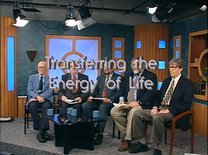
Conversations with Nobel Laureates: Transferring the Energy of Life (ACS Satellite Television Seminar) Tape 2
- 1998-Apr-23

These captions and transcript were generated by a computer and may contain errors. If there are significant errors that should be corrected, please let us know by emailing digital@sciencehistory.org.
Transcript
00:00:44 Welcome back for the second part of our ACS satellite TV seminar on transferring the energy of life during the first hour
00:00:52 We learned a little about ATP and dr. Boyer's important research during this hour
00:00:57 We're going to delve into the work of drs. Capaldi and cross and get a first-hand glimpse into the current direction of ATP
00:01:05 synthase research
00:01:06 First I'd like to digress just a moment to ask each of you a little about we'll get to what?
00:01:14 Sent you into chemistry and we want to show we did not get to a website address
00:01:19 we want to show that videotape once again of the Japanese research and
00:01:24 This address on the screen is where you can call up on the website and you'll find out what from this
00:01:32 dr. Cross you can get a
00:01:34 It's called a quick quick motion video
00:01:39 presentation of this data so you can watch the
00:01:42 Fluorescent filament spinning. This is work from you. She does a lab that they published as a video
00:01:49 Along with their their nature paper, which described the experiment, okay. Thank you very much
00:01:55 Now we're going to go on with our discussion. Certainly. We want to encourage
00:01:59 All of you to we're not taking questions yet, but to be thinking about questions for our panelists and right now
00:02:06 We'd like to go on with dr. Capaldi's part of our program. Dr. Capaldi. Yes. Thank you. One of the questions that dr. Walter asked
00:02:14 Was how you started to work on this interesting enzyme. Well, I'd worked in on mitochondrial
00:02:21 Problems for many years and it was at meetings where I heard dr.
00:02:27 Boyer's proposals and I'd worked on cytochrome oxidase
00:02:31 Which is one of the electron transfer enzymes for a long time and it was really hearing
00:02:35 The exciting new ideas coming out about the ATP synthase that really made me want to switch into
00:02:42 And of course the fact that the
00:02:44 Ideas were so revolutionary. It's not it was one of the things that
00:02:50 for for a scientist to have the challenge of trying to prove something that that is first of all so elegant if something's elegant it
00:02:57 Needs to be proved. So that that really got me into it and I'm really more of a structural biologist. So
00:03:05 What I'll show you is some of the structure of this enzyme you've seen part of it this first part
00:03:09 Extends what you've already heard that much of the talk this morning has been about the f1 part, which is these
00:03:15 Is a ring of alternating alpha and beta subunits and in this picture
00:03:20 We've just removed one of the beta subunits so you can see it better
00:03:24 And you can see that the gamma subunit extends right down the center of this ring
00:03:28 So that it's really connecting the beta subunits, which dr.
00:03:31 Cross and dr. Boyer have told you have got the active sites on that gamma subunit extends right down the center of this ring
00:03:38 active sites on that gamma subunit extends all the way down and interacts with a ring of c subunits
00:03:44 And they're in fact almost certainly but not absolutely proven to be 12 of those c subunits
00:03:51 Now john walker who shared the nobel prize with dr. Boyer
00:03:56 Made the major contribution of actually solving the structure of that alpha 3 beta 3 gamma part of this molecule
00:04:04 And just to give you some indication that part alone is
00:04:08 350 000 daltons. It's a very big protein
00:04:11 This isn't one of the small proteins that are floating around in the cytoplasm
00:04:14 This is one of the biggest proteins that there is and when you look at the whole structure, which again is that f1 part
00:04:22 Linked to the fo part by three other subunits that you can see the epsilon
00:04:27 the delta
00:04:29 and
00:04:30 What you can see on the right hand side of this picture labeled b2 two copies of a subunit called b
00:04:36 And then lastly the a subunit which is part of the membrane intercalated fo part
00:04:41 That whole structure is nearly 600 000 molecular weight. So this is a very big protein
00:04:47 and what john walker accomplished with a crystallographer andrew leslie was just a major accomplishment because just solving that much 350 000 was a
00:04:56 Something that had not been accomplished before so it was a total force of crystallography as well as
00:05:02 providing what was
00:05:04 very important information for understanding mechanism
00:05:08 Now what we've done in my lab is
00:05:11 Extend on that by doing some electron microscopy, which is really a method that allows you to look at these big structures
00:05:17 And i'll show you a picture in a minute
00:05:19 We've solved the structure of the epsilon subunit
00:05:22 By using nmr spectroscopy and we've solved the structure now the delta subunit by using nmr
00:05:29 and these
00:05:30 Interactions, it's like putting together a crossword puzzle
00:05:34 You've got to start at one piece at a time
00:05:37 and then
00:05:38 Put all of the answers together to get a final picture and in this particular model that you're seeing now
00:05:44 The evidence for the interaction of these subunits in the various positions in many ways comes from the sort of cross-linking
00:05:51 experiments that dr. Cross talked about
00:05:54 The beauty of using a bacterial system like e coli
00:05:58 Is that you can genetically engineer?
00:06:01 Anything into that molecule you want you can change any amino acid and just as dr
00:06:05 Cross did we've engineered cysteines into this molecule at all sorts of different places
00:06:10 At last count we had about 150 mutants all with cysteines at different places so you can see this is not a small endeavor
00:06:17 But just to give you an idea of how this whole molecule is put together in terms of function. Let's just look at the next picture
00:06:27 Which again is is more or less the same image you just saw
00:06:32 but
00:06:33 Little bow ties added just to simply show where disulfide bonds have been formed for example
00:06:40 If you look on the left of the picture
00:06:41 You can see that there's a disulfide bond between an alpha subunit and an epsilon subunit
00:06:47 Or if you look at the top of the molecule, you can see bow ties between different subunits
00:06:52 Now obviously if you tie two subunits together, they can't move
00:06:57 So if there's a rotation as we've already heard there must be of the gamma subunit relative to the alpha 3 beta 3 hexamer
00:07:05 If you cross link it just as dr. Cross showed it shouldn't be able to move and therefore you should inhibit activity
00:07:13 And what we've done over this last several years is to put a lot of these disulfide bonds in
00:07:18 From the gamma subunit to alpha from the gamma subunit to beta
00:07:23 From the gamma subunit to epsilon from the gamma subunit to C from the epsilon subunit to alpha and so on and
00:07:31 The net result of all of this is that it tells us what has to be rotating relative to what?
00:07:37 And it turns out that what rotates if you like the crankshaft of this motor
00:07:42 This molecular motor is the gamma subunit which is connecting directly into the catalytic sites
00:07:49 Rotating with the epsilon subunit which again is part of this
00:07:53 Rotational motion part of the rotor if you like which is very tightly attached to the C subunit ring which again
00:08:00 Let me remind you is probably
00:08:02 12
00:08:04 identical copies of the same polypeptide
00:08:06 That whole unit is acting as a rotor and the alpha 3 beta 3 hexamer is being held
00:08:12 constant against the rotation of that
00:08:15 rotor
00:08:17 What's holding? It has been a question for quite a while, and we think we understand that now
00:08:23 We showed a game by this sort of cross-linking experiment and then also by using
00:08:31 Various electron microscopy approaches that in fact the Delta subunit was at the top of the f1 molecule and that
00:08:38 Interconnecting that Delta was the B subunit interacting with the fo part and finally after many many
00:08:44 Attempts we managed to get an electron micrograph, which is shown on the next picture
00:08:51 Okay, well, let's move to the next picture here. It is you can see I think now
00:08:56 This is just an image taken by the electron micrograph of the whole f1fo all 600,000 Dalton's
00:09:03 This isn't a single image, but this is literally hundreds of images
00:09:08 averaged together to see in side view what this whole molecule looks like and
00:09:13 If you use good imagination you can see the alpha 3 beta 3 ring
00:09:18 at least the top part of this molecule that you can see is that alpha 3 beta 3 showing some of the contours and
00:09:25 Remember that electron microscopy is a fairly noisy technique so even if you've averaged
00:09:30 Hundreds of images you're trying to look at the difference in density between water as you're surrounding and protein
00:09:37 Which isn't very different so that?
00:09:39 overall image is not
00:09:41 Very well defined, but I think you can see clearly here that the fo is very asymmetrical
00:09:47 That the f1 is more or less symmetrical
00:09:51 That coming out of the middle of the f1 down to the fo is a stalk and that stalk is the gamma and epsilon
00:09:58 subunits that we've been talking about and there is the rotor and
00:10:03 Incidentally the epsilon subunit is probably acting as a clutch
00:10:08 Because it's one of the very good questions asked earlier was how does this thing move in a particular direction?
00:10:16 Well somehow there's got to be a clutch mechanism to make it go one direction in one
00:10:20 In the ATP synthesis and go in the reverse direction
00:10:23 And we think the epsilon subunit is doing that if we can just go back to the picture again
00:10:29 You can see on the right hand side of this image. It's a second stalk
00:10:34 You can see a density coming down from the f1
00:10:36 And you can just see the density coming up from the fo and in fact that then is the stator
00:10:42 in order to rotate gamma and epsilon and the C subunits against the alpha 3 beta 3 and
00:10:49 The a subunit you've got to have a stator and that presumably is the stator
00:10:54 So it just adds credence and gives some solidity to this idea that the gamma and epsilon subunits are rotating
00:11:04 Now as we all progress that not just the people on this panel
00:11:09 But people all over the world there must be 30 or 40 different labs working on this problem as we progress to understand this mechanism
00:11:16 one of the obvious
00:11:18 Questions people will ask is what is the relevance of this research to?
00:11:22 Other areas of biology and in particular what does it mean for medicine if ATP synthesis is so important for human activity?
00:11:31 How in fact can we
00:11:35 What can we learn from from understanding the mechanism of this enzyme for human diseases for example
00:11:40 And we have been working on that aspect as well and the next slide just shows you
00:11:46 something about
00:11:48 Experiments that are ongoing unfortunately. This is not as clear as I would have hoped that the top panel
00:11:54 Let me just tell you what it shows the top panel
00:11:58 shows a whole series of
00:12:00 Individuals who have diseases in which energy metabolism is defective and in all those individuals
00:12:09 The key characteristic is that there is a mutation a point mutation in the a subunit
00:12:15 and if you remember the a subunit is part of the fo and
00:12:19 the overall mechanism is thought to involve the rotation of the c subunit ring against that a subunit and
00:12:26 Indeed the a subunit power probably forms a part of that proton channel
00:12:31 So you might expect if there were mutations in those a subunits in the a subunit
00:12:36 it would have an effect on function and in fact it turns out that in several human diseases and
00:12:42 They are not
00:12:45 Terribly common, but they're certainly common enough that most physicians will see these type of patients in these particular
00:12:53 Cases there is a mutation in the a subunit now
00:12:57 It's very hard to get enough material from humans to do by a chemical analysis of the type that we've been talking about
00:13:04 but again the beauty of working in a bacterial system and being able to do mutagenesis is that you can actually mimic the
00:13:13 Mutation that occurred in humans back into the bacterium
00:13:16 so we've done that and this just shows you the next to the final slide that I have just shows you a
00:13:22 Particular experiment with a mutation and I didn't say but let me say now that in fact two of the subunits of the ATP synthase
00:13:30 Synthase are not coded on our normal chromosomes in the nucleus, but are encoded on our mitochondrial DNA
00:13:38 mitochondria have their own small piece of DNA that encodes 13 polypeptides that are critical to energy transduction a
00:13:46 Mitochondrial DNA tends to mutate faster than our nuclear DNA in part because there's no good repair system in
00:13:54 this experiment the black line shows you what a
00:13:59 F1 fo from E. Coli how it would perform in a proton pumping function assay
00:14:06 using the normal sequence of the E. Coli and
00:14:10 These curves the first part of the curve shows you the movement of protons as you add NADH
00:14:17 Then as you can see the curve goes back as the proton energy is used up
00:14:22 Then you can add ATP and ATP will drive the proton gradient and again. You can see that the proton gradient
00:14:30 Exists you then add an uncoupler which allows protons to freely transfer across the membrane and you destroy that proton gradient
00:14:38 The dotted line shows the data for a mutant
00:14:43 contrived to be
00:14:45 Identical to a patient who has one of these diseases a disease called Lee's disease
00:14:50 And you can see there's a defect in proton translocation in other words in this patient the reason for their energy
00:14:58 imbalance and the
00:15:00 Neurological symptoms that co with it are that they are mutant in the ATP synthase and if we didn't understand mechanism
00:15:07 We wouldn't have been able to make an accurate diagnosis of what's wrong with this particular patient
00:15:13 Thank You dr. Dr. Walter, do you have a question for dr. Capaldi? Well, I have a question
00:15:20 I'd like to really address to all three of these gentlemen
00:15:24 science
00:15:25 progresses
00:15:27 Because we build on the work of those who have gone before I
00:15:31 Wonder if each of them could just give us the names of one or two people who particularly?
00:15:37 Influenced their work and made possible their discoveries
00:15:42 Well in the in the area of the ATP synthase, of course, it was dr. Boyer who
00:15:47 gave most of the early ideas on which our experiments are based and
00:15:53 The way science works and particularly in this day and age things move so very quickly
00:15:58 That there's a constant
00:16:00 Stream of new information coming on the work that dr. You she did it is certainly very important
00:16:06 but the beauty of doing science at present is that it is such a
00:16:11 collaborative
00:16:13 Effort that there's constantly from many labs across the world
00:16:17 New information and new ideas coming out that help you build piggyback on that
00:16:23 The labs in Germany. Dr. Wolfgang Younger has made very valuable contributions to understanding
00:16:29 How this f1fo works and there are many others
00:16:34 Well, I'd also say
00:16:37 Dr. Boyer was a major influence on my work
00:16:40 And I think it's interesting to point out how long it can take
00:16:46 to fully establish a mechanism for an important process in
00:16:51 in biology
00:16:53 The third the ideas that went behind this
00:16:57 Mechanism a proposed mechanism were developed over an eight-year period
00:17:02 from work done in Paul's lab from
00:17:05 1973 to 1981 and
00:17:07 It's only been
00:17:09 this last year that
00:17:13 People scientists the Nobel Committee
00:17:16 Felt that the print that the three parts of the theory were sufficiently well
00:17:21 demonstrated that this was
00:17:24 To be considered an established theory and because of its very central role in energy production in the cell
00:17:33 fully warranted the Nobel Prize
00:17:39 These are two people that I've admired their work, but I'd like to go back to some others
00:17:47 There's a person that if I am Racker
00:17:51 Who first isolated the f1 ATPase off the particles showed that there was
00:17:57 This knob that dr. Capaldi is characterized. So well really constituted the ATPase
00:18:02 They showed that the chloroplast enzyme had the same properties as the mitochondrial enzyme that they were similar. So
00:18:11 These then were the important aspects of the structure of this. I have to also
00:18:17 Comment about Peter Mitchell who won the Nobel Prize in
00:18:22 1968
00:18:23 Because he had a new idea that I had a hard time accepting
00:18:28 We had here I've made this effort to find an intermediate in oxidative phosphorylation a chemical intermediate
00:18:35 Mentioned the identification of the phosphohistidine which was an intermediate in another way of making nucleoside triphosphate
00:18:43 Peter Mitchell suggested know that the intermediate
00:18:47 and this was a novel idea in the field that it was protons that couldn't get across the membrane and
00:18:53 That was something that we hadn't considered
00:18:55 now I
00:18:58 Participated in some discussions with Peter Mitchell in the early 1960s and
00:19:02 he had the idea of how the protons were used to make the ATP that the protons migrated to the catalytic site and
00:19:10 There they influenced the chemistry that Richard was talking about first of cleavage of the ATP
00:19:16 Now I didn't like that chemistry. I found Peter Mitchell's chemistry was
00:19:22 Not didn't didn't make good chemical sense. So I did literally what you call throw the baby out with the bathwater. I
00:19:30 Discarded the rest of the concept because I didn't see how the proton motive force were used and it wasn't until I came to this
00:19:37 concept of
00:19:39 conformational change
00:19:42 Releasing ATP that I could understand Peter Mitchell's contribution and
00:19:48 Fortunately, we both then
00:19:51 Appreciated each other's viewpoints. We had some nice interesting discussions down the line this internationalism of science now
00:19:58 I'd pay tribute again to
00:20:02 Dr. Green in which you had a postdoc
00:20:05 Experience because David Green set up a large laboratory at the University of Wisconsin and trained some excellent investigators
00:20:12 Now David had ideas of how oxfos worked which didn't prove to be correct, but he got dr
00:20:19 Capaldi started on the program. He got dr. And
00:20:23 Had if he started on the program he had identified the subcomplexes that we had in the respiratory chain
00:20:30 So there were a host of people that did this dr. Stratton in the work of the chloroplast ATP
00:20:36 It's an international science
00:20:39 that
00:20:40 The contributions from many people made it possible. So I can come and say that the beauty of this ATP synthase is
00:20:48 a deserved recognition of a Nobel Prize I
00:20:52 Just happen to be fortunate that I
00:20:54 Got a little bit of first insights all these people did all this other work to show the number of subunits the catalytic site the
00:21:00 Structure and it's the field that deserves credit for it. You see
00:21:05 Thank you very much. That's a very nice comment that it takes a lot of people working toward one goal
00:21:12 Over a number of years. Yes without without without the structural work that the isolation of the enzyme that dr. Racker did
00:21:20 We wouldn't be here today. You see
00:21:24 It's time. I want to remind you the to take some more phone calls from our audience and remember
00:21:28 This is your part of the program. We want to hear from you. So, please call us at 888 802 6555
00:21:35 local callers, it's 466
00:21:38 3162 and be sure to tell the volunteer who answers the phone your site number and your location and then I will be told and
00:21:45 I'll relay the question to the panel. I'd also like to ask dr
00:21:49 Capaldi one question if I could when you mentioned chromosomes a minute ago
00:21:53 Is it now possible through either?
00:21:57 bioengineering to change
00:21:59 Chromosomes to change the the structure of them to possibly combat certain diseases things like that
00:22:07 This is certainly an area where people are working very hard
00:22:11 to be able to
00:22:13 Do what is now called gene therapy is really moving forward very quickly
00:22:20 The problem is to get the
00:22:24 appropriate modified DNA to the right sites
00:22:28 so the difficulty is in
00:22:30 Individuals to get the DNA to wherever the tissue that a particular defect or disease is causing a particular problem
00:22:38 But it's being worked on very actively. Do you think they have the one yet that can figure out male pattern baldness?
00:22:50 Anyway, let's go on dr. Walter
00:22:52 back to your question, I like I'd like to make a comment sort of a question at this time because
00:22:57 Before when I asked the question of how dr. Capaldi and has gotten into this
00:23:04 Listening to him. He's talks about biology
00:23:08 And let's do you we talked about inorganic chemistry and I think for the students out there in the audience
00:23:14 it's worth noting that that the days when
00:23:18 Chemistry was here and biology was there and the twain didn't meet are long gone and
00:23:23 indeed the days that inorganic chemistry organic chemistry and biochemistry were really separate and distinct are long gone and
00:23:31 That we really now are coming back again
00:23:34 And we need to integrate all of these in order to solve problems problems can no longer be solved just by an inorganic chemist
00:23:42 You have problems that require biologists chemists engineers physicists
00:23:47 And this is I think going to be even more the case in the future and I think you give us the beginning of it
00:23:52 here
00:23:53 well, if I could put in an unsolicited plug for the
00:23:57 American Chemical Society
00:23:59 I think being trained as a chemist is a very good preparation for studying
00:24:03 Biological problems because as you get to know more and more about how biological systems work
00:24:09 You're you come closer and closer to a chemical understanding of what's going on and the principles that you learn as a chemist
00:24:17 Of how reactions occur are very applicable to biological systems
00:24:22 And I think that gives you a real edge when you're when you're going after these problems. I
00:24:28 Believe we have a call now from Charlottesville, Virginia. If the caller can hear me, please go ahead with your question. Yes
00:24:35 This is Mark Raymond
00:24:38 The question is for any of the speakers actually
00:24:42 The ATP synthase is an extremely large and complicated machine
00:24:47 involving many interacting parts
00:24:49 Can any of the speakers suggest how and when this machine could have evolved from simpler enzymes?
00:24:57 Well, it looks like nobody was
00:25:00 I
00:25:04 Wrote a paper what some the evolution of FLF 1 and it was the only paper
00:25:09 I've ever written with no data because you have to speculate on how the enzyme probably evolved
00:25:16 but it's it's been suggested that
00:25:20 the complex evolved very early on in evolution because
00:25:25 cells needed to maintain
00:25:28 Electrochemical gradients
00:25:30 to drive transport systems so that they could accumulate the molecules that they needed and
00:25:37 initially
00:25:38 living organisms were thought to be in an anaerobic environment and
00:25:43 This complex FOF 1 may initially have functioned as an ATP driven proton pump
00:25:51 What we've been talking about is the ATP synthase which runs in reverse
00:25:55 It normally uses an electrochemical gradient generated from burning reduced fuels
00:26:01 to make ATP, but initially it may have been
00:26:05 Running in the reverse direction to create an electrochemical gradient
00:26:09 Which then could drive a number of other transport processes as I've mentioned at some point
00:26:16 living organisms learned how to
00:26:19 Develop the capacity for generating gradients that do not require ATP expenditure
00:26:25 photosynthetic cells could use light and
00:26:29 Aerobic cells which evolved could use reduced fuels to generate the gradient
00:26:34 Then the FOF 1 could run in reverse and start making ATP and paying
00:26:40 Paying its dues to the cell and providing energy for other processes
00:26:44 Caller, do you have any other questions? You'd like to ask one of the striking features about the ATP's. Oh, pardon me. No
00:26:52 About the ATP synthase is its ubiquitous distribution you find this enzyme
00:26:59 Are something close to it even in the organisms that are in the deep sea vents volcanic vents you find it in every?
00:27:07 Organism that makes a gradient coupled to ATP meaning. It's a very fundamental thing that showed up early in evolution
00:27:15 Somewhere you have you have a limitation of how much gradient you can put across the membrane
00:27:22 Because otherwise the membrane will break down about 60 millivolts is what you can put across the membrane
00:27:28 Then you in order to get 60 millivolts to make an ATP molecule
00:27:34 You have to use at least three or four protons moving across this membrane to get the energy for an ATP
00:27:41 Molecule this then started to make for complexity that you could do it better if you had more than one subunit if you had
00:27:48 multiple things that cooperate together and nature learned that early on in its
00:27:53 Evolution to start this enzyme the other thing I'd comment on and of course our mitochondria
00:27:58 We think are derived originally from bacteria the bacteria got incorporated into
00:28:05 mammalian cells
00:28:06 and the precursors of the eukaryotes so that we
00:28:11 Incorporated the mitochondria, that's the way we got it to this ubiquitous enzyme from the bacteria at first
00:28:18 Thank you, dr. Dr. Cabaldi. Yeah another thing to point out is that while we've talked about the f1fo
00:28:24 There is a very similar enzyme which is co-evolved if you like and that's the v1
00:28:30 V o type ATP is and in this case this enzyme actually is much more
00:28:35 An ATP driven proton pump than a synthase, but this enzyme is critical to a number of important cellular processes
00:28:43 It's involved in neurotransmitter
00:28:45 secretion it's involved in bone generation so a lot of the
00:28:51 pharmacological interest in
00:28:53 These type of enzymes is actually in the v1 vo type ATP is and that's where a lot of medical
00:28:58 Applications of these ideas are going to come
00:29:01 Thank you very much. We have another caller
00:29:04 I believe from Batesville, Arkansas. If you're on the line, please ask your question. Tell us who you are
00:29:28 Could you hear that? All right. Did you say the C subunits? Yes, sir. Okay. Yeah
00:29:33 in fact
00:29:35 Very recently a structure for the C subunit has been obtained by Robert filling game and his group
00:29:41 at the University of Wisconsin and
00:29:44 So we know pretty much what a single C subunit looks like this structure was determined on monomeric C
00:29:53 So exactly how it sits into the membrane and how it forms a ring isn't well known yet
00:29:58 the obvious long-term goal for everybody who's a structural
00:30:03 Biologist involved in this enzyme is to get an x-ray structure of the whole
00:30:07 600,000 Dalton
00:30:09 System with the fo in particular and of course a lot of groups are trying to do that crystallization now
00:30:15 It is a membrane protein and you may be well aware membrane proteins do not crystallize as well
00:30:22 Soluble proteins or not as easily so that while the f1 crystallizes very readily
00:30:28 The f1 fo as a whole and the fo by itself are very difficult to crystallize
00:30:32 But there's certainly an enormous amount of work being generated to try to get that overall structure now
00:30:38 Thank you. Thank you very much caller. Now. We want to go to
00:30:41 Frederick, Maryland you are on the air
00:30:45 Yes, this is Sharon Smith from Hood College
00:30:48 We have two very different questions for you one relates to your statement about the importance of chemistry and modern
00:30:56 Biology and we agree with that
00:30:59 but we find that much of the outside world beyond the world of chemistry and biochemistry doesn't see that and
00:31:06 We wonder what suggestions the panelists might have as to how we can encourage students to take
00:31:12 More chemistry than two years in college if they want to understand about modern biology
00:31:19 And the second question we have is if you could tell us something about the mechanism of the clutch
00:31:26 Well, do we want to take the first question part of this as far as how to take our
00:31:33 Years of chemistry. How can you get the message across to students?
00:31:38 well, I'd say that these as far as
00:31:41 Solving things about the ATP synthase your three panelists here
00:31:47 came through
00:31:48 good chemical education and this
00:31:52 panelist who
00:31:53 Went into study of the ATP synthase
00:31:57 Didn't even take a course in biochemistry until he was in graduate school
00:32:02 That is I majored as a chemist. I didn't I knew that living things were interesting
00:32:08 But I think in order to understand the complexity of living things and to see many other there are
00:32:15 parts the basic trainings you can get in chemistry is
00:32:19 The most fundamental part you can get it's more important than your physics or even more important than your mathematics
00:32:25 All you need some of the physics and mathematics to be a good chemist
00:32:29 I
00:32:31 Think if the students have an interest in living processes, they'd better start having an interest in chemistry
00:32:38 Okay, I would say that
00:32:41 One of the difficulties that I certainly see in students is motivating them to the interest of certain chemical concepts
00:32:48 And by putting it in the biological perspective
00:32:52 It really encourages students to tie these things together at the beginning instead of taking them as separate entities
00:32:58 And then being left to their own devices later on to try to put ideas together
00:33:04 We certainly make a very conscious effort to teach biology in a biology department with chemistry attached
00:33:11 We don't distinguish
00:33:13 We don't try to teach a student to ten weeks of chemistry and then ten weeks of biology or physics. It's all integrated now
00:33:20 And now I believe there was also the question about the rotator was that the gamma that we're speaking
00:33:25 I think the the question was about the clutch the possibility of a clutch
00:33:30 Well clearly the the fact that this system has to move in one direction
00:33:35 For synthesis and then another direction for hydrolysis means something's got to control the directionality
00:33:41 We know that the epsilon subunit interacts with two of the C subunits at any one time
00:33:47 And it probably follows in one direction the gamma subunit
00:33:51 So the absolute details of that are obviously remaining to be worked out and that's going to be part of the fun
00:33:57 But clearly the epsilon subunits involved in that process
00:34:01 Dr. Cross yes in some recent experiments we did
00:34:05 we found that
00:34:08 The electrochemical gradient alone wasn't enough to cause rotation in
00:34:13 F1 you also needed to have
00:34:16 The ligands binding to the catalytic site there must be some
00:34:21 signal from f1 to fo that says okay, everything's set now we can move and
00:34:30 So there's regulation between there's communication between the fo and the f1
00:34:35 which
00:34:38 Regulates which way it's going and when it goes when it moves
00:34:43 Thank you. We have a call on the line from Tulane University in in New Orleans
00:34:48 If you can hear us, all right, go ahead with a question, please
00:34:55 Thing is like you were talking about protein modification
00:34:59 I
00:35:01 Heard somewhere that these protein modifications involved in muscular relaxation process or not
00:35:05 I would like to know how actually this ATP synthesis and all like, you know, it's in this muscular relaxation process
00:35:13 Could we hear that maybe one more time I didn't understand could you
00:35:17 We weren't hearing your question. Could you repeat it once more please a little slower
00:35:22 Okay
00:35:23 the thing is like
00:35:26 You have been talking about this protein modification stuff and all I think it's like these sort of protein modifications
00:35:32 Involving this muscular relaxation process. What role does what you have been talking about like please in this muscular relaxation process
00:35:41 And anyone there like give me a word muscular relaxation process and relation with the protein modification
00:35:48 The last part was protein modification
00:35:51 There's a there's a ring in the connection it makes it hard to understand. Yes
00:35:57 I'm sorry. We're having trouble hearing that there's a bit of distortion if it is maybe if
00:36:04 Is there anyone else there that could ask?
00:36:07 The question once again or step away maybe from use a different phone the different phone maybe call back in
00:36:14 On a different phone line would be a better idea. Yeah. Yeah. Okay. Okay, that's fine
00:36:20 What we you just touched on about you know talking about students and
00:36:26 studying and to get into
00:36:28 You know the the college level and everything could we?
00:36:31 Talk once about there was this recent study in Newsweek about how much studying time does it take to get into a?
00:36:39 Top flight college, you know today, and you know how much time do you have to to spend studying?
00:36:46 Outside of the time that you spend in the classroom. I'm talking about now for say high school, you know 15 to 17 year olds
00:36:52 What would you have to say about that?
00:36:56 Well, I'm worried about how much time you can spend because our admissions to colleges are getting to be
00:37:03 more
00:37:04 quantitatively designed on terms of grades and test scores that you can do so that it means that in order to
00:37:13 Be
00:37:14 Sure to the mission you have to spend a tremendous effort at that stage just for those quantitative grades
00:37:21 and
00:37:23 Creativity isn't something that comes along with that quantitative study. I think we can get
00:37:29 people
00:37:30 first of all
00:37:31 overachievers that have to work very hard to get the grades that really shouldn't then being
00:37:36 The ones they won't find that they can go on in science
00:37:39 You'll get underachievers people that really have a tremendous interest in something but don't have great interest
00:37:46 that are the ones that are likely perhaps to be a chiever later on I
00:37:52 I'd be concerned right now that if I were to go back I
00:37:56 Might not be admitted to UCLA you see with the present standards because my grade point average
00:38:01 It probably wasn't up to it. I had other activities that I did
00:38:05 That along the way
00:38:08 I know some people
00:38:10 Visualized scientists of having a dedication very early on in junior high school in high school
00:38:16 Just to get into science to solve these problems. I
00:38:20 think that probably
00:38:22 some of the
00:38:24 Other more active and better people get into it because they have the broad interest in biology
00:38:29 They you don't decide to become a biochemist or study this aspect when you're a freshman
00:38:34 You do that when you get further into the field
00:38:38 Some way we need to encourage people
00:38:40 to be have a genuine interest in their
00:38:44 Science and other related subjects not to study for the grades
00:38:48 Then we have to get those people that have that genuine interest into our colleges
00:38:52 There's a gap there that I don't think we're adequately taken care of
00:38:58 You have comments that you see
00:39:01 Are more people once they get to the research?
00:39:04 Is that and maybe it should be their main interest do they lose?
00:39:09 Something about teaching you know that
00:39:12 one on one
00:39:13 Aspect to get students really interested in meaning amongst faculty amongst faculty. Yes
00:39:20 It can happen but certainly as a department head for example, I I work very hard to discourage
00:39:29 people from
00:39:31 Taking the research to a level of
00:39:34 In terms of time that they don't have time for students certainly at the University of Oregon
00:39:40 we
00:39:41 worked our
00:39:43 faculty in
00:39:44 All of the major courses we we don't have a single course taught by a TA
00:39:49 I can honestly say we do not have a single science biology course taught by a TA. We put our
00:39:54 major faculty directly into courses and
00:39:58 These faculty are involved in that quarter when they're teaching they're involved
00:40:03 90 95 percent of the time in the teaching
00:40:07 Good, I think that go ahead
00:40:09 Yeah, I'm a department chair also, and I find in my experience the best researchers are often
00:40:18 the best teachers and and
00:40:20 they
00:40:22 They have considerable teaching commitments. I think it's it's a synergistic
00:40:28 Activity doing research and then teaching that knowledge and other new knowledge that you come across
00:40:34 I think the original question was how hard do you have to work to become a scientist? I think at the
00:40:41 the high school level I I think one thing that's important is to do some reading outside of
00:40:47 Courses you're taking if you find something you're interested in go to the library and look into it
00:40:54 Scientific American articles or
00:40:57 Or books on the subject that you can find that you're interested in I think can can stimulate an interest and help prepare you
00:41:05 For a career in science
00:41:09 Dr. Walter, let's go back to you on that one, too. I
00:41:12 Think that if it is taking an inordinate amount of time
00:41:17 To study to become a scientist. Maybe that isn't the field you want to be in
00:41:22 You really need to have reasonable facility in science in order to become a scientist
00:41:29 However, I think one of the things you've got to be very careful of is that you do not become one-dimensional
00:41:35 If a scientist has made a great discovery and can't communicate it
00:41:39 It doesn't do much good to obey the discovery. And so you must be very careful not to ignore your
00:41:46 communication skills and
00:41:48 Particularly your courses in English, for example, I know this may sound strange, but I was a department head at a small liberal arts college and
00:41:57 I'd look at the SAT scores of my incoming freshmen students in chemistry and then look at their grades and
00:42:04 I found a much stronger correlation between their English SAT that I did with their math SAT math is crucial
00:42:11 But the ability to read the ability to write the ability to articulately state something is much more crucial
00:42:19 So whatever you do with your study for science, don't stop your other subjects. They're very important
00:42:26 Yes, that's true. And as we find out as we get a little older, you know
00:42:31 This this is one thing that I found out that I thought boy now I know it all you know back at age
00:42:36 21 or something. Well, you find out no you you don't you you find out
00:42:40 There's a lot of things a little further down the line that are quite interesting, you know
00:42:44 But I think that point that dr. Boyer's made is also what it needs to be emphasized
00:42:48 in my 29 years of teaching I
00:42:51 Found quite often that the student that got the A's in the coursework was not the student who did the best research
00:43:01 and
00:43:02 that the two are different skills and
00:43:05 You therefore have to be very careful that you don't just judge a person by their grade point average
00:43:10 Because quite often the great researcher may not have the best grade point average
00:43:15 I don't know that we could ever do this test because be a little difficult to ask great researchers to come back with their grade
00:43:21 Point average, but I found that students who sometimes were not turned on by the course
00:43:27 Put them in a research project and they are turned on and they do a magnificent job
00:43:32 and sometimes vice versa
00:43:34 Before we have each of the gentlemen here
00:43:37 Summarize and and wrap up what they have to say. Do you have any other questions that you want to ask about?
00:43:44 ATP. Yeah, I have one and
00:43:48 We've talked about you know, worry how you built on the work of others to come where you are
00:43:54 What you have done. Where do we go from here?
00:43:57 What do you see all three of you as the most important questions that are still remaining in this field?
00:44:05 Well, obviously
00:44:07 getting a
00:44:08 high-resolution structure for the fo part of the enzyme through which you can then begin to
00:44:13 make more detailed models about how the protons are translocated back and forth and
00:44:20 The idea that the gamma subunit rotates is unequivocal
00:44:24 The work of you she did the work of cross is just outstanding and unequivocal
00:44:29 but the proof that that drives rotation of the C subunit remains to be
00:44:35 demonstrated and
00:44:37 So there is a major question
00:44:40 for future research and of course all of us
00:44:44 Doing exactly that now
00:44:46 Dr. Cross. Well, I agree completely. Those are the the most important remaining questions and
00:44:53 It illustrates the fact that in in biology
00:44:57 Advances in mechanism often a company it advances in knowledge of structure
00:45:03 And I think the two are critically linked. You have to know the structure of something to really understand how it works
00:45:15 What these structural things are extremely important
00:45:18 The
00:45:21 But the enzymology of this enzyme how it does its catalysis
00:45:27 It's still got a lot to be learned
00:45:30 the we don't know the rates of
00:45:33 Addition and release of substrates from the individual sites
00:45:36 We don't know how much the equal to what the equilibrium is at the catalytic side during active catalysis
00:45:42 there's a whole host of questions about the
00:45:47 Precise more precise nature how many sites have to be filled to get the catalytic rate to go rapidly?
00:45:52 There are a number of questions of this kind
00:45:55 There are a number of related things to that in the field of bioenergetics and related to human welfare that are important
00:46:02 We haven't mentioned that this respiratory chain
00:46:05 Has a deleterious effect that oxygen can be a dangerous substance that it produces free radicals that can damage
00:46:12 Enzymes and one of those that is damaged most is the ATP
00:46:17 Synthase so we have another kind of relation to come in here to nutrition
00:46:23 the nature of our
00:46:24 Oxidative damage to the ATP synthase that isn't related directly to mechanism, but it is related to the field of bioenergetics
00:46:33 Thank you doctor it's time to conclude our discussion
00:46:37 But before we close we certainly want to find out what thoughts that each of the panelists want to leave with the students
00:46:43 And we'll start over here with dr. Capaldi
00:46:46 well
00:46:47 not directly related to the ATP synthase
00:46:50 but just to science in general and and the excitement that comes with doing science if you read a newspaper today, or if you
00:46:58 Watch the television at all particularly if you watch the news
00:47:02 almost every week new developments in science are being
00:47:06 Promoted almost every day almost every day and the
00:47:10 First question is is that exciting to you or not and the answer is almost certainly yes, because these things are
00:47:18 particularly of interest
00:47:21 that are related to medicine the second question anyone should ask is do I believe it and
00:47:27 Once you ask that question then you begin to think about how would I study?
00:47:32 That particular question if the newspaper says or the television says
00:47:38 That Alzheimer's is caused by protein X
00:47:43 It's one thing to just hear that the other question is what is protein X. How does protein X work?
00:47:48 That is how you get into the next generation of interesting questions
00:47:52 And so that the opportunities there are tremendous for students at the moment starting with chemistry
00:47:57 But going all the way through biology and physics and putting it all together
00:48:02 Thank you, dr. Cross
00:48:03 Yes, I I think what I would say is that
00:48:09 Science is really an exciting occupation
00:48:12 It's a chance to discover new things
00:48:16 Yourself if you'd like to test things and model ideas
00:48:20 Try to explain data that may be hard to explain and by formulating new concepts about how things work
00:48:28 This is something that you could find
00:48:30 Very
00:48:32 Challenging and rewarding as a career following this the ATP synthase has been a wonderful system to study
00:48:39 It's been the focus of attention since it was first isolated in
00:48:44 1960 of many laboratories
00:48:47 And it's been so richly complex and unique
00:48:51 That it's just been a very rewarding experience
00:48:55 Looking into how this
00:48:57 This ATP synthase functions. There are still despite the fact that the Nobel Prize has been awarded
00:49:04 There are still some interesting details that I think
00:49:08 We're all going to be involved in
00:49:11 pursuing
00:49:12 That still have to be that remain to be answered
00:49:15 But there are other very challenging new emerging problems that are enough to engage
00:49:21 Any young person who wants to begin a career in science and so you should find out as was suggested
00:49:28 What what interests you?
00:49:31 What do you want to work on and it can be a fascinating and rewarding career doing that?
00:49:36 Thank you. Dr. Boyer
00:49:38 Well, I think it's important for all students to understand
00:49:43 To understand
00:49:45 points that dr. Capaldi made that science asks questions that the way you find out about nature the way you mentioned in your
00:49:52 Introduction is that truth is out there if you can find out about it the way you
00:49:58 Assess and evaluate and you find that this method this one isn't right. This is another way to approach it
00:50:04 So studying science is I think good for everybody and a fortunate thing
00:50:10 We have schools that tell this and get it out to all people now some of the people among you the students that are
00:50:16 here are
00:50:17 going to make a career in science perhaps and
00:50:20 You're fortunate because I can't think of anything that has been for me more
00:50:26 rewarding than to be able to
00:50:28 Have laboratories where I can ask questions and do this research and get paid for you see
00:50:34 This is this is tremendous and to still have now I'm approaching 80 and I'm still very
00:50:41 Interested in what happens in the world around me in all aspects of it and that comes from an appreciation of science
00:50:47 So I'd say find if you appreciate it if you do continue to study it and you have a wonderful time ahead of you
00:50:54 Dr. Walter
00:50:56 First I'd like to thank drs. Boyer Capaldi and cross
00:51:00 For sharing their excitement and enthusiasm for basic research with us today
00:51:05 their work exemplifies the reasons why many of us chemists chose careers in chemical research and
00:51:11 While we continue to believe in the importance of strong support for basic research
00:51:17 Despite what a recent author would put would have it
00:51:19 There is no end to science every question that is answered brings forth a dozen new questions
00:51:26 So there's lots of room there for you if you're looking for more information about chemistry or careers in chemistry
00:51:33 Please start with the American Chemical Society
00:51:36 our website at
00:51:39 www.acs.org or our web service center
00:51:44 www.chemcenter.org are packed with information for students as well as for ACS members
00:51:52 Whether you are destined to become a chemist or just want to know more. This is a good place to begin
00:51:59 Thank you all very much and you know if
00:52:02 If the mathematicians and the astronomers are off on that calculation about the mile wide asteroid and it does hit us
00:52:09 We're gonna start all over again with
00:52:12 ATP synthase
00:52:14 But we'll hope that yes, I don't want to be around when the asteroid crashes in but anyway
00:52:20 I want to thank all of you for being here today
00:52:22 This has been very interesting and I hope that all the students out there
00:52:26 You know this causes you to think a little bit and you know
00:52:29 Just just get something going within your own community within your own, you know
00:52:33 Talk to your friends about it and it does lead to many interesting things
00:52:38 I'll let you wrap it up doctor
00:52:40 Well, we've come to the end of this ACS satellite TV seminar. I want to thank you all for joining us
00:52:46 Please don't forget to complete and return your seminar evaluation forms. We listen to and need your comments and suggestions
00:52:55 We have a full lineup of seminars scheduled this year
00:52:58 And we hope that we will see you again at the next ACS satellite TV seminar on
00:53:04 behalf of the American Chemical Society's education division
00:53:07 Thanks for watching
| Property | Value |
|---|---|
| Creator of work | |
| Format | |
| Genre | |
| Medium | |
| Extent |
|
| Language | |
| Subject | |
| Rights | In Copyright |
| Rights holder |
|
| Credit line |
|
Institutional location
| Department | |
|---|---|
| Collection |
Related Items
Cite as
American Chemical Society. “Conversations with Nobel Laureates: Transferring the Energy of Life (ACS Satellite Television Seminar) Tape 2.” Betacam (tm), April 23, 1998. American Chemical Society Audiovisual Collection. Science History Institute. Philadelphia. https://digital.sciencehistory.org/works/q41ezgc.
This citation is automatically generated and may contain errors.