
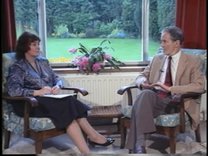
Interviews with Distinguished British Chemists: Sir Ewart Jones (unedited footage), Tapes 2-4
- 1988-Sep-05

These captions and transcript were generated by a computer and may contain errors. If there are significant errors that should be corrected, please let us know by emailing digital@sciencehistory.org.
Transcript
00:00:00 of Hughes and Engle. Ted Hughes was just finishing his PhD when I was in my first year, and I
00:00:07 had this job of making some material for his research, which of course was very exciting
00:00:12 because when I was making it I was walking in and out of his research lab and seeing
00:00:16 what he was doing. It was a connection that is very much lost today. The undergraduate
00:00:23 in the present day university has very little contact with the people doing research. He
00:00:29 gets very little of the thrill of the research except through his tutors. So in a small place
00:00:37 that was a great advantage. How many of you were doing chemistry at Bangor, say in your
00:00:42 third year? In the third year I think no more than six or seven. Any women? I don't think
00:00:53 any of the women survived until the third year. We had women of course who were doing
00:00:58 botany or zoology and they were having to do chemistry associated with it. The women
00:01:04 more or less petered out at the end of the first year. They were very, very rare after
00:01:10 that, sadly. But of course we saw plenty of the women in the college anyway. There was
00:01:16 no shortage of the female. You met your wife at Bangor too, didn't you? I met my wife at
00:01:20 Bangor. She was two years behind me and I met her on the hockey field. She was playing
00:01:25 for the women's team. I first saw her in her gym slip on the hockey field. She had
00:01:30 a nice pair of legs, very attractive. Well the attraction stayed. But you still did not
00:01:39 know at this time, you actually had no idea that you were going to go into research because
00:01:44 you had this grant for teacher's training and you had that contract to fulfil. Yes,
00:01:53 but there was no inhibition. One could always interpolate research after you'd done your
00:02:02 diploma in education. You could always then do some research before taking up a job. This
00:02:08 was regarded as quite normal. And indeed, in those days, getting a teaching job was
00:02:16 so difficult that a PhD was a very considerable advantage. One of my contemporaries, a little
00:02:28 younger than me, he did research up to the master's stage and surprised the professor
00:02:35 by saying that he was going to leave and take up a job in his old school. And the professor
00:02:42 said, well, that's fine, you're going to teach chemistry. He said, no, I'm going to
00:02:47 teach woodwork. But he said, you will have a master's degree and you're going to teach
00:02:52 woodwork. Yes, he said, the chemistry master's retiring in three years' time and they've
00:02:56 more or less guaranteed me the job. And this was the situation, that it was very difficult
00:03:01 to get a job in teaching in those days unless you had a higher degree. So there was a fair
00:03:10 If you didn't do a higher degree, then almost certainly you would go to teach in a primary
00:03:14 school. So you finished your undergraduate degree and then you did go off and do this
00:03:19 teaching diploma right away. That's right. And that was a very useful thing for me in
00:03:25 that it broadened my experience. I found the history of education fascinating because it
00:03:33 introduced me to a whole lot of history that somehow or other I'd missed out on in school.
00:03:39 The disadvantage of our school history education was that you never got a complete view. I
00:03:43 think I did the Tudor period three times. I was very knowledgeable about Henry VII onwards,
00:03:49 but I had some big gaps otherwise. And the history of education helped very considerably
00:03:54 with this. Of course, it was another academic challenge and I ended up with a first in both
00:03:59 the theory and practice of education, which I'm rather proud of. And I think it did me
00:04:07 a good service as far as university teaching was concerned anyway, because one had to
00:04:11 give public lessons at which you were criticised by the examiners and by your own fellow students
00:04:17 and things of that sort. So if you had any obvious deficiencies in your presentation,
00:04:22 these were drawn to your attention at an early stage in a relatively painless way.
00:04:28 But you also liked teaching.
00:04:31 I liked teaching. I don't know, it somehow seemed to come fairly naturally to me to try
00:04:37 and impart understanding into other people. And there was one stage where I went back
00:04:44 to school. The English master was suddenly taken ill and I was employed for three weeks
00:04:52 in school teaching English and mathematics to 12 and 13-year-olds in my old school. I
00:05:00 was then only about 19 and I found this quite pleasant. I didn't have any discipline troubles
00:05:05 because I'd been a prefect, you see, and most of them remembered me as a prefect anyway.
00:05:10 So you had a famous reputation. When you finished the teaching diploma, what then?
00:05:16 Well then was the question of research and perhaps I should say a little more about the
00:05:21 nature of the staff in Bangor and the sort of changes that took place in my time. When
00:05:27 I went there, the professor was a man called Orton, K.J.P. Orton, Kennedy Orton. He was
00:05:34 an old Oxford man. He'd worked in Queens with Chataway and was already making a considerable
00:05:43 impact in the field of physical organic chemistry. He was one of the pioneers in physical organic
00:05:49 chemistry. He was also an ornithologist of some repute. Well, he sadly died in my first
00:05:58 year. He'd been on one of his bird-watching expeditions at Easter and died of pneumonia,
00:06:04 which in those days, of course, was a 50% chance it would be fatal anyway. And so there
00:06:11 was a new appointment by the time my second year began, John Simonson, who had been in
00:06:21 India for 20 years. He was one of Perkins' research people in Manchester. He came and
00:06:28 he was already an expert in the terpene field. He'd written three-volume treaties on terpene
00:06:33 chemistry and so the change now, physical organic chemistry under Orton, terpene chemistry
00:06:41 with Simonson, and this produced an immediate change in the whole atmosphere because Watson,
00:06:49 who was the senior man under Orton, he left. He wrote the first book on physical organic
00:06:56 chemistry with H.B. Watson. He left to go to Cardiff and Bradfield, who was the other
00:07:04 organic man, he switched over to terpene chemistry. And the new recruit, a man called
00:07:11 Kahn, he also worked in the terpene field. So the atmosphere was really completely changed
00:07:18 by the time my second year began and Bangor became a natural product school with the emphasis
00:07:25 on natural products. So when the opportunity came to consider doing research, Simonson
00:07:35 got me a University of Wales studentship, which was £100 a year, which was quite nice,
00:07:41 and this then was to support me for research with him in the terpene field. This is what
00:07:50 I began with and I suppose I should be very grateful that I had my first introduction
00:07:58 in a field which was to become so full of interest for the next 30 or 40 years.
00:08:06 But I was equally, although it so happens that had I stayed in physical organic chemistry with
00:08:12 Orton, that field, with a different set of people of course, quite a different lot of people,
00:08:16 different places, would equally have been a vigorous field for the next 30 or 40 years.
00:08:22 Just that was the way the coin went. I worked with Simonson.
00:08:28 Did you know when you went back to do research, did you know it was going to lead on to a PhD
00:08:33 or was it a one year or two year appointment or were you committing yourself to research for two
00:08:39 or three years? I was committing myself to research for three years. There was no intermediate stage,
00:08:45 no master's degree or anything of that sort. Master's degree was regarded as a stopping
00:08:52 point. If you didn't go on to do a PhD you were very often settled for a master's degree.
00:08:58 But my scholarship anyway, or University of Wales studentship, was for two years so
00:09:03 it got me two thirds of the way. So how were you going to do the third year?
00:09:11 Well, Simonson said of course, oh £100 a year, you save up enough to see you through the third
00:09:17 year, which of course I'm afraid I didn't do. Happily he helped me to get a University of Wales
00:09:26 fellowship then for the third year, which of course was real money. I was getting £200 a year,
00:09:32 which was quite something, and that was for two years also. So at the end of the third year I had
00:09:39 a year of grant that would take me anywhere I wanted to go.
00:09:48 The decision then had to be made, what was I going to do with another year?
00:09:55 Well, I had met Robert Robinson, he'd been up to Bangor and I'd listened to him give a
00:10:02 fascinating lecture on group protection devices. I'd also heard Heilbron talking about vitamin A
00:10:12 and Simonson wrote to both Robinson and Heilbron and Robinson accepted me to go down to Oxford.
00:10:22 Of course it was fine, I was taking my own money, he didn't have to provide anything.
00:10:26 Heilbron, on the other hand, had the courtesy or good sense or whatever to invite me to visit him
00:10:33 at Manchester. We talked about the research he was doing and he seemed to be sufficiently keen.
00:10:41 He said, well, £200 a year, you can't live very well on that, I can supplement it a bit from my
00:10:47 Rockefeller Foundation. Of course this was very attractive to me, to have some supplementary
00:10:53 income and so the die was cast in favour of Manchester, which was absolutely right. I
00:11:01 would have done nothing like as well in the impersonal atmosphere in Oxford as compared with
00:11:07 the very personal atmosphere which Heilbron created all around him in Manchester and I'm
00:11:13 eternally grateful that I took that particular line rather than the alternative.
00:11:19 While you were doing your PhD, what was your particular research interest?
00:11:24 Okay, we can pick that up. Okay. Convenient break. How's it going?
00:11:28 How are you feeling? You feeling all right? It's all right. Oh, I can talk for that.
00:11:31 Well, that's wonderful. I can get very boring.
00:11:38 The entrance to the park or here. Yeah, I've got a friend who's number 22,
00:11:43 you know, Cunninghotties. I did the tiles. They're an Italian tile family and they
00:11:51 kitted out the Ardells and so we do all sorts of tiles.
00:11:57 We're going to drink coffee before we pick up again. Coffee's coming in a moment.
00:12:02 Does your wife need some help?
00:12:03 Oh, it's stiff sitting, don't you think? Yes. There we go. Come in. Which is the best method
00:12:12 of approach? I mean, careful is the best. Oh, yes, I'm being careful. It's just,
00:12:21 I must say I admire your discipline in only sloping.
00:12:25 It's quite a business. Can we talk about the research that you were doing for your PhD?
00:12:36 Simonson, as I said, was an expert in the terpene field, but he hadn't up to that time done any work
00:12:44 on synthesis, that is building up of terpenes. All his work had been on the natural materials
00:12:50 from trees and so on. He began with me some research on the synthesis of sesquiterpenes and
00:12:59 this was particularly challenging because it involved trying to make compounds containing
00:13:05 a so-called angular methyl group, which is a particularly difficult arrangement of carbon
00:13:13 atoms to achieve. It's part of the steroid structure and so on and we were working on this
00:13:20 and in doing moderately successfully, but at the beginning of my third year, Simonson went off to
00:13:27 India and while he was away, I came across a paper by Rajiska and Kuhlhausen-Vind actually, a 1931
00:13:35 paper, in which he described something which seemed to me to be very useful to us in our
00:13:42 endeavours. Encouraged by one of my colleagues, I did some preliminary experiments so that when
00:13:50 the professor came back, I was able to show him that I'd made quite useful progress in this field.
00:13:56 He happily was not worried by it. It's not been one of his suggestions and we worked on it and
00:14:06 it eventually came to a successful conclusion and was the first synthesis of
00:14:12 an angular methyl compound, which was quite something to have achieved.
00:14:18 And its name was? The name of the compound was cyperone.
00:14:27 It was a compound obtained from an Indian oil, the sesquiterpene ketone, and
00:14:35 we published a paper, Simonson and myself, on the synthesis of dihydrocyperone that was a
00:14:41 derivative of this compound and that was published in 1936. The slightly sad thing is that
00:14:51 the following year, Robinson came out with a modified method of
00:14:58 making this kind of arrangement of carbon atoms, which is now very well known as the
00:15:05 Mannich-based methiodide method, or Robinson method, which is distinctly superior. And the
00:15:11 following year, there was a synthesis of dihydrocyperone with Simonson and Robinson
00:15:19 and McQuillan and one or two other people. But it was quite important for me to have got
00:15:26 a good start with something original, which I had originated myself. In fact, it stood me in
00:15:34 good stead when I had my PhD oral, which was with Walter Norman Howarth. He was the professor
00:15:41 of Birmingham, later Sir Norman Howarth, Nobel Prize winner and so on. And at the oral examination,
00:15:48 which one always approaches with a degree of trepidation, although usually candidates know
00:15:54 far more about that work than the examiners, because it's their own work anyway. He asked me
00:16:01 a few questions about the work that was in my thesis and then he said, Professor Simonson tells
00:16:07 me you've done some very interesting work since this thesis was written. And so I was able to
00:16:13 tell him about this new work and we spent all the rest of the time talking about this, which
00:16:19 of course made the examination very painless. Well, you completed your PhD and it was at that
00:16:27 time that you had a couple of options. You had the option of going to Oxford or to Manchester.
00:16:38 Yes, and I chose the Manchester one because Highbrown had been so inviting and the work
00:16:45 that was being done there was so inviting. It so happened that even at the undergraduate stage,
00:16:51 I had been asked by Simonson, I'm not sure if I was asked or told, to give a talk to the
00:17:00 Chemical Society, the local Chemical Society. And I chose as my subject Vitamin A and the Carotenoids,
00:17:09 which I found very fascinating. And I didn't realise, of course, when I chose this subject
00:17:15 that I would have to do so much reading in German, but most of the work by Carer in Switzerland and
00:17:21 Kuhn in Germany was published in the Brichter or the Helvetica. These are published in German.
00:17:28 But I enjoyed doing this and then of course found that Highbrown was doing this kind of work in
00:17:33 Manchester and also working in the steroid series, which proved to be extremely fashionable
00:17:41 at a later stage. And indeed there were so many activities going on in the natural
00:17:47 product field that I found it quite exciting. And I got introduced by him there
00:17:56 into work on the synthesis of Vitamin A, I did a bit of work on Vitamin E,
00:18:02 and particularly into the steroid field. That was my real apprenticeship in Manchester for
00:18:12 two and a half years. Of course, at Benwell you'd also had a very
00:18:17 interesting social life. You said the social environment was very pleasing.
00:18:22 Yes. The main advantage I gleaned from, again, from being at Bangor was that right from the outset
00:18:30 I got into a small men's hostel, which was run by the professor of education, a bachelor,
00:18:38 fond of cats incidentally. And I lived there for six and a half years. There were 36 other people
00:18:45 besides myself and the population was constantly changing of course. I was there all the time. I
00:18:52 certainly was the oldest inhabitant after about four years. And during that time we had to share
00:18:59 rooms. I deliberately chose to share rooms with friends who were doing quite different things,
00:19:07 social studies, English, history, French, physics. Those are the ones that I can remember.
00:19:13 Of course, we learned a great deal from one another and from our friends. We four gathered
00:19:20 very often in the evenings. Also at the same time, of course, I learned a lot of other things. I
00:19:25 learned to play bridge and solo and things of that sort. I learned chess from a man called Barry Wood,
00:19:33 who for 50 years was the telegraph chess correspondent and won the Hastings tournament
00:19:39 many years ago. He figured in the honours list when he retired a little while ago and I had an
00:19:44 interesting letter from him. But you also were still going to the Saturday Night Hops.
00:19:53 Oh yes, yes. And of course I met my wife there and by the time she left we were already engaged
00:20:02 and eventually we got married in Manchester. She only taught for a year or a year and a half.
00:20:13 Many people don't realise, of course, that in those hard times married women were not allowed
00:20:19 to teach and she had to give up her job when she became married. Of course, the fact that they
00:20:26 weren't allowed to teach led to some very interesting arrangements in schools on the
00:20:32 subject of much gossip and interest, of course. But anyway, she gave up her job. I don't think
00:20:39 she was entirely unwilling and came to live in Manchester and we lived there for six months
00:20:46 before we moved down to London. Before we go on and talk about the research you did in Manchester,
00:20:53 can you say something about how hard you worked, for example,
00:20:57 doing this PhD? You say you stayed in the lab until 10 or 11 o'clock at night most nights.
00:21:03 Yes, I should preface that by saying that when I began research it coincided with the appointment
00:21:12 of George Ramage as an assistant lecturer. He was a few years older than me. He'd just done a year
00:21:21 with Robinson. He was from Clemo School in Newcastle. He'd done a year's research with
00:21:25 Robinson in Oxford and he came to Bangor. George was very keen to get on. He was a great inspiration
00:21:34 to me. He was a tremendously hard worker and somehow working until 11 o'clock at night,
00:21:41 seven days a week with Wednesdays and Saturday afternoons off to play games. But this was,
00:21:48 to me, quite normal. My wife-to-be used to come down on Sundays, bring her knitting down and sit
00:21:56 in the lab while I was getting on with my research. Generally, it was a very companionable and
00:22:06 social arrangement to work quite late hours. This I continued to quite an extent in Manchester too
00:22:17 when I went there. Research is a subject that one's success, one of the main factors in success
00:22:26 is the amount of effort you put in. There's no doubt about it that success is proportional.
00:22:31 It's one of the factors to the amount of effort you make.
00:22:34 And the lab facilities in Bangor you found adequate for the research you were doing?
00:22:40 When I was in Bangor, the most valuable piece of equipment that we had in the lab was the
00:22:45 light's polarimeter, which was the professor's pride and joy for measuring optical rotations.
00:22:50 And this must have been worth every penny of a hundred pounds. And that was the most valuable
00:22:56 piece of apparatus. But very few laboratories had or needed anything more. Organic chemistry
00:23:05 research at that time was not terribly equipment dependent as it is today. In those days,
00:23:13 you could get by with relatively little equipment. But of course, the whole pace of
00:23:18 research and development was many times, many, many times slower than it is today.
00:23:25 The outstanding example to me, I mentioned the steroid series, the outstanding example to me
00:23:32 is that of cholesterol, which everybody knows because they read it on bottles,
00:23:35 does not contain cholesterol and things of that sort, which is bad for the arteries.
00:23:40 But cholesterol was first discovered in the early 1800s in gallstones. Its structure was
00:23:49 worked on intensively by Windhausen Wieland in Germany from 1900 roughly until it was determined
00:24:00 in 1935. It took 35 years for the structure of the sterol nucleus to be discovered. And this
00:24:07 involved, I don't know how many, dozens of PhD researches to try and elucidate it by painstaking
00:24:15 method. Of course, it was Dorothy Hodgkin's work with Bernal in Cambridge that eventually
00:24:22 decided between the two possible structures. One was a fat, compact structure. The other was a
00:24:29 long, thin molecule. And Dorothy and Bernal found that cholesterol, by the X-ray crystallographic
00:24:37 method, cholesterol had to be a long, thin molecule. And so the decision was made between
00:24:42 these two. And it must have been very galling for Windhausen Wieland after all these years
00:24:47 to have the proper structure of cholesterol suggested by Rosenheim and King in England
00:24:53 in 1935, based partly on Dorothy's work.
00:24:58 So you decided to go to Manchester and you went to work on what project there?
00:25:07 Well, I was working on, to begin with, work with cholesterol, trying to convert cholesterol
00:25:15 into provitamin D. Vitamin D is a derivative of cholesterol. It's formed in the skin. When you
00:25:25 irradiate yourself, you make some vitamin D that way. You do yourself other harm, but you may make
00:25:30 some vitamin D at that time, which is good for you. It helps to strengthen the bones of
00:25:35 anti-rachitic vitamin. This I began work on and found it quite fascinating to be introduced to
00:25:44 a subject. The only book on the subject was in German, Lettray and Inhofen's book,
00:25:49 Ubersterien. All the literature pretty well was in German, which was not a bad thing to
00:25:57 have to master that. And it was a field in which there was lots of interest. And this
00:26:05 is one of the important things about research, I think, the spur of working in an area where
00:26:10 lots of other people are working. You know that there is interest in what you're doing all over
00:26:15 the world. It's nice to have a field all to yourself, which nobody else is bothering with,
00:26:19 but the chances are it may not be very important. Whereas in the field like the sterile field,
00:26:25 connecting the vitamins, these were great things in those days. A lot of interest in vitamins.
00:26:31 It was a good thing to do. One of the big changes that I encountered in Manchester was
00:26:38 going into a big department where now there were at least half a dozen postdoctorals.
00:26:46 There'd be no postdoctorals in Manchester except the members of the staff. Whereas in Manchester
00:26:52 there were several postdocs and at least three of them were supported by ICI. They had a very
00:26:58 liberal policy. They would take on somebody at the PhD stage and then send him to another
00:27:03 laboratory for a year to get some other experience. And there were at least three
00:27:07 people working in Manchester on that basis who were going to ICI Dystopia afterwards,
00:27:13 but were gaining experience with Ron and his colleagues in those various fields.
00:27:19 The other thing, of course, about Manchester is that even from those days I was very conscious
00:27:24 that it was almost the hub of chemistry in Britain, where chemistry had come from.
00:27:30 The other exciting thing, of course, postdoctoral, as I should have mentioned,
00:27:34 and not in my field, but in the physical field, working with Polanyi, was Melvin Calvin,
00:27:41 who, of course, subsequently got a Nobel Prize for his work on photochemistry. But Mel Calvin
00:27:46 was my first American, I suppose. Yes, I hadn't really known an American in the flesh except on
00:27:54 the films until Mel Calvin. He was perhaps a good example. He was a very fine and inquisitive
00:28:01 scientist. We were all appalled at the way in which he asked the professors questions at
00:28:06 colloquia, which we wouldn't dare to ask. But he was also a very skillful bridge player,
00:28:11 too. We played bridge with him on occasions. That was quite interesting.
00:28:21 The decision, of course, had to be made at some time what I was going to do after
00:28:27 two years at Manchester. The opportunities were pretty dismal. Academic teaching was
00:28:39 the obvious possibility based on my diploma work, but there was only one job going during that year,
00:28:46 and I applied and fortunately didn't get it. I had been interviewed by Monty Barcliffe at
00:28:54 ICI Dystuffs, and he'd offered me a job, which I was almost on the point of accepting. I would have
00:29:02 possibly had to repay the Board of Education something for my grant, but that didn't worry
00:29:07 me too much at the time. Anyway, I was still thinking about the employment with ICI when
00:29:14 Ian Harbron asked me, quite out of the blue, if I would like to accompany him to London. He had
00:29:20 been appointed to succeed Jocelyn Thorpe at Imperial College, and he said, would I like to
00:29:26 go with him and assume responsibility for various of his research activities, which, of course,
00:29:32 to me was a wonderful, wonderful opportunity. Here was a chance to get one's foot on a
00:29:39 relatively short ladder. Imperial College, after all, was quite a place, and to be able to start
00:29:46 off there in the academic world was very thrilling indeed. So without any question at all,
00:29:52 I went. I only discovered afterwards that two of my Manchester colleagues, Frank Spring and Don Hay,
00:29:57 had both been asked if they would like to accompany him, and had both turned it down.
00:30:02 They were both, of course, married with families, and this was the Munich time,
00:30:07 and I think people were wondering whether London was a good place to go and live,
00:30:12 and so I got that opportunity, which I didn't realise until later.
00:30:18 You started working on something else at Manchester too, didn't you, the dictionary?
00:30:23 Yes, Harbron had begun a few years before I went to Manchester, just about two, I think,
00:30:29 his famous Dictionary of Organic Compounds, in association with H. M. Bunbury, who was an ICI
00:30:37 colourist, strangely a barrister as well. Bunbury was a very fine editor, and Harbron, of course,
00:30:45 provided the scientific, general scientific background to this, and the information was
00:30:51 collected by a whole lot of authors who were given lists of compounds they had to look up
00:30:57 in the literature, and then people had to edit these authors' contributions and pass them on
00:31:05 to Bunbury, who then put them in the final form for the printers, and very soon I became an
00:31:11 assistant editor with the task of working through piles of slips. I used to sit by the fire, my wife
00:31:19 in the evening, working through these until the early hours of the morning sometimes, and I must
00:31:24 have written, I suppose, for the second edition, I must have written about two-thirds of the actual
00:31:30 dictionary myself in my own, and when I say written, this was all printed in Italian type,
00:31:39 in that one had to be very careful with all the dots and commas and degree signs and everything
00:31:43 had to be just right, all the spacing. It was a very tedious job, but it was a tremendous
00:31:51 education. I can think of nothing better than a dictionary to educate one into the whole range
00:31:58 of chemical activity, because it's no respect to subjects or specializations, you just have to
00:32:05 take things as they come in the alphabet, and so one moment you'd be dealing with this sort of
00:32:10 compound, the next moment something quite different, and I learned a fantastic amount of chemistry,
00:32:15 and not only chemistry, but people's names, because we gave all the references,
00:32:20 and so I knew who was working in this field or that field, which was really very, very useful
00:32:25 afterwards. I could immediately associate people, oh yes, you did the work on this or that or the
00:32:31 other thing, which was, and they didn't realize, of course, that I had not really read their papers,
00:32:37 I really came across it while I was doing dictionary editing. And you kept that for a very long time.
00:32:42 I did this for nearly 20 years. It was only when I went to Oxford that, with great reluctance,
00:32:46 I had to tell Ian that I couldn't, I just couldn't find time to carry on with it.
00:32:52 He would have liked me to have, I think, taken it over, but I just had so many other things on my
00:32:57 plate, I just had to harden my heart and say, no, I can't do that, along with all these other things.
00:33:03 I'm moving. Oh, okay, great. We got through an awful lot of tape.
00:33:09 That's only an hour and 20 minutes. It may seem like an awful lot.
00:33:12 I saw Jack Lewis at Council and he very nicely said, you know, come and use my office, it's much
00:33:25 bigger. So we actually set this up in Jack Lewis's office, which used to be had Emma Lewis's office,
00:33:30 you see. So we sat there and he sat behind the desk and I sat around the side and he was very
00:33:36 comfortable with that. And then what we did is we took some shots of him walking into the building
00:33:41 with me and then we also took one walking down the corridor of a lab and standing around
00:33:46 beside a piece of glassware. So we actually, but we didn't have to record anything there,
00:33:50 that was just background shots. But we can get some outside shots of the lab and we can also,
00:34:00 but we also have a permission from Magdalen to go down and walk around in your college,
00:34:05 which I think is nice. Of course, when the sun comes out, whether the sun comes out or not,
00:34:08 Magdalen always looks beautiful. Yes, but it looks so much better in the sunshine.
00:34:12 So this time, let's talk about, first of all, the work that you were doing in London, which was
00:34:20 one thing. And then you've said there weren't terribly difficult circumstances, but the fact
00:34:25 that there was a war on and so it wasn't just a simple fact of working, but you also had other
00:34:32 complications. And then we'll lead through what you were working on and how it was going and
00:34:37 your, what did they call it? It wasn't civil defence. Yes, it was, it was part of the civil
00:34:43 defence, gas identification service. And then you can amplify, talk about whatever you liked in that
00:34:49 and then we'll lead up to the point where you're offered up the job in Manchester. We should
00:34:55 probably spend, I think... Right, let me just tell my wife, we'll have lunch at Huppert.
00:34:59 Five, four, three...
00:35:09 You moved to London in 1938 and you continued your work there. What were you doing in London?
00:35:17 I think one of the things that one has to explain is that Harbron had a system of working with
00:35:23 lieutenants. It was not a very common system. Howarth used it in Birmingham with some success,
00:35:31 but Harbron had me and two or three other people to help him with his research, which covered a
00:35:40 large area. In Manchester, for example, it had been Spring and Hay and W.E. Jones, they were all
00:35:48 lieutenants of Harbron. So I was one of his lieutenants in London and the way things worked
00:35:54 out, of course, was that I very soon became first lieutenant or whatever, because he got involved
00:36:02 as scientific advisor to the Ministry of Supply and then at a later stage directly to the Minister
00:36:10 of Production, and the amount of time that he was able to devote to detailed supervision of
00:36:19 research got smaller and smaller, and I found myself with more and more responsibility. To begin
00:36:25 with, in the first few months at Imperial College, I was supervising 18 research people. I'd
00:36:32 supervised one in Manchester, so one was really thrown in at the deep end, and one of them,
00:36:38 Portuguese, so we had to do the supervision in French, which was not so easy. But this was the
00:36:45 way it worked and I gradually found myself, due to the involvement of Harbron in government and
00:36:51 changes of one kind or another, in a couple of years I was largely running the organic department,
00:36:59 which, of course, for a 20-something year old was a tremendous opportunity.
00:37:07 And although the war began in 1939 and we had all sorts of restrictions, one of the great mercies,
00:37:17 of course, was that we should have gone to Edinburgh, but happily, because the administration
00:37:23 was so lax in making their arrangements, by the time December 1939 came, that's right,
00:37:32 we decided, it was decided we should stay in London, and we were the only academic establishment
00:37:38 to stay in London. I often say, like the Windmill Theatre, we never closed, and it was a tremendous
00:37:46 opportunity and advantage, because being the only academic place, anything that went on in White
00:37:53 Hall or anywhere else, well, you better go up to Imperial College, there's sure to be somebody
00:37:56 who knows something about it there. And so we were constantly being used by government and the forces
00:38:03 for this and that and the other thing, which was all very exciting. Of course, it was made a good
00:38:10 bit more hectic in September of 1940, when the action moved to London, and from then on, of
00:38:18 course, right up until the spring of 1945, we were never without the threat of some sort of action,
00:38:27 and I don't think people realised just quite what it was like in the early days of 1941,
00:38:35 for example, when on several occasions more than a thousand people were killed overnight
00:38:40 in the bombing raids, and this went on, not on that scale, I mean, these were individual
00:38:47 individual nights, spaced by perhaps a week or two weeks or ten days in the raids, so often at
00:38:56 weekends, which was very, very unpleasant. But for me at that stage, being young and ambitious,
00:39:07 the work was more of a worry than the enemy action.
00:39:13 But you were involved in civil defence?
00:39:15 I was involved in civil defence, of course, at home one had to do a certain amount in the way of
00:39:20 trying to protect oneself, and I wasn't fit for the forces, I'd been turned down in a medical
00:39:26 in 1938, and in any case I was in a deferred occupation as a university science worker and
00:39:34 teacher. But the civil defence activity began just before the war, when it was realised it would be
00:39:44 very helpful if all our people in civil defence all through the country had a much better
00:39:49 acquaintance with war gases, and an ability to detect and identify them. And so Harry M. Elias,
00:39:58 who was one of my colleagues in London at the time and I, we went down to Porton and we did a
00:40:06 course there on war gases and their identification, and then we set up an organisation at Imperial
00:40:13 College in which we trained people in a four-day course. We gave them experimental work, and we
00:40:21 used the grounds of Imperial College for simulated mustard gas incidents and things of that sort.
00:40:28 Harry, I think when he went away to Chalk River, he was with it for about two years and then I was
00:40:37 on my own for the rest of the time, and during the war period I reckon I trained about 2,000
00:40:43 people who came as it were before me, I was lecturing to them and demonstrating to them
00:40:51 for four days. It was very embarrassing in the years afterwards because all the time up and down
00:40:56 the country people would hail me, ah Professor Jones, Dr. Jones, you remember me don't you?
00:41:03 I remember the face but I couldn't remember the person, but I had a lot of quite distinguished
00:41:08 people came to that course during those four years. We inevitably got involved of course
00:41:15 in all sorts of incidents whenever there were chemicals released as a result of bombing
00:41:20 activities, there were questions as to whether this was dangerous, whether this was war gas that
00:41:25 was being used and so on, so we were constantly being used in a minor way, but I do believe that
00:41:33 the extent to which we were prepared for that sort of CW activity was perhaps a factor that
00:41:42 deterred the Germans from using it, they didn't see they would get all that much advantage.
00:41:49 Throughout this time of course my wife was with me in London, occasionally she would be moved out,
00:41:56 my persuasion or my in-laws persuasion, and our first child was born up north in October
00:42:04 41 and then came back, but our second child he was born during the flying bomb period and she
00:42:11 had him in a nursing home in Putney, flying bombs going around at the time, he was quite
00:42:17 unperturbed by the V1s or the V2s, it didn't seem to disturb his wish to sleep most of the time.
00:42:25 Did you have to go to air raid shelters during attacks?
00:42:31 Well, we didn't have an air raid shelter at home, we just...
00:42:34 In Imperial College?
00:42:36 At Imperial College we did have some reinforcement in the basement. The attacks of course during
00:42:43 1941 and the years after, it's 1942-43, were nearly all at night and so of course there were
00:42:55 no students present at that time. The real worry came with the flying bomb, the V1 period, because
00:43:01 of course these came over for 24 hours in the day and so one was trying to conduct examinations and
00:43:09 laboratory work when people on the roof would signal a warning. Well, you didn't get
00:43:16 any warning more than about one minute, so there was no time to go to shelters,
00:43:22 you just lay down on the floor getting as much protection from benches and so on.
00:43:27 The big danger with the V1s, they exploded on impact and so they did damage over a large amount,
00:43:35 large area with glass windows, roofs and so on, stuff was flying around.
00:43:41 And so if you got down behind a wall or behind a bench, the chances are you were reasonably safe,
00:43:48 but it was quite hard conducting examinations under these conditions.
00:43:53 There were no direct hits in the college though, were there?
00:43:56 The college itself was not hit by any high explosive bombs, they were outside the college
00:44:02 in the grounds and of course they were extremely well built and the bombs used in those days were
00:44:07 the biggest was probably about 120 kilos, 250 pounds, and so they didn't do much damage to the
00:44:15 very substantial outside walls. Of course, had they fallen inside the building they would have done
00:44:21 very considerable damage. The incendiaries, of which a great many were dropped of course,
00:44:26 we removed these from the roof with our fire-watching parties and no fire ever at
00:44:32 Imperial College ever got any sort of hold at all, unlike University College which was largely
00:44:38 burnt during the war. So meanwhile, what sort of research were you doing?
00:44:45 We were doing research which was encouraged by the various agencies,
00:44:52 research of national importance, and this was fairly widely interpreted. I mean some of it was
00:44:59 very obviously chemical warfare research, work on petroleum devices for causing petroleum to
00:45:12 ignite spontaneously. Harry M. Allais was involved in some of that. Then things like
00:45:19 vitamin A synthesis, work on penicillin, penicillin synthesis, these were all regarded,
00:45:26 oh on DDT, these were all regarded as of national importance and indeed I mean the DDT
00:45:31 stuff was largely instrumental in preventing an outbreak of whatever it was in Naples,
00:45:40 an insect-borne pestilence. So the work was largely, as I say, of a kind that could regard
00:45:50 as national importance. And the other big difference from First World War, there a lot
00:45:55 of people had been allowed to go into the forces with qualifications which would have been extremely
00:46:00 useful had they stayed at home, but they were lost, dispersed, and now there was a feeling that
00:46:07 we had to be sure that any things that arose there were enough trained personnel available.
00:46:14 And so this amounted to a certain number of the brightest students being given almost carte blanche
00:46:19 to stay on and do research so they would be available either then or after the war,
00:46:26 which was quite a help to us because we did have some very good people. The class of people we had
00:46:32 in Field College was probably the best that I've ever encountered, they were really first-rate people.
00:46:37 And indeed one of the amusing papers that I refer to on the vitamin A synthesis, Harvon, Johnson,
00:46:46 Jones, and Spinks, all four of us became presidents of the Chemical Society at some stage or other.
00:46:52 At that time we were all members of the Chemical Society but we all became presidents and
00:46:57 the four are together just as the authors of one paper, which gives some indication of the caliber
00:47:03 of the people that were there, and of course Derrick Barton was there during the war period.
00:47:08 We were able to do, as I say, a number of things that were of academic as well as of
00:47:15 of national interest. My association with Derrick Barton is one of the very happy things.
00:47:22 Derrick did a year or so's research and then he went to work for military intelligence down in
00:47:29 Baker Street and to our surprise and his, he found that the work that he was doing was a sort of
00:47:35 nine-to-five, nine-to-five job. And for someone like Derrick this was just no use at all, he wanted
00:47:42 to be doing something. Couldn't he come and work in the lab? Well of course it just wasn't possible
00:47:47 with the security that we had to have, with certain of our secret work, with the precautions
00:47:55 that we had to take about bomb damage and so on. But he could work in the library and so I found
00:48:01 him a problem which I'd had on my mind for a little while in the triterpene series and I said
00:48:08 Derrick if you like to look through the triterpene literature and look at the rotations and so on of
00:48:13 a whole lot of triterpene derivatives I think something useful will come out of this.
00:48:17 And he did this and we found, as I'd hoped we would find, some correlation between the structural
00:48:24 aspects and the actual optical rotations. And when Derrick finished this, and we published it
00:48:31 eventually, he said what are we going to do now? And the same line I said oh well I can't think of
00:48:38 anything else, he said what about the steroid field? Oh I don't think that's a good thing to
00:48:43 do, it's been looked at to some extent, I don't think there's very much to come out of it. Oh he
00:48:48 said I think there is, well I said if you think so you go ahead and you go and have a look at it.
00:48:53 And Derrick of course went ahead with this and published several papers and I've no doubt at all
00:48:58 that this led to the discovery that he made, well it's not a discovery it was a
00:49:06 a mental invention really, the idea of the conformational analysis came out of this steroid
00:49:14 work and of course eventually got Derrick a Nobel prize. I can say I succeeded in not inhibiting
00:49:21 the potential Nobel prize winner. But the war did come to an end so things went a little bit back
00:49:29 to normal and... Oh back to normal is not quite the right thing, what happened of course after
00:49:37 the war we were deluged with people coming partly out of curiosity but of course partly to make
00:49:44 contacts with the people they'd known from the literature, what was going on in the penicillin
00:49:49 world, in the steroid world, in the acetylene world, people were coming to us from all over
00:49:54 Europe and America and so for a long time we were just deluged with visitors coming along and this
00:50:01 was very exciting and it culminated in 1947 in the international congress in London and the
00:50:09 celebration, belated celebration, of the chemsock centenary in 1947 and this of course was really
00:50:15 very exciting. Alex Todd was chairman of the president of the organic section and I was the
00:50:23 secretary. I did the dog's bodying work but of course I met everybody which was all very very
00:50:28 exciting for me at that time and of course at that time I'd had a letter from
00:50:39 Manchester inviting me to go up for an interview for the chair of chemistry there and the headship
00:50:47 of the department. Manchester does things in this way, they don't advertise, they just consult with
00:50:55 various people around the world and then write to one or two people and say we would like to
00:51:00 interview you with the prospect of your coming to us to fill this this chair and I got an invitation
00:51:08 to go and I went up on a Saturday or at least on a Friday and had the interview on the Saturday
00:51:15 Saturday morning and to my very great surprise on Monday morning's post in London I got a letter
00:51:22 from the vice-chancellor offering me the Sir Samuel Hall professorship and headship of the
00:51:28 department which I thought was very efficient, you know, the letter had obviously been written
00:51:32 immediately after the committee had risen. I didn't know, of course, they'd interviewed
00:51:38 somebody else a week before. I knew nothing about it and I sort of wondered whether there had been
00:51:45 anybody for some years before I found out that somebody else had been interviewed for that
00:51:51 for that post but it was a great thrill. Of course Manchester chair was regarded as one of the
00:51:57 the prime chairs in the country. The two previous Waynefleet professors, Robinson and Perkin, had
00:52:04 both come from Manchester to Oxford and I was following in this succession which was a
00:52:10 tremendous thing to happen to anybody. So all this excitement in 1947 was coupled with
00:52:17 my going to Manchester early in 1948, at least that was the the plan. Various things happened
00:52:25 that interfered with that but it was a very exciting period after the war.
00:52:33 In your own field what was the most exciting thing you did in London,
00:52:37 apart from the war? Amongst the various things I did I could pick on several but I think overall
00:52:44 the acetylene field, vitamin A synthesis, we'd had the idea even in Manchester that we could use
00:52:51 acetylene as a useful two carbon unit for this synthesis of a C20 compound and this introduced us
00:52:59 to a whole new lot of chemistry which people hadn't explored before and resulted in acetylene
00:53:09 now being regarded as a very important part of organic synthesis and my Tilden lecture in 1950,
00:53:17 the title of that was Acetylenic Compounds in Organic Synthesis and then Ralph Raefel wrote a
00:53:23 book on it about five years later and there have been since many, many books and now a great many
00:53:30 of the syntheses that one looks at in the chemical literature in organic chemistry,
00:53:35 one sees them employing acetylene molecule as a useful part of the building up of these
00:53:43 structures. So this was undoubtedly the most exciting part of it. The one amusing part was
00:53:52 the oxidation of acetylenic alcohols which we did, a novel method and this is a paper by Boden,
00:54:02 Harbron, Jones and Whedon I think and this turns out to be or turned out to be one of the most
00:54:09 cited papers in organic chemistry that people used the method and then gave the reference of
00:54:16 Boden, Harbron, Jones and Whedon as the method they had used and it throws some dubious light on the
00:54:23 value of citation indexes you know people do say oh yes well the number of times your work is cited
00:54:28 in the literature it shows how important it is. This was a relatively minor discovery or
00:54:37 addition to the organic chemists techniques but it became universally popular and it's known now
00:54:45 as Jones oxidation and is used fairly universally. We start at Jones oxidation but we go on to
00:54:59 Manchester where things I think we're pretty much covering this stuff we're
00:55:15 covering this stuff.
| Property | Value |
|---|---|
| Creator of work | |
| Place of creation | |
| Format | |
| Genre | |
| Medium | |
| Extent |
|
| Language | |
| Subject | |
| Rights | In Copyright |
| Rights holder |
|
| Credit line |
|
Institutional location
| Department | |
|---|---|
| Collection |
Related Items
Cite as
American Chemical Society, and Royal Society of Chemistry (Great Britain). “Interviews with Distinguished British Chemists: Sir Ewart Jones (Unedited Footage), Tapes 2-4.” U-matic (tm), September 5, 1988. American Chemical Society Audiovisual Collection. Science History Institute. Philadelphia. https://digital.sciencehistory.org/works/ppzow9n.
This citation is automatically generated and may contain errors.