
Polymers and Plastics
- Circa 1987

These captions and transcript were generated by a computer and may contain errors. If there are significant errors that should be corrected, please let us know by emailing digital@sciencehistory.org.
Transcript
00:00:00 Tempest in a Test Tube, a series of experiments designed to explain the mysteries of chemistry
00:00:15 and the laws that govern them, produced by KQED San Francisco.
00:00:28 In cooperation with the California Institute of Technology for the Educational Television
00:00:43 and Radio Center.
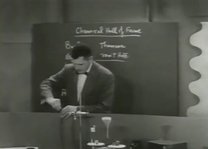
00:00:47 And now let's go to our laboratory and meet Dr. Harry Sello.
00:00:52 Hello, in a previous show we talked about the various compounds that the element carbon
00:00:59 can form in reacting with other elements.
00:01:03 Carbon however has the property that it can form many compounds by reacting with itself.
00:01:09 This particular show we shall talk about such compounds.
00:01:13 The compounds of carbon, those in which one carbon atom can react with other carbon atoms.
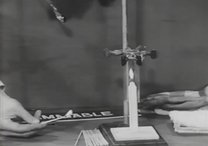
00:01:23 This burner is being fed by a gas contained in the cylinder.
00:01:30 The gas is ethylene.
00:01:33 Ethylene is just such a compound of carbon, that is, it contains two atoms of carbon and
00:01:39 four of hydrogen.
00:01:41 In the molecule ethylene, the two carbons are hooked together.
00:01:45 This is the particular property of carbon about which we speak.
00:01:50 Ethylene is a gas which can be used to drive a Bunsen burner, that is to feed a burner
00:01:56 so that we can get a flame.
00:01:58 Here is the flame being generated by the ethylene in the cylinder.
00:02:03 There it is, now the air has been cut off, the flame is light.
00:02:08 If I open the air supply a little, why, the whiteness of the flame or the yellowness of
00:02:13 the flame disappears.
00:02:14 Now has enough air and we have the typical blue flame of a gas burning in air.
00:02:21 Ethylene can be used for this purpose, it can be used as a chemical.
00:02:25 However, if ethylene is treated in a particular way with particular catalysts, very interesting
00:02:30 compounds can be made.
00:02:32 Here is one of them.
00:02:33 You may recognize this little animal, it's a squeeze bottle used to squeeze out a little
00:02:39 water like I'm doing here on the floor.
00:02:43 Polyethylene squeeze bottles, these are used for cosmetics and for containers of all sorts.
00:02:49 Very popular these days because they're unbreakable.
00:02:52 Notice the difference between the ethylene which has gone in to make up this bottle,
00:02:57 it's a solid here, that is the ethylene has been made into a solid compound.
00:03:02 In the case of the burner, it's obviously a gas, the gas is burning, causing a flame.
00:03:08 Now it is of this particular kind of compound that we'll talk.
00:03:14 Ethylene is just one example.
00:03:17 I mentioned that the name of this particular material is polyethylene.
00:03:24 Let's look a little bit more at that prefix poly.
00:03:26 We're going to talk about a class of compounds known as polymers.
00:03:33 The word mer, m-e-r, the root here, means unit or one.
00:03:40 Polymer would be many units.
00:03:44 Polytechnic high school, many sciences studies, many studied there, many techniques in a manner
00:03:49 of speaking.
00:03:51 One is a figure of many sides.
00:03:57 A polymer then is a molecule made up of many units.
00:04:02 Let's write the reaction or the equation for the formation of polyethylene on the board.
00:04:12 Here is the formula of ethylene, C2H4.
00:04:20 Ethylene can be made to react with itself, that is, many molecules of ethylene can react
00:04:26 with one another to form giant molecules, which we shall write in a shorthand way this
00:04:32 way, C2H4, with a parenthesis around it and a little letter N.
00:04:38 N is just a symbol, call it number if you wish, N is just a symbol meaning a large number,
00:04:46 something of around anywhere between 5,000 and 10,000.
00:04:50 So you see what I've shown here is that N molecules of ethylene can react, 5 or 10,000
00:04:57 molecules of ethylene can react and form a long chain.
00:05:01 That chain will be composed of 5 or 10,000 such units all arranged in a sort of a row.
00:05:07 This we give the name here polyethylene, many units of ethylene.
00:05:16 This is just ethylene here.
00:05:20 This is the monomer, one unit, this is the polymer.
00:05:24 We shall talk in this talk about polymers.
00:05:29 Let's go on and look at a reaction in which we will make a polymer starting with a monomer.
00:05:37 I'll use my nice ethylene burner to warm up some water.
00:05:48 Water is just about ready to boil.
00:05:53 I'll take a second chemical here and put about an inch of it or so in the test tube.
00:06:04 That ought to do the trick.
00:06:08 Cap it.
00:06:11 Now add the catalyst into the chemical.
00:06:26 Shake it up to get the catalyst dissolved.
00:06:30 Put it here in the beaker of boiling water.
00:06:35 The catalyst now is dissolving in that material.
00:06:40 The liquid I used, which resembles greatly acetic acid or vinegar, is called acrylic acid.
00:06:48 Let's write its name on the board.
00:06:51 Keep an ear open for this test tube.
00:06:56 Acrylic acid.
00:07:03 This is the monomer.
00:07:13 I don't need to burn it now.
00:07:15 Turn it off.
00:07:20 It's still percolating along here.
00:07:25 I'll just give it a little swirl.
00:07:28 The acrylic acid is beginning to turn milky.
00:07:54 The polymer we just made is polyacrylic acid.
00:08:03 Acrylic acid being the monomer, the polymer then being polyacrylic acid.
00:08:08 Let's see if we can fish a little bit of this out.
00:08:15 That's in there pretty solidly.
00:08:19 Let's see if we can get at this material here.
00:08:25 Just be careful to hit the test tube and not the test tube holder.
00:08:34 Actually it glues the test tube together.
00:08:43 That's the glass coming off now.
00:08:48 It's a little warm yet.
00:08:50 There is the hard material on the inside.
00:08:54 Since it's warm it's still a little rubbery in nature, but now it's stiffening up.
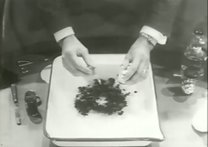
00:09:01 Break off a little piece here.
00:09:05 Pretty tough.
00:09:07 There's a little fragment of it out on the plate.
00:09:12 This particular polymer is not a practical polymer.
00:09:15 It's a little too hard to work.
00:09:17 But in various other forms, it's a very practical material.
00:09:21 For example, a close cousin of acrylic acid, when made into a polymer,
00:09:25 is commonly called lucite or plexiglass.
00:09:28 This, instead of being acrylic acid, is actually another kind called methacrylic acid.
00:09:33 A very close cousin.
00:09:34 The same type of reaction.
00:09:36 When treated in the proper way, you can cast it into sheets.
00:09:39 The product can be cast into sheets.
00:09:41 And lucite or plexiglass can be made from this.
00:09:44 So, acrylic acid was the monomer.
00:09:46 Polyacrylic acid is the polymer.
00:09:49 A long-chain molecule.
00:09:51 Here is another example of a collection of long-chain molecules.
00:09:55 Rubber band.
00:09:58 If you've ever picked up your telephone when the receiver was all wound up in the wire
00:10:03 and tried to pull it apart, just straighten it by pulling on it when the wire is all coiled up,
00:10:08 you notice that as soon as you let go, the wire coils up again.
00:10:13 This is exactly what's happening in a rubber band.
00:10:15 The rubber band is composed of little coils of long-chain molecules.
00:10:20 These polymers.
00:10:22 When you pull on a rubber band, you straighten out these molecules.
00:10:26 So, when you let go, the molecules tend to coil up again.
00:10:30 So this is a property of polymers.
00:10:32 They like to stay in a coiled condition if they can.
00:10:35 By the way, here's a little experiment you can do with a rubber band sometime.
00:10:38 Hold it up to your lower lip and stretch it quickly.
00:10:41 And if you touch it to your lower lip right away, you feel that there's a little heat generated.
00:10:46 You see, you've exerted some energy, done some work to stretch the rubber.
00:10:51 Doing that means that it must come out in some way.
00:10:54 You get a little heat.
00:10:55 The rubber actually warms up.
00:10:59 Polymer.
00:11:01 Let's go on then and look at some more examples of different sorts of polymers or plastics.
00:11:07 By the way, the chemist quite often uses the words polymers and plastics interchangeably.
00:11:12 However, he shouldn't.
00:11:14 The word plastic refers to a kind of property or perhaps a commercial material.
00:11:20 Most everything that's made synthetically in a laboratory these days is called a plastic.
00:11:24 Polymer is the more correct word.
00:11:26 This describes exactly what the material is.
00:11:29 Now, here we have a little bit of a monomer, which I'll pour into the beaker.
00:11:36 Make sure it all gets warmed up.
00:11:48 And I'll put in with it another chemical.
00:11:58 The first material I used is called phenol or carbolic acid,
00:12:04 a common material to a chemist composed of carbon, hydrogen, and oxygen.
00:12:10 The phenol is.
00:12:12 The second one I poured in is a solution of formaldehyde.
00:12:15 Some of you who have taken a little bit of zoology will recognize what formaldehyde is.
00:12:21 Let those warm.
00:12:26 They're simmering a little there.
00:12:28 Now, the catalyst.
00:12:32 Oh, by the way, there was an experiment I wanted to show you about the catalyst in this last sequence.
00:12:39 We'll have time to look at that in the later part of the show.
00:12:44 Here is the catalyst in this case.
00:12:46 It's hydrochloric acid.
00:12:52 The reaction occurs almost immediately or starts to occur.
00:13:00 Some white material is forming.
00:13:04 There, that ought to be enough.
00:13:08 The bumping is due to the poor heating of the liquid.
00:13:12 Now, that's fine.
00:13:14 Put it right out here where it doesn't go too quickly.
00:13:20 There is a strong odor of acetic acid being liberated because acetic acid is used as a solvent for this reaction.
00:13:29 And the reaction is generating heat, you see, even though it's not on the hot plate any longer.
00:13:35 Yeah, quite stifling, I might say.
00:13:38 In fact, I will say, quite stifling.
00:13:43 There it is, perking away all under its own heat.
00:13:47 This is a demonstration of what a reaction to form a polymer can do.
00:13:52 And quite often generate a lot of heat.
00:13:58 Now, let's get this back here where I can get in and stir them a little bit.
00:14:02 There it is, forming a solid now.
00:14:06 Big, sludgy solid.
00:14:12 And there, she's just about finished.
00:14:14 Let's pour a little bit of water in here to dilute that acid.
00:14:16 It's getting a little unbearable.
00:14:20 Now, to see what the polymer looks like, I'll pour it into this jar of water.
00:14:28 There's the gooey mess.
00:14:36 There is the hard, well, it's all full of solvent.
00:14:40 This water is making it wet.
00:14:42 It's a solid material, rubbery in spots because it's quite warm.
00:14:47 This particular polymer, formed from phenol and formaldehyde,
00:14:53 is quite often given the name a phenol formaldehyde resin or plastic.
00:14:58 It is the same sort of material that forms the polymer we know commercially as Bakelite,
00:15:03 used in handles for pots, telephones, so forth.
00:15:09 This is a sample of white material.
00:15:12 Bakelite is named after the man who invented it.
00:15:16 There is a sample of material just like Bakelite.
00:15:20 Now, here is just what happened.
00:15:22 I'll show you this on the board.
00:15:25 Here, if you just look at this portion, this funny-looking six-sided material
00:15:32 with the OH attached to it, that's phenol.
00:15:35 The center structure is provided by the formaldehyde.
00:15:38 So here you have what we call the monomer.
00:15:42 I'll put a parenthesis around the monomer.
00:15:44 Here's a little N.
00:15:46 This unit, this pair of units, is repeated many times in the chain.
00:15:50 I only wrote one, two, three such links, two ends and two in the middle here.
00:15:58 If this were repeated many thousands of times, you'd have that structure of the Bakelite.
00:16:03 Again, it's a long-chain molecule, quite rubbery in nature and beginning to solidify now.
00:16:09 The catalysts which are used to form these polymers are themselves very interesting materials.
00:16:16 In the case of the formation of polyacrylic acid, I used a catalyst called benzoyl peroxide.
00:16:23 Let's look at one of the properties of benzoyl peroxide.
00:16:39 Let's cut down that roaring noise a little bit.
00:16:47 There.
00:16:48 Here is some of the white powder.
00:16:50 This is a compound of carbon, hydrogen, and oxygen.
00:16:54 I'll just hold a little bit of this in the burner flame.
00:16:58 Watch what happens.
00:17:00 It just sort of disappears in the big puff.
00:17:02 There it is again.
00:17:04 Try a little bit more.
00:17:05 Nice one.
00:17:09 It forms little streamers as it burns.
00:17:15 Benzoyl peroxide is a very reactive material.
00:17:18 The reaction to form polymers will not start unless such a catalyst is present.
00:17:23 Well, benzoyl peroxide isn't a catalyst for polymerization universally, but it is in this particular reaction.
00:17:30 A very reactive material.
00:17:31 By the way, I rang in a funny word there.
00:17:34 The word for forming polymers, the reactions to form polymers, is called polymerization.
00:17:42 Very simple.
00:17:43 The formation of polymers, or in short, polymerization.
00:17:48 Polymerization.
00:17:50 Let's go on then and look at the properties of some more polymers.
00:17:53 For these, I won't need the glasses.
00:17:56 Now I can see what I'm doing.
00:18:00 Here is a particular monomer.
00:18:02 Sort of a very gooey material.
00:18:05 Looks like a heavy oil.
00:18:07 Kind of milky looking.
00:18:11 I'll pour in first mysterious compound A, which is water.
00:18:18 Just to help this reaction along.
00:18:20 And quickly right after it, the catalyst.
00:18:27 Now comes the part to work.
00:18:41 Since this is a very viscous material, a very thick, it requires a little bit of mixing in order to get the catalyst spread out throughout the solution.
00:18:51 It shows that chemists occasionally do some work.
00:19:06 It might cook up in the kitchen, although not edible at all.
00:19:10 There, I think that's mixed enough.
00:19:13 I'll just consider it finished.
00:19:16 Let's put this down, allow it to stand here, and then go on to the next reaction and see what happens to this one in the meantime, in just a few moments.
00:19:26 Whoops, things are happening already.
00:19:27 That won't do.
00:19:29 Oh, shucks.
00:19:30 That'll come right out on the table.
00:19:32 Clean it off afterwards.
00:19:34 The dough is rising, sort of.
00:19:39 Let's go on and look at the next reaction and the formation of polymers and allow this one to move along as it will.
00:19:47 Hard not to play with it.
00:19:49 Just wants to keep coming out of there.
00:19:52 Now, just leave it alone.
00:19:54 Don't touch it.
00:19:56 Here I have a solution of a natural polymer.
00:20:01 This is a solution of cotton.
00:20:03 Cotton is composed of cellulose, and cellulose is a polymer which occurs in nature.
00:20:09 It's made up of many units called glucose units.
00:20:13 I'll take out a little sample of this solution of cellulose in the syringe.
00:20:19 It's a rather wicked-looking piece of equipment.
00:20:28 Put the sample up in there.
00:20:29 It's kind of thick itself, and it comes up only slowly.
00:20:39 Come on, rise up there.
00:20:44 Ah.
00:20:45 Now, there's about five milliliters of cellulose solution.
00:20:51 I'll now inject this into the acid in this cylinder.
00:20:59 Watch what happens.
00:21:02 Long, white threads of cellulose are forming, and they're floating up to the top.
00:21:07 Let's repeat that once more with another sample of the cellulose solution.
00:21:14 The cellulose solution is dissolved in sodium hydroxide.
00:21:19 The cylinder contains sulfuric acid.
00:21:22 When the sodium hydroxide is neutralized, why, the cellulose comes out in the form of a precipitate,
00:21:29 in the form of threads, because the cellulose solution is ejected through the hypodermic needle.
00:21:36 This type of method is used commercially to make these threads.
00:21:40 These are rayon threads.
00:21:43 Of course, not hypodermic needles.
00:21:46 These aren't used.
00:21:47 Actually, spinnerets are used, tiny, hundreds and hundreds of tiny little needles,
00:21:51 all ejecting solution-making threads.
00:21:54 Here's another batch of polymer.
00:22:03 Long, silky, thread-like materials.
00:22:08 The bigger the hypodermic needle is, the more thick the threads will be.
00:22:14 Actually, these are not perfectly formed at all.
00:22:17 They're kind of gooey.
00:22:22 I can't seem to fish it out.
00:22:23 They're so thick.
00:22:24 Here's some right in here on the end of the spatula.
00:22:26 I just dumped it right out on the table there.
00:22:31 Cellulose, then, is a natural polymer, and here is one way in which it can be changed to something commercially useful.
00:22:38 Not this particular stuff, but rayon is.
00:22:41 If you look back at the previous sample of polymer that was made, it's all solid now.
00:22:50 Actually, it's very rubbery.
00:22:55 A little bit tacky, but you can see I can bounce it.
00:22:58 It's rubbery.
00:22:59 Here's a sample of the same material that I made a few minutes ago, before the start of the talk.
00:23:03 It has the shape of the bottle even, just came out the same way.
00:23:06 It's quite rubbery.
00:23:07 This is a kind of foam rubber called urethane rubber.
00:23:11 I'll just write the name of this on the board.
00:23:20 Urethane rubber.
00:23:24 This kind of foam rubber, for one thing, is a little bit better in one respect, I should say, than the usual type of foam rubber.
00:23:31 It cannot burn as easily.
00:23:33 It's not quite as flammable.
00:23:34 A little stiffer, has many uses as pads for cushioning blows.
00:23:38 Let's go on then in this matter of natural polymers and look at yet another kind of natural polymer.
00:23:46 For this, we have the following setup.
00:23:50 I'll pour into these test tubes a little bit of hydrogen peroxide, concentrated hydrogen peroxide.
00:24:04 Now, to make this reaction work, we need a sample of human blood.
00:24:16 I just happen to have some.
00:24:19 I hope.
00:24:26 I have a spare finger here somewhere.
00:24:45 There's a little bit. Let's get a little bit more.
00:24:53 It's leaking all over the place here.
00:24:56 I can't hit the finger. It's too long a tube.
00:25:03 My pen's stuck.
00:25:06 Now then, keep coming, blood.
00:25:19 Sort of a vampire effect here.
00:25:26 Now I'll put this little sample of blood into one of the test tubes.
00:25:44 Make sure I have it all out there.
00:25:48 Notice that the test tube, the liquid in the test tube immediately turned milky and is developing a bit of a foam at the top.
00:25:56 I'll stir this one just to show that the actual stirring isn't what's in it.
00:26:02 The blood, the sample of blood, which I took by donating a little bit of myself here, contains in it an enzyme called catalase.
00:26:15 Enzymes are naturally occurring polymers. They are proteins, polymers of carbon, hydrogen, oxygen, and nitrogen.
00:26:21 We can have many of these in our bodies.
00:26:24 This particular enzyme, this particular polymer, has the ability to cause hydrogen peroxide to decompose and form this particular foam.
00:26:33 There it is still foaming a bit.
00:26:36 Whereas without the enzyme, the hydrogen peroxide will not decompose.
00:26:41 Since the experiment was successful, we won't need all this auxiliary equipment.
00:26:47 Well, let's look back and see what we've learned about polymers.
00:26:54 A polymer is a long-chain molecule.
00:26:58 The word means many units.
00:27:01 Polymers are composed of monomers.
00:27:05 Monomer means one unit.
00:27:07 This comes about because carbon atoms have the ability to react with one another and form chains.
00:27:14 We made some polymers.
00:27:16 One of the ones we made at the start of the show was a polymer made from acrylic acid.
00:27:21 This was that popcorn reaction so-called.
00:27:24 It formed polyacrylic acid.
00:27:27 We showed a polythene squeeze bottle.
00:27:29 This is a form of polymer.
00:27:32 We then went on to prepare a common polymer.
00:27:35 Sometimes these are called plastics.
00:27:37 This was a polymer formed by phenol and formaldehyde reacting together.
00:27:42 It formed a resin, the structure of which is shown on the board.
00:27:47 Then foam rubber, also an example of a polymer.
00:27:52 Then the naturally occurring ones, cellulose.
00:27:56 Finally, the bloodletting experiment, the formation or the collection of the sample of natural polymer, the enzyme catalase.
00:28:05 This caused hydrogen peroxide to react in this particular reaction.
00:28:13 With the formation or the collection of this enzyme, this brings us to the end of the talk on polymers.
00:28:19 Thank you.
00:29:07 This is national educational television.
"Polymers and Plastics" is one of fifty-three short educational films originally produced in 1955 for KQED San Francisco as part of the series Tempest in a Test Tube. This series of half-hour episodes illustrates basic chemistry concepts for high school students through live experiments and demonstrations by presenter Dr. Harry Sello. The experiments used in the show were designed by the American Chemical Society’s California chapter and reflect the safety standards of the time. A later, 1987 introduction with Dr. Sello has been removed from this version due to sound and image issues, but identical introductions are available in other Tempest in a Test Tube videos in this collection. A brief portion of the recording shows damage due to degradation of the tape over time. "Polymers and Plastics" teaches viewers how carbon compounds form long chains, and shows how these reactions create common materials like plastics and rubber.
| Property | Value |
|---|---|
| Creator of work | |
| Place of creation | |
| Format | |
| Genre | |
| Medium | |
| Extent |
|
| Language | |
| Subject | |
| Rights | In Copyright - Rights-holder(s) Unlocatable or Unidentifiable |
| Credit line |
|
Institutional location
| Department | |
|---|---|
| Collection |
Related Items

Cite as
American Chemical Society, and KQED-TV (Television station : San Francisco, Calif.). “Polymers and Plastics.” Vhs, circa 1987. Tempest in a Test Tube Videocassette Collection. Science History Institute. Philadelphia. https://digital.sciencehistory.org/works/p11xy9r.
This citation is automatically generated and may contain errors.