
may contain errors
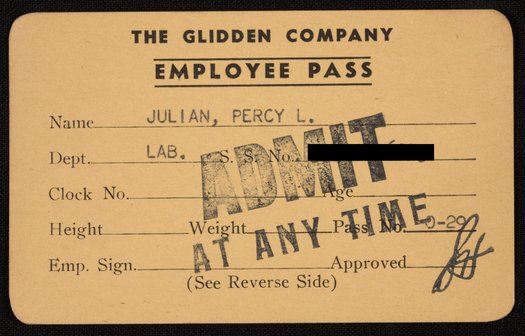
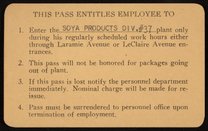
Percy Julian's Glidden Employee Pass
- Undated
Rights
 Unknown Rightsholder
Download all 2 images
PDFZIPof full-sized JPGsDownload selected image
Small JPG1200 x 768px — 181 KBLarge JPG2880 x 1843px — 961 KBFull-sized JPG3250 x 2080px — 1.2 MBOriginal fileTIFF — 3250 x 2080px — 12.6 MBEmployee pass issued by Glidden Company to Percy Lavon Julian (1899-1975), granting him access to the Soya Products Division #37.
Julian joined the Glidden Company in 1936, where he supervised the assembly plant. In 1940, he began researching the synthesis of steroids from soybean oil, work that contributed to his pioneering research in cortisone, sex hormones, soybean proteins, and firefighting foam. He remained at Glidden until 1953. Over the course of his career, Julian received more than 130 chemical patents and, in 1973, became the second African American elected to the National Academy of Sciences, following David Blackwell (1919–2010).
Julian's Social Security number has been censored for privacy purposes.
| Property | Value |
|---|---|
| Creator of work | |
| Place of creation | |
| Format | |
| Genre | |
| Extent |
|
| Language | |
| Subject | |
| Rights | In Copyright - Rights-holder(s) Unlocatable or Unidentifiable |
| Credit line |
|
Institutional location
| Department | |
|---|---|
| Collection |
Related Items
Cite as
Glidden Company. “Percy Julian's Glidden Employee Pass,” n.d. Percy Lavon Julian Papers. Science History Institute. Philadelphia. https://digital.sciencehistory.org/works/oiwpy0z.
This citation is automatically generated and may contain errors.

Rights
Unknown Rightsholder