
Reflections by an Eminent Chemist: William O. Baker (draft), Part 1
- 1988

These captions and transcript were generated by a computer and may contain errors. If there are significant errors that should be corrected, please let us know by emailing digital@sciencehistory.org.
Transcript
00:00:00 ♪♪
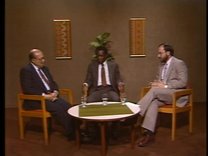
00:00:42 Hello, my name is Jeffrey Sturchio.
00:00:44 I'm here today in Murray Hill with Dr. William O. Baker,
00:00:47 Chairman Emeritus of AT&T Bell Laboratories,
00:00:50 for an interview in the American Chemical Society's
00:00:53 Eminent Chemists videotape series.
00:00:55 Dr. Baker has had a distinguished career
00:00:58 as a research chemist, as a manager of one of the world's
00:01:01 leading industrial research laboratories,
00:01:04 and as a science policy advisor in Washington.
00:01:07 Recently, he has also been active in the movement
00:01:09 to improve the quality of science education in America.
00:01:12 His many awards include the Priestly Medal
00:01:15 of the American Chemical Society,
00:01:17 the Parsons Award and Gibbs Medals
00:01:19 of the American Chemical Society,
00:01:21 and the Perkin Medal, which he received in 1963.
00:01:27 Dr. Baker, I know you were born in Chestertown, Maryland in 1915.
00:01:31 I wonder if you would tell us a little about your family
00:01:33 and childhood on the eastern shore of Maryland.
00:01:36 Well, Jeff, my family came from New York
00:01:40 and settled on the eastern shore,
00:01:43 attracted by its terrain and climate,
00:01:46 and proceeded to pursue the kind of plantation programs
00:01:51 that had been done there for a couple of hundred years.
00:01:57 Thus we early saw that the growing of crops and of animals
00:02:03 was subject to all kinds of natural distortions,
00:02:08 and that the application of technology in those fields
00:02:12 was very modest indeed.
00:02:15 My parents were not specialists in any of these matters,
00:02:19 but were interested in what kind of technical improvement
00:02:25 one might make in the growing of crops and animals.
00:02:30 So that is where I got some early interest
00:02:36 in how to relate the behavior of molecules and atoms
00:02:41 to the essentially colonial economy of those days.
00:02:50 And your mother had a particular area of expertise, didn't she?
00:02:55 Yes, she got very intrigued about the growing of poultry,
00:03:01 which clearly was an important economic
00:03:05 and even cultural pursuit in that region.
00:03:11 The climate and terrain were relatively favorable,
00:03:19 as these matters were done in those days.
00:03:23 It was already a beginning of the artificial cultivation,
00:03:29 or I should probably say raising of poultry,
00:03:36 away from their natural brooding
00:03:41 and its purely natural process of growth.
00:03:49 And she got going on incubation,
00:03:55 which had already become fairly well pursued there,
00:03:59 and on the isolated growth of fairly large colonies
00:04:06 of young chickens and turkeys.
00:04:10 She got very interested also in the improvement
00:04:14 of the quality of the mature birds.
00:04:22 There were programs beginning at the University of Maryland
00:04:26 across the bay which related to selective breeding
00:04:30 and nutrition to improve this quality.
00:04:36 I remember you told me that she had had contact
00:04:39 with scientists from Merck at one point.
00:04:42 The turkeys were highly vulnerable to a disease
00:04:50 known colloquially as blackhead.
00:04:53 It apparently had some parasitic carrier origins,
00:04:57 but it was mysterious and was transmitted rapidly
00:05:02 and fatally to large colonies of turkeys,
00:05:08 so that nobody had been able to raise
00:05:11 a large number of those birds to maturity
00:05:16 without very heavy losses.
00:05:19 She got interested in research which was being done
00:05:23 in several universities on the possible causes
00:05:30 of this particular scourge.
00:05:35 And to make, to truncate the study and the efforts,
00:05:40 it turned out that Professor Ernest Edward Tizer
00:05:43 of the Harvard Medical School had discovered
00:05:46 a fascinating cycle in which this very deadly infection
00:05:53 was transmitted through soil elements,
00:05:57 through probably certain kinds of insect parasites
00:06:02 that lived in the soils on which turkeys were raised.
00:06:09 That was your first encounter with experimental science in a way.
00:06:13 Yes, that is so, in a very intriguing chemical form
00:06:18 because these colloids had to be managed
00:06:21 so that their toxicity was minimized,
00:06:24 and yet their reactivity for the invading organism
00:06:28 was maximized.
00:06:30 And Merck did some very interesting work on that
00:06:33 in connection with the Harvard Medical School people.
00:06:37 Could you tell us a little bit about the other influences
00:06:40 that led you toward a decision to have a career in science?
00:06:45 Well, in addition to this regime,
00:06:49 my father had a long-standing interest in mineralogy
00:06:53 in a rather practical way.
00:06:55 He had been interested in certain sources
00:06:58 of lead ores, tin ores,
00:07:01 and some of these things were around the house
00:07:06 and I learned something with a primitive blowtorch
00:07:14 and flames of how to characterize minerals
00:07:20 and accelerate some of their reactions.
00:07:23 How about at Washington College where you studied?
00:07:26 That was altogether sympathetic.
00:07:28 We had two of these interests.
00:07:30 We had a very keen chairman of the chemistry department
00:07:33 named Dr. Kenneth Buxton,
00:07:36 a very good physicist named Dr. Jesse Koop,
00:07:40 and they and their junior faculty
00:07:44 pursued these interests very strongly.
00:07:47 They were very small classes
00:07:49 with lots of individual work and attention.
00:07:52 So when you graduated from Washington College,
00:07:54 was it clear to you that you wanted to become a scientist?
00:07:57 Yes, I had a very strong commitment at that time
00:08:02 and Buxton in particular recognized these interests
00:08:08 and cultivated a whole group of us going that way.
00:08:15 We had several of my closest friends
00:08:19 who went to graduate school one place or another
00:08:23 and it was rather symptomatic of the tradition
00:08:27 that has lasted up to fairly recently
00:08:29 that a major element of American chemistry,
00:08:32 of American research and professionalism
00:08:36 came from small colleges
00:08:39 and went on to universities for further study.
00:08:43 Why do you think that is?
00:08:45 I think this exposure to the technology
00:08:50 of what was then a somewhat agriculturally oriented,
00:08:55 rural-oriented country was a part of it.
00:08:59 I think that you encounter natural phenomena
00:09:07 very strongly that way,
00:09:09 much more than in a more sophisticated urban milieu,
00:09:15 and I think a great many of the small college students
00:09:20 came through that route.
00:09:22 It's true in the Midwest, for example,
00:09:24 where a great distinction in chemistry
00:09:27 has come over these years from people in the rural sections.
00:09:33 And you decided to go to Princeton at that time.
00:09:36 This was 1935.
00:09:38 Yes, indeed so.
00:09:40 We thought very hard about the places
00:09:43 that were doing exciting new things.
00:09:47 There were several.
00:09:49 We considered the obvious ones of Berkeley and Pasadena
00:09:54 and Cambridge, Massachusetts,
00:09:56 and Providence, Rhode Island,
00:09:58 and various other spots.
00:10:02 Buxton was, of course, an active advisor in this,
00:10:06 and Dr. Buxton was much intrigued
00:10:10 in a kind of predestined way, I guess,
00:10:15 to how our interests eventually developed.
00:10:17 He was much intrigued by the enthusiasm
00:10:20 that Professor Hugh Taylor, Sir Hugh Stott Taylor,
00:10:24 was showing in the nature of solid state catalysts
00:10:31 and the reaction of the influence of chemistry
00:10:35 and of traditional chemical reactions with solids.
00:10:40 This wasn't a definitive issue at that point,
00:10:44 but it was one of many factors
00:10:47 which turned us toward Princeton.
00:10:51 These were years when Princeton's chemistry department
00:10:54 was really one of the world's centers for physical chemistry,
00:10:57 so it must have been a very exciting place
00:11:00 to study physical chemistry and related areas.
00:11:04 Taylor, of course, was chairman,
00:11:06 and on the faculty were Henry Eyring and Charles Smyth,
00:11:09 who you later did your Ph.D. with.
00:11:11 Could you tell us about the intellectual atmosphere?
00:11:14 Indeed, Jeff.
00:11:16 As your own knowledge and experience attest,
00:11:20 the group gathered there at that point,
00:11:25 leading to the later times that you know so well,
00:11:29 was a very remarkable combination.
00:11:33 Eyring had been persuaded to come by Taylor
00:11:38 at a time when quantum mechanics
00:11:40 was barely impacting chemical theory and practice,
00:11:47 although Professor Pauling and Professor Bright-Wilson
00:11:51 had recognized the enormous implications and opportunities.
00:11:55 At the same time,
00:11:57 Professor Smyth had seen in the work of Debye
00:12:03 and others in the very active German colony of physics
00:12:10 a powerful implication for chemistry
00:12:15 on the side of structure and charge distribution,
00:12:19 which of course is very vital to all the kinetics
00:12:23 and the structural work which was going on there.
00:12:26 Furman was an already distinguished analytical chemist
00:12:32 and, however, recognized that the future of analytical chemistry
00:12:37 depended on instrumentation
00:12:39 and the applications of physical chemistry
00:12:42 in a host of exciting ways.
00:12:44 Well, this is all just a very brief sampling
00:12:47 of how exciting it was to be there.
00:12:50 And Pacheu's work on carbohydrates and organic systems,
00:12:55 Wallace's on molecular rearrangements,
00:12:59 the whole realm of Dougherty's work
00:13:03 on highly odoriferous sulfur compounds
00:13:06 was all stimulating, exciting,
00:13:10 so that a naive chemist like myself
00:13:14 recognized the great range of the subject
00:13:17 that was shaping up there.
00:13:19 You dug right into some work with Dr. Smyth at that time.
00:13:23 Quite early.
00:13:24 Quite early.
00:13:25 I needed, of course, to study a good deal
00:13:28 of the new frontiers that were coming on,
00:13:32 particularly with Eyring and his affiliates in theory,
00:13:40 statistical mechanics,
00:13:42 and Fowler was a member of the visitors
00:13:48 in the graduate college.
00:13:50 He was a visitor, of course, to physics,
00:13:53 and was perhaps the world from Cambridge University,
00:13:57 leading interpreter of quantum statistics
00:14:03 and significance for structure of solids, among other things,
00:14:07 and for the implications for chemistry.
00:14:12 We worked our way through his monumental tome.
00:14:18 We had all sorts of exchanges with the physics department,
00:14:23 all stimulated by Eyring and his colleagues.
00:14:30 It occurs to me that one problem students face
00:14:34 in learning quantum mechanics and statistical mechanics
00:14:37 is that the mathematics required is quite a leap, usually,
00:14:40 from what they've often encountered.
00:14:43 Did your earlier experience really prepare you for that,
00:14:46 or did you find you really needed to work hard at it?
00:14:49 No, I had to work hard at it.
00:14:52 Again, the environment was exceedingly conducive.
00:14:56 The dean of the graduate school was Dr. Luther Eisenhardt,
00:15:00 a world-famous scholar in mathematics in topology,
00:15:04 but Eisenhardt had taken a great interest
00:15:07 in the undergraduate curriculum in mathematics at Princeton.
00:15:11 Of course, in the advanced work,
00:15:15 he was already a world leader,
00:15:18 and Einstein and his associates were strong adherents
00:15:23 to mathematics at Princeton, von Neumann,
00:15:28 a whole group of others that have been well-identified over the years.
00:15:35 Now, what Eisenhardt did was to organize a pedagogy
00:15:39 of relatively elementary calculus
00:15:46 and other analytic algebra and algebraic geometry
00:15:54 and other fields at the time
00:15:57 so that students greatly in need of help
00:16:02 could get it through participation
00:16:05 in the Princeton undergraduate mathematics regime,
00:16:09 which indeed we did.
00:16:12 We exercised various habits to try to bring ourselves up to speed.
00:16:18 One of my colleagues, a very long-time friend
00:16:21 who's still in good fettle,
00:16:26 retired a couple of years ago from the EPA laboratories,
00:16:31 Dr. John Smith,
00:16:33 and I undertook a calculation from first principles
00:16:36 of the expected dipole of HCl.
00:16:39 Now, by that time, people who were really good at it
00:16:42 had undoubtedly done half a dozen detailed estimates,
00:16:46 but for us it was a kind of heroic exercise
00:16:51 which we got help from our senior associates
00:16:55 among the students at Princeton
00:16:58 and with help from the professors, of course.
00:17:01 It was really a sort of large part-of-a-year exercise
00:17:06 in how quantum mechanics might work.
00:17:10 It also led us, of course,
00:17:13 to an interest in dipole moments broadly
00:17:16 and dielectric properties.
00:17:18 Could you talk a little bit more about that,
00:17:20 since that was the kind of work that you did your Ph.D. on?
00:17:23 Yes.
00:17:25 We benefited a lot from the scope and enthusiasm
00:17:28 of the chemistry faculty that I've referred to,
00:17:31 and the question was what could one do
00:17:35 that was in any way worthy of that freshness
00:17:40 and vigor of foresight.
00:17:43 We had a deep interest in structure and behavior
00:17:48 of systems of chemistry,
00:17:52 and indeed Professor Fuhrman and Professor Cayley
00:17:57 were sympathetic about whether this should take the form
00:18:02 of some relatively detailed analytic effort
00:18:09 using what perhaps at the time
00:18:12 were rather exciting techniques of spectroscopy,
00:18:16 electrochemistry, polarography, the like.
00:18:20 We did a little exercise,
00:18:25 which largely supervised by Professor Cayley,
00:18:29 on a somewhat modest,
00:18:33 less elegant view of analytic chemistry,
00:18:39 but we learned through that great respect and enthusiasm
00:18:43 for quantitative methods that had to be refined
00:18:49 and really brought out the importance
00:18:52 of knowing what structures you were dealing with in chemistry
00:18:56 before you did other studies of them.
00:18:59 The thing that we concentrated on
00:19:01 were the triple uranyl salts of lithium,
00:19:04 lithium at that point being a rather renegade element
00:19:08 for analysis,
00:19:11 and the amusing feature of this was
00:19:15 that people were already beginning to get a little interested
00:19:20 in the transuranium elements,
00:19:23 and the reactions that we studied were, as I said,
00:19:28 simply uranyl acetates, uranium oxide derivatives,
00:19:33 but we had a strong early feeling
00:19:39 that the frontiers in that case of transuranium elements
00:19:45 were going to be much aided in understanding
00:19:51 by very specific analytic work,
00:19:55 and while, as I say, our work, which was published during that time,
00:20:01 had to concentrate on lithium ions,
00:20:04 we began to understand some of the complexities
00:20:07 of very big ion structures such as these uranyl salts.
00:20:13 Well, this, however, also indicated
00:20:16 that there were really exciting possibilities in solid state
00:20:21 because the kind of separations one does there, of course,
00:20:25 depend on some kind of precipitate,
00:20:28 some kind of solid or gel or structure
00:20:31 usually very poorly characterized,
00:20:34 and the whole notion that,
00:20:37 along with the high selectivity of these uranyl salts,
00:20:42 you would have in solid state
00:20:45 a multiplying factor of chemical properties.
00:20:48 You'd have a huge domain of atoms or ions or molecules
00:20:55 which required a certain individuality or specificity
00:20:59 for any other chemical ingredient in the system,
00:21:03 and this interested us quite a lot.
00:21:06 Of course, your interest in the solid state in chemistry
00:21:09 was a little bit unusual at that time
00:21:12 since most people think of the late 30s
00:21:14 as a time when solid state physics really got underway,
00:21:17 and I know that there was a lot of interest in that
00:21:20 in the physics department at Princeton
00:21:22 and also among your colleagues in the graduate college at Princeton.
00:21:26 Yes, you're quite right.
00:21:28 I spoke of the chemistry elements that you had to deal with
00:21:33 in characterizing particular ions or atoms
00:21:36 as turning toward solids,
00:21:39 but equally important and reinforcing that
00:21:43 was the extraordinary activity in physics
00:21:48 which had been very effective
00:21:52 and wide-ranging in particle physics before
00:21:57 and in the physics of electrons from surfaces
00:22:03 such as the work of Richardson and the work of Compton
00:22:08 who had been there for a great many years
00:22:12 in electron impacts and all the like.
00:22:16 This rather dramatically got augmented
00:22:23 by the interest of Professor Wigner
00:22:26 of a group that had come from Hungary,
00:22:29 von Neumann being another teller and others,
00:22:32 in the application of quantum mechanics
00:22:36 to very large aggregates of atoms.
00:22:41 Now, the quantum statistics had indicated
00:22:43 that you should be able to deal with large populations,
00:22:46 but the notion of crystals being accessible in this scheme
00:22:51 was a very startling one
00:22:54 that Professor Wigner had been interested in for some time.
00:22:59 He enlisted the interest of Frederick Seitz,
00:23:04 a senior graduate student
00:23:07 who I've later come to know and admire greatly,
00:23:11 and now a professor at Stanford,
00:23:16 Conyers Herring,
00:23:18 who was a graduate student of my own group
00:23:22 and a number of others.
00:23:24 But they, those two in particular,
00:23:27 were finding remarkable insights
00:23:32 into solid lithium,
00:23:35 into the alkali halides
00:23:39 and a few other crystal structures
00:23:42 by quantum mechanical interpretation and analysis.
00:23:48 And this impacted pretty strongly
00:23:52 on these more chemically-based ideas
00:23:55 that I reported about the interest in solids,
00:23:58 and it carried me in.
00:24:03 What sort of informal mechanisms were there
00:24:06 for exchanging information like that
00:24:08 among the graduate students?
00:24:10 Well, they were many and decisive.
00:24:14 The community of the graduate college at Princeton
00:24:17 that Dean West had envisioned and realized
00:24:22 in a special location,
00:24:24 in a college where the residence
00:24:27 was focused around scholarly interests,
00:24:30 but that there were a great variety of people there,
00:24:34 a great variety of subjects being pursued,
00:24:37 that led us to talk about our interests and enthusiasms
00:24:43 among the students,
00:24:45 with interesting visiting scholar
00:24:48 and professor participation at times.
00:24:51 And in that respect,
00:24:54 we had a good occasion
00:24:59 to see what the opportunities
00:25:04 for interdisciplinary cross-field work might be like.
00:25:10 You also mentioned there were visiting scholars
00:25:13 from time to time,
00:25:14 and I believe that among those who visited
00:25:16 was Niels Bohr.
00:25:17 Did you have much contact with him in those years?
00:25:20 This train of luminaries
00:25:22 who frequently lived at or near the graduate college
00:25:26 and other times came out for evenings
00:25:30 and for discussions
00:25:32 was of profound impact.
00:25:35 I mentioned Professor Fowler.
00:25:38 There was Professor Hardy, also from Cambridge,
00:25:41 a great mathematician.
00:25:43 There was a great range of these folks,
00:25:45 including people from many fields besides science.
00:25:50 But it happened that Professor Bohr was there
00:25:56 when he got cable from Germany
00:26:00 describing the fission of the uranium nucleus,
00:26:05 and typical of the way these visitors reacted
00:26:09 and participated in our work
00:26:11 was that he called a seminar immediately that afternoon,
00:26:14 and it was an exciting time
00:26:18 because Bohr, who spoke rather softly often,
00:26:23 was properly equipped with a microphone of those days
00:26:26 that had a long cord.
00:26:29 We didn't have the transistorized systems yet,
00:26:34 so it remained for solid-state science to come up with that.
00:26:37 And Bohr was thinking so fast and so hard
00:26:41 about what this startling finding
00:26:44 about the fission into large nuclei
00:26:46 rather than just a particle emanation of uranium
00:26:49 could mean that he was inventing new theories as he went along,
00:26:53 and he would write something on the board
00:26:55 and turn around and then go back to another place,
00:26:58 and he was getting himself tangled in the cord
00:27:01 so that we feared for his survival.
00:27:03 He would also get another idea
00:27:09 in the middle of the prior one,
00:27:11 and he would stop in the middle of the sentence
00:27:13 and start off on a new theory.
00:27:15 So you see that the most insightful responses
00:27:22 to uranium fission on this side of the Atlantic
00:27:26 were exceedingly lively,
00:27:31 and of course forwarded by the most expert European theorists
00:27:40 and visionaries about what atomic structure was like.
00:27:48 You talked a little bit about the research you did for your Ph.D.,
00:27:51 and it was in 1938 that you did receive your Ph.D. from Princeton,
00:27:55 and you stayed for a year as Proctor Fellow, I believe,
00:27:59 to continue your research.
00:28:02 It was in the middle of 1939 that you decided to come to Bell Labs.
00:28:07 Could you tell us about how that came about,
00:28:10 what the contacts were between Princeton and Bell Labs?
00:28:13 Well, those are fond recollections as well.
00:28:15 They come right out of the milieu that you have already outlined, Jeff,
00:28:21 in that Princeton, of course,
00:28:25 was moving steadily into modern quantum and statistical mechanics
00:28:31 in a theoretical base.
00:28:33 It was moving into these new fields of physical chemistry.
00:28:37 The particular excitement about solids was growing,
00:28:44 and the work that we had done with Professor Charles Smyth
00:28:48 on the dielectric properties of organic crystals
00:28:52 was exceedingly stimulating and attractive to us,
00:29:02 not in the ordinary sense of perhaps loyalty to one's thesis subject,
00:29:07 which is characteristic in every graduate work,
00:29:11 but in the sense that it should be expandable to other fields.
00:29:18 Now, I had already long had a deep interest in application of science,
00:29:25 in the derivatives of technology that had a scientific base
00:29:31 and that one could then conversely expand the technology by knowing science.
00:29:36 That we tried to refer to in your early queries
00:29:39 to our first interests in science and technology in our rural milieu.
00:29:47 The bare outlines were known to us from other friends and connections.
00:29:57 A man named Paco, for example,
00:29:59 who was the descendant of the sign of the Declaration of Independence,
00:30:04 had become a telephone person himself
00:30:07 in one of the independent telephone companies.
00:30:09 Through him and his family, for instance,
00:30:12 we got very interested in the remarkable role of science in telephony
00:30:20 and science and technology.
00:30:22 That here was an industry in the application of science
00:30:25 which was almost totally dependent on scientific and technical creativity
00:30:33 and knowledge rather than being dependent on,
00:30:38 as most chemical industry was at that time,
00:30:42 a raw material, a natural material.
00:30:44 As interesting as that was, it was true nevertheless
00:30:47 that the chemical industry and the metals industry
00:30:51 and to a large degree the pharmaceutical industry
00:30:54 and many others were dependent fundamentally
00:30:56 on some kind of natural substance,
00:30:59 even as complicated a thing as cellulose,
00:31:02 or a mineral, or whatever else.
00:31:06 But we were struck by the property
00:31:10 that telephony and telecommunications
00:31:13 were almost solely creation of the brain,
00:31:19 of the ingenuity of people's minds,
00:31:23 and it seemed like an interesting challenge
00:31:29 to see whether modern chemistry could get further into that field.
00:31:36 Now, we were already struck, well informed in fact,
00:31:42 in the university at Princeton
00:31:45 by the communications of the telephone,
00:31:51 of the bell system, of the bell laboratories
00:31:54 with the whole scientific domain,
00:31:56 but particularly that of chemistry.
00:31:58 And Burns, who was assistant director of the chemical laboratory,
00:32:02 was a Princeton alumnus
00:32:04 and had great enthusiasm for the modern physical chemistry
00:32:11 related to what telephony was already doing,
00:32:15 which had a large electrochemical component,
00:32:18 it had large structural,
00:32:21 in the case of mechanical structures,
00:32:24 a component of what we now would call materials,
00:32:27 science and engineering.
00:32:29 And those factors, with the policy of the AT&T Bell Laboratories
00:32:35 to report its findings to the university world,
00:32:41 all combined to make a lot of interest in Bell Labs.
00:32:44 Among other things, the Bell Laboratories record
00:32:47 had a very large impact.
00:32:49 It was a major part of our graduate college journal system,
00:32:55 not the specific journals of a department,
00:32:58 which, as you remember, were widely occupied,
00:33:01 but here was an industry
00:33:03 which provided a credible scientific and technical publication
00:33:07 talking about its business
00:33:09 to the midst of a bunch of very critical,
00:33:13 rather offish graduate students
00:33:18 who felt that industry was something you might get around to
00:33:21 in about 100 years if you didn't have anything else to do.
00:33:25 But here was a journal that really spoke about what was going on.
00:33:31 So that had a strong influence.
00:33:34 And so you found yourself in the summer of 1939
00:33:38 working in a laboratory in Summit, New Jersey,
00:33:41 on high polymers in a program that was directed by Calvin Fuller.
00:33:46 What sort of equipment did you have in the Summit labs?
00:33:49 Well, we had a range
00:33:53 going from very high vacuum,
00:33:58 carefully controlled atmosphere,
00:34:00 controlled temperature, autoclave reactions,
00:34:05 for reaction equipment, that is,
00:34:11 to what was then quite new X-ray diffraction
00:34:15 and scattering equipment,
00:34:20 to very elegant dielectric measuring equipment,
00:34:27 some of it Jaeger at very high frequencies.
00:34:31 This, of course, was a delightful, smooth transition
00:34:36 from the Princeton work
00:34:38 where some of the bridges and other circuits
00:34:41 that I had used in Doc Smythe's laboratories
00:34:44 were designed by Bell Laboratories people
00:34:48 who were exceedingly active.
00:34:52 And we got the very latest of their outputs
00:34:58 in the Summit Bell Laboratories,
00:35:00 which is, as I said before, done by Morgan and Jaeger primarily,
00:35:03 but I had access to that.
00:35:06 Talk a little about some of the projects that you worked on
00:35:08 when you first got there.
00:35:10 We had become very interested
00:35:13 in the relations of solid-state science
00:35:17 and solid-state chemistry
00:35:19 to technology of a variety of matter.
00:35:25 And the matter that seemed particularly appealing then,
00:35:30 as Fuller had identified, was polymers.
00:35:34 We in the Bell Laboratories
00:35:37 had already depended on somewhat modified natural polymers
00:35:42 for an absolutely vital part of our circuitry
00:35:45 and our equipping of the beginnings
00:35:50 of the telecommunications and information age.
00:35:53 Now, these were generally things from cellulose,
00:35:57 some of them very elegantly purified dielectric films
00:36:01 for condensers, some of them pulp.
00:36:04 Cellulose is an insulator,
00:36:06 which we couldn't have built the telephone system without.
00:36:09 Some of them forms of rubber for cables
00:36:14 and modified rubber and gutter percha
00:36:18 for very special high-frequency,
00:36:22 what in those days were high-frequency dielectrics.
00:36:25 The beginnings of synthetic enamels
00:36:29 for magnet wires in the whole switching domain,
00:36:34 which was, incidentally,
00:36:36 the origin of modern digital computers.
00:36:39 These things depended on very thin layers
00:36:43 of insulation in very fine wires,
00:36:46 which were really a challenge
00:36:48 to the chemistry and materials technology of the time.
00:36:51 And then, in the midst of all this,
00:36:54 we were enormously excited
00:36:56 by Carruthers' discovery of condensation polymers.
00:36:59 Because, as you know from your own very incisive records
00:37:04 of how polymer science and chemistry started,
00:37:08 there was, at that point, still a very active debate
00:37:11 as to whether polymers were molecules or aggregates.
00:37:14 Here was Carruthers producing molecules of high polymers
00:37:19 that were clearly molecules.
00:37:21 There wasn't any question about it.
00:37:23 And so we felt immediately
00:37:26 that there should be applications for those
00:37:30 in addition to the elegant work
00:37:34 that DuPont undertook with Julian Hill's leadership,
00:37:39 Julian being one of your adherents in the CHOC,
00:37:44 and enjoying it, I may say.
00:37:47 He was there the other day.
00:37:49 To make fibers, to make nylon,
00:37:52 which they undertook to do,
00:37:54 we said there's got to be a lot of application
00:37:57 of these Carruthers polymers in addition to that.
00:38:02 Well, Jaeger and I and others,
00:38:06 I had studied ester-dipole linkages at Princeton
00:38:10 with Professor Smyth, the stearates, palmitates.
00:38:14 We knew that there were certain properties there.
00:38:18 More interesting as insulating matter,
00:38:21 which the whole telephone system has to depend,
00:38:24 you have to isolate circuits by insulators,
00:38:27 we knew that there were properties there
00:38:30 which none of the existing polymers showed,
00:38:33 dielectric qualities.
00:38:35 And they were very different
00:38:37 than the properties which the nylons were showing.
00:38:40 On the other hand, the nylons,
00:38:42 when applied in very thin films
00:38:45 because of the strength that Carruthers had already identified
00:38:49 and modified by a little oxidation
00:38:52 and by some other chemical changes,
00:38:54 gave this very, very thin insulating layer
00:38:57 that I was talking about for magnet wires
00:39:00 in the most attractive form,
00:39:02 which permit very important efficiency
00:39:07 and compaction of major parts of telephony.
00:39:14 So we took off in those directions.
00:39:17 Now, we began to make polyamides and polyesters
00:39:23 by different methods than Carruthers had reported,
00:39:27 some of them by interchange methods.
00:39:29 We were influenced by Flory's discoveries
00:39:32 of what the molecular weight distributions
00:39:35 and the kinetics were in polyesters.
00:39:38 He had already found at DuPont
00:39:41 that there was a much wider range of opportunity there
00:39:45 than anybody had imagined.
00:39:48 So we undertook...
00:39:50 One of the first things that I synthesized
00:39:53 was polyomegahydroxy acids,
00:39:58 polyundecanoate,
00:40:01 which gave you a very much controlled ester-polar linkage,
00:40:08 a long hydrocarbon portion,
00:40:10 which we knew was the most inert
00:40:13 and high-quality dielectric that could be found.
00:40:16 We knew that portion was.
00:40:18 We didn't have polyethylene yet,
00:40:20 but we were about to be given some
00:40:25 from the British discoverers,
00:40:27 and we were about to put it in
00:40:29 as a dielectric in the Baltimore to Washington cable.
00:40:32 So here we were beginning to synthesize polymers
00:40:35 that had segments of polyethylene,
00:40:38 they had segments of polar linkages,
00:40:41 which we wanted to understand.
00:40:43 By the way, those ester linkages, of course,
00:40:45 were prevalent in the set of those esters,
00:40:47 which we were beginning to use
00:40:49 and whose dielectric properties we had to understand.
00:40:52 So we took off on those bases
00:40:55 and made a lot of new polymers.
00:40:58 We modified the polyamides.
00:41:01 In dipolar terms,
00:41:04 we replaced the H of the amide linkage
00:41:09 with methyl groups
00:41:11 that Biggs and his associates
00:41:14 very ingeniously created.
00:41:17 We are told, I guess,
00:41:19 that these were the first
00:41:22 of the substituted polyamides,
00:41:25 methyl primarily.
00:41:27 They had very interesting properties.
00:41:29 We began to make copolyamides out of those,
00:41:32 and again, we expanded the opportunities
00:41:36 for dielectrics and for structural materials
00:41:39 in the telephone business.
00:41:41 The phone system, even then,
00:41:44 was accounting for about 7%
00:41:48 of the total national investment
00:41:50 in capital material.
00:41:53 That is, that includes the whole national investment
00:41:56 in factories, in products, in housing,
00:41:59 in everything that went into
00:42:01 the gross national product at that time.
00:42:03 The growing telephone, the Bell system, the AT&T,
00:42:07 was providing about 7% of that,
00:42:09 which was a very large element
00:42:12 in materials usage,
00:42:14 which, as we said, involved primarily
00:42:17 metals, copper, many ferrous alloys
00:42:20 and growing amounts of aluminum,
00:42:22 but very significant amounts
00:42:24 of organic material,
00:42:27 mostly of natural origin.
00:42:29 We began to see opportunities
00:42:32 for displacing major parts
00:42:35 of that tonnage of matter
00:42:37 with these synthetic substances.
00:42:40 It turned out 15 years after that,
00:42:44 of course, through the war,
00:42:47 that the volume of material
00:42:52 that comprised the telephone system
00:42:55 at that time was dominantly organic,
00:42:58 dominantly polymeric.
00:43:01 This graph shows that
00:43:04 the weight of matter
00:43:08 was metals, remained metals for some time.
00:43:12 The volume of matter was
00:43:16 dominantly polymers,
00:43:19 mostly polyethylene as it emerged.
00:43:22 But the basic understanding
00:43:24 of how you could control the properties
00:43:28 came from this early work in synthesis.
00:43:31 We could measure very accurately chemically,
00:43:34 and we did, how many carbonyl groups,
00:43:37 for example, per cc you had.
00:43:40 The carbonyl groups were
00:43:43 entrance into polyethylene accidentally.
00:43:46 They were things that happened in synthesis.
00:43:49 They also happened rather dramatically in use,
00:43:53 partly due to processing,
00:43:55 partly due to exposure.
00:43:57 We had to control that and know
00:44:00 what the dielectric effects were
00:44:03 and what the hydrophilic effects were
00:44:06 and the whole range of mechanical properties.
00:44:09 The synthesis of those initial structures
00:44:12 gave us the first grasp on that.
00:44:15 In a way, the fabric in generic terms
00:44:19 of information age,
00:44:22 because this applies to computers
00:44:25 and all kinds of other electronic machinery
00:44:28 and equipment,
00:44:30 was strongly influenced by the chemistry
00:44:33 of polymers in those very early pre-war years.
00:44:37 So here was a case where applied work
00:44:40 in an industrial laboratory
00:44:42 was really at the cutting edge
00:44:44 of the development of macromolecular science.
00:44:47 Well, it seems so.
00:44:49 It seems that's the way it's turned out.
00:44:52 It was influenced by the industrial
00:44:55 and functional interests we had.
00:44:58 The Bell Laboratories was an extraordinary place for it
00:45:02 because the Bell Laboratories
00:45:04 in a separate corporation
00:45:06 had responsibility for all the science
00:45:09 and technology of the whole Bell system,
00:45:12 of the whole telecommunications domain.
00:45:15 We felt we had better be at the cutting edge.
00:45:18 We had better be assuring the telephone user
00:45:21 the telephone subscriber
00:45:23 of the very latest that was known
00:45:26 in scientific and technical fields.
00:45:29 Well, this had come from theoretical work,
00:45:32 mathematical work of George Campbell
00:45:35 in the laboratories much earlier in the century.
00:45:38 It had come from the circuit work
00:45:40 of Corson and others.
00:45:42 It had come from the beginnings
00:45:44 of the computer age
00:45:46 by Stibitz's discovery of digital machines.
00:45:49 It had better come from the chemical era as well.
00:45:54 Were you bringing in academic consultants
00:45:57 in this work around that time?
00:45:59 At first, there were very, very few.
00:46:02 There was a history of detachment
00:46:05 from consultants of any kind in the laboratories,
00:46:09 partially due to the fact that
00:46:11 while there was great respect for the academic realm,
00:46:14 the laboratories had had to struggle
00:46:17 to become identified,
00:46:19 to become situated as the independent source
00:46:23 for the rest of the telephone system.
00:46:26 And so they didn't go for consultants very much.
00:46:30 We worried about this,
00:46:32 and we began to agitate
00:46:34 for an opening, for a change.
00:46:39 So when we heard that Professor Debye,
00:46:42 who was perhaps the most active pioneer
00:46:46 in dielectrics since Faraday,
00:46:49 was coming to this country,
00:46:51 we'd already had, of course,
00:46:53 many indirect affiliations with him through Smythe,
00:46:57 we very warmly welcomed the opportunity
00:47:01 to persuade him to be a very large part of his time,
00:47:06 like a half, with us
00:47:08 in conjunction with his appointment at Cornell.
| Property | Value |
|---|---|
| Creator of work | |
| Format | |
| Genre | |
| Medium | |
| Extent |
|
| Language | |
| Subject | |
| Rights | In Copyright |
| Rights holder |
|
| Credit line |
|
Institutional location
| Department | |
|---|---|
| Collection |
Related Items


Cite as
American Chemical Society. “Reflections by an Eminent Chemist: William O. Baker (Draft), Part 1.” U-matic (tm), 1988. American Chemical Society Audiovisual Collection. Science History Institute. Philadelphia. https://digital.sciencehistory.org/works/jq0qcop.
This citation is automatically generated and may contain errors.