
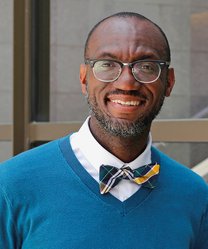
Oral history interview with André K. Isaacs
- 2023-Dec-11
- 2023-Dec-19
- 2023-Dec-21
Oral history interview with André K. Isaacs
- 2023-Dec-11
- 2023-Dec-19
- 2023-Dec-21


 This work is licensed under a Creative Commons Attribution-NonCommercial-NoDerivatives 4.0 International License.
André K. Isaacs was born in Kingston, Jamaica in 1981. He grew up in Arnett Gardens, which he describes as being a tough place to live due to the prevalence of crime. However, there was a lot of love and support around him as a child, and he had fun playing games like dandy shandy and cricket. Isaacs enjoyed grade school and thought he would become a mathematician because he excelled at math. After scoring well on the Common Entrance Examination, he was admitted into Saint George’s College for high school. Isaacs moved out of his grandmother’s home and moved with his mother and sister to the Portmore area, resulting in a long commute to high school. Isaacs was very involved in student activities and leadership at his high school, and he even gained teaching experience as a prefect. Isaacs’s choir director had a big influence on him and served as a source of support. Isaacs chose the sciences as his area of specialization in high school. After struggling with chemistry, he started attending his uncle’s evening school, which helped him learn the course content.
Isaacs planned to attend the University of the West Indies, but after his uncle’s death, he decided to apply to universities in the United States. Isaacs accepted an offer to attend College of the Holy Cross on a full scholarship. As he adapted to campus life, Isaacs found that he had to learn about American culture, procure new clothes, and adjust to the weather and food. Soon after beginning school at Holy Cross, the September 11 attacks occurred, leading to stricter regulations for international students. Isaacs got involved in a myriad of campus activities, including participating in singing groups and starting the Caribbean and African Students Assemblage (CASA). He also worked in the cafeteria and as a Resident Assistant (RA). During Isaacs’s second semester in college, he declared chemistry as his major. He played an active part in the chemistry department, taking on leadership roles and organizing events, and was in the chemistry honors program. He also began to do research in Kevin Quinn’s laboratory, working on the synthesis of Muricatacin and researching Rollicosin. Isaacs benefitted from the mentorship of Kevin Quinn as well as the mentorship of Ron Jarret, Isaacs’s organic chemistry professor. As an undergraduate student, Isaacs attended national conferences and received positive feedback about his research when he gave a poster presentation.
Isaacs decided to attend the University of Pennsylvania for graduate studies in chemistry. Over the summer before his program began, he worked in Marisa C. Kozlowski’s (1967-) lab. Then, after his initial graduate coursework, he joined Jeffrey D. Winkler’s laboratory in a collaborative agreement with Bill (William F.) DeGrado’s (1955-) lab. As Isaacs became aware of his identity as a queer person and came out, some of his friends and family responded negatively. This resulted in mental health struggles that took a toll on Isaacs and his graduate studies until he received support. Winkler encouraged Isaacs to go to San Francisco, California to conduct research at Genentech. There, Isaacs worked on novel compounds to inhibit the sonic hedgehog signaling pathway. After a positive experience at Genentech and in San Francisco, Isaacs returned to Penn. In the Winkler and DeGrado labs, Isaacs worked on arylamide foldamers and indole derivatives. Isaacs also worked on steroid-derived inhibitors of the hedgehog signaling pathway, mimicking cyclopamine. Isaacs enjoyed spending time with peers in both the DeGrado and Winkler labs. He worked as a TA during his graduate studies, managing labs and honing his teaching skills. Isaacs was the first member of his family to graduate with a PhD, so his graduation was a noteworthy occasion that family and friends attended, some coming in from Jamaica.
Isaacs accepted a postdoctoral fellowship in Richmond Sarpong’s (1974-) lab at the University of California, Berkeley. At Berkeley, Isaacs worked long hours on his research. Sarpong was a supportive advisor and Isaacs appreciated having the opportunity to work for another Black, immigrant chemist. Isaacs had a variety of projects during his postdoc. One of his projects, in collaboration with John E. Casida (1929-2018), was to work on a synthesis for insecticides. While living in Berkeley, Isaacs met his future husband, and they began dating. When Isaacs heard that College of the Holy Cross was hiring for a chemistry faculty member, he decided to apply. He was offered the position, and he took a road trip with his partner across the country to move to Massachusetts. Soon, he began setting up his lab and reflecting on how to manage the various facets of his position.
Isaacs primarily teaches organic chemistry courses. He strives to build connections between faculty and students, connect course material to students’ lived experiences, and incorporate digital media into his teaching. Isaacs’s research employs click chemistry to make nitrogen heterocycles. His lab is made up of undergraduate students, and Isaacs does regular check-ins with them to learn about their lives and learn how to best support them. He fosters a communal atmosphere in his lab, and the group participates in social events together.
Isaacs has applied computational methods to his chemistry research through his involvement in the Center for Computer-Assisted Synthesis, a National Science Foundation center. He is also part of the center’s Data Chemist Network for faculty of color. Isaacs co-founded Outfront, an LGBTQ+ faculty and staff alliance at Holy Cross. He is also part of the HHMI Inclusive Excellence IE3 team, working on improving the retention of students in STEM who come from historically excluded groups. Isaacs says that Holy Cross’s leadership, faculty, and students have played a role in making Holy Cross a place where diversity and inclusivity are valued. Isaacs is active in professional service, serving on committees at Holy Cross, advising student groups, and serving on the Executive Committee for the American Chemical Society Division of Organic Chemistry. He regularly speaks at conferences, and he organized a conference session about how to interest students from historically excluded groups in STEM. Isaacs also shares his chemistry knowledge with adults and children in his local community.
During the COVID-19 pandemic, Isaacs started creating videos on TikTok. When he created and shared a video of himself in his lab, there was a strong response from people who had never seen a Black, queer scientist. Isaacs realized that he could use his platform to generate interest in science and highlight underrepresented people in science. Soon, Isaacs was dancing in videos with students in a rainbow lab coat, featuring people from historically excluded groups in content, and partnering with other science social media stars. He has garnered a large following, and it has been meaningful for him to hear how his content has inspired students to pursue careers in science. Isaacs’s lab was featured on The Today Show and he has received other press coverage and honors as a result of his social media engagement.
Isaacs reflects on his experiences with international collaborations as a Black, queer person. He talks about the importance of diversity in STEM, becoming a United States citizen, and his goals for future research, teaching, service, and advocacy work. Isaacs shares his hopes for what future generations of scientists will achieve and provides advice for anyone considering a career in science.
This interview was conducted remotely via Zoom.
| Property | Value |
|---|---|
| Interviewee | |
| Interviewer | |
| Format | |
| Genre | |
| Extent |
|
| Language | |
| Subject | |
| Rights | Creative Commons Attribution-NonCommercial-NoDerivatives 4.0 International License |
| Credit line |
|
About the Interviewers
Sarah Schneider is a Program Associate in the Center for Oral History at the Science History Institute. She has an interest in preserving and sharing immigration stories in the oral history collection. Schneider holds a BA in American Studies from Brandeis University and an MA in History (Public History track) from the University of Central Florida. She serves as a board member of Oral History in the Mid-Atlantic Region (OHMAR) and was on the 2024 conference committee for the Oral History Association (OHA) annual meeting.
David J. Caruso earned a BA in the history of science, medicine, and technology from Johns Hopkins University in 2001 and a PhD in science and technology studies from Cornell University in 2008. Caruso is the director of the Center for Oral History at the Science History Institute, a former president of Oral History in the Mid-Atlantic Region (2012-2019), and served as co-editor for the Oral History Review from 2018-2023. In addition to overseeing all oral history research at the Science History Institute, he also holds several, in-depth oral history training workshops each year, consults on various oral history projects, and is adjunct faculty at the University of Pennsylvania, teaching courses on the history of military medicine and technology and on oral history.
Institutional location
| Department | |
|---|---|
| Collection | |
| Oral history number | 1151 |
Interviewee biographical information
| Born |
|
|---|
Education
| Year | Institution | Degree | Discipline |
|---|---|---|---|
| 2005 | College of the Holy Cross (Worcester, Mass.) | BA | Chemistry |
| 2011 | University of Pennsylvania | PhD | Organic Chemistry |
Professional Experience
University of California, Berkeley
- 2011 to 2012 Postdoctoral Research Associate
College of the Holy Cross (Worcester, Mass.)
- 2012 to 2018 Assistant Professor, Department of Chemistry
- 2018 to present Associate Professor, Department of Chemistry
Honors
| Year(s) | Award |
|---|---|
| 2015 | Research Corporation for Science Advancement (Isaacs, Principal Investigator) Award |
| 2022 | C&EN LGBTQ+ Chemists Trailblazer Award |
| 2023 | TikTok LGBTQ+ Visionary Voices Award |
| 2024 | American Chemical Society Committee on Education – Eminent Scientist Award |
| 2024 | Department of Justice Gerald B. Roemer Community Service Award |
| 2025 | Out to Innovate LGBTQ+ Educator of the Year |
Cite as
See our FAQ page to learn how to cite an oral history.
Complete transcript of interview

The published version of the transcript may diverge from the interview audio due to edits to the transcript made by staff of the Center for Oral History, often at the request of the interviewee, during the transcript review process.