
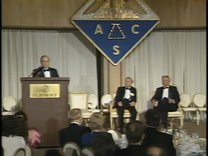
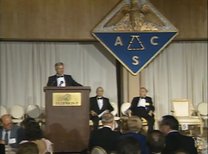
American Chemical Society Annual Meeting 1989, Awards Ceremony (raw footage), Tape 2
- 1989

These captions and transcript were generated by a computer and may contain errors. If there are significant errors that should be corrected, please let us know by emailing digital@sciencehistory.org.
Transcript
00:00:00 I can't tell you how wonderful I feel tonight. It's especially gratifying to see so many
00:00:08 friends, old colleagues, former students, and so many people from the ACS with whom I had worked
00:00:18 while I was an officer in the ACS. It's like old home week and all of that of course
00:00:26 made richer by this marvelous honor. It's difficult to express the depth and the
00:00:33 compass of my feelings as I receive this 1989 Priestly Medal of the ACS.
00:00:40 It's with awe and some wonder that I consider the addition of my name
00:00:45 to the list of preeminent chemists who have been so honored in the past.
00:00:50 I noticed with real satisfaction that the 1969 winner was Kenneth S. Pitzer,
00:00:56 who was my research director during my Ph.D. study at Berkeley.
00:01:01 Then I came across the 1986 winner of the Priestly Medal, J.D. Roberts. Jack was my
00:01:08 first teaching assistant when I entered chemistry as a freshman at UCLA, and he scared the hell
00:01:15 out of me, I'll tell you. Always has. These are only two of the many mentors who over the years
00:01:25 have guided me, inspired me, and instilled in me a love of chemistry. I would like as well to pay
00:01:34 some homage to Joseph Priestly, in whose name this award is given. It's a pleasure to be even
00:01:41 distantly related to Priestly because he displayed throughout his life many qualities I admire
00:01:48 and try to emulate. He was an idiosyncratic iconoclast who felt no reluctance to express
00:01:54 views counter to prevailing dogma. He loved experimentation in chemistry, and he worked well
00:02:01 alone, guided by his own imagination and motivated by his native curiosity. Late in his life,
00:02:08 Joseph Priestly made a conscious decision to remain in remote Northumberland, Pennsylvania,
00:02:14 rather than be distracted by the diversions of a more prestigious academic post in Philadelphia.
00:02:21 Let me remind you of some of the discoveries that came out of this individualistic approach.
00:02:27 When he was 11 years old, he noticed that spiders had a limited lifetime in a closed bottle,
00:02:33 presumably because of a depletion of some constituent of the atmospheric gas in the bottle.
00:02:38 Some years later, he became interested in the gas produced in a fermentation vat,
00:02:44 which he called fixed air. This gas caused a flame to be extinguished, and he found that mice
00:02:50 could not live in fixed air. By dissolving some of the gas in water, he obtained a sparkling,
00:02:56 pleasant-tasting drink, thereby providing the foundations for the soda water industry.
00:03:02 Then, in 1972, he discovered that while spiders and mice had limited lifespans in a closed bottle,
00:03:10 the inclusion of plant life in the bottle restored the atmosphere so that it would again sustain
00:03:16 life and support combustion. That was, of course, the real beginning of our study of photosynthesis.
00:03:23 Two years later, at the age of 41, Joseph Priestly discovered that solar light, when
00:03:28 focused onto mercuric oxide, released a gas that was identified as the active element in air.
00:03:36 Priestly had discovered oxygen. Priestly finally came to America because of his dissenting religious
00:03:42 views, and he spent the last 10 years of his life conducting experiments in Northumberland,
00:03:47 Pennsylvania. Two of his achievements during this period were the discovery of carbon monoxide,
00:03:53 formed by passing hot steam over charcoal, and the first discovery of what we now call
00:03:58 acid rain. He found nitric acid in freshly fallen snow and deduced that it came from
00:04:05 nitric oxide formed in the atmosphere by lightning. There is one more quality of Joseph Priestly that
00:04:12 I can mention. He wasn't always right. I like that in a person. His discovery of oxygen
00:04:21 makes some of us feel more comfortable. His discovery of oxygen signaled the demise of the
00:04:25 phlogiston theory of combustion, but Priestly never gave up on that theory. In his mid-60s,
00:04:32 he published a pamphlet entitled The Doctrine of Phlogiston Established. Why do I value this trait?
00:04:40 Well, it's because it identified him as an individual who thought for himself,
00:04:45 not to be swept along by scientific vogues. This trait, I believe, is necessary for the bigger
00:04:51 breakthroughs. If one wants to tread on new ground, one must expect to stumble and fall once in a
00:04:57 while. Now, you people are all wondering, I'm sure, when I'm ever going to get around to something
00:05:03 appropriate to the title of this talk, which I don't think you gave, did you? Well, let me tell
00:05:10 you, the title was supposed to be Chemistry at a Crossroad. Now, those of you who know me will
00:05:14 recognize this as a recently familiar theme. Actually, ever since my three years as deputy
00:05:21 director of the National Science Foundation. While there, I became acutely aware of the mismatch
00:05:28 between the rich potentialities of chemistry today and the tarnished public image carried
00:05:33 by chemicals and the chemical industry. The potentialities point the way down a road to
00:05:39 discovery and advances at an unprecedented rate. But we've reached an intersection with another
00:05:46 road that cuts at right angles to this road to extended benefits from chemistry. I realize that
00:05:52 I don't have to convince this audience that chemistry is poised for remarkable advances.
00:05:57 Nevertheless, let me enumerate a few of these possibilities. Lasers have given us diagnostic
00:06:03 probes that permit temporal resolution down to the picosecond level. This means that every
00:06:08 chemical behavior we can imagine might be examined in real time. Alongside these impressive
00:06:14 possibilities, computers have brought classical theory, pardon me, chemical theory into a powerful
00:06:20 partnership with experiment. For polyatomic molecules composed of first row elements,
00:06:25 computational methods can predict structures and bond energies as accurately as they can be
00:06:30 measured. At the other extreme, we are at a stage at which biological functions can be understood at
00:06:37 the molecular level. Using powerful instruments such as high resolution NMR, two-dimensional NMR,
00:06:43 x-ray crystallography, and mass spectrometry, chemists are able to deduce chemical composition
00:06:49 of extremely complicated biological molecules and then to map out the primary, secondary,
00:06:55 and tertiary conformations of these molecules, conformations that figure importantly in biological
00:07:01 function. So we have on the horizon exciting new frontiers, such as mapping the human genome,
00:07:11 synthesis of superconductors that operate even closer to room temperature, synthesis of even
00:07:16 more effective pharmaceutical drugs to reduce suffering and increase longevity,
00:07:21 development of molecular scale computers, and who knows, perhaps even nuclear fusion
00:07:27 in an electrochemical cell. In view of such potentialities and promise,
00:07:36 one might expect that chemistry would be entering a golden era of benefit to human society.
00:07:42 However, we find public attitudes pointing us down a road orthogonal to this optimistic prospect,
00:07:48 a road that might deny us this golden era. This new road is a rocky one cobbled with fear
00:07:54 and sensationalism. Sad to say, it's sponsored and stimulated by well-meaning environmentalists
00:08:01 and single-issue advocates who are well-versed in exploiting the news media, who in turn are
00:08:08 ever searching for newsworthy and sensational stories that will catch the attention of readers
00:08:14 and TV viewers. A message of alarm has that quality. A message of reassurance does not.
00:08:21 This sensitivity and urgent desire for protection from the unknown is spelled out in the New
00:08:28 California Act Proposition 65, the Safe Drinking Water and Toxic Enforcement Act.
00:08:35 This law, and you may ridicule it because it comes from that wild place called California,
00:08:40 but it's going to be copied all over the country, you watch. This law has the following provisions.
00:08:45 One, of course, to protect drinking water from industrial contamination.
00:08:50 Two, it requires businesses to warn people about potential hazards to which they are being exposed.
00:08:57 Three, it requires the state to publish a yearly list of dangerous chemicals,
00:09:01 where safe means less than one case of cancer per hundred thousand exposed.
00:09:06 Four, it has a bounty hunter clause enabling citizens to sue possible violators and collect
00:09:16 a portion of the settlement, whether they claim injury or not. Now, this warning requirement that
00:09:22 I mentioned, requiring businesses to warn people about potential hazards, has a wide reach. It
00:09:29 applies to gas stations. Benzene, of course, is present in gasoline, lead additives in gasoline.
00:09:37 It applies to dry cleaners. They use perchloroethylenes. To restaurants who serve wine,
00:09:42 beer, charred food, sugar, even table salt. Even to grocers. Now vegetables because of
00:09:50 the possibility of pesticides. Drinks, artificial sweeteners or caffeine. Herbal tea, peanut butter,
00:09:56 preserved meat. Richard Lipkin writes about Proposition 65 this way. Proposition 65 highlights
00:10:05 in stark fashion an ongoing American debate about how to respond to risk. It is a debate
00:10:12 that touches on some of the most primal human passions, fear of death, fear of the unknown,
00:10:18 and raises the question of whether the political system is capable of reasoned policies in the
00:10:24 faces of such fears. He goes on to say Americans today feel they are more at risk than ever before
00:10:32 and yet in terms of health, life expectancy, and even accidents, things have improved greatly.
00:10:39 Ironically, the more the nation spends on regulations and environmental controls,
00:10:45 the less safe the American public seems to feel. It's a strange paradox.
00:10:51 This public fear and susceptibility of public response to panic response is illustrated in the
00:10:57 recent furor over the fruit ripener hormone LR. This incident was initiated by the National
00:11:09 Resources Defense Council, NDRC. Using models for extrapolation from animal tests to humans,
00:11:19 as everyone must do, they estimate that 5,000 children per year may develop cancer in their
00:11:25 elderly years as a result of their exposure to eight pesticides during their preschool years.
00:11:32 NDRC says flatly that this risk is intolerable. NDRC does not advertise the fact that in a
00:11:40 population of 22 million preschool children, five and a half million will ultimately get cancer
00:11:47 anyway. Thus, the NDRC estimate of 5,000, if correct, and that's probably a worst case estimate,
00:11:55 would represent a barely noticeable perturbation of only 0.025 percent of the expected total.
00:12:03 Neither did NDRC in its presentation on the 60 Minutes TV show
00:12:12 mention the fact that only about five percent of the apple growers currently spray with LR.
00:12:17 On the same day that three federal agencies responsible for food safety, the FDA, the EPA,
00:12:23 and OSHA, made a joint announcement that LR is not an imminent hazard to children,
00:12:29 on the same day that they made that announcement, the NDRC enlisted a movie actress, Meryl Streep,
00:12:35 to testify before a packed Senate Labor and Human Resources subcommittee.
00:12:40 She announced that, even now, we don't know what's on our food. I no longer want my children to be
00:12:47 part of this experiment. The outcome in our litigious society was predictable. Meryl Streep
00:12:54 prevailed. Apples were removed from school cafeteria in New York, Los Angeles, and Chicago.
00:13:00 One school official said it was overreaction carried to the point of stupidity.
00:13:05 This strong statement can be backed up by the statements of concern and authoritative
00:13:09 scientists like Professor Bruce Ames, biochemist at UC Berkeley and inventor of the Ames test
00:13:16 for mutagenicity. He says, the qualitative extrapolation from rodents to humans,
00:13:24 particularly at low doses, is guesswork that we have no way of validating.
00:13:29 We are ingesting in our diet at least 10,000 times more weight of natural pesticides
00:13:36 than of man-made pesticide residues. These are natural, toxic chemicals that appear to
00:13:43 be present in all plants and serve to protect plants against fungi, insects, and animal predators.
00:13:50 Richard Wilson, a Harvard physicist, focuses on the dilemma we face. Almost every regulation
00:13:57 of chemical risk is a willingness to accept natural chemicals over a willingness to accept
00:14:04 artificial chemicals. This willingness has nothing to do with risk. And Richard Lipkin adds,
00:14:10 the problem is how to achieve perspective as relative risks and how to communicate the fact
00:14:16 that risk, by definition, cannot be eliminated. Believe it or not, I've found one faint ray of
00:14:24 hope for the future in this ALAR incident. Some of the media seem to have awakened to
00:14:29 the fact that they are being manipulated to stimulate this panic response. For example,
00:14:35 Time Magazine on March 27 published an article that distinctly questions the rationality
00:14:41 and appropriateness of the course of events in the ALAR apple furor. Quotes from this article
00:14:47 convey its tone throughout. The incident demonstrates how the public increasingly
00:14:53 demands a risk-free society, whatever the cost. Immune from the ills that all less affluent
00:15:01 societies that ail less affluent societies, America has the luxury of fretting over the
00:15:08 little things. These are quotes from this Time Magazine article. And then regulation that swoops
00:15:14 down on the scare of the week keeps attention diverted from the problems individuals can do
00:15:19 less about, like acid rain and overflowing trash dumps. Noting that some of the leaders of these
00:15:26 environmentalist organizations come from the protest generation of the late 60s,
00:15:30 the article summarizes, they turn to perfecting their immediate environment,
00:15:37 pressing the government for help, and suing anyone who did not share their finicky obsessions.
00:15:43 Safety regulations multiplied, tort law loomed, boomed, and liability rates soared. Now,
00:15:50 those are strong words coming from a public news medium. Could it be that at last the media are
00:15:56 recognizing their tacit participation in spreading irrationality, fear, and panic response?
00:16:04 Well, now I must turn to what can be done to help the situation.
00:16:08 Much is at stake for all technologically advanced cultures. I believe that a massive and ongoing
00:16:14 campaign of public education is needed. This campaign must be launched and led by people
00:16:20 who understand risk assessment, people who are used to dealing with uncertainty and tentativity,
00:16:26 and by people who see the rich possibilities that might be lost. Who are these people? They're us,
00:16:32 you and me. We're all familiar with chemical hazards. We're used to assessing danger and
00:16:38 taking rational and appropriate measures to avoid injury. There are many fronts on which to act,
00:16:44 many roles to be filled. Each one of us must ask, where can I participate? Here are some
00:16:52 possibilities. One, you can actively engage in communicating with the public about the risk
00:16:58 benefit assessment. Let your voice of reason and perspective be heard, whether it be across the back
00:17:05 fence, talking to neighbors, talks at Rotary Club, or any other arena where you can reach
00:17:11 concerned citizens. Find your place in making the ACS National Chemistry Week a big success.
00:17:21 Another possibility, engage actively in communicating with the public about
00:17:25 societal benefits that flow from chemistry. See that promising advances come into public view
00:17:32 through newspaper articles and TV reports. Get acquainted with the science reporters in your city.
00:17:38 Make your expertise available to them. Once again, National Chemistry Week might be the place to get
00:17:43 your feet wet. Three, help upgrade the presentation of chemistry as part of the education of
00:17:51 non-scientists. If you're in academia, help design attractive and interesting college courses for
00:17:58 non-scientists. More important, get involved at the pre-college level, particularly at the middle
00:18:05 school level. My experience in summer institutes for middle school teachers points this as a
00:18:11 disaster area. The average middle school teacher took their last chemistry course in high school
00:18:17 and hated it. The usual approach to chemistry in such a cross-disciplinary course is to spend a
00:18:25 little time talking about pollution in the environment. Instead of attracting their students
00:18:31 to want to learn more about chemistry, these teachers subtly convey their own discomfort with
00:18:36 the field. They need reassurance and guidance so they can speak about chemistry with confidence.
| Property | Value |
|---|---|
| Creator of work | |
| Place of creation | |
| Format | |
| Genre | |
| Medium | |
| Extent |
|
| Language | |
| Subject | |
| Rights | In Copyright |
| Rights holder |
|
| Credit line |
|
Institutional location
| Department | |
|---|---|
| Collection |
Related Items
Cite as
American Chemical Society. “American Chemical Society Annual Meeting 1989, Awards Ceremony (Raw Footage), Tape 2.” U-matic (tm), 1989. American Chemical Society Audiovisual Collection. Science History Institute. Philadelphia. https://digital.sciencehistory.org/works/b3l1eo6.
This citation is automatically generated and may contain errors.