
Interview with Halina Szejnwald Brown
- Circa 1988

These captions and transcript were generated by a computer and may contain errors. If there are significant errors that should be corrected, please let us know by emailing digital@sciencehistory.org.
Transcript
00:00:08 Because we edit this thing totally,
00:00:11 as we just take bits and pieces.
00:00:13 Sometimes we might have your voice over a shot of, say, a hazardous waste site,
00:00:18 and you're describing something that has to do with that site.
00:00:21 Sometimes it might be just you on camera,
00:00:24 and we'll just pick and choose, and they're called bites.
00:00:27 I just want to say that you say that we have...
00:00:32 I'll ask you, if you would, please, to move just a little to your right.
00:00:37 Right there?
00:00:39 Yeah.
00:00:53 So, at the end, there is a text written,
00:00:56 somebody that underlies the whole...
00:00:59 That's right. The text has not been started yet.
00:01:01 So, that's why this thing is going to take forever to get on the air.
00:01:05 It won't be on the air for another year.
00:01:07 We'll finish the program, the television program,
00:01:10 this fall, October, supposedly.
00:01:14 But the text will still have to be written.
00:01:16 Then it has to be coordinated with colleges and universities.
00:01:19 We're going to use it.
00:01:20 So, it'll probably be the fall semester of 89.
00:01:23 So, it is for colleges and universities?
00:01:26 Freshman campus.
00:01:27 A little to your left.
00:01:28 One more.
00:01:29 Go back one more.
00:01:30 Okay, great.
00:01:32 I thought it was for high school students.
00:01:35 What does that say?
00:01:36 EFC camera.
00:01:39 Saw focus look anywhere?
00:01:41 You can tell it, huh?
00:01:42 Yeah, I noticed.
00:01:49 You're not going to...
00:01:50 I don't want you to watch it when we...
00:01:52 No, I was just curious how the colors look.
00:01:58 Well, I'm glad I didn't wear red, because with this background, it would be not...
00:02:04 That actually matches very well.
00:02:07 Yeah, I like that font.
00:02:10 Red is really forbidden.
00:02:13 Interesting.
00:02:14 It just smears horribly.
00:02:16 I think there's a pain in there.
00:02:19 Have you seen that?
00:02:20 It's like this black woman walking down the steps of somewhere, a building in Rome or somewhere.
00:02:26 She's got this brilliant red.
00:02:29 Have you seen that?
00:02:30 It just smears.
00:02:31 I don't know why they did it.
00:02:33 Okay.
00:02:39 I'm sure you have more.
00:02:43 Okay.
00:02:48 Do you think there's too much shadow on it?
00:02:52 I like that.
00:02:53 I like that, but it depends on how you've been doing things and if it's...
00:02:59 I like a contrast.
00:03:00 Could you put a little more light there?
00:03:02 Sure.
00:03:10 Do you want to look at me?
00:03:12 Yeah.
00:03:13 It's fine.
00:03:14 Good.
00:03:15 Good.
00:03:25 Looks nice.
00:03:28 Now, if you would just go in and out on my question.
00:03:31 That's a wide shot.
00:03:32 That's a good shot.
00:03:41 Where are you going?
00:03:45 Great.
00:03:46 Okay.
00:03:47 We're rolling already?
00:03:48 We're rolling, yes.
00:03:57 Let's start off just by talking about what we did earlier, and that is, just what do
00:04:01 we mean when we say something is toxic?
00:04:03 And if you would just describe to me the things you did earlier about dosage, basically, or
00:04:09 total quantity being the main determinant, if that's expressed accurately.
00:04:14 Well, let me first define the science of toxicology.
00:04:19 Okay.
00:04:20 Toxicology is a science that concerns itself with harmful effect of chemicals on biological
00:04:27 systems.
00:04:28 Now, those harmful effects can be described in several ways.
00:04:34 They can be described by...
00:04:39 I'm too uptight.
00:04:40 That's okay.
00:04:41 Let's just stop.
00:04:42 I'm too uptight.
00:04:43 That's okay.
00:04:44 Could we move the monitor around here?
00:04:47 Let me see the close before we...
00:04:53 You want to tell me what...
00:04:59 Okay.
00:05:02 Toxicity is a qualitative as well as quantitative term.
00:05:07 Qualitatively, when we say that substance is toxic, we usually talk about adverse health
00:05:13 effects that the substance can produce when it's administered to a biological system.
00:05:19 In other words, it can cause liver toxicity, kidney toxicity, can be adverse to the central
00:05:26 nervous system, to the blood-forming system, reproductive system, and so on and so forth.
00:05:32 It's the nature of the adverse effects that it causes that represents the qualitative
00:05:39 aspect of the term toxicity.
00:05:42 But toxicity also is a quantitative term.
00:05:46 And when I say quantitative, I mean that just about every chemical can be toxic at some
00:05:55 dose, and with the exception of cancer-causing chemicals, at least, can be harmless at some
00:06:02 other dose.
00:06:05 Could you give me an example of something?
00:06:08 Milk or whatever you'd like to pick as something that's maybe even beneficial at a low dose
00:06:15 but at a higher dose is harmful.
00:06:17 A classic example of substances that are beneficial at low doses and harmful at high doses are
00:06:25 certain trace metals.
00:06:27 As you probably know, a number of metals are essential to the normal functioning of the
00:06:34 body.
00:06:35 Example, iron, zinc, calcium.
00:06:39 However, too high doses of those metals will cause adverse health effects.
00:06:44 So, toxicology will concern itself with defining the level, the threshold at which these adverse
00:06:52 health effects begin to manifest themselves, as well as the shape of the dose-response curve
00:07:01 which will describe the relationship between the amount administered and the adverse health
00:07:08 effect that will occur.
00:07:11 Would you feel comfortable with saying that all substances are toxic at some dose level
00:07:17 and that really toxicity is a measure of, it really depends on the amount?
00:07:23 If you feel comfortable, would you say that?
00:07:25 Yes, I would say that.
00:07:27 That actually is a premise of the whole science of toxicology that dates back to the early
00:07:33 days of toxicology, sometime in the 16th century, where a definition was made that
00:07:41 sounds something like that.
00:07:43 The dose makes a poison.
00:07:45 Any substance can be harmless at low enough dose and can be harmful at high enough dose.
00:07:52 So, to say that a substance is toxic is really incorrect.
00:07:57 When one says that a substance is toxic, one needs to say what is the nature of that
00:08:03 adverse health effect and at what dose that effect was observed.
00:08:10 That's in addition to defining in what biological system that occurred and under what conditions
00:08:18 of exposure it happened.
00:08:21 Because different animals will react differently to exactly the same dose of a particular chemical
00:08:30 and different routes of exposure can lead to a whole different spectrum of adverse health
00:08:36 effects and once again, qualitatively and quantitatively.
00:08:42 Could you give me an example of, let's say, a route of exposure and how that would affect
00:08:49 the toxicity of something, a specific substance and a specific route of exposure?
00:08:55 Metals are a very good example of substances that will have entirely different adverse
00:09:00 health effects when ingested or when inhaled.
00:09:05 For example, let's take a chemical such as chromium.
00:09:09 Chromium is known to cause respiratory and lung cancer among workers.
00:09:15 And it's an effect that's fairly well documented by now.
00:09:19 Nasal cancers and lung cancers.
00:09:22 When ingested, it's fairly harmless.
00:09:26 And when I say fairly harmless, I mean it takes very large doses to produce any kinds
00:09:32 of adverse health effects and no cancer at all has been ever observed.
00:09:39 Instead of saying ingested, would you mind saying, you mean eaten?
00:09:43 Yes.
00:09:44 Okay.
00:09:45 Should I say eaten?
00:09:46 If you wouldn't mind.
00:09:47 Okay.
00:09:48 Because that's something that...
00:09:49 Stop.
00:09:50 Take a second.
00:09:51 That's the sort of thing that, once again, people know what the word means probably,
00:09:53 but they have to stop and think about it.
00:09:55 Okay.
00:09:56 By the time they've said, oh, okay, eating or is that smelling or...
00:09:59 Okay, so inhaled and eaten.
00:10:01 Yeah.
00:10:02 Okay.
00:10:03 But otherwise, it was great.
00:10:04 It was a perfect kind of example.
00:10:05 Okay.
00:10:06 So should I explain that again?
00:10:07 If you wouldn't mind.
00:10:08 Because actually, chromium is a very interesting case.
00:10:09 Yeah.
00:10:10 I'll give you a signal.
00:10:11 So this is the point that you made earlier about all these other effects that have to
00:10:16 occur simultaneously and why we can...
00:10:20 We can...
00:10:21 Change shot?
00:10:22 Yeah.
00:10:23 Okay.
00:10:30 Development of cancer is a probabilistic process.
00:10:33 It starts with the first event, which we presume to be a mutation, a chemical change in the
00:10:39 DNA, which can be inherited or can be caused by a chemical exposure to a chemical.
00:10:46 In order for cancer to develop, several other events have to take place.
00:10:52 Those are events that involve perhaps more mutations or perhaps some other changes in
00:10:59 the cell or in the surrounding tissue.
00:11:03 When the probability of...
00:11:06 This is going to be difficult.
00:11:15 When the...
00:11:16 Why don't you just start talking and say anything, and then maybe it will just come to you in
00:11:21 midstream, so to speak.
00:11:23 Okay.
00:11:24 When we have very few mutations, the probability that the other events will take place is very
00:11:32 low.
00:11:33 No, that doesn't come...
00:11:34 Why am I...
00:11:35 Oh, I have trouble with this.
00:11:39 Just keep trying.
00:11:40 I think it will come out eventually.
00:11:45 Okay, stop.
00:11:46 Yeah, yeah.
00:11:47 No, no.
00:11:48 Well...
00:11:54 Okay.
00:11:56 Body has a very clever mechanism of dealing with foreign substances that it encounters.
00:12:04 When a chemical enters the body, it has to be, of course, first absorbed, then it is
00:12:11 distributed between different tissues, and then very frequently is metabolized.
00:12:19 Why are chemicals metabolized?
00:12:22 Metabolism is a detoxification mechanism.
00:12:26 What's needed in order to get rid of the chemical is to make it more soluble so it could be
00:12:33 excreted through the urine.
00:12:34 Urine is the predominant method of excretion of foreign chemicals, toxic chemicals, from
00:12:40 the body.
00:12:42 The metabolism means chemical transformation of a substance, and body is very well equipped
00:12:49 to do so.
00:12:50 What happens with a chemical, for example, which is poorly soluble in urine?
00:12:55 That means it cannot be excreted easily, it will not dissolve, and it cannot be filtered
00:13:00 out of the blood in the kidneys into the urine.
00:13:04 In that case, the body is going to transform that chemical, make it more chemically reactive.
00:13:12 We call that chemical intermediates.
00:13:17 And those chemical intermediates then can be bound chemically with certain highly soluble
00:13:25 biological molecules, which will essentially carry that chemical out into the urine and
00:13:31 excrete it.
00:13:32 The process that I describe is called metabolism, two stages of metabolism.
00:13:39 The first stage is make the chemical more reactive.
00:13:43 Stage two, bind that with certain biological molecules, highly soluble in water, which
00:13:50 can be excreted via urine.
00:13:53 Those two stages are called metabolic transformation of a chemical.
00:13:58 A typical chemical such as benzene, for example, once it enters the body, is going to be transformed
00:14:05 into benzene epoxides, so-called epoxides, which are very chemically reactive, and it's
00:14:13 going to bind to glucuronides and excrete it.
00:14:19 So metabolism is a very efficient detoxification mechanism.
00:14:25 There is a problem.
00:14:27 The problem is that some of the intermediates, some of those results of the chemical transformation
00:14:33 turns out to be more toxic than the original compound.
00:14:37 And here a very good example is alcohol.
00:14:40 Alcohol per se is not particularly toxic.
00:14:44 Once it enters the body, it's going to be transformed into an aldehyde, which is much more toxic than the benzene.
00:14:53 Okay, let me start again with that one.
00:14:58 Hold it a second.
00:14:59 Let's change the shot here.
00:15:01 You don't need to change it.
00:15:02 Probably change tapes is what I'd say.
00:15:04 Okay.
00:15:05 Well, let's see.
00:15:06 How much time do we have?
00:15:07 Four.
00:15:08 Let's finish this phrase.
00:15:09 Okay, fine.
00:15:11 And we'll just start back with alcohol as a good example.
00:15:14 Okay.
00:15:15 Ready?
00:15:17 Alcohol is a very good example of detoxification mechanisms making things worse rather than better.
00:15:24 Alcohol per se is not particularly toxic.
00:15:27 When ingested, when swallowed by an oral route, alcohol is metabolized into an aldehyde.
00:15:35 That aldehyde is much more toxic than the alcohol itself,
00:15:39 and it's the aldehyde that produces toxicity to the liver,
00:15:44 especially over a long period of time when the ingestion takes place.
00:15:50 Another example—
00:15:52 Excuse me.
00:15:53 I'm going to stop you there.
00:15:54 Change shot again.
00:15:56 Could we talk about alcohol as being a cause of cancer as well?
00:15:59 Not really, no, because—no.
00:16:06 Let's start by saying another example.
00:16:08 Another—ready?
00:16:10 Yeah.
00:16:11 Another example of the adverse effect of detoxification mechanisms, which metabolism is,
00:16:19 is benzoylpyrin.
00:16:21 Benzoylpyrin is a common byproduct of incomplete combustion.
00:16:26 We see it every day when we charcoal a steak.
00:16:31 The dark material that we see there is a mixture of compounds, polycyclic aromatic hydrocarbons.
00:16:38 Benzoylpyrin is a very common member of the large class of chemical compounds.
00:16:44 Benzoylpyrin is very poorly soluble in water, and it's rather chemically unreactive.
00:16:50 What that means is that if it goes through the system unchanged,
00:16:56 it's very difficult to filter it into the urine.
00:16:59 It's not soluble in water.
00:17:02 It is also chemically unreactive, so it cannot be bound with those biological molecules,
00:17:08 which could make it more water-soluble.
00:17:12 So benzoylpyrin presents a problem in terms of excretion, unless it's changed chemically.
00:17:21 And benzoylpyrin is changed chemically through the phase I metabolism.
00:17:28 It's made into reactive intermediates, which then can be bound chemically with biological molecules
00:17:37 and fairly easily excreted in urine.
00:17:42 Now that's where the catch is.
00:17:45 It's the reactive intermediates, the products of this phase I metabolism,
00:17:52 which is intended to detoxify the chemical and remove it from the body as efficiently as possible.
00:18:00 These chemical intermediates are also capable of reacting with other constituents of the cell,
00:18:07 most notably proteins and DNA.
00:18:11 And it is believed that that chemical reactivity
00:18:15 Intermediate with DNA is the fundamental event that ultimately leads to benzoylpyrin being carcinogenic.
00:18:28 It is the binding, chemical binding, of that reactive intermediate to DNA that causes mutation.
00:18:38 Okay. Good timing.
00:18:46 We'll take...
00:18:51 Should I...
00:18:52 I'll tell you when.
00:18:54 Do you have a question before we start?
00:18:56 No, I think...
00:18:57 Okay.
00:19:05 Benzoylpyrin is a member of a larger class of chemicals known as polycyclic aromatic hydrocarbons.
00:19:12 Polycyclic aromatic hydrocarbons are products of incomplete combustion, and we often find them in everyday life.
00:19:19 For example, when we charcoal broil steak, the dark material that forms when the fat is burned incompletely is...
00:19:33 Just start from the beginning.
00:19:34 Yes.
00:19:35 Benzoylpyrin is a member of a larger class of chemicals known as polycyclic aromatic hydrocarbons.
00:19:42 These chemicals are commonly found in daily life.
00:19:45 For example, when we charcoal broil a steak, the dark material that we see has polycyclic aromatic hydrocarbons,
00:19:54 and benzoylpyrin is one of many of those substances.
00:20:00 Benzoylpyrin is probably the most studied carcinogen of all the chemical carcinogens that we know.
00:20:07 It's been studied for around a century by now, its chemistry and the mechanism by which it causes cancer.
00:20:17 It is a highly water-insoluble chemical.
00:20:21 So, in a usual manner, the body deals with it by transforming it chemically into a much more chemically reactive species,
00:20:31 the reactive intermediate, in order to be able to excrete it much easier through the urine.
00:20:39 Now, the byproduct of that process is that the chemical intermediate is capable of reacting chemically with the components of the cell,
00:20:52 namely proteins and nucleic acids, the DNA.
00:20:58 It's that chemical reaction between DNA and the reactive intermediate of benzoylpyrin that leads to a mutation.
00:21:08 Mutation is a chemical change in the DNA.
00:21:12 In this case, it's a formation of a chemical bond between benzoylpyrin metabolite and a site on the DNA.
00:21:24 That's a mutation.
00:21:27 This event, single molecular event, can ultimately lead to cancer.
00:21:37 Now, if you ask me now, can a single mutation cause cancer?
00:21:43 I would answer to it, in theory, a single mutation can cause cancer.
00:21:49 In practice, it may be such a rare event.
00:21:53 In other words, it would happen with such low probability that in practice, we would not be concerned about that.
00:22:02 In other words, very improbable that it would happen, although possible.
00:22:08 Why is it so improbable?
00:22:11 We don't understand everything about the process of cancer formation, but we do understand that it's a multistage process.
00:22:22 Probably the initial event that takes place is a mutation on DNA.
00:22:29 It could be caused by exposure to a chemical carcinogen, such as benzoylpyrin, for example,
00:22:37 or benzene, or vinyl chloride, or a host of other chemicals known to induce cancer.
00:22:45 Or that initial mutation may be inherited and not caused at all by exposure to chemicals.
00:22:53 Or, perhaps, it may be caused by oncogenic virus.
00:22:57 In either case, it is the initial event, the mutation, that, as it's believed currently,
00:23:05 leads to a series of changes in the cell that will ultimately lead to cancer.
00:23:11 Now, in order for cancer to develop, several additional events must take place.
00:23:18 Some of them are better understood than others.
00:23:21 But if there is only a single mutation, the probability of all the events taking place
00:23:30 in the right order that is required for this ultimate transformation of normal cell into malignant cell
00:23:40 are very improbable.
00:23:43 Each event has a limited probability, so if we combine several events,
00:23:48 each of them of very low probability, including this single mutation,
00:23:53 we come up with an event which is very, very unlikely.
00:23:58 That's why a single mutation, although in theory capable of leading to cancer,
00:24:06 is very unlikely to lead to cancer simply because the probability of it happening is very, very low.
00:24:14 Does that explain it?
00:24:16 Yeah, that was very good.
00:24:17 Let's see if we can go from that.
00:24:19 And you're doing a great job, Pam.
00:24:22 I'm still trying to relate it to a standard.
00:24:29 In other words, what I'm trying to get at is, you know,
00:24:32 there are people who say we should have zero, that certain carcinogens we should have zero tolerance for.
00:24:39 They should not be present, say, in our drinking water.
00:24:41 And I'm trying to say, given this arbitrary nature of things, not arbitrary,
00:24:46 but given this decreasing probability and, practically speaking,
00:24:50 the unlikelihood of cancer being caused, can we justify that it's a certain percentage
00:24:58 or a certain amount of a substance in our food or in our drinking water?
00:25:02 Is it okay?
00:25:04 I can say that where the rule of thumb is that people consider risks below one in a million to be insignificant
00:25:14 and risks greater than one in 10,000 to be significant.
00:25:19 In other words, we as a society have determined this gray area of cancer risks
00:25:25 of between one in 10,000 and one in a million.
00:25:28 So we really as a society believe that once the risks are lower than one in a million,
00:25:32 it's nothing to worry about.
00:25:35 But it's not by any scientific analysis.
00:25:40 It's by practicing it that way.
00:25:46 And what goes into that?
00:25:48 In other words, what other factors go into making this decision?
00:25:52 You are not taping it now, are you?
00:25:55 I actually, that last statement, I thought she was saying what she was going to say,
00:26:00 so I'm sorry a little bit right in the middle.
00:26:02 Okay.
00:26:03 It was good.
00:26:04 Let's do it again.
00:26:05 Yes.
00:26:07 Can you repeat what you just said?
00:26:10 Yes.
00:26:11 As the dose of a carcinogen gets smaller, the risks associated with it get smaller.
00:26:17 It never reaches zero, but it can become very, very small,
00:26:21 such as one in 100,000, one in a million, one in a billion.
00:26:27 You can go on and on and on into infinitely small doses and infinitely small risks,
00:26:34 although they will never be zero,
00:26:38 based on our current understanding of the carcinogenic process.
00:26:42 Now, what value of risk should we consider to be so small that we shouldn't worry about that?
00:26:50 Well, that's a matter of debate.
00:26:53 In practice, when we look at the government regulations of carcinogenic substances,
00:26:59 we see that in most cases when the risks are one in a million or smaller,
00:27:05 no action is taken by the government.
00:27:08 When the risks are greater than one in 10,000,
00:27:13 usually regulatory action is taken by the federal government.
00:27:17 So what we have defined by practicing it, not by any particular debate or analysis,
00:27:24 we have defined that risk of one in a million or smaller is an insignificant risk.
00:27:31 We have also defined a significant risk of one in 10,000 or greater,
00:27:38 but we have left this large gray area which spans two orders of magnitude,
00:27:44 hundredfold, where sometimes the action is taken, sometimes the action is not taken.
00:27:51 And that particular gray area is where all the debate takes place
00:27:58 and where different individuals and different organizations interpret the risk differently.
00:28:05 Sometimes it's significant, sometimes it's not significant.
00:28:10 You're fired.
00:28:14 Quiet, please.
00:28:16 Okay, we're talking about the gray area between the 10,000, one in 2,000, one in a million.
00:28:21 So I'd like you to say, if you would, that since we have this wide range,
00:28:27 there are other factors coming into play, such as, I think, give us some examples.
00:28:32 When the carcinogenic risks are in that gray area between one in 10,000, one in a million
00:28:44 is when other factors not related to risk and not necessarily related to the scientific concerns that are—
00:28:56 When the risks are in that gray area—
00:28:59 Start again.
00:29:00 Okay.
00:29:01 When the carcinogenic risks are within that gray area somewhere between one in 10,000 and one in a million
00:29:08 is when other concerns are included in the debate at what level to regulate.
00:29:15 And those include costs of the regulation, feasibility of enforcing that regulation,
00:29:22 technology available to remove a carcinogenic substance from circulation,
00:29:28 or technology available to measure it.
00:29:32 If no measurement can be made, no enforcement of the regulations can be made.
00:29:38 So there is a host of other considerations that will affect where, ultimately, the standard will fall.
00:29:46 And it will fall anywhere, as based on our past experience, anywhere in this range of two orders of magnitude.
00:29:56 What kind of considerations will be included also depends on what the law requires.
00:30:03 Carcinogens are regulated in many environmental statutes.
00:30:07 An example, Safe Drinking Water Act deals with carcinogenic risks in drinking water.
00:30:14 Clean Air Act addresses carcinogenic substances in ambient air, outdoor air.
00:30:21 Clean Water Act addresses carcinogens in surface waters, and so on and so on.
00:30:28 Several environmental statutes.
00:30:30 The statutes also have very specific requirements of what considerations have to be included in setting a standard.
00:30:40 So, for example, the Safe Drinking Water Act specifically requires that EPA,
00:30:47 in developing a drinking water standard, looks into the carcinogenic and other adverse health effects,
00:30:58 but it also looks into feasibility and cost of that particular regulation.
00:31:04 And that's exactly what EPA does when it sets the drinking water standard.
00:31:10 Clean Air Act does not make specific requirements that costs have to be considered
00:31:17 in setting ambient air standards for toxic chemicals, including carcinogens.
00:31:24 FIFRA, for example, which regulates pesticides, makes a specific requirement, once again,
00:31:32 that cost-benefit analysis is performed before a chemical is, for example, banned,
00:31:39 a pesticide is banned, or the registration of a new pesticide is given or is denied.
00:31:46 So those are the considerations that routinely have to be considered
00:31:51 when a standard is set for a carcinogenic substance.
00:31:56 Okay, fine. That was good.
00:31:58 Now, let's talk a little bit about...
00:32:07 If we could just say fairly, in a fairly short way,
00:32:11 the difference between non-carcinogenic and carcinogenic substances,
00:32:15 in terms of the fact that we can set a definite level, say a definite level below which no harm will be done,
00:32:23 whereas that we can carcinogenic, without going too far along in the explanation of the probability.
00:32:28 Okay.
00:32:31 Still rolling?
00:32:32 Yeah.
00:32:33 Go ahead.
00:32:34 The fundamental difference between carcinogenic and non-carcinogenic effect
00:32:40 is that it is believed that there is a threshold for non-carcinogenic effect below which no...
00:32:49 No, this is all wrong. Okay, I'll start again.
00:32:52 Start again.
00:32:55 For non-carcinogenic effects...
00:33:03 I'm thinking. Yeah, I'm thinking how to phrase the question.
00:33:06 I'll take a second.
00:33:18 For a substance that does not cause cancer, such as, for example, methanol or ozone or carbon dioxide or aspirin,
00:33:29 there is a level below which no adverse effect would be expected.
00:33:35 That dose differs with the individual chemical.
00:33:40 It also differs among people.
00:33:44 But we can, at least in principle, find a level below which the population as a whole
00:33:50 will not suffer any adverse health effects if exposed to that chemical.
00:33:56 No such level can be assumed for carcinogenic substances
00:34:01 because, in principle, a single molecule of a carcinogen increases a risk of cancer.
00:34:10 That may be a very, very small risk, but a risk nonetheless which is greater than zero.
00:34:17 So for carcinogenic substances, we don't say that we have to come up with a dose
00:34:24 below which no harmful effect will be observed.
00:34:28 Instead, we relate a dose to a risk.
00:34:33 So in other words, for benzene, for example, one part per billion in drinking water
00:34:40 may be associated with a risk of, for example, one in a million.
00:34:46 Ten parts per billion in water will be associated with a risk ten times higher of, in this case, one in 100,000.
00:34:57 These are illustrative numbers.
00:34:59 They are not much different from the real ones, but I do not remember what the real ones are.
00:35:05 What that creates from a regulatory viewpoint and from the perception viewpoint
00:35:11 is that an agency cannot come out and tell the public, you are safe.
00:35:19 We have reduced the exposure to the level that nobody will suffer any adverse health effects.
00:35:25 That can be said for ozone, but it cannot be said for benzene, which causes cancer.
00:35:32 The best that the agency can say is we have reduced the levels of benzene in ambient air
00:35:39 so that the risk of cancer is no greater than a particular number.
00:35:46 It may be a very small number, but the word safe cannot be used by an agency.
00:35:53 And that, of course, produces a serious problem of interpretation and perception
00:36:00 because people would like to know that they are safe.
00:36:05 That is the fundamental question, am I safe?
00:36:08 And the agency, when dealing with carcinogens, cannot ever say you are safe.
00:36:14 All that the agency can say, the risks are very small or they are above a certain level
00:36:20 or they are below a certain level.
00:36:22 And that is at the center of the controversial debate over carcinogenic risks.
00:36:30 Let's see if we can relate this to our interviews.
00:36:52 This question has two separate scientific components.
00:36:56 The first one is, can we document scientifically
00:37:01 that the population that claims that suffers from elevated rates of cancer
00:37:06 indeed has elevated rates of cancer?
00:37:09 In other words, do they have more cancers than we should expect
00:37:14 of a group of people with their particular socioeconomic characteristics,
00:37:20 their age distribution, their income, and so on and so forth.
00:37:24 That's the first question.
00:37:26 The second question is, suppose we can show that they indeed have more.
00:37:30 If we did have more cancer than we would expect of a group of people like that,
00:37:37 can we attribute that increase to the site?
00:37:43 Each of those scientific questions has its own problems.
00:37:48 The first one, demonstrating that there is an elevated rate of cancer,
00:37:54 has a problem of sensitivity.
00:37:56 It is done through epidemiologic studies.
00:37:59 Epidemiology is a very insensitive science.
00:38:04 Maybe I should explain what epidemiology is.
00:38:07 Well, let's stop for a second.
00:38:09 Or a health study.
00:38:27 Does the population have higher rate of cancer that we would expect of a population like that?
00:38:35 How do we answer that question?
00:38:37 We answer it by comparing the rate of cancer in that population with some other group of people
00:38:43 who are hopefully very similar to this group in all respects,
00:38:49 and look at the rates of cancer in that other group.
00:38:54 We'll call them control population.
00:38:57 The problem with doing that is that in order to see a difference between the two populations,
00:39:07 the rate in our study population would have to be at least two times higher
00:39:15 than the rate in control population in order for us to believe the results from a scientific viewpoint.
00:39:24 Two times higher rate is a significant increase, and we may not see it.
00:39:30 We may, for example, see 50% increase over the control.
00:39:35 Is it a significant difference?
00:39:37 Enough for us to conclude that they indeed suffer higher rate of cancer.
00:39:42 It's hard to tell.
00:39:44 There is large uncertainty in those results.
00:39:48 Now suppose that we show that this population really does have an elevated rate of cancer,
00:39:54 two or three times what we would expect otherwise,
00:39:58 based on national statistics or based on a comparison with some control population
00:40:03 which is well matched with this population.
00:40:06 Then the question comes, can we attribute that increase to the dump?
00:40:12 In other words, can we find a causal relationship between living in the vicinity of the dump
00:40:20 and elevated rate of cancer?
00:40:23 Now this question can never be answered beyond any doubt.
00:40:31 All we can do is present a set of evidence.
00:40:39 Is that an English set of evidence?
00:40:42 Set of arguments, right?
00:40:45 Okay, I will go back to the...
00:40:55 Okay, so I'll go back to...
00:40:57 Can I go now?
00:40:59 Yeah.
00:41:01 Suppose we document...
00:41:09 Suppose we document that the population in question
00:41:13 indeed has a rate of cancer which is higher than we would expect otherwise.
00:41:18 How can we attribute that to the dump?
00:41:24 That's the second question.
00:41:26 That question cannot be answered beyond a reasonable doubt.
00:41:31 All we can do is present a set of arguments,
00:41:35 a set of pieces of data that will either make that hypothesis strong or weak.
00:41:44 For example, if chemicals that have been detected at the dump
00:41:49 clearly are known to cause cancer, that strengthens the argument.
00:41:55 If it can be demonstrated that the population in the vicinity of the dump
00:42:01 has actually been exposed to those chemicals,
00:42:05 either by inhaling the air or by drinking contaminated water
00:42:11 or by using that site as a playground for the families or for the children,
00:42:19 that will strengthen the argument.
00:42:22 If we can show that the appearance of cancer
00:42:28 chronologically followed appearance of the dump,
00:42:34 that again strengthens the argument.
00:42:36 If cancer seems to have occurred, elevated cancer,
00:42:41 only in the last year or two,
00:42:44 has there been enough time to develop cancer?
00:42:48 Cancer requires a decade or two to develop.
00:42:51 If the dump has been there only for two years
00:42:54 and now we are observing cancer,
00:42:56 it is less likely that it's the dump that's causing the cancer.
00:42:59 So there is a whole set of arguments that one would have to make
00:43:05 in order to consider that there may be a causal association
00:43:11 between the existence of the dump and the elevated rates of cancer.
00:43:16 It will not be proven, but it can be demonstrated quite closely.
00:43:24 That was wonderful.
00:43:34 If the people who live in the neighborhood of a dump
00:43:38 inhale fumes of carcinogenic chemicals
00:43:42 such as tetrachloroethylene, trichloroethylene,
00:43:46 vinyl chloride, or PCBs,
00:43:49 it is possible that an elevated cancer rate will take place there.
00:43:57 It is possible.
00:43:59 Unfortunately, we will always be left to theoretical predictions.
00:44:05 Science cannot distinguish between the background levels of cancer
00:44:12 and those additional cancers that may occur
00:44:16 as a result of inhalation of carcinogenic chemicals.
00:44:20 Suppose, for example, that there are 10,000 people
00:44:23 living downwind of a site.
00:44:26 And suppose further that as a result of inhaling the air
00:44:30 contaminated with some volatile solvents,
00:44:34 carcinogenic solvents that emanate from the site,
00:44:37 suppose that those chemicals increase the risk of cancer
00:44:42 by, say, 1 in 10,000 in that population.
00:44:47 That means that upon a lifetime of exposure to these fumes
00:44:53 among 10,000 people, with the risk of 1 in 10,000,
00:44:58 we are going to observe one additional cancer attributed to that site.
00:45:05 Could we detect that above the existing background levels of cancer?
00:45:10 No, we could not.
00:45:12 Even if there were 10 cancers in addition to the existing background,
00:45:18 the science would not be able to distinguish
00:45:22 between the background levels and the additional levels of cancer.
00:45:27 That's why we are left with this hypothetical methodology
00:45:32 of risk assessment in predicting
00:45:36 what the magnitude of the risk may be at those sites.
00:45:40 But we have no tools to prove that, to test that hypothesis experimentally.
00:45:47 So we are left with a great deal of uncertainty,
00:45:50 and all we can do is assume that our theoretical predictions are correct
00:45:56 and act upon them as though they were correct.
00:45:59 But we cannot test them experimentally.
00:46:02 When you say assume that our theoretical assumptions are correct
00:46:05 and act upon them, what are you referring to?
00:46:08 Just a moment.
00:46:14 The theoretical predictions are calculations of risks
00:46:20 based on some presumed dose.
00:46:23 And these calculations of risks are based on what we know
00:46:28 the risks of chemicals are.
00:46:32 No, I will start again. This is getting convoluted.
00:46:35 I wonder if we could just say something like,
00:46:37 if we know that certain substances can cause cancer,
00:46:39 then we just try to eliminate the exposure or something?
00:46:43 That's right. Yes.
00:46:48 The theoretical predictions are what we know about chemicals
00:46:52 based on animal...
00:46:58 Theoretical predictions are what we know about chemicals
00:47:02 on the basis of tests with animals.
00:47:05 If... Okay, I'll do it again.
00:47:23 Theoretical predictions are what we know about properties of a chemical
00:47:31 based on some previous studies that were performed on it,
00:47:35 usually with animals, sometimes with humans.
00:47:39 If we know that the chemical is likely to cause cancer,
00:47:43 then we would like to reduce the exposure to it.
00:47:47 If we know that it causes cancer at relatively low doses,
00:47:54 in other words, it has high risk at low doses,
00:47:58 we would like to reduce the exposure to very low levels.
00:48:02 And especially if we can calculate that risk
00:48:09 on the basis of what we know about the chemical...
00:48:12 This is not going very well.
00:48:14 No, I don't like what I am doing.
00:48:16 Yeah, okay.
00:48:17 What if we could say something very simply,
00:48:19 like if we know that there are carcinogenic chemicals
00:48:22 being given off on the stump, then...
00:48:24 Well, there is more to it.
00:48:26 When I talk about theoretical prediction
00:48:28 is that we can actually calculate how many additional...
00:48:31 Okay.
00:48:41 If we know that these chemicals
00:48:44 will cause a significant number of additional cancers,
00:48:47 we simply want to reduce the exposures or eliminate them at all.
00:48:53 Okay.
00:48:54 How about AC noise?
00:48:56 Yeah, it just came in.
00:48:58 Can you try once more?
00:49:01 Oh, okay.
00:49:04 That's why people build studios,
00:49:06 so they don't have to worry about this.
00:49:08 Is it on now?
00:49:09 Yeah, but it's constant now, so it's all right.
00:49:11 So go ahead.
00:49:12 Okay.
00:49:13 If we know that exposure to the chemicals emanating from the dump
00:49:17 is going to cause a significant number of additional cancers,
00:49:22 even though we cannot demonstrate it experimentally,
00:49:26 we want to reduce the exposure or eliminate it altogether.
00:49:31 That's good.
00:49:32 That's very good.
00:49:33 Let me ask you one thing.
00:49:35 Your flight isn't at risk.
00:49:45 When a scientist looks at the risk,
00:49:47 which is one in 100,000,
00:49:50 they look at it and say,
00:49:52 this is indeed a very small risk,
00:49:54 not to worry about or certainly not a great concern.
00:49:59 When a person who lives downhill...
00:50:03 Okay, I have to change that.
00:50:06 You might even start with a person who lives downwind of a...
00:50:10 When a person who lives downwind from a site
00:50:14 and is exposed to carcinogenic substances
00:50:17 looks at the risk and sees a risk of one in 100,000,
00:50:22 they ask several questions.
00:50:24 They'll ask, risk of what?
00:50:28 Dreadful disease, cancer.
00:50:31 How well do scientists really understand this disease?
00:50:36 Not that well.
00:50:38 How sure are they that it's one in 100,000
00:50:41 and not one in 10,000 or one in 1,000?
00:50:45 It turns out there is a great deal of uncertainty.
00:50:48 Who caused this risk?
00:50:52 Chemicals dumped by a reckless company.
00:50:55 What if that one in 100,000 is my child?
00:50:58 In other words, this risk acquires a lot of dimensions
00:51:03 and many of them are personal dimensions.
00:51:07 Certainly this is not an abstract number of one in 100,000.
00:51:11 It's a very personal issue.
00:51:14 And it's an issue which has consequences
00:51:19 to the life of the person and their loved ones.
00:51:22 That's why the perception is entirely different
00:51:25 than a lay person will have of a risk versus the scientist.
00:51:29 The scientist will look at the number
00:51:31 and say probability of one in 100,000,
00:51:34 well, that's indeed a very low probability event,
00:51:37 very unlikely to happen.
00:51:39 What is the big problem?
00:51:41 Why is everybody getting upset?
00:51:43 And that difference in perception,
00:51:46 the personal multidimensional view of risk
00:51:50 that the lay person has
00:51:52 and the purely analytical view of risk
00:51:56 in terms of probability of an event
00:51:59 is what creates the tremendous gap between...
00:52:11 You have a great cheeto?
00:52:15 The grape is gone.
00:52:22 Okay, so start on that subject anywhere you'd like.
00:52:30 When an average person looks at the risk of cancer
00:52:33 that says you have a risk of cancer
00:52:36 which equals one in 10,000,
00:52:40 they ask several questions.
00:52:43 They don't stop at the number.
00:52:45 They ask, what is the source of it?
00:52:50 The answer in this case will be the chemicals
00:52:53 which were recklessly dumped by some company.
00:52:56 What is the disease that we are talking about?
00:52:59 Cancer, dreadful disease, disease that everybody fears.
00:53:04 What if that risk of one in 10,000
00:53:07 means that it's my child is going to get sick?
00:53:11 It's not an abstract concept anymore.
00:53:13 It's an extremely personal concept.
00:53:16 Therefore, there is a big gap
00:53:19 between how a lay person who is exposed to chemicals
00:53:24 which they have nothing to do with,
00:53:27 how these people perceive the risk versus a scientist.
00:53:32 A scientist will look simply at the probability
00:53:35 and say one in 10,000, that's a very low risk.
00:53:39 There is no reason to get all upset about that.
00:53:42 There is a tremendous gap between how people
00:53:46 who are affected by the exposure
00:53:48 to these environmental carcinogens perceive the risk
00:53:51 and how a scientist will perceive the risk.
00:53:54 A scientist will simply try to understand
00:53:56 what it means, one in 10,000,
00:53:59 and the answer will be it's a very low probability.
00:54:03 A lay person will look at all the human dimensions,
00:54:07 personal dimensions of that risk,
00:54:10 and that speaks an entirely different language
00:54:13 than the scientific language.
00:54:15 The lack of understanding of this different perception
00:54:19 between the scientists and the lay people
00:54:22 has led to a lot of problems in communicating risks
00:54:28 between the agencies or the scientists and the lay public
00:54:33 because simply the perceptions were quite different.
00:54:46 Ideally, of course, we would like to eliminate all carcinogenic substances from our environment
00:55:01 and reduce the risk of cancer to zero, at least cancer caused by those chemicals. And
00:55:08 in many ways, we are going very far in that direction. When you look at how much money
00:55:14 we are spending on cleanup of hazardous waste sites in this country, hazardous waste sites
00:55:20 on a whole are a relatively small risk to the population in terms of their effects on
00:55:28 health. They are not an insignificant risk, but compare, for example, with the risks of
00:55:36 cancer from indoor radio, or compare with the risks of cancer from… Oh, that's a
00:55:48 problem. I can't think of another. Okay. I'll start again. Okay.
00:56:02 Once again, the sort of encapsulation of why we have to make these cold decisions.
00:56:12 Of course, ideally, it would be very nice to get rid of all the chemical carcinogens
00:56:17 from the environment and say, do whatever it takes. Eliminate them. There is no need
00:56:24 to have carcinogens in drinking water, air. They have no business being there. But then
00:56:30 it boils down to money. Unfortunately, it takes tremendous resources to reduce the levels of
00:56:38 exposure in the environment to carcinogens, especially when you get to very low levels.
00:56:43 Reducing it by another order of magnitude may take millions of dollars per one hazardous
00:56:48 waste site. And the pie is not unlimited. There is only that much resources that we have. So,
00:56:55 it really boils down to how much money, as a society, can we spend on this particular hazard
00:57:03 in a sea of many other hazards from carcinogens and from any other products of our everyday life.
00:57:10 That's good. Let's talk about some of the other things. For example, the points that Ames mentions,
00:57:20 where we get carcinogens in our food. I guess we want to include, no, we don't want to include smoking in here now.
00:57:29 Carcinogens from our food. Things that we're inadvertently exposed to that we more or less
00:57:33 have to be exposed to, at least until we can do something about it. Am I shining? No, you're good so far.
00:57:40 Okay, so just comment on what he said. Yeah, don't mention my name or anything, but we just want to make
00:57:50 a comparison between. There are all these other problems, all these severe, I don't want to say severe.
00:57:57 Are we stopped? Yeah, we're stopped. We want to compare the amount of exposure we get normally
00:58:11 from foods, even radon in some cases, to the very low levels that we're trying to establish in
00:58:19 carcinogens from synthetic chemicals, and say something to the effect of, what is his point, that should we spend as much money?
00:58:38 Well, his point is that we are really, that we are implicitly accepting risks from carcinogens in food, and don't worry about it,
00:58:51 and those risks may be much higher than the risks from carcinogens in the environment.
00:59:00 If we are accepting those, why shouldn't we accept the additional risks from chemicals?
00:59:07 Can you pose that question and then give your viewpoint on that? Let's do it that way, because you started off very well.
00:59:12 And don't refer to him, which might even say, some people say, or something like that, or sometimes it's argued.
00:59:22 Well, there are trace amounts of carcinogens naturally.
00:59:28 No, just as you said, in other words, some people say or it's argued that we accept a lot of risk from carcinogens, making his point,
00:59:39 without looking at him by name, and going on to give your view of it.
00:59:43 Okay, let's roll. I turned it off, but it kept rolling, so we're on. Okay, go ahead.
00:59:52 Some people argue that we are implicitly accepting significant cancer risks from natural products.
00:59:59 Food, there are a lot of trace carcinogens naturally occurring in the food chain.
01:00:06 The fact that we charcoal broil our steaks, and we don't worry about that.
01:00:11 The fact that we eat a lot of fats, which are associated with breast cancer.
01:00:17 So we are really implicitly accepting certain amount of risk of cancer,
01:00:23 and Americans are not really changing their eating habits much, not in terms of carcinogenic risks.
01:00:32 So the argument goes, why shouldn't we expect, so the argument goes, why shouldn't...
01:00:40 Let's just change the shot there. Okay.
01:00:46 So the argument goes, we could accept certain amount of additional risks of cancer from synthetic chemicals.
01:00:58 I don't know what to say about that. We could.
01:01:05 Well, let's stop tape for a second.
01:01:08 So you don't want me to repeat what I said, or do you want me to repeat?
01:01:12 No, you only have to start from... I forget what you ended with.
01:01:19 Do you recall your last sentence? That's all you need, really.
01:01:22 If we accept those risks, why can't we accept small risks from chemical carcinogens in the environment?
01:01:32 It's a valid argument.
01:01:35 But then there is, of course, the counter argument.
01:01:38 The counter argument is, we cannot do much about trace amount of carcinogens that are present in the food.
01:01:46 Why should we add to this burden that we already have by increasing the level of exposure to carcinogens?
01:01:55 That's also a valid argument.
01:01:57 And once again, it boils down to how much effort can we as a society put into reducing those additional risks?
01:02:06 Once again, how many ways can you cut the pie?
01:02:10 It is not enough.
01:02:14 So could we then move on to talk about the political considerations or some of the other considerations that come into then making these decisions?
01:02:24 Is there a logical extension of that thought into that area?
01:02:31 Let's stop tape.
01:02:32 Not really. This is a sort of...
01:02:45 People argue that we as a society are accepting a significant risk of cancer by eating everyday diet.
01:02:54 There are trace amount of naturally formed carcinogens in a variety of foods.
01:03:00 One can make a list of dozens of naturally occurring carcinogenic substances,
01:03:05 which are present in fruits, in vegetables, in health foods, in grains, and so on and so forth.
01:03:13 If we are accepting these risks, and we are implicitly by not going after these natural substances
01:03:21 and not trying to extract them and eliminate them out of the food,
01:03:25 why can't we accept small risks from synthetic chemicals?
01:03:31 Well, I think we can.
01:03:34 Of course, the argument then is how high is high and how low is low.
01:03:42 And once again, that brings us to the interpretation of what is the acceptable level of risks.
01:03:48 And we can't set the definite level.
01:03:51 But I believe that small amounts of chemicals are not a big problem.
01:04:01 Okay.
01:04:02 I can't fly.
01:04:12 There is a general perception among the population that somehow everybody is dying of cancer
01:04:18 and cancer is on the increase.
01:04:20 The fact that cancer is a very common cause of death,
01:04:24 in this country it's a second leading cause of death, only second after heart disease, it's true.
01:04:31 But we have to look historically at how it came to be.
01:04:36 When you look at the leading causes of death 100 years ago,
01:04:40 you find that the leading causes of death then were infectious diseases.
01:04:45 Over the years, we have eliminated infectious diseases.
01:04:49 We have also increased the lifespan of the population.
01:04:54 So in relative terms, cancer has become among the leading causes of death.
01:05:01 It's not necessarily that we are increasing the risks of cancer.
01:05:07 Maybe we are, maybe we aren't.
01:05:09 But when we eliminate other causes of death,
01:05:14 cancer, which was maybe number five or six on the list, has become number two.
01:05:21 That's good. That's very good.
01:05:23 What about the element of just the increased lifespan?
01:05:28 Well, let's back up a minute.
01:05:38 Overall, in the last 30 or 40 years,
01:05:41 despite tremendous technological advances and growth of chemical industry
01:05:48 and use of technology in everyday life and chemicals,
01:05:52 the rate of cancer remained more or less the same.
01:05:56 The most significant growth has been in lung cancer,
01:06:01 which is greatly attributed to smoking.
01:06:04 For other cancers, overall the rate remained pretty much the same in the last 30 or 40 years.
01:06:11 So there is no strong indication, based on these statistics,
01:06:16 that increased use of chemicals in everyday life
01:06:20 increased the cancer mortality in this country.
01:06:25 Okay. And just so you don't sound like you're a spokesman for the Chemical Manufacturers Association,
01:06:32 if you feel comfortable saying it, let's say something in effect,
01:06:37 but nevertheless we should try to eliminate these causes to the extent we can,
01:06:42 and we can afford to, if you have sort of maybe a stock statement that you could say along those lines.
01:06:50 All right.
01:06:51 Go ahead.
01:06:52 That is not to say that we should not worry about chemicals in the environment.
01:06:59 I think that carcinogens have no business being in drinking water
01:07:04 and have no business being in air,
01:07:07 and to the extent that it's possible, we should reduce those risks.
01:07:12 Okay. I think we might have just lost it.
01:07:14 You kind of swallowed your words there, but just say that in your lesson again, if you will.
01:07:17 Okay.
01:07:19 That doesn't mean that we should accept chemicals in the environment
01:07:24 and cancel risks associated with them.
01:07:27 I think that carcinogens have no business in drinking water.
01:07:31 They have no business being in the air,
01:07:34 and I think to the extent that it's possible, we should eliminate them from the human environment.
01:07:43 Okay. Good.
01:07:44 Now, let me actually be able to wind this up now.
01:07:56 Many organic compounds disposed in an environment get biodegraded.
01:08:01 Biodegradation means chemical transformation to simpler chemicals by microorganisms.
01:08:09 Microorganisms use these chemicals as their source of carbon
01:08:14 and in the process reduce them to simpler and simpler molecules
01:08:18 until they get completely mineralized.
01:08:22 It's a slow process but effective.
01:08:25 Some of the synthetic chemicals that have been produced in recent years
01:08:30 are quite foreign to those microorganisms.
01:08:34 PCBs are a case in point.
01:08:36 The carbon-chlorine bond, it's quite foreign in nature and it's difficult to break.
01:08:46 Many of the microorganisms simply don't have enzyme systems that can easily break these bonds.
01:08:54 As a result, PCBs have not been biodegraded.
01:09:01 They have been quite persistent in the environment for that reason.
01:09:07 PCBs have another property.
01:09:10 They are very poorly water-soluble and therefore they are very soluble in fatty tissues.
01:09:18 So not only have they persisted over the years,
01:09:21 but they have been incorporated into the organisms, terrestrial organisms, aquatic organisms
01:09:30 and stored in the fatty tissues of those organisms.
01:09:35 As the organisms get eaten by larger species in the food chain
01:09:40 and those get eaten by even larger species,
01:09:44 the PCBs which have been accumulating in the bodies and very, very slowly degraded and excreted
01:09:54 accumulate through this food chain and increase to concentrations
01:10:00 which end up being 10,000 times, for example, higher than in the water from which they came.
01:10:10 So the fish may have concentrations in their bodies 10 times higher
01:10:16 than the concentration in the water in which they swim.
01:10:31 Carbon-chlorine bond is quite foreign in nature
01:10:34 and microorganisms that would be involved in biodegradation of organic compounds in the environment
01:10:41 have a difficult time breaking these bonds.
01:10:45 Their enzyme systems that usually break chemical bonds
01:10:50 and therefore make the molecules smaller and simpler, biodegrade them,
01:10:57 are not very well suited for breaking those carbon-chlorine bonds.
01:11:02 Therefore, PCBs have been quite persistent in the environment.
01:11:07 They have not been effectively biodegraded by microorganisms.
01:11:11 It's worth noting that in the last few years the scientists have found natural new strains of bacteria
01:11:20 which are quite efficient in utilizing PCBs as their source of carbon.
01:11:26 The reason is that the random process of mutations has produced new strains of bacteria
01:11:34 which are quite well suited to utilizing the PCBs.
01:11:38 And of course, in an environment which has a lot of PCBs,
01:11:42 these microorganisms have an advantage.
01:11:45 They have a source on which they can thrive.
01:11:48 So they have a competitive advantage over other bacteria which cannot utilize this source of food.
01:11:54 And therefore, they have grown.
01:11:57 And the scientists have been able to identify them and collect them
01:12:02 and are currently using these bacteria to destroy environmental deposits of PCBs.
01:12:11 Good. Excellent. You saved me the trouble of writing that.
01:12:15 Okay. This will be, what, 30 seconds of room tone?
01:12:21 Let's go.
01:12:51 Close. Okay.
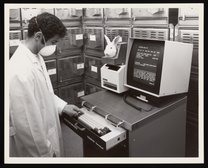
Unedited footage of an interview with chemist, toxicologist, and environmental activist Halina Szejnwald Brown, created for the television show World of Chemistry, which aired in 1988. Brief excerpts from this interview are used in the episode, "Chemistry and the Environment."
| Property | Value |
|---|---|
| Creator of work | |
| Producer | |
| Format | |
| Genre | |
| Medium | |
| Extent |
|
| Language | |
| Inscription |
|
| Subject | |
| Rights | In Copyright |
| Rights holder |
|
| Credit line |
|
Institutional location
| Department | |
|---|---|
| Collection | |
| Physical container |
|
Related Items



Cite as
Maryland, College Park University of, and Educational Film Center (Annandale, Va.). “Interview with Halina Szejnwald Brown.” Vhs, circa 1988. Science History Institute DVD and Video Collection, Box 3. Science History Institute. Philadelphia. https://digital.sciencehistory.org/works/auubqwb.
This citation is automatically generated and may contain errors.