
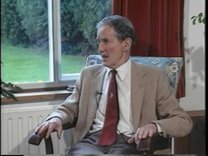
Interviews with Distinguished British Chemists: Sir Ewart Jones (unedited footage), Tapes 1-2
- 1988-Sep-05

These captions and transcript were generated by a computer and may contain errors. If there are significant errors that should be corrected, please let us know by emailing digital@sciencehistory.org.
Transcript
00:00:00 It brightened.
00:00:01 Uh-huh.
00:00:05 Problems?
00:00:06 I just got a little...
00:00:10 Okay. Never mind.
00:00:11 You're not...
00:00:12 There's one other there that is slightly...
00:00:17 What?
00:00:19 In my wide shot, I do.
00:00:21 You do?
00:00:23 Yeah. What?
00:00:24 I do have your papers.
00:00:26 Does it matter? Are you...
00:00:30 It doesn't really matter.
00:00:32 It matters to you.
00:00:33 It doesn't bother me.
00:00:34 That's right.
00:00:35 I don't think you should...
00:00:36 I mean, you can't be expected to know it all, right?
00:00:38 Memorize it.
00:00:39 No.
00:00:40 I would think this is quite...
00:00:41 What is this?
00:00:43 That's the other slightly musy one.
00:00:45 Oh, that's it.
00:00:46 All dressed up.
00:00:48 Uh...
00:00:49 Porter.
00:00:50 Porter, miss England.
00:00:51 You...
00:00:52 Fred.
00:00:53 We were born in 1911.
00:00:54 Yeah.
00:00:55 Yeah.
00:00:59 Five.
00:01:00 Four.
00:01:01 Three.
00:01:05 Can you tell me a little bit about your early life,
00:01:08 about what your parents did for a living?
00:01:11 Well, my early life, I first saw the light of day
00:01:14 in the front room of a semi-detached house
00:01:17 in a little village called Horsetothen,
00:01:20 which is near Wrexham on the Wales-England border.
00:01:25 My father was a solicitor's clerk.
00:01:28 My mother was the daughter of two well-known evangelists
00:01:32 who spent most of their life preaching up and down the country.
00:01:36 She was actually born in Stockport
00:01:38 while my grandmother was on her way
00:01:40 from the north of England down to South Wales
00:01:42 and had to get off the train and give birth to a child in Stockport.
00:01:46 So she wasn't really Welsh. She was born in England.
00:01:49 My father was born in Wales, a Welsh village.
00:01:54 Life in a little village, a population of about 1,000,
00:01:59 was dominated by the colliery,
00:02:05 mining for coal, which was half a mile away from our house.
00:02:09 That was the main view from the front window,
00:02:11 along with the Great Western Railway line to London from Birkenhead.
00:02:17 The colliery was a fascinating place to a youngster
00:02:22 because one went around and there was steam hissing here, there and everywhere,
00:02:28 things turning, and all the technology.
00:02:32 It was really very, very fascinating.
00:02:35 The pump room pumping the water out of the mine,
00:02:38 the winding gear hauling the cages up and down,
00:02:43 the blacksmith shop where they looked after the ponies
00:02:46 that hauled the wagons up and down the mine.
00:02:50 All of this was very fascinating.
00:02:52 Of course, one has to remember that in that period,
00:02:57 it was dominated, first of all, by great prosperity after First World War
00:03:01 when the miners, those of them that were working,
00:03:05 all did very well because they were working lots and lots of overtime and so on.
00:03:11 Then, of course, later on, all the disputes and troubles
00:03:16 ending up in the general strike and a great deal of poverty.
00:03:22 My father used to work in the town, Wrexham, just a few miles, two miles away.
00:03:29 This was served by an electric tramway from Wrexham to Rose.
00:03:35 Open deck at the top, great fun, of course, to climb up the top and sit on the open deck.
00:03:42 As a boy, I went to school in Wrexham at the age of five and a half on the tram every morning.
00:03:49 I didn't have to bother with the fare because my father used to travel on the tram later on
00:03:54 and I merely had to say to the conductor,
00:03:56 my dad will pay the fare and this is what happened.
00:04:00 It was a very personal service.
00:04:02 Father used to catch the tram at about ten to nine every morning.
00:04:07 The tram, if he wasn't obvious, the tram would stop and the bell,
00:04:12 and the driver would ring the bell and we'd have to go out.
00:04:15 My dad's not coming today, he's not well.
00:04:19 This was the sort of life we led.
00:04:22 I think my interest in technology was really fostered by the buses.
00:04:30 Those are the old buses with solid tyres, of course, the first buses I saw,
00:04:35 and the trams and the mine.
00:04:39 Incidentally, Bersham Colliery, which is what it was called,
00:04:42 was the place where Wilkinson got his coal from for his ironworks, which was at Bersham.
00:04:50 It was a famous ironworks and produced a lot of the cannons used in the Peninsular War
00:04:57 and the Battle of Waterloo and so on.
00:04:59 These were produced by Wilkinson's ironworks.
00:05:02 He even made his own money.
00:05:04 They were penny coins that Wilkinson's ironworks produced.
00:05:10 And there was the railway too.
00:05:12 The railway was fascinating, just about half a mile away across the field,
00:05:17 and the Great Western, of course, had a wonderful reputation for its cleanliness,
00:05:25 the bright colours, the drivers, whenever the trains stopped,
00:05:28 they would be out polishing the steam domes and the paintwork.
00:05:33 It was a very smart railway.
00:05:35 Next door to us lived the local stationmaster,
00:05:37 and he was quite a character with a long frock coat with beautiful gold gilt buttons on,
00:05:44 quite a personality.
00:05:46 It was only a one-man station, but nevertheless, he was quite a character.
00:05:50 He took all that very seriously.
00:05:53 Of course, when you went to school on the trams,
00:05:56 there was something quite different about them.
00:05:58 You had women drivers on these trams.
00:06:00 Yes, during the war, we had women drivers and conductors.
00:06:04 I can even remember a Miss Millington.
00:06:06 The name of one of them is extraordinary stuff that one does remember from these days.
00:06:11 And they had to be rather hefty women because the trams had handbrakes
00:06:15 that required quite a lot of manpower or woman power to operate them.
00:06:21 Of course, this was true in World War I for many things.
00:06:24 There were lots of jobs done by women, more so than in World War II, I think.
00:06:30 The manpower drain, of course, was so considerable.
00:06:36 Nexham was an interesting town, being a border town.
00:06:41 The only place that I know where the bus service on Sunday
00:06:45 occupied a full page in the timetable,
00:06:48 at least the bus service in a certain direction,
00:06:51 a full page in the timetable,
00:06:53 whereas on weekdays it only occupied a couple of lines.
00:06:56 The reason was that on Sundays you could go from Nexham to Farnham,
00:07:00 which was five miles, which was across the border into England
00:07:03 where the pubs were open.
00:07:05 So that was a very considerably augmented service on a Sunday.
00:07:10 Exercise everybody's concentration.
00:07:12 That's right.
00:07:13 But when you went to school, you also had some women teachers
00:07:17 because, again, the men were all fighting.
00:07:20 There was a man headmaster,
00:07:22 but as far as I recall, all the teachers were women.
00:07:27 It was only in 1919, 1920, when the people came back from the war,
00:07:33 that we began to have men teachers again.
00:07:36 But the headmaster, of course, was quite a person.
00:07:40 He was a man called Charles Dodd, M.A.,
00:07:43 Fellow of the Royal Geographical Society.
00:07:47 He was an interesting character in himself,
00:07:49 but he had three sons who were even more notable,
00:07:54 the eldest of them.
00:07:57 He became professor of theology.
00:08:00 They all won scholarships to Oxford.
00:08:02 He became professor of theology in Cambridge
00:08:04 and was the leading figure in the latest revision of the Bible.
00:08:09 He ended his days here, retired in Oxford,
00:08:12 and I knew him moderately well.
00:08:14 He was rather nice.
00:08:15 He was several years older than me,
00:08:17 and I used to remind him that his father was my headmaster at one time.
00:08:21 And the other, the younger son, the middle one died early,
00:08:25 but the younger son became professor of history in Bangor,
00:08:28 and he taught my wife history when she was up at the university.
00:08:32 That was a very interesting bit of background to the education.
00:08:37 And I went from this Victoria Boys' School, of course,
00:08:40 to secondary school after the so-called 11-plus examination.
00:08:47 This was a very important hurdle in two respects.
00:08:52 One, that it meant you got a free education, free secondary education.
00:08:59 The other was that you didn't get in to the secondary school.
00:09:07 You were then more or less condemned to leave school at 13 or 14
00:09:12 and do the best you could.
00:09:14 Probably head for the pits.
00:09:15 That's right.
00:09:16 Well, this was the main occupation when there was work,
00:09:19 was working in the mines and the various things associated with it.
00:09:23 You actually, your primary school sounds quite remarkable, actually,
00:09:27 because it doesn't sound like my idea of a primary school today.
00:09:31 You were doing lots of science in primary school fairly early.
00:09:35 You talk about some blowing some into carbon dioxide, blowing air into...
00:09:41 Yes.
00:09:43 Surprisingly, the classes were all about 50.
00:09:46 In the primary school?
00:09:48 In the primary school, very large classes.
00:09:50 But one of the things that is a vivid recollection for me
00:09:53 is that as you went down the main corridor of the school,
00:09:56 there were glass cupboards on the walls,
00:09:59 and these glass cupboards contained a lot of scientific and chemical apparatus.
00:10:04 And at the age of, I suppose, 8, 9, 10,
00:10:08 I saw the simple experiments like acid on marble chips giving carbon dioxide,
00:10:16 oxygen being produced by heating chlorate,
00:10:19 and hydrogen being produced from zinc and sulfuric acid, and so on.
00:10:23 All these kind of things were demonstrated together with physics experiments,
00:10:28 the use of, well, electrostatic phenomena,
00:10:32 use of a wind source machine to produce high voltages.
00:10:36 These things were all demonstrated to us, even by women teachers in the school.
00:10:41 Why do you think that was?
00:10:43 Was it because they were very highly educated and knew about these things
00:10:47 and could bring them into the classroom for very young children?
00:10:50 I think one has to recognize that in Wales, as in Scotland,
00:10:55 education had a very, very high priority.
00:10:58 Although my father left school at the age of 13,
00:11:01 nevertheless he, and incidentally my wife's father,
00:11:04 both belonged to the Workers' Educational Association.
00:11:07 My father was secretary of it.
00:11:09 And there was a great deal of evening activity
00:11:12 and people trying to educate themselves.
00:11:14 They missed out on the formal education,
00:11:17 but they were doing the best they could to educate themselves.
00:11:21 And they got a lot of distinguished people coming along to inspire them
00:11:24 and their reading and so on.
00:11:26 The result was our house had lots of books in it.
00:11:29 Unusual, I think, in that sort of population
00:11:32 to find a house with a literary background,
00:11:36 but there were lots of books at home, and this was a great help to me.
00:11:40 And I think it had a general effect on the educational provision that was made.
00:11:46 You didn't only see these experiments demonstrated, though.
00:11:50 You actually had to write them up.
00:11:52 Yes. This, of course, was the less useful part.
00:11:56 You had to draw diagrams of a wolf's jar, you know,
00:11:59 with its two necks and things of that sort.
00:12:01 This was kind of just part of the formal education,
00:12:05 not really very helpful.
00:12:08 And the same, of course, happened when I went to the secondary school.
00:12:12 There, there was a continuation of this scientific interest
00:12:16 in that, remarkably, we had a lecture theatre in which,
00:12:20 well, we call it a rate, a seating arrangement
00:12:23 in which the seats were stepped so that everybody could see
00:12:27 what was going on on the bench down at the bottom
00:12:30 where the chemistry and physics masters had an assistant,
00:12:34 a man called Ross Thomas.
00:12:36 And he was really very expert, as were the masters themselves,
00:12:39 in handling chemicals, handling apparatus.
00:12:42 And we learnt a great deal about the safe handling
00:12:45 of relatively dangerous materials, phosphorus and things of that sort,
00:12:50 from just watching what was going on.
00:12:53 And this happened to us from, in the secondary school,
00:12:56 Bro Park, from 12 onwards,
00:12:58 we had the benefit of seeing all these experiments expertly done
00:13:03 so that when we went into the lab ourselves,
00:13:06 we at least knew some of the sensible precautions to take.
00:13:10 So you were interested in chemistry very early.
00:13:13 When do you think you were beginning to decide
00:13:17 that this is something you would like to do for the rest of your life?
00:13:21 Was there any particular time?
00:13:23 Oh, I think up to the age of 15,
00:13:27 the most interesting thing that I had come across at that time
00:13:32 was definitely science, chemistry and physics.
00:13:35 Biology, of course, we knew nothing about.
00:13:37 That was a girls' subject.
00:13:39 We didn't do biology in school.
00:13:41 You just picked it up as best you could.
00:13:43 But chemistry and physics, yes, these were very serious things
00:13:47 and I had no hesitation by the time I was 15
00:13:51 in deciding that I wanted to specialize in chemistry, physics
00:13:55 and, of course, one had to do mathematics as well.
00:13:58 So I fairly naturally got into that line.
00:14:01 But chemistry versus physics, I didn't know.
00:14:04 In fact, I was better at physics than chemistry.
00:14:07 I had a very, very good physics master
00:14:09 who taught us extremely well and made the subject live.
00:14:12 It was very exciting.
00:14:14 And later, when I went to university,
00:14:16 I found university physics much less interesting than school physics.
00:14:22 School physics had been very experimentally based.
00:14:25 The theory had only been an adjunct of the experiments.
00:14:29 But in university, so much more seemed to be attached to theory
00:14:33 and I found this much less interesting.
00:14:36 But aside from going to school, what other activities did you have?
00:14:40 What was it like after school?
00:14:42 Did you do anything, games or other sports, fishing?
00:14:47 You couldn't spend all your time on academic work.
00:14:51 No, most of the activities were outdoor activities
00:14:57 when the weather was clement, that is, playing games,
00:15:00 particularly cricket, tennis, not so keen on football.
00:15:06 And, of course, in the winter one had various indoor activities
00:15:12 and I can well remember, of course, the early 1920s
00:15:18 fiddling around with crystal sets.
00:15:20 You had one famous boxer that...
00:15:23 Oh, yes.
00:15:25 We weren't interested in boxing.
00:15:27 Professional boxing was regarded as a rather rough business
00:15:32 and low-down business.
00:15:34 There was a man called Johnny Basham.
00:15:36 I'm sure that wasn't his real name.
00:15:39 But he fought with Ted Kid Lewis for the world title
00:15:43 sometime in the early 20s, I think.
00:15:46 And he was occasionally to be seen around the town.
00:15:48 He was a horrible-looking character with these cauliflower ears and so on.
00:15:53 It put one off boxing.
00:15:54 But, of course, watching football was quite a thing.
00:15:57 Wrexham was quite a good team
00:16:01 eventually in the Birmingham League and then in the Third Division.
00:16:05 But, of course, the great thing was to go to Liverpool
00:16:08 and see either Liverpool or Everton play.
00:16:11 This occasionally happened.
00:16:13 I was taken there to see a First Division match.
00:16:15 That was very, very exciting.
00:16:17 Because Liverpool was our big city.
00:16:21 It was the one that we really knew.
00:16:23 Christmas shopping, you went to Liverpool for that.
00:16:28 My father at one time was not well
00:16:31 and was advised to have some sea air.
00:16:35 One thing we used to do was to go to Liverpool on the train
00:16:38 and then take a paddle steamer from Liverpool to Flandindo and back.
00:16:43 A day trip in the St Marguerite, I think it was called.
00:16:48 This was quite interesting.
00:16:50 It could be very rough too.
00:16:52 But the big attraction in Liverpool, of course, was the shipping.
00:16:55 It was, after all, the major port of the country.
00:16:58 At the end of the First World War,
00:17:01 it was a wonderful sight to see the four-funnelled Aquitania,
00:17:05 Mauritania, the three-funnelled White Star,
00:17:08 Olympic, Majestic,
00:17:11 all of these in their wartime camouflage.
00:17:14 Then later on we saw them assume their proper colours,
00:17:17 the punard red and black and so on.
00:17:22 The river at Liverpool was just alive with exciting craft.
00:17:27 We used to go across on the ferry boat.
00:17:29 The ferry boat, of course, was a tiny thing
00:17:32 compared with these huge liners that were all nestling up against the quay.
00:17:37 There were electric railways, of course.
00:17:39 The overhead railway to Southport went along the docks.
00:17:42 You could see all the dockyards in Liverpool.
00:17:45 Very, very exciting in those days.
00:17:48 Nothing much so interesting now.
00:17:50 You had a very interesting medical experience too while you were growing up.
00:17:55 I found it quite horrifying to read about,
00:17:57 but you talk about it quite lively.
00:18:00 Well, I suppose at that age I remember
00:18:03 I was just trying to think how old I must have been,
00:18:06 probably about nine or ten.
00:18:10 I went with my father one morning to the doctors,
00:18:14 and the doctor was known as Colonel Davies.
00:18:16 He was ex-Royal Army Medical Corps.
00:18:20 My tonsils were excised.
00:18:23 I sat in the chair, and I was held down by the doctor's chauffeur.
00:18:26 He, with a long guillotine, took my tonsils out.
00:18:31 Did what?
00:18:33 I got some tablets, and I went to school.
00:18:35 I was very notable for coughing up blood during the day.
00:18:40 Everybody was very impressed with this.
00:18:42 I didn't think anything very much of it.
00:18:44 The only thing that hurt was actually being held down and having them taken out.
00:18:49 I think I was feeling better after having got rid of the tonsils
00:18:52 because I had more discomfort beforehand.
00:18:55 But medicine, of course, was relatively primitive in those days.
00:19:00 The local doctor did most of the surgery.
00:19:03 There were very few specialists around.
00:19:05 You had to go to Liverpool to find specialists in various things.
00:19:11 But around about the age of 15,
00:19:14 you had to start thinking about whether you would be going on for further education,
00:19:19 and it wasn't always certain that you would continue, was it?
00:19:23 No. Well, my family situation was affected.
00:19:26 My father and my sister and my grandmother all died within three years,
00:19:30 and so our family was reduced from five to two.
00:19:34 My mother married again, fortunately, in not too long a time.
00:19:40 My stepfather was a master at the school.
00:19:44 He was a mathematics master,
00:19:47 and it was assumed that I would try to go on to further education from school.
00:19:55 So at the age of 15, I just stayed on in school and did the advanced level.
00:20:02 But where I would go after that, if anywhere,
00:20:06 depended entirely on getting enough money to be able to pay the cost of going to university.
00:20:13 I would, I think at one stage, have liked to have been a doctor,
00:20:18 but to get a medical education in those days was quite impossible.
00:20:23 There was no scholarship where you couldn't win scholarships to get a medical education.
00:20:28 The only way you could get it was by having parents who had enough money
00:20:33 to see you through a university course.
00:20:37 Of course, this was six years for medicine, so it was very expensive.
00:20:41 It was slightly galling for me.
00:20:43 I coached the local doctor's son in his first 10B exam in chemistry to help him get through.
00:20:50 It was slightly galling. I would have liked to have been doing it myself.
00:20:54 I gave him some assistance in that.
00:20:58 Anyway, life was such that one had to win scholarships and so on.
00:21:04 Unfortunately, I did manage to accumulate enough in the way of scholarships and exhibitions
00:21:10 together with a teacher's training grant.
00:21:13 This was the key to it, accepting a grant from the Board of Education
00:21:19 to be trained as a teacher.
00:21:22 Three years of university education followed by a year as diploma.
00:21:26 This I undertook to do, and it guaranteed me a fair amount of support for my university days.
00:21:33 Together with, I won the top scholarship in Bangor, which was quite a help,
00:21:38 and a county exhibition on top of that.
00:21:41 Altogether, I was not badly offered at university.
00:21:46 I did manage to supplement it for quite a period, six years actually,
00:21:54 as a correspondent for the Guardian, Manchester Guardians.
00:21:57 It was known in those days.
00:21:59 I used to write up the weekend sporting activities for their Tuesday feature.
00:22:05 They had a feature in the Guardian, Sport in the Universities,
00:22:08 and I used to do the Bangor section.
00:22:17 Getting to university?
00:22:19 Well, we've got through primary school and secondary school,
00:22:24 and you talked about the science experiments.
00:22:40 I didn't ask you about corporal punishment.
00:22:43 I didn't think we should...
00:22:46 I have nothing to say about that, except that it was a very useful deterrent.
00:22:51 I believe in it.
00:22:53 My son is a schoolmaster, and fortunately he's a big, hefty fellow,
00:22:59 and he doesn't have to use any corporal punishment.
00:23:02 I think just moving around in the class is enough, or was enough.
00:23:05 He's a principal now.
00:23:07 I went to school in Scotland, and of course they used the toss.
00:23:10 I grew up with that.
00:23:12 He was never abused in my experience, never abused,
00:23:15 and did serve as a deterrent.
00:23:25 There was a hop every Saturday night, seven to ten, sixpenny hop.
00:23:30 We had a dance band and so on.
00:23:33 And at this, I would... I mean, I was playing myself.
00:23:38 You see, I would be playing in the hockey team,
00:23:40 and I had to find out how the rugby team and the soccer team
00:23:43 and the women's netball and the women's hockey, how all these got on.
00:23:46 So at the dance in the evening, I would be finding out,
00:23:50 asking my friends, you know,
00:23:53 who scored today, what sort of a game was it, and things of this sort.
00:23:57 You did actually get the scholarship that you needed to go to the university.
00:24:02 Can you tell us about the scholarships that you won?
00:24:05 Oh, I can tell you about the value of 40 pounds a year,
00:24:08 which doesn't sound very much,
00:24:11 but actually the best grant you could get in those days,
00:24:17 best scholarships you could win at universities,
00:24:19 were in the region of £100.
00:24:21 If you came to Oxford and got one of the top scholarships, you got £100.
00:24:25 So £40 a year was big money.
00:24:28 It was really quite helpful
00:24:31 and certainly enabled me to live moderately comfortably in the university.
00:24:37 Of course, Bangor is a relatively small place
00:24:41 with few opportunities of spending money.
00:24:48 One lived in a very modest way,
00:24:51 and the general costs in the university were low.
00:24:55 I didn't mention anything about why I went to Bangor.
00:25:00 Bangor was the most convenient.
00:25:03 It was the cheapest place that I could get.
00:25:05 It was the place where I stood the best chance of getting scholarships.
00:25:09 But, strangely enough,
00:25:12 it had one of the best chemistry departments in the country,
00:25:15 and this was not a factor that I fully appreciated at that time,
00:25:19 but I did have some knowledge that chemistry was a very good,
00:25:23 a very well-taught and researched subject in Bangor.
00:25:28 I should say a little, of course, about the financial side,
00:25:34 in that I was helped by being a correspondent to the Manchester Guardian.
00:25:38 And there, a job was passed on to me by one of my former schoolmates.
00:25:45 When he left, he gave me this introduction to the Manchester Guardian,
00:25:51 and I used to write a thing for them every Sunday,
00:25:56 put in the mail on Sunday night,
00:25:58 and it appeared in the Guardian's university sports section on Tuesdays.
00:26:04 And in that, I recalled as best as I could
00:26:08 the information about the performances
00:26:11 in the various sporting activities on the previous Saturday.
00:26:15 The way I accumulated the information
00:26:18 was that we had a Saturday hop, seven till ten, sixpence,
00:26:24 quite a good dance band,
00:26:26 and there I would talk to the people I knew in the soccer, rugby,
00:26:33 women's netball, hockey teams, and find out what went on,
00:26:37 and proceed to write this up on Sunday and send it off to the Guardian.
00:26:42 Can you remember how much it paid?
00:26:45 Oh, not an unsatisfactory amount.
00:26:48 It was definitely paid by the line, and it was edited, of course.
00:26:52 If I was too verbose,
00:26:54 then I found I only got half as much space as I thought I deserved,
00:26:58 and so the amount was variable,
00:27:00 but I suppose it must have turned about ten shillings, fifteen shillings a week.
00:27:07 Got a check every month from the Guardian for this.
00:27:13 I mentioned the Saturday hops,
00:27:16 and of course one of the features that some of us found very pleasant at Bangor
00:27:21 was that the college as a whole had about 600 students,
00:27:25 and there were more women than men.
00:27:28 There were 300-odd women and 200-odd men.
00:27:32 This, of course, was very advantageous from the male point of view.
00:27:36 We had a good time, thoroughly enjoyed ourselves.
00:27:41 It was not a disadvantage to be non-Welsh-speaking.
00:27:47 Nowadays in North Wales, Welsh-speaking is regarded as essential,
00:27:53 but in those days there was a very considerable English population that came to Bangor.
00:27:58 It was a very nice place, beautiful climate,
00:28:01 never got any snow.
00:28:03 Snow on the mountains, on Snowdon, but no snow down at sea level.
00:28:08 It was a very pleasant place to be, rather wet,
00:28:11 but the services to London and everywhere else were excellent.
00:28:15 The Irish Mail went through every twice a day,
00:28:19 and you could get post onto it, and they got into London about four hours later.
00:28:24 It was a very advantageous place from that point of view.
00:28:27 What I didn't fully appreciate until years afterwards
00:28:33 was how lucky I was to go to Bangor and do chemistry.
00:28:37 I understand that it had a fine chemistry department,
00:28:40 but I didn't know a lot about it.
00:28:42 But later on I realized how fortunate I was to have been there.
00:28:47 It's record in terms of people who held the chair in British universities.
00:28:56 We have a limited number of professors,
00:28:59 only one in those days in each university.
00:29:04 The people who held the chair in Bangor, right up to the present time,
00:29:08 have always been fellows of the Royal Society.
00:29:11 Whereas in the University of Wales, which has its four constituent colleges,
00:29:15 up to the time until quite recently,
00:29:18 I think no other professor of chemistry had been a fellow of the Royal Society.
00:29:23 But everyone in Bangor, right up to the present time,
00:29:26 and that includes six people.
00:29:28 Dobby, Orton, Simonson, Hughes, Peat and Sterling.
00:29:33 All fellows of the Royal Society.
00:29:35 Sterling only about two years ago,
00:29:37 which was quite interesting in maintaining this remarkable record.
00:29:43 When I was first appointed to be a professor,
00:29:47 which was in 1947 in Manchester,
00:29:51 at that time there were 43 professors of chemistry in Britain altogether.
00:29:57 In all the universities.
00:29:59 And of these, six were Bangor students.
00:30:04 It's quite a remarkable proportion.
00:30:07 When you think of the size of the departments in Manchester,
00:30:10 Birmingham, Imperial College,
00:30:13 not so much Cambridge and Oxford,
00:30:15 because they didn't count for much in those days.
00:30:17 But the provincial universities were quite big,
00:30:20 and yet they didn't provide as many professors as one might have expected.
00:30:26 What age were you when you started your undergraduate studies in Bangor?
00:30:30 Eighteen.
00:30:31 Eighteen.
00:30:32 And you took what, physics, mathematics, chemistry?
00:30:35 Physics, chemistry and mathematics in the first year.
00:30:38 And I found the physics so uninteresting
00:30:43 that at the end of the first year I decided to stay
00:30:46 and do pure mathematics for the second year,
00:30:49 which is what I did.
00:30:50 And then chemistry alone in the third year.
00:30:53 That was the normal progression.
00:30:55 Was it all teaching,
00:30:57 or were you already beginning to do some research projects at this time?
00:31:02 Oh, one big advantage of a small department
00:31:06 is that everybody knew everybody else.
00:31:09 One very quickly knew the four members of staff.
00:31:12 There were only four.
00:31:14 And the research students, there weren't all that many around.
00:31:17 You soon got to know them.
00:31:19 And inevitably one found oneself doing odd jobs
00:31:24 that were related to the department.
00:31:25 And one of the thrills for me in my first year
00:31:28 was being asked to make some, oh, I think 500 grams of acetalbromide,
00:31:34 pure acetalbromide, for Ted Hughes.
00:31:38 Well, Ted Hughes was known to the scientific community as E.D. Hughes,
00:31:43 and he's the Hughes of Hughes and Ingold,
00:31:46 who made very important contributions
00:31:49 to our understanding of substitution reactions
00:31:51 in SN1, SN2.
00:31:53 These are associated with the names of Hughes and Ingold.
00:31:57 And Ted Hughes was just finishing his Ph.D.
00:32:00 when I was in my first year,
00:32:02 and I had this job of making some material for his research,
00:32:05 which, of course, was very exciting
00:32:07 because when I was making it,
00:32:09 I was walking in and out of his research lab
00:32:11 and seeing what he was doing.
00:32:13 It was a connection that is very much lost today.
00:32:17 The undergraduate in the present-day university
00:32:20 has very little contact with the people doing...
| Property | Value |
|---|---|
| Creator of work | |
| Place of creation | |
| Format | |
| Genre | |
| Medium | |
| Extent |
|
| Language | |
| Subject | |
| Rights | In Copyright |
| Rights holder |
|
| Credit line |
|
Institutional location
| Department | |
|---|---|
| Collection |
Related Items
Cite as
American Chemical Society, and Royal Society of Chemistry (Great Britain). “Interviews with Distinguished British Chemists: Sir Ewart Jones (Unedited Footage), Tapes 1-2.” U-matic (tm), September 5, 1988. American Chemical Society Audiovisual Collection. Science History Institute. Philadelphia. https://digital.sciencehistory.org/works/8ex7nz5.
This citation is automatically generated and may contain errors.