
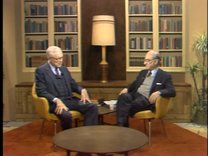
Reflections by an Eminent Chemist: Paul Flory Interview (master copy) Reel 2 of 2
- 1982

These captions and transcript were generated by a computer and may contain errors. If there are significant errors that should be corrected, please let us know by emailing digital@sciencehistory.org.
Transcript
00:00:00 Well, I want to ask a few questions of a general nature. The dedication that is required from
00:00:20 an individual to be one of the best scientists in the world, to win the Nobel Prize, as you
00:00:29 have done. It's often been said that to do that and have any sort of family life and raise a
00:00:41 family is extremely difficult. I don't think it really should, the question really should be
00:00:48 limited to scientists necessarily, because I think it's true that there are other areas of
00:00:55 endeavor besides science. Do you have any comment to make on that? You ought to ask my family. It
00:01:08 does involve sacrifices, I suppose sacrifices for the whole family. If I could interject that I'm
00:01:18 using recollection when my son was about six or seven. He was traveling with his mother to visit
00:01:26 his grandparents, and they went by taxi to the home of my wife's parents, and he struck up a
00:01:38 conversation with the taxi driver. Suddenly he asked, mister did you ever write a book? And he
00:01:47 said, who me? Well, my daddy is and it's terrible. It did spill over on the family, I suppose. I hope not
00:02:02 in a damaging way. Well, from what I personally know about your good wife, she's been a loyal
00:02:15 trooper in every sense of the word. More than that. A source of inspiration in subtle ways, I'd say.
00:02:23 Well, I think the real answer to a question of that sort is an individual one, and I thank you for sharing your
00:02:34 thoughts on the matter. The advent of science policy in the federal sector, which we have had in part since the
00:02:57 Second World War, has run a kind of a spectrum of endeavors. President's Science Advisors, National Science
00:03:11 Foundation, National Science Foundation Board, all of the input of the Academy of Science to issues of substance
00:03:25 which border on policy decisions. Always controversial matters in some cases. Are we doing a satisfactory job, or
00:03:42 should we be doing more? Is science policy more or less agreed upon as something other than evil at the present time? And we have
00:03:57 various ways of exercising, or at least voicing our opinions. Do you have any comments in general on this?
00:04:09 We need to do much more. I think we've evolved. We now have an established, compared with say, pre-1950, we now have an established
00:04:23 National Science Foundation with a National Science Board. The National Academy of Sciences has become much more active, both
00:04:31 directly and through its National Research Council. Successive presidents have become more active in national affairs. There was a time
00:04:42 when they felt it was incumbent on the Academy to maintain an aloofness, except when asked for an opinion. That is no longer, that proviso is
00:04:53 no longer altogether fully accepted or practiced. And I think now we have a new president of the National Academy of Sciences, Frank Press, who
00:05:06 with his years in Washington as a science advisor to President Carter, it's almost a certainty that he will play a more active role in national affairs.
00:05:19 The Office of President's Science Advisor has been downgraded over the, during the past decade, let's say, without any reflections on the
00:05:33 incumbents in that office, but it simply isn't as close to the center of power as it was in perhaps a decade ago. But then there are these other
00:05:46 avenues which have been strengthened. Science policy means different things to different people. You have properly, I think, highlighted the
00:05:58 importance of policies which involve a science component, or national issues, which have a strong science component. As to some, science policy means
00:06:13 how much, how big will a science budget be next year? That's not an unimportant matter, to be sure. The public awareness of science, well, there's
00:06:28 been much anti-science, there still is, which needs to be combated because science is surely going to be needed more, even more in the future than in the
00:06:41 past. And that tends to impair the detachment of science, which in a sort of, in the best of all universes would be, science would be detached. We would like to
00:07:01 work in a detached situation, but seldom can we. I don't know what more to say on this. It's a many-faceted problem. Public recognition of science, education in
00:07:13 science, broader education in science are urgent priorities at the present time. I certainly agree with you, and clearly the general theme that is being enunciated, I don't know that it stems from
00:07:32 any one source, but certainly Frank Press has been partially responsible, is the fact that if we don't have enough basic science, we lose a resource eventually, and do not compete well in the world scene. What about professional societies? American
00:07:57 Chemical Society, American Physical Society, they have evolved over a period of time in what they do and how they do it. There are interesting combinations of things as allegedly non-political bodies, but they do have interest in science policy, interest in congressional action,
00:08:26 funding the Appropriations Committee. The American Chemical Society has a very large publications program. Are there directions that the societies are taking which may hurt them in the long run, or are there directions in which they need to go in terms of both concrete science and technology as well as
00:08:56 science policy? You touched on the publications, American Chemical Society, American Physical Society. They hold the responsibility for our primary, principal, core science publications which serve a purpose of communicating science to other scientists, communication between scientists,
00:09:26 for the documenting science for future generations, the repository function. This is exceedingly important. It's exceedingly important in the first instance for science, but if one observes that science is important to society, then it's important to society as well.
00:09:53 Our science societies carry a very great obligation and responsibility in this whole area of science publication. I'm sure there's more they could do. I would mention two aspects.
00:10:14 One is the proliferation of scientific journals and publication. Means need to be found for consolidating scientific information and packaging it in a way that it can be stored and yet remain accessible. Much to be done here is partly technological, not entirely.
00:10:41 There are too many journals. That's easy to say. It's very hard to weed out the ones that shouldn't be. They aren't all, many of those are not published by the scientific societies.
00:10:51 There's another function that perhaps isn't carried fully to the extent that it should be, and that is publications which of science expressed, communicated in terms of public and large, or large segments of the public outside of science can grasp and understand.
00:11:22 Steps have been taken. The American Association for the Advancement of Science has their new journal Science. It's now Science 80, Science 81, Science 82 this year, which is a move in this direction. Perhaps even more. The American Chemical Society has had and continues to have publications in this area. That, I think, is very important.
00:11:49 If we go back to the field of polymers and macromolecules, and we've seen that there were very few journals 50 years ago, and now in virtually every country, there are one or more journals in polymer science.
00:12:06 Do you have any opinion about the adequacy of this, or are there already too many journals in polymer science?
00:12:16 Obviously, the outlets, the demand for outlets have increased without necessarily a corresponding increase, necessarily, in quality of publication.
00:12:37 But it may stem from some nationalism, from some need for an area to have a rapid outlet.
00:12:48 You have this enormous eruption of Japanese activity and their desire to publish in English, or not necessarily in Japanese, in a language which is more universally read than Japanese.
00:13:11 One can say it's the law of supply and demand, but I'd like any comments you might have with me.
00:13:21 I think our number of publications is about adequate in the polymer field worldwide, recognizing the considerations you bring up.
00:13:32 It's easy to say, and it's certainly true, that much is published that isn't worth publishing. That's easy to say.
00:13:42 But who has the wisdom to distinguish and pass judgment on what should not be published? That's, as you well know, a very difficult matter.
00:13:56 And we tend to incline, I think, to favor erring on the side of perhaps publishing a little too much, rather than suppressing publication to a degree that would preclude publication of some which at first appearance might seem to be unsuitable or not meet requirements.
00:14:23 Sometimes I think we err too far in accepting below standard material, but that's an exceedingly difficult task for an editor.
00:14:38 I think we have enough journals now for polymer science going at the level that it is.
00:14:48 As you look down the next five years, and having looked at this polymer science and engineering report that we've talked about before, where do you see the cutting edge of polymer chemistry apt to be in five years?
00:15:12 Well, that's a very difficult question, because you have to qualify it. But from your own rather broad viewpoint, and also your background in the use of polymers, where do you think there will be extra effort made?
00:15:35 Well, there are a couple of questions. One here concerning the direction of polymer science, pure science.
00:15:42 I would refuse to make predictions, because I think the really innovative and novel approaches, new lines of research, depend on people.
00:15:59 Someone has an idea, conceives a new idea, a new concept, a new theory, or a new method, whatever. And that depends on the creative process, which is almost completely unpredictable. It depends on the people.
00:16:16 My concern should be that we have enough creative people in the field, so that these new things of whatever direction, whatever direction, will emerge over the next five, ten years, and so on.
00:16:32 I think it's urgently important that creative people, whatever that term means, motivated people, with the dedication and reasonable mental capability, will be attracted to the field and devote themselves, think hard about issues and questions and observations that come to their attention.
00:17:02 And out of this will come new theories. Where they will be is hard to say.
00:17:06 Now, one can make, as to where we'll go in the next five years, if it's worth making prognostications, the way to do it is to look around and see who's doing good work today, and say, well, he'll probably continue good work at least for five years, so this is a valid direction.
00:17:27 Turning to technology, I have some general ideas.
00:17:32 In the chapter of this book you wrote, in the chapter for this book that the Academy published on, what is it, science?
00:17:44 The Science of Macromolecules?
00:17:46 Yes. You have a little bit of that, if I remember the text.
00:17:51 I think polymers will, well, let's go to the past, the recent past.
00:17:58 Polymers have appeared in profusion since, say, 1930, or not to choose a precise date, you might prefer 1940.
00:18:11 They appeared in profusion, in many kinds, in mass volume, polypropylene, polyethylene, in enormous tonnages, nylon, enormous quantities.
00:18:22 And the goal was, and has been, to develop polymers and manufacturing methods so that these polymers can be produced in large quantity at low cost.
00:18:35 And this was certainly an admirable goal, and achieved much for the benefit of mankind, and especially for those in the underdeveloped countries, in the poorer countries.
00:18:49 The polymers have provided cheaper substitutes, very desirable.
00:18:54 I think the trend in the future, with the necessity to conserve on raw materials, is going to be in the direction of more specialized polymers.
00:19:05 Polymers that will last long and carry a high value, at least a high use value, and probably a high cost value.
00:19:15 Very high strength, unsurpassed physical and mechanical properties, unsurpassed special properties for physiological applications.
00:19:34 Perhaps not always as exotic as artificial organs, but to include them.
00:19:40 I think there will be the specialty applications.
00:19:43 Polymers admit of the greatest variation in precise control and structuring and so on.
00:19:51 The constitutional variables, at the chemical level, are so great compared with other materials such as metals.
00:20:02 The variations are enormous.
00:20:07 And we have only to see what nature has done with polymers to recognize this, if we can't discover it for ourselves.
00:20:16 There are enormous possibilities for special polymers to do things which we haven't even thought about.
00:20:22 I think, if I have to make a prediction, I think the future may lie in that direction.
00:20:30 Well, I certainly have enjoyed this conversation.
00:20:39 Well, I have too.
00:20:41 It's nice to talk to a friend.
00:20:43 And I thank you from the bottom of my heart and for the American Chemical Society for stopping in Ann Arbor to do it.
00:20:51 I think it will be an important part of the archival material.
00:20:56 And I think it's important that she would be willing to take the time to do this.
00:21:01 Well, thank you, Charlie.
00:21:03 It's a pleasure and a privilege to participate in this program.
| Property | Value |
|---|---|
| Creator of work | |
| Format | |
| Genre | |
| Medium | |
| Extent |
|
| Language | |
| Subject | |
| Rights | In Copyright |
| Rights holder |
|
| Credit line |
|
Institutional location
| Department | |
|---|---|
| Collection |
Related Items
Cite as
American Chemical Society. “Reflections by an Eminent Chemist: Paul Flory Interview (Master Copy) Reel 2 of 2.” Open reel videotapes, 1982. American Chemical Society Audiovisual Collection. Science History Institute. Philadelphia. https://digital.sciencehistory.org/works/8cs5xn1.
This citation is automatically generated and may contain errors.