
Oral history interview with Samuel Natelson
- 1998-Feb-26
Oral history interview with Samuel Natelson
- 1998-Feb-26

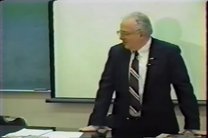
Samuel Natelson begins the interview with a discussion of his family background and childhood in Brooklyn, New York. After receiving his Ph.D., he began his career teaching at Girls Commercial High School. While maintaining his teaching position, Natelson joined the Jewish Hospital of Brooklyn in 1933. Working as a clinical chemist for Jewish Hospital, Natelson first conceived of the idea of a society by and for clinical chemists. Natelson worked to organize the nine charter members of the American Association of Clinical Chemists, which formally began in 1948. A pioneer in the field of clinical chemistry, Samuel Natelson has become a role model for the clinical chemist. Natelson developed the usage of microtechniques in clinical chemistry. During this period, he served as a consultant to the National Aeronautics and Space Administration in the 1960s, helping analyze the effect of weightless atmospheres on astronauts' blood. Natelson spent his later career as chair of the biochemistry department at Michael Reese Hospital and as a lecturer at the Illinois Institute of Technology. He then became an adjunct professor at the University of Tennessee's College of Veterinary Medicine. Natelson concludes his interview with thoughts on the future of clinical chemistry and reflections on his career and family.
| Property | Value |
|---|---|
| Interviewee | |
| Interviewer | |
| Place of interview | |
| Format | |
| Genre | |
| Extent |
|
| Language | |
| Subject | |
| Rights | In Copyright |
| Rights holder |
|
| Credit line |
|
About the Interviewer
James G. Traynham is a professor of chemistry at Louisiana State University, Baton Rouge. He holds a PhD in organic chemistry from Northwestern University. He joined Louisiana State University in 1953 and served as chemistry department chairperson from 1968 to 1973. He was chairman of the American Chemical Society’s Division of the History of Chemistry in 1988 and is currently councilor of the Baton Rouge section of the American Chemical Society. He was a member of the American Chemical Society’s Joint-Board Council on Chemistry and Public Affairs, as well as a member of the Society’s Committees on Science, Chemical Education, and Organic Chemistry Nomenclature. He has written over 90 publications, including a book on organic nomenclature and a book on the history of organic chemistry.
Institutional location
| Department | |
|---|---|
| Collection | |
| Oral history number | 0166 |
Related Items


Interviewee biographical information
| Born |
|
|---|---|
| Died |
|
Education
| Year | Institution | Degree | Discipline |
|---|---|---|---|
| 1928 | City University of New York. City College | BS | Chemistry |
| 1930 | New York University | ScM | Chemistry |
| 1931 | New York University | PhD | Chemistry |
Professional Experience
New York University
- 1928 to 1931 Instructor
New York Testing Lab
- 1931 to 1932 Research Chemist in-Charge
Jewish Hospital of Brooklyn
- 1933 to 1949 Research Biochemist
Brooklyn College
- 1947 to 1949 Lecturer
- 1957 to 1965 Lecturer
Rockford Memorial Hospital
- 1949 to 1957 Chair, Department of Biochemistry
St. Vincent's Hospital (Sydney, N.S.W.)
- 1957 to 1958 Chair, Department of Biochemistry
Roosevelt Hospital (New York, N.Y.)
- 1958 to 1965 Chair, Department of Biochemistry
New York Polyclinical Medical School and Hospital
- 1962 to 1965 Lecturer
Michael Reese Hospital
- 1965 to 1979 Chair, Department of Biochemistry
Illinois Institute of Technology
- 1971 to 1979 Lecturer
University of Tennessee (System)
- 1979 to 1999 Adjunct Professor, College of Veterinary Medicine
Honors
| Year(s) | Award |
|---|---|
| 1961 | Van Slyke Award in Clinical Chemistry |
| 1965 | Ames Award, American Association of Clinical Chemists |
| 1971 | Science Award, Illinois Clinical Lab Associates |
| 1972 | Chicago Clinical Chemistry Award |
Cite as
See our FAQ page to learn how to cite an oral history.
TRAYNHAM: From what I have read, I’ve learned that you were born on February 28, 1909, in Brooklyn. Can you tell me something about your early childhood and your family situation in Brooklyn?
NATELSON: Well, I was a consultant to the National Aeronautics and Space Administration. They had me investigated. They came to me and said to me, “You have two birthdays: February 27, 1909 and February 28, 1909.” I said, “How did you get the first one?” They said, “We got it from your father’s prayer book.” He used to write in his prayer book the time and date that each child was born. He had me down for February 27. Well, it so happened that I must have been a difficult delivery. The nurse who reported my birth at the hospital put down February 28. That’s how I happen to have two birthdays.
TRAYNHAM: Which one do you celebrate?
NATELSON: I usually put down February 28, because that’s on my birth certificate. Now, I never found out that I had two birthdays until I was of marrying age.
TRAYNHAM: Did you attend public schools in Brooklyn?
NATELSON: Yes. I attended the public schools in Brooklyn.
TRAYNHAM: Where did you go to high school? Was this in Brooklyn?
NATELSON: In Brooklyn, at the Eastern District High School. It was a class A high school for gifted children. I had the highest I.Q. in the school.
TRAYNHAM: What was your father’s business?
NATELSON: My father was, as he considered, in the only good business. He was a tailor. He would design clothes and get them out, and then baste them together. He would insult anybody by calling them a basting puller—someone who just pulled the basting. There’s a famous anti- Semitic poem that was written by some anti-Semite. He said, “Rosenbaum—he was a fighter. But a sword he never drew. He said, ‘The hell with fighting. It’s no business for a Jew. Butcher, baker, clux operator. Those are jobs of great renown.’ At the Battle of Manila, he was killing bedbugs on the pillow. Oh, what a fighter was Rosenbaum.” Well, you can see the background of that.
TRAYNHAM: What was your father’s name?
NATELSON: My father’s name in English was Max, but in Hebrew it was Menach Mendel.
TRAYNHAM: What was your mother’s name?
NATELSON: My mother’s name was Bashahenna. She had no other name except her Hebrew name. Bessie Ann—Betty Ann, if you want to call it that.
TRAYNHAM: Was she employed outside the home?
NATELSON: No. She had ten children.
TRAYNHAM: I see. She had a busy day. [laughter] Well, when you graduated from high school, what did you do then? Did you go directly to college?
NATELSON: Well, at that time you had to have an eighty-five average to get into City College.
I had the average, and I went to college. In order to get to college, I had to walk about a mile to the Lexington Avenue El. Do you remember the Lexington Avenue El? It left me out at City Hall. Then I’d walk across the area there and get to a subway, and take the “midnight express.” That’s what our nickname for it was. It was all Blacks. I had to be at 137th Street. You can see it took me a long time to get to school.
TRAYNHAM: Was this City College of New York that you went to, then?
NATELSON: Yes.
TRAYNHAM: Did you spend all of your undergraduate college years there?
NATELSON: All my undergraduate college, yes.
TRAYNHAM: Did you major in chemistry while you were at City College?
NATELSON: Well, I wasn’t there long enough. I did it in about three and a half years. I majored in physics, mostly.
TRAYNHAM: How did you happen to become interested in science, coming out of the kind of background you had?
NATELSON: I got a fellowship at NYU through the head of the department. I was recommended by Professor Stevenson, who was a professor at City College in physical chemistry.
TRAYNHAM: You went on directly from college to graduate school at NYU, then.
NATELSON: Well, the graduate school was NYU. By the time I got through NYU, I had published five papers. All of them were blockbusters. I made a lot of people rich.
TRAYNHAM: Including yourself, I hope.
NATELSON: No, not myself. That’s the trouble.
WARSHAW: Sam, when you were in high school, what drew your attention to chemistry and physics?
NATELSON: I was always interested in science. I would look up in the sky and say, in Hebrew, “Shine, shine little star. How I wonder what you are. Up above the world so bright, like a diamond in the sky.” Do you remember that poem?
In those days, there were street lighters who came around and lit the posts. The city was lighted by gas. If you looked up to the sky, the stars looked very close to you. I have felt an affinity for the stars.
TRAYNHAM: Well, when you were at NYU in graduate school, what led you to pick organic chemistry as your specialization?
NATELSON: Well, the professor I had in organic chemistry [Joseph B. Niederl] was about the best man they had on their faculty. I wanted to be like him, so I went into organic chemistry. My first papers I published were on how to make rose oil by condensing ethylene oxide with benzene (1). I didn’t realize that I had a blockbuster. Everybody jumped at that. They were trying to find out some way to make rose oil, which is a phenyl ethyl alcohol. Then I converted it to styrene resins. I dehydrated it. That was another patent, which I messed up.
I used a patent attorney by the name of [George B.] Oujevolk, who was a very nice guy, but that’s about all. He was not clever. He was very strict with me about what I wrote. As a result, his patents were weak and were easily broken. I did not get the benefits of any of my patents. I have about forty or fifty patents.
TRAYNHAM: When you graduated from NYU with your Ph.D., did you get a master’s degree on the way?
NATELSON: I got a master’s degree on the way, just as a matter of fact. They didn’t give me a master’s degree. They gave me an Sc.M., which stood for master of science. Then I went on. I was very stupid in my handling of these patents. You see I had a rat for a professor, [Joseph B. Niederl]. He was a low-down character.
TRAYNHAM: Would he have been the one whom you thought was the best one in the department?
NATELSON: Well, I didn’t know who was the best one. I just knew that he was looking for students. I was a student, so he told me to go. He gave me a problem. I was to condense ethylene oxide. He told me to make rose oil, which I did. I didn’t realize that I had made a very important contribution. These were simple things to me.
TRAYNHAM: When you graduated, you said you already had several publications.
NATELSON: I had about five publications.
TRAYNHAM: Five publications, yes. What was your first employment after getting your doctorate?
NATELSON: I went into teaching high school. I had the misfortune of having a brother who was a history teacher in high school. He told me that the salary was very good, the jobs were very easy, and a lot of people who had Ph.D.s went into high school teaching. I went into high school teaching and started teaching chemistry and general science.
TRAYNHAM: It must have been unusual in those days for a high school chemistry teacher to have a Ph.D.
NATELSON: I don’t know if it was unusual. No, it was not so unusual. As a matter of fact, the objective of many Ph.D. candidates was to pass the exam and get into the high school system, because they paid so well compared to industry at that time.
TRAYNHAM: Oh, really? There is quite a difference now, though, in the pay.
NATELSON: Do you think there’s a difference? I don’t know about that. I think that the public school system generally pays a little better than, on an average, the college. College teachers are very much underpaid.
TRAYNHAM: Do you remember the name of the high school where you started teaching?
NATELSON: Girls Commercial High School. [laughter]
TRAYNHAM: Does that mean you had solely girls in your class?
NATELSON: Yes, all girls. They were very nice girls, too—very pretty. They averaged about fifteen years of age.
TRAYNHAM: How long did you teach in that high school?
NATELSON: How long did I teach in that high school? I don’t remember. I’m trying to figure out when I left.
TRAYNHAM: When you left the high school, what was your employment then?
NATELSON: I stayed in the high school until I went to Jewish Hospital of Brooklyn.
For fifteen years I had, subsequently, several jobs as a clinical chemist. I tried to define clinical chemistry as an elevated science, but the clinical chemist wouldn’t allow himself to be raised to the level of a Ph.D.
TRAYNHAM: You also started off with a very promising industrial career, I believe.
NATELSON: That’s right.
TRAYNHAM: What caused you to shift your interest from industrial chemistry to clinical chemistry?
NATELSON: I was not getting any money from the so-called industrial chemistry. I was not earning a good salary. A teaching fellow got something like sixty-five dollars a month. A teacher in high school got about five thousand dollars a year. I was perfectly satisfied with my income from high school teaching. I married a high school teacher, so I was involved in high school teaching, you might say.
TRAYNHAM: Then you became interested in clinical chemistry.
NATELSON: Well, I think I invented the term “clinical chemistry.” The reason I invented it was because the high school I taught at originally, the Girls Commercial, had an annex. The annex was a little building across the way from the Jewish Hospital of Brooklyn. I went across the way to the Jewish Hospital of Brooklyn, and I found a very receptive person there. I found a man by the name of Benjamin Kramer. Benjamin Kramer had a master’s degree from, I think, Indiana University. He went on to Johns Hopkins and got his M.D. degree. He was the first clinical chemist I’d ever met who was really a clinical chemist.
Now, for example, [Harry H.] Sobotka got a degree in Switzerland, I believe. He got an appointment in the Bronx at some hospital. He was paid very well. When I went to the Jewish Hospital of Brooklyn, the fellow who hired personnel, I told you, had a masters degree in chemistry. He hired a chemist from the Rockefeller Institute to do his analyses for him. The chemist from the Rockefeller Institute was Albert E. Sobel, whom I made famous, you might say, because I was pushing him all the time. Ninety-five percent of his contributions were contributions that I had made. I encouraged him to publish them. I left Albert E. Sobel to go to—I’ve forgotten exactly where.
TRAYNHAM: Was that when you moved to Rockford Memorial Hospital?
NATELSON: No. I went to Rockford Memorial Hospital by accident. See, I’m a very reasonable person, you might say. Too reasonable, in the sense that I’ve got to agree with people who don’t know their left hand from their right. Every time I would get a consulting job with some industry, this guy Sobel would interpose himself because he had control of the laboratory. He had no degree at all. Under my influence, he started going to night school at Brooklyn Polytechnic Institute. I helped him with his master’s thesis. He finally got a master’s degree.
TRAYNHAM: He was in charge of the laboratory?
NATELSON: He was in charge of the laboratory. The person who really was in charge was Benjamin Kramer. He was really the first clinical chemist that I ever knew. People knew him from the method of doing calcium determinations called the Kramer-Tisdall method.
WARSHAW: Why do you feel such high regard for Benjamin Kramer as a clinical chemist? How was he unique?
NATELSON: Well, he was primarily a chemist. He had gotten into medicine at Johns Hopkins University. He was hired by Johns Hopkins University as a chemist. He proceeded to develop this method for calcium. He’s the author of the so-called calcium phosphorous product: the concept that if you multiply the calcium times the phosphorous, you could see what it was doing. That was a well-known technique in chemistry. The number had to be above a certain value in order for a calcification to take place.
He set up experiments in the laboratory. He would raise rats with rickets. Then he would kill them and take their bones and incubate them in little bottles, in order to deposit the calcium and determine the level at which it deposits. He discovered that if you multiplied the calcium times the phosphorous level, you got a number. If you exceeded that number, the bone would calcify. You could say that he was the first clinical chemist I ever encountered.
TRAYNHAM: Well, this year is the fiftieth anniversary, I believe, of the American Association of Clinical Chemists. That’s part of the reason for having this interview. We would like for you to comment about your early involvement with the AACC.
NATELSON: Well, I can show you better. I prepared a series of reprints and had Kinko’s reprint them. That’s the way my wife got killed. She got killed looking for a reprint. She drew out the lowest drawer and stood on that, and tried to get something in the back. She turned around to me and said, “I’m losing my balance.” She fell backwards and smashed her head. I feel very unhappy about that situation, because I feel that I was responsible for her death, see, to a certain extent.
TRAYNHAM: Well, you did what you could at the time.
NATELSON: I didn’t do what I could. I could have made a stronger effort. I was sitting on the couch, but I couldn’t get up. Like you’ll see here, I have difficulty getting up, unless I have a little support.
TRAYNHAM: Yes. Well, that’s a very sad event, I know.
NATELSON: Let’s continue the interview upstairs, in honor of her memory.
TRAYNHAM: You were about to tell us about some of the research you conducted after you had arrived at Rockford Memorial Hospital.
NATELSON: Yes. I concentrated on microchemistry. I developed a machine, which I have in the basement. I have two copies of it. I got a phone call from [Donald F.] Othmer, who has a museum. He wanted me to write up an article on rose oil. I said to him, “You write the article, and I’ll publish it.” [laughter] I was sick and tired of this business. Nevertheless, after I did my study, I invented this term, you might say, the “immature infant” (2). This is a copy. I made about two thousand copies of this and distributed it at an American Medical Association meeting. If you look at the beginning of the book—I’ll give you a copy.
Actually, you’ll notice that there are twenty-five physicians who are involved. The principle I established was this: that with chemistry, you could analyze a patient’s blood, or some other tissue, find out what his problem was, and also what the solution is. That’s essentially what this “immature infant” is. There were twenty-five physicians engaged in this project. I encouraged them. Each of them gave me at least one patient to work with. When you take the book home, you will see what the current thought was at that time. Here’s a copy for you.
TRAYNHAM: I received one. You gave me one. Thank you.
NATELSON: All right. I was up against tough competition. There was a fellow by the name of Smith, who was at Harvard, who had written a book on the premature infant, in which he said that if an infant weighs less than one pound, leave him alone for twenty-four hours. One of the first experiments I did was to test his theory. I weighed a child, and I saw how much fluid he lost in twenty-four hours. Then I tried to bring him back—the fluids. I was unsuccessful. I actually killed that child, so as to prove my theory that the present situation that they used was unsatisfactory.
For the next five or six years, I concentrated on developing a machine that would analyze the blood of infants, and which was good for space. I used space money—space travel money— to do it. I’ve got the machines, two of them, down in the basement. I used them for fifteen years in the routine laboratory. Then I moved out—I was pushed out by a pathologist.
THE GENERAL RULE WAS THIS: they would let you work until you were ready for retirement. Then they would hold an affair in your honor, in which they would give you all kinds of awards, like these plaques. Then they would tell you, “Get the hell out of here,” which was a polite way of—this was a routine. I’ve got a number of plaques all over the place. If you turn around and look up there, you’ll see the twenty-ninth Annual Meeting of Clinical Chemistry. I chaired that meeting. Some photographer put together all those pictures, put me in the center, and made that picture. On my job, I came to Rockford.
[END OF TAPE, SIDE 1]
NATELSON: Now, this is the reprint that she was looking to get. I want to give you a copy. You take it with you.
TRAYNHAM: All right.
NATELSON: When I was about sixty-five years of age, I was interviewed by a fellow from the American Chemical Society. All the time, I was a chemist first and a clinical chemist second. He found out that I had made rounds with Benjamin Kramer. That’s how I became a clinical chemist.
Now finally, I was visited by Willie [Willard R.] Faulkner. He stayed with me for a couple of days, and figured exactly what I was doing. He wrote this article (3). With these three articles (4)—you got a copy of this? You ought to be able to write my history without me telling you.
TRAYNHAM: We would like to have you tell us things that we would not find in these documents. Although we are very glad to have these documents as resource and backup material, we specifically would like to record your recollection.
WARSHAW: Sam, you piqued my curiosity when you said you were at Brooklyn Jewish Hospital. You were there for a reasonable amount of time. During that time, were you doing both jobs, high school teaching and researching?
NATELSON: That’s right. I would leave my high school job, go to the hospital, and work at the hospital. There I met this guy, Benjamin Kramer. He took me by my hand, led me up to the floors, and had me go from bed to bed saying, “Tell me, what’s wrong with this?”
AN EXAMPLE: I took the blood of a woman who was suffering from hyperemesis gravidarum, you know. These women, they vomit their guts out when they become pregnant. She had very low potassium. We tried to treat her with salt cubes, you know, made from meat. She didn’t respond. I analyzed the cubes and found there was no potassium in them. They had faked it. That was Bovril. I took some meat, and I boiled the hell out of the meat until I got it very concentrated. Then I lyophilized the residue, and then I did a potassium on that. I had potassium. Then I gave that to the woman. After she had had two or three little cubes of this Bovril—it was a homemade Bovril, you might say—she said, “I’m hungry. Give me something to eat.” She started to eat and hold her food down. That convinced me that the answer for many diseases is in this type of article by a chemist.
TRAYNHAM: That must have been very gratifying to be able to identify that cause, and to do something about it.
NATELSON: I had a brother-in-law who gave me a rougher problem. He was dying of a peritoneal sarcoma. In other words, there was an article saying that cancer cells tend to be acid. They’re metabolizing very rapidly. If you could take advantage of that, you might be able to cure certain types of cancer.
My youngest son, Ethan, had a setup down in Texas where he raised these mice, which had no resistance to any disease. You could inoculate them with any tumor. He put the tumor under the skin and measured the amount it grew, at the same time. Then I injected them with a chemical that would hydrolyze. In other words, I showed hydroxylamine was a poison for cells.
It was a mitogen, you might say. Then there was another thing I had discovered, that the roots of trees were loaded with an amino acid called homoserine, which was a serine with one extra carbon, yet it was not present in any protein. I made the homoserine hydrosolic acid, inoculated the mice in whom we had put a peritoneal sarcoma, then cured the peritoneal sarcoma and killed all the mice. I should have had a reprint of that (5). I don’t seem to have one here. Anyway, someone else might pick this up.
That’s the job of a clinical chemist. You see, I wanted to make clear that the job of the clinical chemist is to help the physician find the cause of disease and find a cure for the disease.
TRAYNHAM: How would you characterize your relationship with physicians? That is, how would you describe your personal interaction with them?
NATELSON: Well, I should have shown you some letters. My wife used to keep all of the letters. If I showed the letters to the AMA, they’d put me in jail for practicing medicine. Many of the letters said, “My patient was near death and was not surviving. You pulled her out. How you did it with your chemistry, I don’t know, but you did it.” I have a number of letters like that.
TRAYNHAM: You had the feeling that the physicians really respected you, then.
NATELSON: I was very popular in the place there. When I told them that I was going to leave—when I got a couple of these letters and somebody included a twenty-five dollar check, that was something to hang me. I sent the check back to him and told him that, “I’m not in the practice of medicine.” Of course, I really was. In other words, what I said was, “The practice of medicine should include clinical chemistry.” That’s the message I’d like to leave with you.
You’ll read that in the first article here, “Opportunities in Clinical Chemistry” (6). Now what happened—now you’ll see the people I had over there. You’ll recognize Albert [L.] Chaney was the guy who set up an iodine message. Remember Chaney? Hugh [J.] McDonald—he became president of the VAF; Samuel Natelson; Arnold E. Osterberg; and Joseph I. Routh. All of these people lambasted me for saying that a clinical chemist could be a person who did not have a Ph.D., so I changed it.
That was a turning point in my life, that I was inventing a new science—clinical chemistry—and that the definition of clinical chemistry should include the management of the patient. In other words, if you read in this book, you’ll see how you calculate out how much blood the patient needs. If you know the extracellular fluid volume, and you know the weight of the patient, you can easily calculate out how much of a material you need to cure the person.
Remember the title of this article, “Opportunities in Clinical Chemistry” was good. This was the article that, you might say, was the foundation stone of—at least what I consider—the clinical chemist (6).
TRAYNHAM: When did you first have the idea that clinical chemists needed to be organized into an association?
NATELSON: I had that idea back when I was with Benjamin Kramer.
TRAYNHAM: Did you have a major role in the organization of the American Association of Clinical Chemists?
NATELSON: I organized the thing. You see, these people all claim it. There were nine people there, but the reason they were there was because I invited them. I had to get someone in charge whom they would respect. I put—what’s his name again?
TRAYNHAM: Sobel?
NATELSON: No, not Sobel.
TRAYNHAM: Sobotka?
NATELSON: Sobotka, yes. We held a meeting in his office. He brought in his senior technician, [Miriam Reiner], who had written a little booklet on methodology. That qualified her as a clinical chemist.
TRAYNHAM: This was while you were at the Jewish Hospital in Brooklyn.
NATELSON: I was at the Jewish Hospital of Brooklyn, yes.
TRAYNHAM: You had said that when this took place, there were nine people you had gathered together for that organizational meeting.
NATELSON: I would say that there were nine people gathered together.
WARSHAW: Do you remember any of them? Was Benjamin Kramer one of the nine?
NATELSON: No. Benjamin Kramer had become completely involved in his medicine, and became rich.
WARSHAW: Who were some of the invitees who came to Sobotka’s office that day?
NATELSON: Well, you have them. You’ve published them many times. There were some who turned me down.
WARSHAW: Who turned you down?
NATELSON: I would have to look back at my records.
WARSHAW: Was Miriam Reiner one of the people who came to that meeting?
NATELSON: She was Sobotka’s senior technician. She was there.
TRAYNHAM: Your position was that the clinical chemist was involved with patients.
NATELSON: My position was self-made. In other words, this one here that says, “A Clinical Chemist Who ‘Made Rounds’” (7). I felt that a clinical chemist should make rounds with a physician, go over each patient carefully, see if in any way chemistry can help, and be qualified to help.
For example, if you decide that the extracellular fluid in a patient is twenty percent of his weight, and if he weighs one hundred pounds, then you’ve got twenty pounds of fluid. With twenty pounds of fluid, you have so much potassium, or so much calcium, or whatever it is to be added to the patient’s body to bring him back to normal. It’s not very difficult. You just have to know what it’s about.
TRAYNHAM: You said, however, that your position was in opposition to some of the others.
NATELSON: My position was in opposition to the whole organization.
TRAYNHAM: What was the organization’s position, then?
NATELSON: The organization didn’t have any position, except that it was, “Get Natelson.” I was public enemy number one.
WARSHAW: When was this “get Natelson” policy or feeling starting to occur? It wasn’t in your early days, was it?
NATELSON: Yes. I think it was right from the start, right from the beginning. Whenever we held a meeting, I was invited to the meeting because they didn’t know exactly what I stood for. They wanted to throw me out.
TRAYNHAM: Were you ever an officer in the American Association of Clinical Chemists?
NATELSON: No. I was head of the Nominating Committee for many years.
TRAYNHAM: Did that enable you to make sure you stayed?
NATELSON: I would tally up votes, but that’s about all.
TRAYNHAM: You were able to pick the people who ran the organization, then?
NATELSON: Sometimes I could be successful. I was a bad chooser.
TRAYNHAM: What was the relationship of the AACC to other scientific organizations?
NATELSON: Well, every scientific organization looked at them with disrespect, because they took such a meaningless position. If you read Sobotka’s initial speech, most of that was material that I had told him. His first speech as president of the society was that the chemist should involve himself more with a doctor and be involved in the treatment of the patient. That is described in here.
TRAYNHAM: Well, that was certainly your position.
NATELSON: It was my position right from the start.
TRAYNHAM: When did you think that the AACC departed from that position?
NATELSON: I think that the biggest influence against my position was Mort Schwartz.
TRAYNHAM: Was he a clinical chemist? Was he president of the organization?
NATELSON: No. Every time I would appear at a meeting with the government holding a hearing, he was there. He had a collection of about five or six people with him, who all voted against me. I would use the standard argument that a nurse with eight years’ experience doesn’t make her a doctor. You see, I said, “A clinical chemist is a scientist like any other scientist.” I can show you in here.
TRAYNHAM: Well, let me turn to a slightly different area for a minute. What do you perceive to be the significant contributions of the AACC in the field of clinical chemistry?
NATELSON: I feel that the contributions I suggested at the beginning, in this little booklet, are still the same. Get the data. Measure the data. See if you can find some chemical way of treating the disease.
TRAYNHAM: Do you think that the American Association of Clinical Chemists has been particularly helpful, then, to clinical chemists throughout the fifty years of its history?
NATELSON: No, it hasn’t been helpful. It’s been helpful in a financial way. Clinical chemists today are paid a little better than they used to be paid. At the time that I got involved in it, they were not. A housewife who could handle a frying pan became the clinical chemist.
Do you remember when—you were in the middle of this—that war was going on? He was in the middle of the war. What happened was that a number of people on research grants were appointed to universities. When money became tight and they eliminated these grants, then these people became supernumerary and they became unemployed. I searched them out, and somehow or other, I found out Myron [M. Warshaw] was one of them. If you hired one of those, the government would pay him the same salary that he got as professor at the University, if you taught him a new science. I started that method of publishing monographs for the university. That “Techniques of Clinical Chemistry” was with my assistant, whom I imported from Germany (8). His name was [Peter] Haux, I believe.
WARSHAW: Sam, I’d like to return to the American Association of Clinical Chemistry briefly, if I may. When it first started back in 1948—when you helped start it—what was the criteria for membership? Was there a limitation at all?
NATELSON: There was no limitation. Anybody who said he wanted to join could join.
WARSHAW: All right. There was no requirement that you had to be a Ph.D., then.
NATELSON: No.
WARSHAW: How did it differ from other, similar organizations, such that this requirement was not deemed necessary?
NATELSON: There was no program in clinical chemistry to train clinical chemists.
WARSHAW: Yes, until later on.
NATELSON: That came later.
WARSHAW: Yes. In the middle 1970s, when the Chicago group decided to form the National Academy of Clinical Biochemistry, what were the changes, or why did they form that?
NATELSON: They formed that under the influence of Mort Schwartz and his gang—that’s what I refer to them as. At least I got one concession from the clinical chemists. That was the entitlement as fellow. If you had taken your boards and passed your boards, and you had a Ph.D., you became a fellow. Well, Mort Schwartz succeeded in getting that abolished. Not only did he get it abolished, but he went down to Washington to debate with me against a clinical chemist having a Ph.D. The government was fair about this thing. They wanted to find out what all this was about. There was not only Mort Schwartz, but he had a whole gang of them. Some of them then became president of the society [AACC]. I was pushed aside as a fly in the ointment, you might say.
[END OF TAPE, SIDE 2]
NATELSON: You get a picture of the history of clinical chemistry from these three reprints, and the copy of that, the Immature Infant. I first became a national figure with this booklet, you see (2). It was not only me, but there were two other doctors, particularly Dr. [Woodruff L.] Crawford and Dr. [Franklin A.] Munsey. I convinced them that by working with their infants, the clinical chemistry had something to offer. I wrote this booklet completely from beginning to end, and they endorsed it. All the physicians on the staff at Rockford Memorial Hospital got to know me. They were very enthusiastic in supporting me.
TRAYNHAM: Do you feel that through its fifty-year history AACC has been responsive to member needs?
NATELSON: I don’t know if they’re responsive to member needs. I don’t believe that’s the way you should put it.
TRAYNHAM: How should we put it, then?
NATELSON: It should be put in this way. What is a clinical chemist? Should a clinical chemist be involved in the management and treatment of the patient? Should he develop new and better ways of treating disease, and use his chemical knowledge? Should he manage operations in various hospitals with that in mind? That’s essentially what I feel a clinical chemist is.
TRAYNHAM: Do you feel that the Association helps provide that kind of focus or interaction?
NATELSON: The Association has taken a laissez-faire attitude. They have not supported, yet they did abolish the fellowship. The way it was abolished was that a meeting was held. One of Mort Schwartz’s colleagues got up and made a motion that they should abolish the concept of fellow. It was seconded and it was turned down.
TRAYNHAM: Did they have any fellows at that time?
NATELSON: There were many fellows.
TRAYNHAM: Did they lose their title of fellow at that time?
NATELSON: That’s when they lost their title of fellow. They waited until the majority of people in there who weren't supporting me—I was on one side, and they were on the other side—that the fellow was an essential part of the objective of the society. They waited until they got a majority. Then they voted again. They kept voting. It was an illegal system that they used. That was the way they operated.
TRAYNHAM: Did you have any idea why they opposed the title of fellow?
NATELSON: Yes. They felt that I was requiring too much of the clinical chemists; that the clinical chemist was not in any way prepared to help the physician in treating the patient; and that therefore, they should not have the title of fellow. I felt that he had the background, and that with very little training he could go on. For example, in this booklet I point out the fact that I’m using the term “immature infant” because I can’t think of any other term (2). An immature adrenal gland, I said, adrenal immaturity. There’s no evidence that the adrenal is involved at all.
As a matter of fact, it’s not involved. What is wrong with the premature is its kidneys are not properly developed to handle the retention of sodium.
TRAYNHAM: You’ve spoken a bit about some of the negative aspects of AACC during your career, and your conflicting opinions with some of the persons in it. Can you identify any particular positive changes in AACC during your career?
NATELSON: As far as I’m concerned, I have not seen any positive changes. I believe that they’ve taken the position of supporting—that’s a pathologist’s job. The position they take is that the pathologist should run the chemistry lab. It’s a source of income, a huge source of income. That’s the only thing that counts.
TRAYNHAM: Were the pathologists the persons who were taking that position then?
NATELSON: Pathologists? Many pathologists did not feel that that was the case. They welcomed the chemist. I can’t say that about every pathologist, but there were some pathologists who took advantage of something dropped in their lap. They became the clinical chemists, if you want to call it that. Many of the private outfits opposed it. As a matter of fact, I have an award here from one of the commercial laboratories that gave me an award trying to shut me up because I was fighting them. It didn’t help.
TRAYNHAM: It didn’t work, I guess.
NATELSON: Didn’t work, but I took their award. [laughter] I hung all the awards up on the walls. You see them all around the room. This is my awards room.
WARSHAW: I received the impression that some clinical chemists practice clinical chemistry similarly to the way you describe they ought to, depending on their situation.
NATELSON: I don’t know of any. We put it that way. You probably will practice it to a certain extent.
WARSHAW: Yes, but that is actually very limited when one has a private practice. However, in the university setting, some do practice clinical chemistry.
NATELSON: I think that it’s worse in the university setting than anything else. I tried to practice clinical chemistry at the veterinary school. I established norms. I established a course. The veterinarian was very anxious to learn about this. What happened was, I started with about five people. I ended up with about thirty people. They started coming in and listening to the lectures because they all had animals to deal with.
How could you tell what the normal level of a chloride was? If you never did a chloride determination before, how would you interpret it, especially with animals? There’s a wide variation among animals as to what they normally run. I have not lived long enough to see the clinical chemist get what he should. In other words, if the clinical chemist took my pathway, they would all be rich. They would be very wealthy because they would be practicing medicine to a certain extent, like my son. A clinical chemist would be respected.
TRAYNHAM: You mentioned that your son is a physician. Do you think he respects clinical chemists in the way that you would likewise do?
NATELSON: No.
TRAYNHAM: Oh, really?
NATELSON: He tries in every possible way to interfere with my work. He feels that I’m invading his pasture.
WARSHAW: What about Ethan?
NATELSON: He’s different. He works with me. He’s reasonable.
WARSHAW: You wrote a book with him.
NATELSON: That’s right. When he started to study the literature, he realized that I was right. Well, I wrote a number of books. I started writing a series of books on clinical chemistry. What is that?
WARSHAW: That’s your book with your son Ethan (9).
NATELSON: Yes. There’s a principle to apply clinical chemistry. In my books I don’t criticize anybody. I just say what I think ought to be done.
TRAYNHAM: I would like to touch briefly again on the subject of the AACC. Even though you’ve had differences of conviction from some of the members, did you maintain your membership in the association all through your career?
NATELSON: Yes. I refuse to give up, you might say. As a result, I paid my dues like everybody else.
TRAYNHAM: Did you find that attending the meetings was helpful in your career?
NATELSON: Yes, I think so.
TRAYNHAM: Would this be in terms of interacting with other clinical chemists?
NATELSON: I was a spy. I found out what the other side was doing.
TRAYNHAM: The contact with other members of the association, I presume, was important to you.
NATELSON: Yes. You see, I was more than a clinical chemist. I was actually, one might say, an engineer to a certain extent. If you look at that cabinet over there against the wall, that’s made of pure mahogany all the way through. I made four such. Here’s another one. They’re very heavy.
TRAYNHAM: Did you build these cabinets yourself?
NATELSON: Yes, I built these cabinets myself. I enjoy doing that kind of work.
WARSHAW: Sam, as I recall, one of the things to which you made a major contribution in clinical chemistry was your desire, and interest, and explorations along the lines of miniaturizing things to use low volume, or microtechniques. In fact, you wrote a book (10).
NATELSON: That came from my job, my first major job.
WARSHAW: Would this have been at Rockford?
NATELSON: At Rockford Memorial Hospital.
WARSHAW: Give us some background of how this evolved. You expressed so much interest in microclinical chemistry.
NATELSON: Well, eventually I tried to make a machine that would do this automatically. I had capillaries built. That came about from my relationship with the NASA. How do you draw blood in space in a weightless atmosphere without an atmosphere—with an uncertain atmosphere? I decided to use a capillary. Just stick the finger and put the capillary in, and let it run up to the end. I built two machines. I employed two engineers, who were in the business of machining stuff. At my direction, they made these two machines. One I set up in my laboratory to do phosphorous. Do you remember that? The other I set up to do infrared analysis, because I was looking at blood, you know. I was looking at the hemoglobin and other related materials. I have them down in my basement.
WARSHAW: Sam, of all the patents you had, the fifty-odd patents, what do you believe is your most important one?
NATELSON: It’s not what I believe is the most important. It’s what has been most successful: the one that makes rose oil from phenyl ethyl alcohol. It turns out to be the simplest invention. It’s made several companies very rich.
WARSHAW: Did this enrich you as well?
NATELSON: No. I’m not a good businessman.
TRAYNHAM: Well, among your clinical chemistry inventions, which one do you think has been most successful?
NATELSON: The very idea of using small volumes of material. You know, the machines that pick up with a very fine capillary suck up small amount—ten microliters, five microliters. The general idea of using small amounts of materials.
TRAYNHAM: Do you feel at ease or content with the development of the field of clinical chemistry today?
NATELSON: No.
TRAYNHAM: What major changes would you like to see in the field itself?
NATELSON: I would like to see the clinical chemist, first of all, get paid a decent salary. A few of them are. I’d like them to have a position of the pathologist—in other words, equivalent to the pathologist, and the head of any department. See, when I was at Michael Reese Hospital, I was head of the department of biochemistry. Actually, I was a member of a group of heads of departments of the whole institution. I had a tremendous amount of influence on the policies of the hospital. In other words, I would like to see the clinical chemistry be taught in the medical schools as a requirement.
TRAYNHAM: Do you see any indication that the field is moving in that direction?
NATELSON: No. I don’t see any indication. I see the pathologists getting richer and richer. That’s about all, but they’re called pathologists.
TRAYNHAM: What do you think is going to be the future of clinical chemistry?
NATELSON: I believe, eventually, the clinical chemist will be recognized as an important individual in the hospital, and in the management and treatment of patients. I think that time is coming.
TRAYNHAM: What do you think is leading to that change from the way things are now, as you perceive them?
NATELSON: I think a lot of things. Certain institutions are centers of learning for all over the country. People are going to places like the Rockefeller Institute to be treated for particular diseases. I believe that that is the motivation. The motivation for any change will be an economic one.
TRAYNHAM: Persons who have previously written accounts about you, including two of these photocopies that you gave us here, emphasize your seemingly boundless energy. Do you see yourself that way?
NATELSON: I don’t know. I was basically originally an athlete, you might say. I ran for my elementary school in the one hundred-yard dash. I ran for my high school. I played football. My sport was baseball. I still have a broken finger from the Texas League trying to make me into a catcher. In those days, you couldn’t grab the ball with your glove. Your catcher’s mitt was like a spare pillow. You had to go like this—catch it, and over and out. I was just a little slow, and broke my finger.
TRAYNHAM: It looks as though it’s crooked just right for putting over the end of a pipette.
NATELSON: I was also a pitcher. It helped me as a pitcher. I could throw a curve that broke about three feet from the plate.
WARSHAW: Well, Sam, I was reading about your technique for batting. Instead of following the pitch as it came towards you, you set up a focal plane.
NATELSON: That’s right.
WARSHAW: Tell us about that.
NATELSON: I used to watch until the pitch came into my view. They used to tell the batters, “Look at the pitcher.” I say, “Don’t look at the pitcher. Look at the plate. In the view, you have your plate, then an area here. When the ball comes into that area, then you swing.” It didn’t make any difference where I was. I was always the best hitter.
TRAYNHAM: Well, it worked for you.
NATELSON: The last time I batted, I batted .385—before the Texas League became a big league, when it was a minor league.
TRAYNHAM: Did you ever have an ambition to join the big league?
NATELSON: While I was catching for this team, I got a notice that I had been appointed at NYU to become a teaching fellow. I quit my job and I went for a tremendous reduction in salary—about thirty-five dollars a month—to become a teaching fellow.
TRAYNHAM: Did you become a fellow because it was more interesting to you, then?
NATELSON: Well, I was not a true athlete. I was essentially an athlete only because there was nobody else around who could bat .385, you see. I liked to play ball as a sport. I liked to hit the ball very far. I consider my major goal in life to upgrade the role of the clinical chemist from that of failure. I’ve lost to the pathologists and to private industry.
TRAYNHAM: Well, when you started out your career in clinical chemistry, there was really hardly a field of clinical chemistry. You had hardly any role models to attract you to the field.
NATELSON: No. I had no role models.
TRAYNHAM: What persuaded you to give up a very promising start in industrial chemistry and go into clinical chemistry?
NATELSON: Well, because you follow your nose, you see. That’s the way the cookie crumbled. I happened to be in a hospital. I happened to have a job in a hospital. I didn’t say, “I’m going to quit now, and go and do this.” I just did what was—
TRAYNHAM: What needed to be done.
NATELSON: What I thought needed to be done.
TRAYNHAM: What prompted you to take that first job in the hospital?
NATELSON: Nothing. I was teaching school at Girls Commercial High School. There was an annex to some other school. When I went into the laboratory, the laboratory person welcomed me. That was Albert E. Sobel. He was hired previously by Benjamin Kramer. I think you’ll find his picture in one of these.
Sobel, of course, didn’t have the philosophy that I had. He went along with Sobotka, although Sobotka eventually was won over to my position. If you heard his inaugural speech, when he was first elected president, in his speech he said, “A clinical chemist should be consulted in the management of the patient.”
WARSHAW: Sam, I’d like to go back to when you had this meeting that initiated the founding of the AACC back in, I assume, 1947. Apparently, in one of your articles, you listed the participants in that first meeting (3). There really were nine participants. One of them was a Max [M.] Friedman.
NATELSON: Max Friedman was a creation of Harry Sobotka. Max Friedman was working for a small hospital and also had a private small lab. Harry Sobotka enlisted him to join the group. He eventually became president of the society. He wasn’t too bright.
WARSHAW: Tell us about Julius [J.] Carr.
NATELSON: Julius Carr was a nice guy. He also was a product of Albert E. Sobel. He never did make a decent living.
WARSHAW: Now, did Sobel move from Brooklyn Jewish Hospital to another hospital in New York?
NATELSON: No. He was paid very well at the Brooklyn Jewish Hospital. When Kramer left, or retired, Sobel took over his job. That happened in many places. For example, it happened at Cook County Hospital. When the fellow in charge of the chemistry lab retired. Do you remember his name?
WARSHAW: Would this have been [Alvin] Dubin?
NATELSON: Dubin, yes. He took over. Dubin was a technician. He had no degree.
WARSHAW: Tell us about Mary [H.] McKenna.
NATELSON: Mary McKenna was a friend of mine from my days at NYU. I don’t know too much about her. She was involved in clinical chemistry. Many chemists who were trained in colleges eventually got jobs as clinical chemists at hospitals.
WARSHAW: Mary McKenna had a doctorate degree from NYU, then?
NATELSON: Yes.
WARSHAW: Let’s see. You mentioned two other people in that group. Was one of them Joseph Kahn.
NATELSON: Joseph Kahn died about that time. He was also a friend of Sobel’s and a friend of Sobotka, but Sobotka was dead by then.
WARSHAW: Louis Dotti. Do you remember that name?
NATELSON: Dotti, yes. Dotti was in charge of the laboratories at Presbyterian Hospital in New York City.
WARSHAW: Sam, I think I know your feelings of why clinical chemists should start a society.
What do you think some of these people were interested in?
NATELSON: They were motivated by an invitation from Harry Sobotka. He loaded his meeting with his friends. He just called them and said, “Will you come attend the meeting?”
WARSHAW: Were these some of the major clinical chemists in New York City at the time?
NATELSON: I wouldn’t say they were the major clinical chemists.
WARSHAW: Who was left out?
NATELSON: I don’t know who was left out, because I didn’t know all of the clinical chemists.
Mary McKenna was a friend of Harry Sobotka and Sobel. Both of them probably contacted her.
WARSHAW: When you look back, of all the people you associated with in the years you were in clinical chemistry and in the AACC, who are the individuals that you still have a warm feeling for and liked?
[END OF TAPE, SIDE 3]
WARSHAW: You had a warm feeling for Dotti, I believe.
NATELSON: Yes. I had a warm feeling for Mary McKenna. Several people. There were several people among the nine you didn’t mention who after that meeting quit and refused to be part of it, because Sobotka was dominating the meeting.
WARSHAW: In later years, of whom do you think very highly? I’m thinking of later, you know—the 1970s and 1980s.
NATELSON: There are several, but I’ve forgotten their names. You see, you have to remember that I have an approaching Alzheimer’s disease.
WARSHAW: I wouldn’t think so.
NATELSON: Well, you may not think so, but I know so. I’ve been taking such things as ginkgo, you know—the extract of the ginkgo tree. I’ve been drinking a lot of warm hot tea. Papers appear from time to time, comparing those who drink hot tea and those who drink coffee.
They say if you drink hot tea, especially black tea, then you have a less severe case of Alzheimer’s disease.
TRAYNHAM: Do you think it works with you?
NATELSON: I don’t know. See, I haven’t got much of a memory.
WARSHAW: Well, tell me, do you remember Mort [Morton B.] Epstein?
NATELSON: He was the one I was trying to think of. Mort Epstein’s son committed suicide. Mort Epstein always sided with—whenever I was at a meeting, everybody was against me because I was a purist. I said that the clinical chemist should be a clinical chemist.
TRAYNHAM: Well, during your career you were at several different hospitals. You chaired the department of biochemistry after you left Jewish Hospital. In which one of those positions did you think you had the best opportunity for your career development?
NATELSON: I didn’t have a good opportunity in any of them. For example, I was at the St. Vincent’s Hospital. I moved my x-ray spectrometer there. They made me sign a paper, saying that if anybody got hurt, I would be responsible personally for the x-ray spectrometer. That’s the kind of influence I had. The more they opposed me, the stronger I became. I’m a very stubborn guy.
TRAYNHAM: What was it that persuaded you to move to St. Vincent’s from Rockford Memorial Hospital, then?
NATELSON: I started getting letters thanking me for helping them save their patients. I knew that that meant certain jail for me. There would be one doctor who would put in an official complaint to the AMA. The AMA had made a deal with a chemist—a clinical chemist—in 1929, that they would not interfere with the development of clinical chemistry, but they did. The AMA would like to get some of these letters that my wife had.
WARSHAW: Sam, you would have had very good opportunities at Rockford, then.
NATELSON: Yes. At Rockford I convinced the doctors that I was useful to them by working them with patients. For example, I went to New York City to look for a job. I was treating a patient who had a ruptured appendix. I told the people there that at the Brooklyn Jewish I had seen something like ninety patients who had a ruptured appendix. They all referred to pain to some other part of the body. There were several physicians who said this patient had a ruptured diverticulum. You know, a diverticulum is a part on the opposite side of a body. I said to them, “If anybody here wants to take my bet, I’ll bet them a dollar to one set that this person does not have a ruptured diverticulum.” They said, “How do you know that?” I said, “I used to make rounds at the Brooklyn Jewish Hospital. I saw about ninety patients with a ruptured appendices.” They all had pain. They all had referred the pain to the other side of their body. Will you read it when you get home?
WARSHAW: Sam, if I understand your explanation, you left Rockford because you were afraid that the AMA would—
NATELSON: Get after me.
WARSHAW: You mean, because you participated in patient care so intimately?
NATELSON: That’s right.
WARSHAW: You spent only a year at St. Vincent’s before going to Roosevelt Hospital, I think it was.
NATELSON: Well, at St. Vincent’s the nuns were terrible. They kept bothering me with my x- ray spectrometer. They felt that it was a public menace.
WARSHAW: Did you take your x-ray spectrometer to Roosevelt with you?
NATELSON: Yes. They felt that I should be personally responsible for it.
TRAYNHAM: Was the attitude at Roosevelt better toward you than at St. Vincent’s?
NATELSON: There was a Sister assigned above me to just watch that machine. Her name was Sister Henrietta. She would hang around and watch to see to it that nobody went near the x-ray spectrometer. I never did. Later on, it turned out that x-ray spectrometry was used by NASA in analyzing moon rocks and things like that.
TRAYNHAM: Did you find the reception and opportunities at Roosevelt Hospital better than you had found at Saint Vincent’s?
NATELSON: No. I never found any acceptable place—as acceptable as Rockford Memorial— the reason being that this one person, Woodruff L. Crawford, brought me into Rockford. He sort of felt responsible for me. He would pay close attention to what I was doing. He was very helpful. Munsey was his assistant. These three doctors were helpful and saw how I operated. They saw the logic of what it was.
WARSHAW: What was it like to be a clinical chemist at Roosevelt?
NATELSON: At Roosevelt? That’s a good question. I didn’t get a chance to practice as a clinical chemist at Roosevelt.
WARSHAW: Well, you must have made a pretty good name for yourself. Didn’t Michael Reese Hospital invite you to come back to Illinois?
NATELSON: Well, my reputation was made in Rockford.
WARSHAW: All right. What got you to go back to Illinois?
NATELSON: I wanted to get away from these letters that started to pile in. My wife has a bunch of them.
TRAYNHAM: Well, I suppose you officially retired in 1979 when you were seventy years old.
NATELSON: That’s right.
TRAYNHAM: You moved here to Knoxville. What prompted you to choose Knoxville as the place for your retirement?
NATELSON: My son invited me to come here. Well, what I intend to do is sell this house and get out of Knoxville.
TRAYNHAM: Where do you want to go?
NATELSON: I will go to my brother’s house.
TRAYNHAM: Where is that?
NATELSON: That’s in New Jersey. He has a son who lives in Montana. I may end up in Montana.
TRAYNHAM: Where is your son Ethan living?
NATELSON: Ethan lives in Texas. Had I known what I know now, I would never have moved into Knoxville. I would have moved to Texas.
TRAYNHAM: Well, while you’ve been in Knoxville, you’ve had an appointment as adjunct professor at the College of Veterinary Medicine. Have you found that to be reasonably satisfying?
NATELSON: That’s just on paper.
TRAYNHAM: You haven’t had anything to do there?
NATELSON: No.
WARSHAW: I came to visit you one time.
NATELSON: I lectured to the students there on the use of clinical chemistry in animals. I gave courses.
WARSHAW: You had office space and lab space.
NATELSON: I had office space and lab space.
TRAYNHAM: That must have been satisfying for your retirement period.
NATELSON: Yes, that was very satisfying.
TRAYNHAM: Well, can you think of anything else that you need to tell us to make a story about your career and your association with AACC complete?
NATELSON: No.
TRAYNHAM: Dr. Warshaw, can you think of more that you want to ask?
WARSHAW: Well, Sam, let’s talk a little about Ethel [Natelson]. She played a role in your career through the years. Going back in time a little bit in the early days of your career, can you remember how Ethel participated?
NATELSON: She never participated much in my career. She went to Brooklyn College and was a bookworm.
WARSHAW: Sam, I have some good memories of you and Ethel. What did you do at Michael Reese every Christmastime?
NATELSON: Christmastime, yes. I used to give out gifts to the technicians.
WARSHAW: They put on a potluck dinner with all the ethnic dishes, right?
NATELSON: That’s right.
TRAYNHAM: Well, Dr. Natelson, you’ve had a very successful career.
NATELSON: I don’t know. It depends. It’s been successful for other people, but not for me. I have not achieved what my goals were.
TRAYNHAM: What were your goals?
NATELSON: My goals were to make the clinical chemist a self-respecting individual.
TRAYNHAM: You don’t think they are self-respecting?
NATELSON: No. He’s still a tool of the pathologist.
TRAYNHAM: You certainly have developed a number of procedures that have bettered medicine for lots of patients.
NATELSON: That’s true. I didn’t develop it for the patients. I developed it for a patient. In other words, when I had a particular patient. When you read this book—you’ve got a copy of this, I hope (2).
TRAYNHAM: Yes.
NATELSON: You’ll see that I call it the condition of the immature infant. Actually, I’m really saying that for want of a better word, I’d call it adrenal immaturity. That’s what would happen if he did have adrenal immaturity. These are different points—high points—in my career, you might say, these three papers (4). This is my initial conception of the idea of a clinical chemist society (4c). A member from the American Chemical Society came to visit me. He wrote this article (4b). This is the final article by Faulkner, who wrote the article reviewing my career (4a).
This is fairly complete. You see, what they all are influenced by is the fact that when they came here they saw me working outside, pouring cement or concrete, or something like that you see. I like to do that. See, I like to build something, like these bookcases. They’re too big. If I had it to do over again, I’d make them smaller.
TRAYNHAM: Well, they’re filled up with books. You’d have to have more of them if you had them smaller.
NATELSON: That’s right. I’ve got two more of them down in the basement. I didn’t show you those.
TRAYNHAM: You referred during the conversation so far to your two sons, Stephen and Ethan. Did you have any other children?
NATELSON: Yes. I had two girls. One was Lisa, and the other was Nina.
TRAYNHAM: Are they professionals also, like your sons?
NATELSON: I think so. Lisa works for the CIA [Central Intelligence Agency].
TRAYNHAM: What does she do there?
NATELSON: She now has the highest job that she can have in her category. She went to the University of Pittsburgh. She has a Ph.D. in linguistics. She’s been figuring out new and better ways of training spies. In other words, she gets behind a curtain of some sort and has the spy interviewed by someone who’s looking to see if he’s a spy. If he’s unsuccessful, then she applies that she feels she’s been successful. If he is successful in calling out which of the five or six people whom they have is a spy—in other words, she teaches them to speak the native language of a particular community. Rather than the book learning. She invented that system.
TRAYNHAM: Which daughter is that?
NATELSON: Lisa. Her full name is Elissa Rebecca.
TRAYNHAM: What does your other daughter do?
NATELSON: She has taken up with animal rights. She makes recordings of teaching sessions for Arab and Jewish children in Israel. She called the organization CHAI, which means “life” in Hebrew. It’s officially the Committee to Help the Animals in Israel. She organized the thing and has raised money for it. I’ve given her money for it.
TRAYNHAM: Does she live in Israel?
NATELSON: No. She visits Israel and goes from school to school, both Arabic and Israeli, and makes speeches.
WARSHAW: Where does Lisa live?
NATELSON: Lisa lives in Washington, D.C.
TRAYNHAM: What is the name of your other daughter?
NATELSON: Nina Beth.
TRAYNHAM: Nina.
WARSHAW: Where does Nina live?
NATELSON: Nina lives in Washington also. She’s the daughter named after my mother. My mother’s name was Bashahenna—Bessie Anna or Betty Ann. She has her name reversed, Ann Betty. Well, Nina Beth we called her when she was young. That’s my younger daughter. They’re both professionals.
TRAYNHAM: You said you have about seven grandchildren?
NATELSON: Yes. Most of them are female.
TRAYNHAM: Do you think any of them will become a clinical chemist?
NATELSON: No. They’ve all chosen their careers by now. The girls have their careers as, you might say, instructors or teachers. The boy is still in the formative stage. I don’t know what his career is going to be. I've helped him go to Israel. It has paid off. I went to synagogue during the high holidays. They got new books, the print got smaller, and the pages got shinier. So, they were very difficult for a person with my limited vision to see. He read it to me as fluently as you can. That was worth all the money that I spent for him.
TRAYNHAM: He read it to you in Hebrew?
NATELSON: Yes, he read it to me in Hebrew. Of course, I translated it into English.
My oldest son, Stephen, has married. He started out by living illegally with a woman. She was pregnant. I paid him the money to go to Cuba so she could get an abortion. He then came back. When he came back to Knoxville and he took up with a nurse. She was pregnant. He married her, and he had two more children. The children are adorable.
WARSHAW: Sam, is Nina married?
NATELSON: Nina, yes. She’s married to a fellow by the name of Cohen.
[END OF TAPE, SIDE 4]
WARSHAW: Sam, how old are your children?
NATELSON: Well, I’ll start from the top. The doctor who I live with now—he’s sixty.
WARSHAW: Stephen?
NATELSON: Yes. Then the number two boy, Ethan, he’s fifty-six. Lisa is fifty-two. Nina is forty-nine.
TRAYNHAM: Well, can you think of anything else that you would like to tell us about your family or your career?
NATELSON: No. I would only like to say that I’m glad you gentlemen came here. I was able to give my message to the clinical chemists as a whole.
TRAYNHAM: Well, we have it recorded in your own words.
NATELSON: That’s right. In other words, I feel that the clinical chemist should concern himself with not only the management of laboratories, but with the management of the patient, and act as a consultant to the medical staff as a specialist.
In other words, the physician will hire a specialist to do surgery for him, in which he is not skilled, by a surgeon who is approved by and has his medical boards. Well, when a surgeon or a physician has a patient whom he is treating, he should consult a clinical chemist. The clinical chemist should have the capability of using his science to investigate what’s wrong with the patient, and how would be the best way to go and treat it.
TRAYNHAM: Do you think that physicians in general are inclined to consult clinical chemists in that way?
NATELSON: No. They’re not inclined to consult them now. If they had the experience of the clinical chemists at Rockford Memorial Hospital, they would, see? I have worked with physicians who started out by giving their patients potassium penicillinate because they’re afraid of sodium. They read somewhere in a book that sodium is a bad thing for patients. They’ve even given potassium penicillinate to a patient who has low potassium. Now, of course, they would never do a thing like this. They would consult with a clinical chemist if they could find one, or they would try to act as a clinical chemist would act—in some way to use chemistry to treat their patients.
TRAYNHAM: Well, I want to thank you for participating in this interview for the Chemical Heritage Foundation and for the American Association of Clinical Chemists. I’m sure that the archival record of your recollections of your career, and the message that you’ve given, will be a valuable resource for persons in time to come.
NATELSON: If it saves one life, then it’s worthwhile. For example, there was a patient who was very sick—that patient that they had a meeting on—and decided that he had a ruptured diverticulum. A ruptured appendix is a dangerous thing. Today we have penicillin products. You load the patient up and keep him alive. I’ve seen patients loaded up with penicillin. Then the ruptured appendix is sutured closed and washed in antiseptic fluids. The patient then recovers. I’ve never seen any of them recover if they were surgically treated for a ruptured diverticulum that they don’t have.
I recognize the fact that the clinical chemist has a definite place in the community, in the medical community, and that he should use his skills for helping the physician manage and treat the patient, rather than to make money. If the clinical chemist opens up a private laboratory, he will make large sums of money as the analysts’ analyses come in. If he tries to set up a practice to advise the physician on how to treat the data, he would be doing something much more useful. That’s the message I would like to teach.
TRAYNHAM: Well, I hope that this recording will help spread your message more effectively than perhaps it might have been spread before.
NATELSON: I hope so, too.
TRAYNHAM: Thank you very much for giving us this time today.
NATELSON: Thank you for coming here.
TRAYNHAM: We’re almost on top of your birthday. I hope that you have a very happy birthday celebration on Saturday.
NATELSON: Thank you very much.
[END OF TAPE, SIDE 5]
[END OF INTERVIEW]
Complete transcript of interview

The published version of the transcript may diverge from the interview audio due to edits to the transcript made by staff of the Center for Oral History, often at the request of the interviewee, during the transcript review process.