
Oral history interview with Charles M. Judson
- 2002-Dec-06 – 2002-Dec-07
Oral history interview with Charles M. Judson
- 2002-Dec-06 – 2002-Dec-07

Charles M. Judson begins his interview with a description of his father and the effect that his father had on his own interest in science. His father was a chief metrologist at the National Bureau of Standards and enjoyed taking young Judson on Sunday walks, describing the scientific aspects of the world around them as they went along. Judson’s father also had a strong influence on his academic career, arranging his high school curriculum to best suit his educational needs. Judson describes himself as a tall, “clumsy” young man and a “disorganized” student who was saved from anonymity by his prowess in basketball. However, in tenth grade, when a heart murmur prevented him from continuing with sports, Judson began to focus on his academics. Judson received a partial scholarship at Swarthmore College and began his undergraduate studies as a physics major. After struggling with the mathematics involved in physics, Judson switched to chemistry and received high honors at Swarthmore. In 1940, Judson began his graduate work in chemistry at the University of Pennsylvania, working on the dissociation constants of substituted phenols. However, in 1942, World War II erupted, and Judson left the University of Pennsylvania to work on the Manhattan Project. Judson was put to work studying the absorption of regular uranyl nitrate versus concentration as a possible method of controlling the proposed process. In 1945, with the end of the war, Judson returned to the University of Pennsylvania, and in 1947 he finished his thesis and accepted a job at American Cyanamid Corporation, where he worked on radioactive isotopes and in industrial applications. Judson left American Cyanamid in 1962 and took a position as manager of the Analytical Developments Group at Consolidated Engineering Corporation. After seven years at CEC, Judson left and worked at the University of Southern California’s School of Pharmacy. In 1980 Judson settled in a laboratory position at the University of Kansas, where he stayed until retirement. Judson concludes his interview with a discussion of some of the scientific instruments in his home.
| Property | Value |
|---|---|
| Interviewee | |
| Interviewer | |
| Place of interview | |
| Format | |
| Genre | |
| Extent |
|
| Language | |
| Subject | |
| Rights | In Copyright |
| Credit line |
|
About the Interviewer
Michael A. Grayson is a member of the Mass Spectrometry Research Resource at Washington University in St. Louis. He received his BS degree in physics from St. Louis University in 1963 and his MS in physics from the University of Missouri at Rolla in 1965. He is the author of over 45 papers in the scientific literature. Before joining the Research Resource, he was a staff scientist at McDonnell Douglas Research Laboratory. While completing his undergraduate and graduate education, he worked at Monsanto Company in St. Louis, where he learned the art and science of mass spectrometry. Grayson is a member of the American Society for Mass Spectrometry (ASMS), and has served many different positions within that organization. He has served on the Board of Trustees of CHF and is currently a member of CHF's Heritage Council. He currently pursues his interest in the history of mass spectrometry by recording oral histories, assisting in the collection of papers, and researching the early history of the field.
Institutional location
| Department | |
|---|---|
| Collection | |
| Oral history number | 0326 |
Related Items


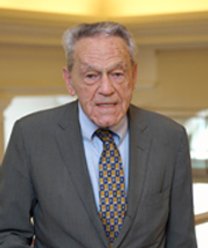

Interviewee biographical information
| Born |
|
|---|
Education
| Year | Institution | Degree | Discipline |
|---|---|---|---|
| 1940 | Swarthmore College | B.A. | Chemistry |
| 1942 | University of Pennsylvania | M.S. | Chemistry |
| 1947 | University of Pennsylvania | Ph.D. | Physical Chemistry |
Professional Experience
University of Pennsylvania
- 1940 to 1942 Assistant Instructor Chemistry
Columbia University
- 1942 to 1944 Research Chemist
Standard Oil Company
- 1944 to 1945 Research Chemist
American Cyanamid Company
- 1947 to 1954 Research Chemist
- 1954 to 1957 Group Leader
American Cyanamic Company
- 1957 to 1962 Manager Chemistry, Physics Section
Consolidated Engineering Corporation, Analytical Instruments Division
- 1962 to 1963 Manager of Analytical Development
- 1963 to 1970 Director of Engineering
Granville-Phillips Co.
- 1970 to 1971 Research Scientist
- 1971 to 1973 Consultant and Inventor for Mass Spectrometry
Analog Technology Corporation
- 1973 to 1976 Scientist
- 1976 to 1979 Chief Scientist
University of Southern California. School of Pharmacy
- 1973 to 1980 Research Associate
Microtrace Analytical Services
- 1975 to 1977 Scientist
University of Kansas
- 1980 to 1989 Mass Spectrometer Laboratory, Director
Cite as
See our FAQ page to learn how to cite an oral history.
GRAYSON: I’m going to start by saying that this is the sixth of December and the year 2002. This is Mike [Michael A.] Grayson speaking, and I’m interviewing Dr. Charles M. Judson in Lawrence, Kansas. So we’re going to go ahead and just talk about those items that I had sent to Charles earlier, which related to how he got interested in science in the beginning. So can you tell me something about your early years, and how it was that you decided to become involved in science?
JUDSON: I guess I have to start with my date of birth that establishes my age. I was born July 2, 1919, in Washington, DC, where my father [Lewis V. Judson] worked for the National Bureau of Standards. He was for most of his career the Chief of the Length Section at the Bureau of Standards, and my interest in science came from him.
GRAYSON: It was because of the work that he did that you were aware of . . . or did he, like, promote science to you by giving you books to read or, kind of, engaging your mind with regard to science?
JUDSON: Actually, the only thing he did directly was we went on walks on Sunday afternoon, and he would explain some scientific aspects of whatever we saw. They were mostly engineering aspects. The only thing I can remember in particular was he told me about how the railroad rails were laid to allow for expansion. This was of particular interest to him, because his work 00:05:00 in Length Standards was heavily influenced by problems of thermal expansion.
GRAYSON: So how long was your father at the National Bureau of Standards, his whole career?
JUDSON: Yes. [. . .] He retired at age seventy.1 [. . .]
GRAYSON: Well, it’s not real important at this point. It’s just that he spent his whole career with the National Bureau of Standards in this area.
JUDSON: Yes. He was chief of the Length Section most of the time.
GRAYSON: Were there any other people who influenced your interest, say for interest when you got into high school, or into college?
JUDSON: Well, we’ll deal with college later.
GRAYSON: Okay. What about high school, anything there?
JUDSON: Well, no. It comes down to the fact that my father arranged my high school curriculum. He started college as a classics major and finished as a physics major.
GRAYSON: That’s quite a switch.
JUDSON: And he thought that ideally I should get a liberal arts degree first, and then science later if I was going to do science. But he didn’t think he could afford that. So he wanted to get as much liberal arts as I could in high school. He thought high school science was not terribly important because it had to be repeated in college, so I took only high school physics. He worked out a curriculum that would get me admitted to any college, except an engineering school. We decided I was not interested in engineering. So I took five years of language and three years of history, including modern European history, which is not frequently taught in high school.
GRAYSON: It sounds like he had a very good plan for your education. 00:10:00
JUDSON: It turned out that Swarthmore College, where I went, required the courses that I took in high school for admission.
GRAYSON: So at Swarthmore, then you started to get involved in science classes, science curriculum?
JUDSON: Let’s leave that for a minute. Living in Washington, my friends’ parents were scientists, or engineers, or other technocrats. The boy across the street [Richard E. Stephens], his father was a PhD economist [Chief Statistician] with the Federal Trade Commission. Many of my friends’ [parents] worked at the Bureau of Standards or the Department of Agriculture, which was the largest department that hires scientists, chemists, and biologists.
GRAYSON: Do you want to go onto college now?
JUDSON: No.
GRAYSON: Okay. What else did you want to tell me?
JUDSON: I’ll finish with the parents of my friends. One was a PhD with the National Education Association, not a scientist. The man next door was a PhD geophysicist with the Coast and Geodetic Survey.
GRAYSON: Can you remember any of their names?
JUDSON: The economist was named [George A.] Stephens. The Coast Surveying man was N. [Nicholas] H. Heck, and he had a problem that when he said, “This is N. H. Heck,” they thought he was saying, “Any check.” 00:15:00
GRAYSON: Was that the geophysicist?
JUDSON: Yes.
GRAYSON: Okay.
JUDSON: The economist—I don’t remember his first name.
GRAYSON: Anything else about this period before we go on?
JUDSON: Well, I was pretty disorganized. I didn’t get good grades in elementary school. My friends remember me as being clumsy. I grew too fast, and the school told me I was underweight for my height. Actually, I was over—
GRAYSON: Over height for your weight.
JUDSON: Over height for my weight. There’s an interesting story, how I recovered from being a nobody in ninth grade. The [Boy Scouts of America] Scout Troop [57] had a basketball team of fifteen- and sixteen-year-olds, and the captain decided to teach a group of thirteen-year-old ninth graders to provide a practice team. And as a result [of] my being too tall for my weight, I was the center. In the 1930s, the center was the key man in the offense.
We had a basketball team in our homeroom in junior high school and with my experience with the scout troop, I was the center on that team. And we won the championship of all the classes that were made up of mostly thirteen-year-olds. There were ninth-grade classes of fifteen- and sixteen-year-olds that we didn’t compete against. They were boys who were being recycled through ninth grade, year after year, and would never graduate from junior high school, and they were too rough for us to be allowed to play with them.
GRAYSON: So after 00:20:00 you kind of came into your own then?
JUDSON: This gave me more self-confidence and in the second half of the ninth grade, I got all As.
GRAYSON: So you became a straight-A student because of the self-confidence that you developed in sports?
JUDSON: Yes. The end of the story is that in tenth grade I played basketball in the Sunday School League at the YMCA [Young Men’s Christian Association] on a team of mostly older boys. I was fourteen at that point.
GRAYSON: You want to go on to college now?
JUDSON: Not yet. I have to end this.
GRAYSON: Very good.
JUDSON: I went on a camping trip, Easter vacation in tenth grade, caught a bad cold, and went to the doctor. He thought I had a heart murmur, and I had to stop playing basketball. Maybe that helped my academic career because I had to give up athletics. I managed to get through high school with straight As all the way through. Graduated at the top of my class.
The guidance counselor wanted me to apply for a scholarship to Swarthmore College, which was a pretty expensive school, a thousand dollars a year. They offered a scholarship of five hundred dollars. It turned out that they gave me a scholarship of three hundred dollars. My father decided he could afford that so I went to Swarthmore.
GRAYSON: Do you remember the name of your high school?
JUDSON: Western High School.
GRAYSON: And elementary school?
JUDSON: E. V. Brown.2
GRAYSON: Then these were in the Washington, DC area?
JUDSON: Yes. 00:25:00
GRAYSON: So you want to tell me then about your time at Swarthmore?
JUDSON: I started as a physics major and took courses the first two years to meet the requirements for a major in either physics or chemistry. At the end of sophomore year, I decided to major in chemistry because I was having trouble with the mathematics in physics.
GRAYSON: Did you receive any counseling with regard to that, or was this a decision that you made on your own?
JUDSON: I did that on my own.
GRAYSON: Did anyone in your later career there at Swarthmore influence you in your career later on?
JUDSON: Well, the head of the Physics Department, Winthrop Wright, gave me a very favorable view of physics. The head of the Chemistry Department, H. Jermain Creighton, taught me elementary chemistry and physical chemistry that I ended up pursuing in graduate school.
GRAYSON: Was that also at Swarthmore, or did you go to a different school for graduate work?
JUDSON: No, I went to [the University of] Pennsylvania.
GRAYSON: So your college started probably about what, 1937, ’36, when you started college?
JUDSON: I graduated from high school in ’36 00:30:00 and from college in ’40.
GRAYSON: Then you went to [the University of] Pennsylvania in Philadelphia, [Pennsylvania]?
JUDSON: Yes. There’s a little story there. The man in charge of getting us assistantships in graduate school told me to forget graduate school and get a job in industry. He thought I wasn’t good enough.
GRAYSON: What was his name?
JUDSON: [Edward H.] Cox, the organic professor. Swarthmore had honors courses in the last two years. You took what was called a seminar—two-week semester. Actually, it was a discussion of assigned reading material. Then at the end of two years, you were examined [by] outside examiners, a written exam and an oral exam. There was an examiner for each seminar that you took. The examiners as a group heard your oral exams and voted to give you honors or high honors or highest honors, or no honors. I did very well on the exams, and I got high honors and made Phi Beta Kappa. So Professor Cox hunted around for a graduate school for me. He sent me to Penn, which was not considered among the best schools, but it turned out well. Penn paid much better than most. Most graduate schools did not pay enough to their assistants for them to live on, the salary. Penn paid seven hundred-fifty dollars a year, which was enough to live on. So it was lucky I went to Penn.
GRAYSON: That’s Pennsylvania State [University], right?
JUDSON: No, University of Pennsylvania in Philadelphia.
GRAYSON: U of Pennsylvania.
JUDSON: It’s a private Ivy League school.
GRAYSON: [Yes]. Well, I always thought it was a good school, but apparently Cox didn’t think it was that good.
JUDSON: It was a reasonably good school.
GRAYSON: So did you have any other things you want to tell me about college before you go to graduate work?
JUDSON: I think that’s enough.
GRAYSON: Okay. Anything on graduate school?
JUDSON: I did my thesis [with] a man named Martin Kilpatrick, whose field was electrolytes and acid-base relations. I did a thesis on dissociation constants of substituted phenols. [John G.] Kirkwood and [Frank H.] Westheimer had published a theory of the effect of the dipole moment of a substituent and the dissociation constant of an aromatic acid. [Otto] Behaghel had shown that this worked for the benzoic acids. A man, a Greek, named [James N.] Sarmousakis did a refinement of Kirkwood-Westheimer. One of Kilpatrick’s students had already shown that the benzoic acid fitted better to Sarmousakis than to the original Kirkwood-Westheimer. I did the phenols of a calorimetric method, figuring the ratio to a natural phenol, in which the yellow color is entirely due to the base form of the ion, and I verified the Samousakis theory. [recording paused] I also had to drop out during the war. [referring to a document] Oh, I didn’t change this to [PhD conferred August], 1947.
GRAYSON: So there was a hiatus because of World War II?
JUDSON: So that’s where I got into mass spectrometry.
[END OF AUDIO, FILE 1.1]
GRAYSON: [. . .] So where we stopped talking, your graduate education was interrupted by the war?
JUDSON: Yes.
GRAYSON: So you went into the service, then?
JUDSON: No. I’m under the atom bomb.
GRAYSON: Manhattan Project?
JUDSON: Yes. In September of 1942, Professor [Harold C.] Urey at Columbia [University] thought he had found a way of separating the isotopes of the uranium by a chemical method, extracting uranyl nitrate out of water into ether.
GRAYSON: Uranyl nitrate?
JUDSON: Yes. And he enlisted the experts that he knew in electrolyte theory at Yale [University] and Pennsylvania to work on this. [. . .] So I was put to work studying the absorption of yellow light in the uranyl nitrate versus concentration as a possible method of controlling the proposed process. By December they repeated the experiment at Columbia—no, at Yale—and found there was no separation, so this project was a dead end. And the powers that be decided to move the people at Yale and Pennsylvania who had worked on this to Columbia. Professor Kilpatrick and his students moved to Columbia.
GRAYSON: Would that be in [. . .] early ’43?
JUDSON: Early ’43. I went to Columbia. It was called the SAM Laboratories.
GRAYSON: SAM?
JUDSON: Special Alloyed Materials, which was the code name for uranium. I worked on a series of other dead-end projects related to uranium and hydrogen isotope separations and analysis for two years. Eventually, Kilpatrick got me assigned to the Boron Project, which he knew was important. The Boron Project was to separate the isotopes of boron, concentrating the boron-10, which is a neutron absorber, and then making powdered elemental boron. The isotope separation was already in operation at the Standard Oil of Indiana Refinery in Whiting, Indiana.
THE QUESTION REMAINED: how can we make elemental boron? I was assigned to analyze commercial materials that claimed to be elemental boron and see if there was an existing process for making elemental boron. I found they were all fakes.
GRAYSON: So you have to enlighten me. Boron just occurs as an oxide?
JUDSON: Boron occurs as a composite. It occurs as borate in California in the Mojave Desert. 01:00:00
GRAYSON: So getting it in the elemental form is difficult?
JUDSON: Yes. At the time we started looking, it had probably never been done. The Norton Company was selling boron nitride and calling it boron. A good part of their business is boron carbide. I found their thing they called boron was 80 percent boron. We switched BN [boron nitride], and the Norton Company complained, and the Bureau of Standards verified my analysis.
About this time, Professor [Albert W.] Laubengayer, at Cornell [University], published a paper in JACS [Journal of the American Chemical Society] describing a method of making elemental boron, by reacting BCl3 [boron trichloride] with hydrogen on a tungsten filament. The catalytic reaction showed chemical vapor deposition sometimes. We got Laubengayer to come in and describe his process to us. Clyde Hutchison said, “I’m willing to try to make that work on a large scale.” Actually, Laubengayer made a few milligrams and the bomb people wanted kilograms. Clyde Hutchison said, “I’ll try to do it in kilogram quantities.”
So now I had to analyze the product of each step. The separation was done with BF3, dimethyl ether complex. We had to convert that to BCl3 and then to boron, and I had to analyze the purity of each step 01:05:00, while Hutchison tried to scale the process up.
GRAYSON: So what was the tool that you used for the analysis?
JUDSON: It was chemical analysis. Essentially, the boron is eventually determined after the conversion. You get it in solution with nitric acid, in the case of the elemental boron, and distill it as methyl borate, and get that dissolved as boric acid. There’s a titration of boric acid, a complicated thing involving adding mannitol to the boric acid and doing an acid-base titration.
GRAYSON: Was that mannitol?
JUDSON: Yes, a sugar.
GRAYSON: If you could get the boron in the metallic form, was it stable there, or did it want to revert to a complex?
JUDSON: It’s quite stable, except that it’s deposited on a tungsten wire.
GRAYSON: Which isn’t very useful?
JUDSON: You hit it with a hammer and knock it off, and you’ve got a mixture of boron and tungsten. So you have to not only analyze the boron content but the tungsten content to make them add up. Eventually we made 98.8 percent boron, 01:10:00 and we arranged for American Cyanamid to build a power plant to receive the product from Indiana if there ever was a product.
Along the way, they had me analyzing the dimethyl ether complex that was being distilled at Indiana. Actually, it’s a distillation in that you boil off a liquid. Actually, it’s a dissociation. In the gas form, the dimethyl ether complex dissociates into the BF3 and dimethyl ether, which is why the isotopes separate.
About this time, they had me analyzing the complex which was getting water into it and making boric acid. The Indiana people were told they couldn’t get water in the stuff. They thought if they had water you would see water floating around and they were getting water into the complex and dissolving the packing, which was glass, and dissolving the iron tubing that was the distillation column. So I developed methods for analyzing for the impurities 01:15:00 in the complex, and I was sent out to Whiting to show them how to do it.
While I was there, Colonel [Kenneth D.] Nichols, the number two man in Los Alamos, [New Mexico], descended on the plant. The bomb people were concerned. I have to explain what this stuff was going to be used for.
GRAYSON: [Yes]. I’m curious, myself.
JUDSON: You know the plutonium bomb worked by compression. It turned out that couldn’t be used with 235, with the uranium bomb, because the uranium bomb, if you made a half- critical density, it would blow up prematurely. So the uranium bomb had to be done by having two half-critical masses propelled towards each other down a rifle barrel. The boron-10 was to be put in a space between and blown out a few milliseconds before the pieces were propelled together.
The weapons people were worried that this stuff was not coming, and so Colonel Nichols reviewed the status of the plant and said that Professor [Philip] Schutz at Columbia, who had developed the distillation process, should come out and run the plant and that I should be moved to the plant to run the laboratory. [Schutz was] a chemical engineer. [. . .] And along with this the Indiana plant manager was told to sit in his office and not meddle with the plant, and similarly the lab manager was told to leave me alone. I was told if he got in my way, I would tell Columbia and 01:20:00 and the Chairman of the Board of Indiana would get a visit from the [United States] Army.
So I moved to Whiting in September of 1944. A man named [Alan] Webb—I forgot his first name—a chemist from Kansas State, had been trained by Mark Ingram to run an isotope mass spectrometer built specially for the boron analysis.
GRAYSON: That mass spectrometer was from Nier’s Laboratory?
JUDSON: [. . .] Actually, it was built by Ingram at Columbia. The parts may have been built at Minnesota. I had an Army sergeant working for me—one of these guys who was drafted and sent to the Manhattan Project because he had chemistry training. He was sent to me to help, and he did the titrations to determine purity. We had some technicians who did the iron and Karl Fischer water analyses, and the zinc analysis for dissolved packing.
The plant runs seven days a week, twenty-four hours a day. 01:25:00 I worked every other weekend, and Webb worked the weekend I didn’t work and supervised the technicians. The Army boy did not work on weekends. Either Alan Webb or I had to do the titrations on the weekends. On the weekend that I worked, I had to run the mass spectrometer. [. . .] It was the Sundays. We all worked every Saturday. It was the Sundays that we had off every other week.
GRAYSON: One day, every two weeks.
JUDSON: One day every two weeks, we got off.
GRAYSON: So what was the mass spectrometer doing in this context? What was the mass spectrometer analyzing?
JUDSON: Isotope ratio, ten to eleven.
GRAYSON: Now did the chemical process afford any isotope separation? Was there any isotope separation in getting the metal?
JUDSON: No.
GRAYSON: So you just wanted to check the isotope ratio that you were getting?
JUDSON: We had to deliver, every two weeks, two gallons of 99.8 percent 10B dimethyl ether complex. We shipped it by courier, Army courier. The courier was told, “If this can leaks, starts fuming, you should throw it out the window of the train.” He was shut up in a compartment with this thing for twelve hours. [laughter]
GRAYSON: Did any of them ever leak?
JUDSON: He never had a leak. 01:30:00
GRAYSON: So where did the isotopic enrichment occur, or was there any?
JUDSON: The isotopic separation took place in a distillation column. There were eight fifty- foot columns. So it was essentially all run in series, so it was essentially a four-hundred-foot distillation.
GRAYSON: And they were distilling the dimethyl ether complex?
JUDSON: Yes. The leaks were occurring at the flanges. We fixed the leaks in the column. That was causing the decomposition of the stuff. We got the total GE [General Electric] output of Glyptal shipped to us, and we painted Glyptal around the flanges until there was no decomposition. We had the world’s supply of Glyptal. In two months we were making two gallons a week of 99.8 [percent] 10B.
GRAYSON: How many people were all involved in this particular project? Would it be maybe six or eight, or ten people working on this particular project?
JUDSON: How many people were in the plant?
GRAYSON: For the Boron Project?
JUDSON: Well, there were fifty people in the plant at a time. I don’t know many people were at Cyanamid. I think there were five chemists at Cyanamid working on this. I know who three of them were: J. K. Dixon, and Erwin [L.] Carpenter, and a man named 01:35:00 [M. V.] Norris was doing chemical analysis.
GRAYSON: And this was primarily for the uranium bomb or the plutonium bomb?
JUDSON: It was all for the uranium bomb. I assume it was used at Hiroshima, which I think is the only time the uranium bomb was ever exploded.
GRAYSON: How long did this production last?
JUDSON: Well, we had it going by March, and I left in October. We shipped two gallons a week over that period of time.
[END OF AUDIO, FILE 1.2]
GRAYSON: [. . .] Did you feel cheated by the fact that the war interrupted your graduate education?
JUDSON: No.
GRAYSON: So after you left that project in Whiting, you went back to Pennsylvania?
JUDSON: Yes.
GRAYSON: And completed your graduate studies?
JUDSON: I felt it was very useful for me to have this experience because on the project I was treated as a supervisor, as if I had already got my degree. I got experience that one doesn’t normally have for several years after you get a degree.
So how I left is an interesting story. I got a communication from Kilpatrick. I don’t know if it was a phone call or a letter, shortly after the Alamogordo, [New Mexico] test telling me to apply for a DuPont Fellowship for the fall of 1945, that the war would be over and I wouldn’t be needed anymore at Whiting. And I got the fellowship because nobody else applied. So I didn’t have to teach when I went back because I got a thousand-dollars-a-year fellowship. I worked two years after the war, from October ’45 to July ’47. Turned in my thesis in [June] of ’47.
GRAYSON: And the thesis work was on dissociation constants of the substituted phenyl.
JUDSON: Phenol. Then about the time I was turning in my thesis, I started looking for a job. 01:30:00 The first place I tried was American Cyanamid where I knew the people, that I had helped them with the Boron Project. And they offered me a job. I interviewed several other places. Everybody was very cautious. They said they would meet Cyanamid’s offer. They didn’t want to get into a bidding situation. I interviewed also at DuPont [E. I. du Pont de Nemours & Company] and Hercules [Incorporated]. I declined to interview at Indiana, because I had no respect for their operation. [. . .] They wrote me a letter and offered me a job.
GRAYSON: So your mass spec exposure started in Indiana? What happened next that you got involved in more mass spectrometry?
JUDSON: After that? [recording muted] . . . at Cyanamid was the work with radioactive isotopes. A man named Donovan [J.] Salley had been doing work with radioactive isotopes, getting the isotopes from the [University of California at] Berkeley Cyclotron and then help from Professor [Melvin] Calvin on the measurement of isotopes. [. . .] He was moving up in the organization. He wanted somebody to take over the operation of the radioisotope laboratory which involved one BS chemist as an assistant. So I went to Cyanamid and worked for several years with radioactive 01:35:00 isotopes in industrial applications.
GRAYSON: So I need a little bit of clarification. Donovan Salley hired you at Cyanamid?
JUDSON: Yes.
GRAYSON: Then he moved on to bigger and better things?
JUDSON: That’s correct. He became my boss.
GRAYSON: And you then took over the radioisotope operation?
JUDSON: Well, I took over the isotope operation, and he took over the management of the Physics Division. [Robert] Bowling Barnes had been the manager of the Physics Division— Director he was called. Bowling Barnes developed the infrared spectrometer and which eventually was produced by Perkin Elmer [Corporation] under license to Cyanamid. Barnes got wind of the fact that Mr. [Herbert C.] Hoover, [Jr.] was trying to sell the CEC [Consolidated Engineering Corporation] business.3 He proposed that Cyanamid buy CEC and make mass spectrometers and the infrared spectrometer that they eventually sold to Perkin Elmer and get [him] into a business. The board of directors turned him down and he resigned and Dr. Salley became the director.
GRAYSON: [. . .] So Cyanamid turned down the offer to get into the instrument business?
JUDSON: Yes.
GRAYSON: Then you stayed on to do radioisotopes for a while?
JUDSON: I did radioisotopes for several years, and I became the poster boy for Oak Ridge [National Laboratory], the only person in industry using radioactive isotopes. I gave a lot of talks at meetings. Eventually, what we were doing was really not all that exciting, and I was very happy when Dr. Salley came to me and said, “I want you to find out if the mass spectrometer can be used 01:40:00 for things other than hydrocarbons, and where such a thing can be obtained.” I called the CEC salesman who had been visiting us periodically. He sent me to Atlantic [Refining Company]. Oh, what was the name of those guys? [Ralph] Brown and Mel Polder.
GRAYSON: This was Atlantic Richfield [Company]?
JUDSON: Atlantic Refining [Company] eventually became Atlantic Richfield. Incidentally, in your book you say, “Atlantic Refining is near Philadelphia.” It’s actually in Philadelphia. Going from the airport you would think that it’s not in the city, but it is in the city.
Mel Polder and Ralph Brown were analyzing long chain alcohols with a 21-102 modified with a design developed by Shell Houston. [. . .] Shell Oil Company had a research lab in Houston, [Texas], and they had built the first heated cover plate or hat. CEC built for them a heated cover plate which was a requirement to analyze low-boiling materials, and also, CEC now had a gold leak, which was required by low-boiling materials. What was the name of the guy at Houston? [M. J. “Jack” O’Neal, Jr.] 01:45:00
GRAYSON: Ah, people who might have been there then would be [Henry] Earl Lumpkin.
JUDSON: No, that’s not Shell.
GRAYSON: I’m just trying to think of names of people that were in that vicinity. Well, we can get that later. So you went to this laboratory at Atlantic Refining to get some insight as to whether or not you could use a mass spectrometer for something besides hydrocarbons?
JUDSON: Yes.
GRAYSON: Were they very helpful?
JUDSON: They said, “No problem. Just make sure you buy an instrument with a heated cover plate and a gold leak.” The salesman said, “We don’t promise anything if you put compounds with oxygen and hydrogen atoms in the instrument.” CEC couldn’t promise what you can do. [They said], “We only know that Atlantic says they can do it.”
GRAYSON: Do you remember the name of the CEC sales guy?
JUDSON: I forgot. I used to know.
GRAYSON: This was in the late forties, right?
JUDSON: This was the late forties or early fifties. We took delivery in ’53 or ’54. I’m not sure which.
GRAYSON: At Cyanamid?
JUDSON: I think we got the first [CEC 21]-103C off the line from California.
GRAYSON: So then your job was to apply the technology to non-hydrocarbon-only compounds?
JUDSON: Yes. We wanted to use it for qualitative identification for which we were using infrared. We had a battery of infrared instruments, and the synthetic chemists had a spectrum run and took the spectrum to Norman [B.] Colthup and he told them what he thought they had.
GRAYSON: He was an infrared jockey?
JUDSON: He’s involved with [the Colthup] Chart of wavelengths, infrared wavelengths 01:50:00 for various functional groups. We sent a letter to every chemist doing synthetic work saying, “We think maybe we can help you with identification. If you send us a sample and give us the report from infrared, what they think they’ve found, we think we can give you some more information about the actual size of a molecule.”
GRAYSON: These were chemists inside of Cyanamid?
JUDSON: Yes. After a year of this, we had a regular clientele of people who sent us samples of every new compound.
GRAYSON: So you were successful in helping these people out?
JUDSON: All we knew to start with is a first approximation. You break a single bond in the molecule. We had to work with a lady chemist—I can’t think of her name—at CEC, who had developed the mathematics of the . . .
GRAYSON: [. . .] I know who you’re talking about, Sybil [M.] Rock.
JUDSON: Yes. Sybil Rock had written a paper suggesting the fragments of different substituents, and that was all we had to go on.
GRAYSON: Was that based on her experience, or was that a theoretical concept that she was developing?
JUDSON: Based on her experience.
GRAYSON: When you left Cyanamid, did you go to CEC directly?
JUDSON: That’s another matter. How did I get to Cyanamid? After we got the mass spectrometer program working, I had Al [H.] Struck, 01:55:00 who pretty much could run the lab by himself, and I went on to get us an NMR [Nuclear Magnetic Resonance] spectrometer so we could do some important analyses with high resolution NMR.
[END OF AUDIO, FILE 1.3]
GRAYSON: That hat you purchased an NMR and were doing high resolution NMR work. What kind of instrument did you buy? Was it a Varian [Associates]?
JUDSON: Yes.
GRAYSON: Did anybody else make NMR besides Varian?
JUDSON: No.
GRAYSON: Probably a proton NMR?
JUDSON: A proton NMR, 1H. Forty was the serial number, forty megacycles.
GRAYSON: It was a forty-megahertz machine.
JUDSON: Forty-megahertz NMR and I found an infrared man, John Lancaster, to run that.
GRAYSON: Lancaster?
JUDSON: Like the city in England.
GRAYSON: Okay. So you were essentially setting up a physical analytical laboratory.
JUDSON: Then I became the manager of what was left of the Physics Division. Dr. Salley moved on to something else, and I became the manager of what was left of the Physics Division, all the instrumental analysis. And also the physical chemistry group had gone into the physics operation at this point. This was a section of something called the Research Service Department, which [grew] off of the wet chemistry section. There was a man named Erwin [L.] Carpenter who was head of the whole Research Service.
GRAYSON: So what happened next?
JUDSON: I had a lot of arguments with him. [. . .] There was a man named [George L.] Royer, who had been the head of Analytical Chemistry in our Bound Brook, [New Jersey] plant, which we closed down. He was an assistant 02:05:01 director of the laboratory. He had picked me out for management training and sent me to several training courses inside and outside the company. I asked him to find me another job within the company, so I wouldn’t have to work for Carpenter, and there were a couple of specific jobs I applied for. Royer said, “We need you where you are. We can’t let you go. You just have to sit tight and wait. Carpenter’s going to get fired sooner or later.” Later was not time enough for me.
GRAYSON: What specifically did you guys fight about? You had some specific issues that were problems between you . . .
JUDSON: The biggest problem was one of my group leaders came in late every morning, and worked late every night, so he came in at 9:15 [a.m.]. Carpenter ordered me to tell him he had to be here at 9:00 [a.m.], and I refused. That was the biggest argument I had with him, and I called him a “damn fool” one time.
GRAYSON: He didn’t like that.
JUDSON: And he told me he was going to cut off my annual salary increase. Royer told me he couldn’t do it. The explanation why he couldn’t be fired was that he knew too much about the synthetic fiber acrylonitrile plant. It had been his project. As long as the acrylonitrile was an important product, they couldn’t risk letting him go to [the] 02:10:01 competition.
GRAYSON: So you decided that you had to leave?
JUDSON: I decided to start looking for a job. The first thing I did is write to Hal [Harold F.] Wiley at CEC and ask if they had any jobs for an applications chemist in mass spectrometry. It turned out they did. They were actually looking for somebody and they brought me out for an interview in December of ’62. I went to California in January of ’63. I was supposed to be a manager of a small group of myself and three other people called [the Advanced] Analytical Development [Section].
GRAYSON: So you spent probably about, eight, nine years with Cyanamid before you started at CEC? Would that be about right, about eight or nine years?
JUDSON: I went to Cyanamid in 1947 and left in . . . [telephone rings] [. . .] It was July 1947.
GRAYSON: [. . .] So ’47 to ’62 is about fifteen years that you were with Cyanamid.
JUDSON: I was just short of three weeks’ vacation for fifteen years of service. I left in January of ’63. What CEC wanted was work on quantifying spark source mass spectrometers.
GRAYSON: So at this time, they had the [21]-110 instrument?
JUDSON: It was the 110 spark source. And [Charles W.] Chuck Hull had been working on this for a year and pretty well worked out a quantitative technique. 02:15:01
GRAYSON: Was he part of this analytical development group?
JUDSON: They put me in charge of the group including Chuck Hull and two other people.
GRAYSON: Do you remember their names?
JUDSON: Royce Howard and Dorothy [G.] Comaford.
GRAYSON: And the spark source quantification, that was just one of the efforts in the analytic area?
JUDSON: That was the immediate problem, and in theory I could find my own projects.
GRAYSON: Did you start any of your own projects?
JUDSON: Yes.
GRAYSON: They were? Do you want to maybe pick up tomorrow on this and call it a day for today?
JUDSON: No, I think let’s continue this. The main project that I started was gas scanning for GC-MS [gas chromatography-mass spectrometry] using the 21-130 cycloid instrument. I did a systematic study of the limitations of gas scanning of magnetic deflection instrument.
GRAYSON: So the cycloidal instrument had a voltage scan?
JUDSON: Yes.
GRAYSON: And it had a limited mass range compared to the 103, didn’t it?
JUDSON: That’s right. It had a limited mass range.
GRAYSON: Since you brought up GC-MS, were you at all involved in the whole business of getting the two instruments interfaced, getting the gas chromatograph hooked up to the mass spec? Or were you just solely interested in the mass scanning problem?
JUDSON: Later on, I was involved in interfaces. 02:20:01 At this time—1963—I was only interested in the mass scanning limitations.
GRAYSON: So what other activities did you pursue after the GC-MS work?
JUDSON: Then I got a new, different job. I was reporting to [Clifford E.] Cliff Berry, the Director of Engineering. Cliff Berry was having personal problems, mostly related to his wife.
GRAYSON: So Berry was the director of engineering effort?
JUDSON: Yes, and engineering meant research and development. Berry was having trouble making decisions. When he had to make a decision to cut off a program, he would go in his office and lie down on the couch and close the door.
GRAYSON: Did this help him make a decision?
JUDSON: No, it didn’t help. After a while it was the general manager [who] called in a consultant. Arthur [D.] Little, probably not Mr. Little himself but two guys from the company, came to review and channel the problems of the division, including the problem of Cliff Berry. They interviewed 02:25:01 everybody in engineering and among other things asked them, “Should Dr. Berry be replaced, and if so, by somebody outside or is there somebody inside?” I was a little concerned that Cliff Berry had given me a job and I owed him some loyalty. I had to say, “He’s got to be replaced, and I have no idea where we can get a replacement—inside or outside.” The net result of all this was that the consultant went to Mr. Wiley and recommended that they give the job to me. Cliff was distressed. He said, “Charlie’s not an engineer.”
Wiley tried to placate Berry by getting him the supervision of an advanced development group, which already existed. Cliff was not happy, and he located a job with Veeco [Instruments]. He thought they offered him a position that would ultimately be a vice president. He went to Veeco and after a few weeks committed suicide, 02:30:01 turning the gas on in his apartment. He left a note, and I never found what the note said. The gist of the situation was he couldn’t live with his wife, and he couldn’t live without her.
[END OF AUDIO, FILE 1.4]
[END OF INTERVIEW]
GRAYSON: [. . .] So yesterday, we had gotten up to [when] you had joined CEC and were given the control of operation of this department after Cliff Berry was let go.
JUDSON: Let’s go back.
GRAYSON: After you left American Cyanamid?
JUDSON: I couldn’t remember the name of the guy who developed the heated cover plate at Shell. His name was O’Neal. Can’t remember his first name. You can look in the bibliography and find him. [. . .] I wonder why that has slipped.
GRAYSON: I forget a lot of things very easily. So, it’s just the way things go. Are there any other items that you wanted to recall from yesterday? Or do you want to move forward?
JUDSON: My role model—the only scientist I knew other than my father personally—was my father’s colleague, the chief of the Weight Section. His name was Arthur [T.] Pienkowski. We lived in their house. They remodeled the second floor to make an apartment for us, and I knew him pretty well. He was a very fine man. He was also the head man in the government of our church. In the Presbyterian Church, the head man is called Clerk of the Section. The Section is the Board of 02:55:01 Elders that governs the church, and the Scotch name for presiding officer is Clerk. It’s not that he writes anything down. It’s just a Scotch word for chairman.
GRAYSON: One thing I didn’t ask about yesterday was whether you had any brothers or sisters.
JUDSON: No.
GRAYSON: You were an only child.
JUDSON: I had a brother who was born deformed and only lived for a few hours.
GRAYSON: Are you ready to go back then to the CEC period?
JUDSON: Yes. Now, I’m Director of Engineering [Analytical & Control Division]. I have to learn a new job. The hardest part was to learn to control your expenses. Bell & Howell [Co.] expected you to stay within a very small percent of your budget for your total expense for the year.
GRAYSON: When you started then, Bell & Howell owned CEC as a subsidiary.
JUDSON: That’s correct. That happened before I went to CEC, a few years before. It was called a merger. Actually, it was an acquisition.
GRAYSON: Do you know if Bell & Howell had interest in a broader participation in the analytical equipment instrumentation market?
JUDSON: Well, that’s an interesting story. We had a session with the CEO of Bell & Howell every year to review our budget, and he continually harped on wanting us to do something other than mass spectrometry.
GRAYSON: Did they make any suggestions as to what they wanted you to get into?
JUDSON: No.
GRAYSON: It was up to you to figure it out.
JUDSON: They also said they wanted us to develop a consumer product that every housewife would need. I told them rather bluntly that my engineers 03:00:01 had no competence to design a consumer product, that with the mass spectrometer you use the best component available regardless of price, and that’s not the way you build refrigerators or radios.
GRAYSON: So how long did they keep the mass spec business after it was clear that . . . ?
JUDSON: Well, that’s another story, which I will come to.
GRAYSON: Okay.
JUDSON: We did try to get other business, other analytical instruments. We had some before I got there. We had what we called a “moisture monitor,” which was a water analyzer of water and gases with water packs from DuPont and designed a product that was done in Bell & Howell research.
I have to explain about Bell & Howell research . . . go backwards. Harold Washburn was gradually replaced as director of CEC Research by Dr. Charles [A.] Robinson. And when Bell & Howell acquired CEC, they took the research group out of CEC and called it Bell & Howell Research. It was in the CEC building still and the same people. Robinson was made a vice president of Bell & Howell. 03:05:01
GRAYSON: So what happened to Washburn then?
JUDSON: He resigned.
GRAYSON: About what year would that have been?
JUDSON: Early 1960s.
GRAYSON: But your employment overlapped with Washburn’s some.
JUDSON: I don’t think so.
GRAYSON: Okay.
JUDSON: I think Washburn was gone before I came there in 1963.
GRAYSON: Okay.
JUDSON: Washburn went to JPL [Jet Propulsion Laboratory] and then to Long Beach State College, but Washburn had long since ceased to be a major player in Bell & Howell research, in CEC research. Robinson and Berry handled all the mass spectrometer work after 1950, and [Lawrence G.] Larry Hall.
Well, now, I’m saying about the budget. It took me a while to learn that the way to stay within the budget is in the last few months of the year postpone large purchases wherever possible until January. By fiddling with that, you can control your expenses and hit it within 1 percent.
GRAYSON: How much was the budget for your operation?
JUDSON: A million dollars a year. That was another thing I had to learn. At the beginning of every month, you get accounting sheets showing the charges that are being made against your department, some of which are absolute nonsense. Somebody entered the wrong code number. 03:10:01 I learned to have my secretary find those and have them taken out. I showed her how to do it, what kind of things to look for.
Now I started to say, we had some electrochemical products, and we bought the patent to the moisture monitor. Bell & Howell Research hired an electrochemist, [Michael] Mike Czuha [Jr.].
GRAYSON: Is that Chinese?
JUDSON: Middle European. He designed the product and stayed in research. Finally, Robinson said Czuha should be transferred to the analytical division, which was called Analytical and Control, A&C. So Czuha became a one-man group in my engineering department.
I also acquired another electrochemical instrument in a different way, somewhat the same way. Bell & Howell Research hired a man who was named [R. R.] Doc Austin, like the city in Texas. He was just called Doc. I have no idea what his first name was. He developed an instrument called a Titrilog. It was an instrument for analyzing 03:15:01 sulfur in natural gas. It was essentially a potentiometric—it was a colorimetric titration with iodine, automated. A&C hired an engineer named Henry Landsberg and put him in charge of a business selling and maintaining Titrilogs. Those were the two successes. Somebody designed the gas chromatograph, which we sold, which was a total failure. It had cold spots in the column. I lost track of who designed that. One of the first things I did when I became director was to kill the gas chromatograph business, because it was damaging our reputation. There was an engineer in the mass spectrometer group named Heinz [G.] Boettger.
GRAYSON: Heinz?
JUDSON: Heinz, 57 Varieties. That’s a good German first name. He knew enough to tell me that the gas chromatograph we were selling had no possibility of being fixed. 03:20:01 We also somewhere had developed a process-chromatograph which worked okay. We had an engineer in Texas . . .
[END OF AUDIO, FILE 1.5]
JUDSON: I don’t remember his name . . .
GRAYSON: But he did the process-chromatograph thing?
JUDSON: Well, he essentially was running a business. He was his own engineering, manufacturing, and marketing department. Actually, there were two guys. They were located in Houston. During my time as director, we entered into two other ventures [in] emissions spectrometry. A man named John [M.] Carrol, who was the head of ARL’s [Applied Research Laboratory] European emissions spectrometry business in Lausanne, [Switzerland], came to us in order to bring himself and two of his colleagues to Pasadena, [California] to develop a new design of an emissions spectrometer. [Do] you know what an emissions spectrometer is?
GRAYSON: No. Wasn’t [Thermo] Jarrell Ash [Corporation] big in that business at one time?
JUDSON: Yes, Jarrell Ash and ARL, Applied Research Laboratory.
GRAYSON: Did that venture work out?
JUDSON: Not really. We also acquired an interest in [an] emissions spectrometer business in the Boston area. It had been 03:30:01 created by the man whose last name was [Jason] Saunderson, who had been head of spectroscopy at Dow. He formed a business to manufacture emissions spectrometers. They were not very successful. What was it called? RCI [Research and Control Instruments, Inc.] The letter R, the letter C, and the letter I—stood for something.
We acquired that business and its people and its designs, and we tried to meld this with the guys from Lausanne. It didn’t work out very well. For years we tried to get Chicago, [Illinois], to let us—we always referred to Bell & Howell as Chicago—to let us close down the emissions spectrometer business. It meant taking a large write-off of inventory. [Peter G.] Peterson insisted that we keep the engineering program and continue a losing business because if we stopped the engineering we would have to take a write off a lot of inventory, a half a million bucks. At the very last minute, before the end of the Analytical Instrument Division, we did take a write off, and we gave the 03:35:01 inventory and the designs to the engineers. They formed a company which they called Angstrom [West Division, Ångstrom, Inc.], and operated the business in a garage right down the street from the Monrovia, [California] plant. Somehow the Analytical Instrument Division had been moved from Pasadena to Monrovia.
GRAYSON: So after you got rid of the emissions business, what happened?
JUDSON: Lots of things. Another unsuccessful business was Cameca. Cameca was a French company. They manufactured electron probe instruments which were actually x-ray instruments from an electron beam. [It] generates x-rays and you move the beam around to get a picture of the concentration of a particular element. It’s determined by the x-rays generated by the electron beam. They were making instruments.
A man named [Raimond] Castaing at the University of Paris had invented this thing. The French government assigned Cameca to build a version of it. Castaing then developed a mass spectrometer which was an ion microscope that transmitted an image 03:40:01 of secondary ions through a mass analyzer. He called it an ion microanalyzer. They wanted us to sell this in the US and at the same time, they also wanted us to sell their other company instruments.
GRAYSON: And this would have been in the mid-sixties?
JUDSON: Yes.
GRAYSON: Was that very successful?
JUDSON: Marginal.
GRAYSON: Were there any other ventures of this type?
JUDSON: Let me finish with that one.
GRAYSON: Okay.
JUDSON: There was a small company in Massachusetts that had a contract to build and sell electron probe instruments from Cameca, and they figured out a way to break the contract and offered us the electron probe business. We contracted to buy twenty electron probes a year, and Marketing assigned a man named Shaffer to sell these instruments. Engineering hired a man named Lewis, a physicist, to provide technical backup 03:45:01 to the electron probe business. Shaffer didn’t trust technical people.
GRAYSON: In what way?
JUDSON: He didn’t want any advice about limitations of the instrument. So he was selling the instruments to people who didn’t really know what they were getting. We were not [even] selling twenty instruments either and inventory was piling up. Cameca was still bringing instruments from France, and they were not going to customers. Then finally, Cameca completed the design of the ion instrument, and we contracted to sell two of these a year.
GRAYSON: Were these more sophisticated instruments than the ones Shaffer was trying to unload?
JUDSON: Than what?
GRAYSON: The electron probe instruments that Shaffer was selling. Were the ion instruments more advanced?
JUDSON: Yes. It was more sophisticated, and we had the same problem. Shaffer didn’t do a good job of selling the ion instruments so this whole business was losing money because we were paying Cameca and not getting any income from customers. 03:50:01 So the only attempts to broaden our product line during my period as director of engineering were unsuccessful. Now we come to what ultimately destroyed the business. Mr. Peterson hired a man whose last name was Robert A. Charpie, who was a Carbide and Carbon’s [Chemical Corporation] man in charge of Oak Ridge [National Laboratory], a nuclear physicist by training. And he gave Charpie the title of President of Bell & Howell. Many of these people had this title. It didn’t mean anything because the CEO ran the business, and the president didn’t have any real responsibility. He told Mr. Charpie his initial assignment was to get a contract with Pan Am [Pan American World Airways] to install an airline entertainment system.
I have to go back and explain the airline entertainment systems. There was a man who had the title of Engineering Vice President of CEC. For the moment 03:55:01 I can’t think of his name. He had nothing to do in this job except sit and twiddle his thumbs, and he dreamed up the idea of running film around, movie film, threading it through the airplane and . . .
[END OF AUDIO, FILE 1.6]
GRAYSON: Its own projector. It sounds like he was a little ahead of his time.
JUDSON: He didn’t understand that a simpler way to do it was to have each seat have its own TV [television] set. Anyway, Charpie made a deal with Pan Am which had penalties for flights that the system didn’t run which were common because the film would break. The percentage of successful flights was actually low. Mr. Peterson was very annoyed, and he drew the conclusion that PhD scientists couldn’t be trusted with business decisions.
Then another thing happened. There were several divisions of CEC, one that made data recorders, oscillographs, and tape systems, and one that made transducers including galvanometers. Each division had to forecast its profits a month 04:05:02 in advance, and the ultimate sin was to not meet your forecast, which was really more important than whether you made a profit. The head of the largest division, the Data Recorders Division, missed his forecast by a large sum of money. He was an engineer who had been with the company a long time. Mr. Peterson concluded that not only PhDs but engineers were not to be trusted with business management.
So Mr. Peterson decided that buying CEC had been a horrible mistake. He was playing golf with a man named—it’s important but I can’t remember. [. . .] Bowes, William Bowes, and telling him that he had this business in California he wanted to get rid of. Now Mr. Bowes had flunked out of Annapolis and then presided over the destruction of Philco Radio and Philco Television [Philco Radio and Television Corp.], and then worked for ITT [International Telephone & Telegraph] for a period of time—some of the business acquisitions that didn’t pan out. He told Mr. Peterson, “I can sell off your California businesses 04:10:02 piece by piece, if you let me take charge of this business.” So Bowes became the man we dealt with in Chicago instead of Peterson, a, kind of, super president of CEC. Bowes came in and gave us a lecture. “I’m a salesman. I like salesmen. I don’t like engineers and scientists.” So to jump to the conclusion, Bowes looked for ways to sell the product lines of CEC. He found the only one that would sell was mass spectrometers. He ultimately sold the Analytical Instrument Division to DuPont. It was ten years before he sold any other parts of CEC or before his successor eventually did sell Data Recorders. I can’t remember to whom.
GRAYSON: What year was that when he sold the mass spec business?
JUDSON: 1970.
GRAYSON: You described a lot of these businesses that were not making money. Were the mass spec sales making any profit for the company?
JUDSON: In 1969, the mass spectrometer business did not make any money, but in some years it did. Now ’69 was critical 04:15:02 because that was the year in which the camera business didn’t make any money. For many years, it would turn out CEC would make money and Chicago would not or vice versa. I think ’69 was the first year when both Chicago and Pasadena lost money.
Before Mr. Bowes started actively trying to sell the division or the mass spectrometer business, he got rid of the division general managers who were all physicists and engineers whom he distrusted. He got rid of them by abolishing the divisions. He did that in January 1970, and Wiley was laid off.
GRAYSON: Wiley? So where are we now, DuPont?
JUDSON: No. Not only were the general managers laid off, but the engineering and marketing directors in the divisions had no job because the divisions were gone. About two weeks after Wiley was laid off came my turn. 04:20:02 So I was terminated because I had a PhD.
GRAYSON: And you weren’t in sales.
JUDSON: And the only other PhD in the organization was [L.] Alan Cambey, who was the director of Custom Products in Analytical Instruments. He was a PhD physicist, who had been president of [Leonard F.] Herzog’s mass spectrometer business.
GRAYSON: Leonard?
JUDSON: Yes, but what was it called?
GRAYSON: Nuclide [Corporation].
JUDSON: Nuclide. He had been president of Nuclide under bankruptcy, reporting to the bankruptcy court. When that came to an end, he came to us looking for a job. Wiley and I talked to him, and Wiley said, “I can’t figure out a way we can use this man,” and I suggested that we had a man named [W.] Bill Kneen running Custom Products, who was only marginally competent.
Custom Products was created 04:25:02 at the time I became Engineering Director to get the custom engineering out of the Engineering Department. Prior to that, [if] somebody wanted a mass spectrometer, that was not a standard product, the mass spectrometer engineering group estimated the cost to develop a design. Now Custom Products was a group that both designed and built one-of-a-kind special designs.
Cambey agreed to take that job and did a very good job of it, but he also tangled with Mr. Peterson. On one occasion he exposed Mr. Peterson as a liar, and Mr. Peterson didn’t like that. So Cambey’s days were numbered, even beyond the fact that he had a PhD. So he was also terminated at the same time I was.
I was looking for a job and somehow 04:30:02 DuPont got wind of the fact that the mass spectrometer business was for sale. They talked to me . . . needed advice as to whether the mass spectrometer business was worth buying. Mr. Bowes invited the general manager of DuPont, the instrument business, to come to Chicago to discuss . . .
[END OF AUDIO, FILE 1.7]
GRAYSON: What was the fellow’s name from DuPont that wanted to look into buying the mass spectrometer business?
JUDSON: [John] Johnston, [Jr.]
GRAYSON: Johnson went to Chicago to talk to Bowes.
JUDSON: And Johnson asked me if I could explain why Bowes would tell them the business was not for sale, if he was actually trying to sell it. I had no explanation, except that Mr. Bowes was a strange man. Eventually in July, they did execute a contract to buy the analytical instrument business from Bell & Howell.
GRAYSON: July of what year?
JUDSON: 1970.
GRAYSON: So it was about six months after you had been laid off?
JUDSON: Yes. I had been offered a job as engineering director with Aero Vac [Corporation], a small RGA [residual gas analyzer] business in New York State—Troy, I think it was. I asked if I could postpone [the] decision because I would prefer to stay with the CEC business if it might be possible after DuPont acquired it.
Johnson called me on the phone after he’d signed the papers to buy the mass spectrometer business. He said he could not offer me a job as Engineering Director but would offer me a job working on 04:40:03 new designs in mass spectrometry. I told him that I had better job with Aero Vac. I called Aero Vac, and Aero Vac said, “We don’t have any job for you. The company is bankrupt.”
My wife was standing there listening to this conversation. I said, “I’m going to call DuPont and accept their offer.” She said, “Please don’t do it. Think about it overnight.” In fact, she was distressed at the possibility that I might have a job in Pasadena. She wanted me to move somewhere far away. I eventually did get a job in Pasadena, but not with DuPont. Now that’s another story.
GRAYSON: So did you go back to DuPont and see if you could get that job back that they’d offered you?
JUDSON: Yes. I phoned Johnson. He had already left town. I called him at his hotel, and he had left town. When I finally caught up with him in Wilmington, [Delaware], he said, “We don’t have any job for you because we found there are people we wanted to hire would not work for us if you were hired.” 04:45:03 So that’s enough of that.
GRAYSON: But you did get a job in Pasadena with some outfit.
JUDSON: Analog Technology [Corporation], ATC for a time had the contract for the [NASA] Mars [Viking I] mass spectrometer. They had a group of ex-CEC employees working on that. It was a company with three partners. When they lost the contract for the Mars instrument, they were bankrupt. It was a curious business. They had three owners. They also had a board of directors elected by the stockholders.
One of the three owners was a man named [J. Howard] Marshall [III], had money of his own, family money. He told the board of directors if they would make him president and fire the other two partners that he would provide money to keep the business going. So they did that, and come time to elect new directors, the two partners who were fired elected a new board who fired Mr. Marshall and left the other two partners as the sole officers of the company.
Then about this time, the company hired Wilson [M.] Brubaker and tried to get in the quadrupole business with help from Brubaker. Brubaker sensed that the business was not very stable, and he resigned, and he recommended to them that they hire me. So I went to work for ATC. 04:50:03 I helped them get a contract to build quadrupole mass spectrometers for a consortium of government agencies, the centerpiece of this being a mass spectrometer—to fly in an airplane—that was a laser generator to fly around and blast buildings with a laser from the air. They believed they needed a mass spectrometer continuously monitoring the cabin atmosphere for toxic materials used in the laser.
GRAYSON: This would have been a chemical laser?
JUDSON: It was a chemical laser.
GRAYSON: And this was 1970 . . . ?
JUDSON: Mid-1970s.
GRAYSON: Was Brubaker ever with CEC—Wilson Brubaker?
JUDSON: Yes.
GRAYSON: Okay, because I think you sent me a report that he created a quadrupole mass spectrometer when he was at CEC. Am I mistaken?
JUDSON: Well actually, he was at Bell & Howell’s research for several years. Ultimately, Robinson decided that Brubaker should be in A&C and transferred him. He worked for me briefly, and he was no help in designing a commercial quadrupole. He said, “I’m not interested in making a quadrupole scan over a range of masses. That doesn’t interest me.” 04:55:03 [knocking] [. . .] I think I have to go to lunch.
GRAYSON: Okay. Well, I think it’s probably a good time to take a break. [recording paused]
I think we’re back underway. Do you remember where we left off?
JUDSON: I think we need to wind up Analog Technology.
GRAYSON: [Yes.] So after you developed this mass spectrometer for measuring the atmosphere in this air cabin due to the chemical laser, then . . .
JUDSON: We delivered ten instruments for air monitoring, one for the Air Force for the laser airplane. The Air Force gave the instrument to their airworthiness group and the airworthiness people destroyed it, so it was an airworthy piece of junk that didn’t do anything.
GRAYSON: The destruction was a result of testing it for airworthiness? Or was it just ineptitude?
JUDSON: Just ineptitude. So now, ATC was broke again. They had used the money they put in the development of the mass spectrometer on a ROM [read-only memory] based chromatograph monitor that didn’t do anything that a PC [personal computer] wouldn’t do better. They were trying to sell that. It was just a piece of junk. They were broke. The two partners, Conrad [S.] Josias and Jim [James L.] Lawrence [Jr.], started trying to build a business, in each case on a condition that the other partner would be fired and the one doing the selling would remain the head of a business.
Josias’s plans all involved a job for me. Lawrence felt that he was an expert on mass spectrometry and didn’t need me. Actually, Lawrence found a buyer. 05:00:03 UTI [Uthe Technology. Inc.], an RTA [rapid thermal annealing] manufacturer, negotiated a deal for ATC to build some quadrupole analyzers and some data systems.
GRAYSON: What were data systems based on in those days, computational or hardware wise?
JUDSON: The data system was a ROM-based system which was already out-of-date. It didn’t do anything that wouldn’t be done better by a PC. It had an elaborate keyboard. You could punch in numbers for the starting mass and ending mass and a scan theme.
GRAYSON: Did you go to Uthe, to UTI?
JUDSON: No.
GRAYSON: So when did you leave ATC?
JUDSON: The day we delivered the last instruments. So what I did after, that’s another story. The other thing that they sold to UT[I] was a method to make a hyperbolic rod quadrupole chemical vapor deposition [CVD], which was worthless because the yield was only one in every ten times that you tried to build this thing to did you get something, a usable structure out of it. 05:05:03 So I looked for a job and got one at Southern California University [University of Southern California] School of Pharmacy.
GRAYSON: So you were going to academia?
[END OF AUDIO, FILE 1.8]
JUDSON: A mass spectrometer at Hewlett Packard, quadrupole.
GRAYSON: Do you recall the model?
JUDSON: It was a big instrument. I can’t remember what it was called. It was their product, large mass spectrometer.
GRAYSON: So you started there when?
JUDSON: Difficult to say. It was long before I came here. I came here to Kansas when I was sixty-one—1980.
GRAYSON: Nineteen eighty?
JUDSON: And so it was the fall of 1979, I went to USC [University of Southern California].
GRAYSON: So you were there for a brief period of time?
[section sealed]
JUDSON: I got a position in Kansas and told him I was leaving. He told me I couldn’t resign, I was fired, and he processed papers to fire me. I protested to the head of the department. 05:20:05 The head of the department asked me if I wanted him to give me the job back. I said, “I’ve got a job. I don’t want to work. I don’t want the old job back.”
There’s a little more to the story. I went to the Pittcon [Pittsburgh Conference on Analytical Chemistry and Applied Spectroscopy] meeting and registered at the employment bureau and got two interviews, Kansas and Michigan State. Michigan State wanted a lab supervisor for their mass spec lab. They had several instruments.
GRAYSON: So was the Kansas offer more attractive, for what reason?
JUDSON: Two things. The Kansas offer was I would be in charge of the lab. At Michigan State, they had a NIH [National Institutes of Health] contract and there were two people who were officially the co-directors. [. . .] It was [J.] Throck Watson and [Jeffrey F.] Jeff Holland.4
GRAYSON: Okay. 05:25:05
JUDSON: And this second thing was I liked the location in Lawrence much better than Michigan State. The climate there is a lot worse than Lawrence. Lawrence is not the best climate in the world.
GRAYSON: But it beats Michigan.
JUDSON: It sure beats East Lansing, [Michigan]. I didn’t like the atmosphere at Michigan State. The people I would be working with were graduate students. They weren’t interested in science. All they were interested in was beer and football and sex. I thought it was a lousy atmosphere. I was very impressed with the situation at Kansas, a rather unique situation of cooperation between chemistry and pharmacy, which is rare to find.
GRAYSON: So you came here around 1980?
JUDSON: Summer of 1980, July.
GRAYSON: So what particular items did you want to talk about that happened during your work at Lawrence? Anything in particular?
JUDSON: I want to tell you a rather interesting story. The first project was a graduate student in psychology who was monitoring phenylethylamine in skydivers, taking a blood sample immediately after they’d landed and showing that they had very high phenylethylamine content.
GRAYSON: Why was that compound of particular interest? 05:30:05
JUDSON: I’m not a physiologist.
GRAYSON: But it was an interesting project?
JUDSON: It was known that phenylethylamine is generated under conditions of stress.
GRAYSON: Any other work that you wanted to talk about?
JUDSON: The data system of the aromatic quadrupole used a PDPA [Programmable Data Path Array] and a disk drive had a log of a few months. We had to replace it with a Shrader System with a PC. The data system had been sold with the provision that it could be used on the [Varian MAT] CH-5 magnetic instrument, that Jeff Holland would provide the program and make it work on the CH-5, and that didn’t work out. So eventually, we got the Shrader System to work on the CH-5 05:35:05 also. We bought a ZAB [Zero Alpha Beta aberrations] to replace the CH-5. The ZAB came with a FAB [Fast Atom Bombardment] system which gave us far more capability.
GRAYSON: So when you left ATC, then you were through with the instrument business?
JUDSON: I was through with the design business.
GRAYSON: Then you were also through with the West Coast?
JUDSON: For the time being. I retired in 1989 at age seventy. The main thing I did after retirement was to work on total ionization. [M. S. Burnaby] Munson had shown that total ionization could be used to measure quantities in the GC-MS. 05:40:05 I decided to test this. Then we had an immediate application. A person in [the] pharmacy was running a series of homologues and there was some vacant sum compounds of which there was no standard available. We found that the total ionization curve with a series of homologues was a straight line which was an interpolate of the missing compounds, and we found a rather interesting thing.
[END OF AUDIO, FILE 1.9]
JUDSON: We found that the long-chain alkyl esters gave normal total ionization relations linear with the carbon number, and we found that the compound with two tails, the omega alkoxy compound is nominal. I have always thought it would be interesting to see if there are the other phases of compounds with alkyl groups in two places on the molecule that don’t follow the straight-line relationship. 05:50:05
GRAYSON: This was between the total ion current created by the molecule . . . ?
JUDSON: Yes.
GRAYSON: The sum of all of the ion currents and all the peaks. Just saying that a branched one would not fall on a line or doubly branched one wouldn’t fall on a line with the normal.
JUDSON: No. The line of the doubly branched compounds goes in the wrong direction.
GRAYSON: Oh.
JUDSON: Total ionization decreases with higher mass.
GRAYSON: That is strange. It is interesting.
JUDSON: I also found for some groups that you get a region of saturation at high mass. The line curves over but is still a continuous relation that you can interpolate. There would always be this closed curve, not always a straight line, but the totally branched one gives a straight line in the wrong direction. We had a graduate student doing the actual measurement. I was just studying the data. The graduate student no longer became available, so we sent this temp form in.
GRAYSON: So is there any other work at Kansas that you wanted to discuss?
JUDSON: Not much.
GRAYSON: Okay. 05:55:05 In that paperwork that I sent, towards the end of that list, I asked or . . . if you had any recollections of early ASTM [American Society for Testing and Materials] meetings, activities. Do you have any insight into the early days of ASTM?
JUDSON: I’m not sure that I was at the meeting when the vote was taken to form an E14. I may have been.
GRAYSON: You were still at American Cyanamid then?
JUDSON: I was with Cyanamid, and I went to Pittcon meetings.
GRAYSON: When you were at Cyanamid, did you use any mass spec there?
JUDSON: Did I do what?
GRAYSON: Any mass spectrometry at Cyanamid?
JUDSON: Yes. That’s where we bought the 103.
GRAYSON: Okay, that’s right. Going to Pittcon, you probably would have been in one of the conferences back when they actually started ASTM.
JUDSON: The first E14 meeting I remember was New Orleans, [Louisiana], 1954. We had just got delivery on the 103.
GRAYSON: So in terms of the big picture of mass spectrometry, do you have any judgments as to what important instruments were? Significant instruments?
JUDSON: I’ve got one more thing—
GRAYSON: Okay.
JUDSON: That I did at Cyanamid. I ran four [CEC]-620s to be bought for a plant in Louisiana, acrylonitrile plant.
GRAYSON: These were cycloidal instruments? [. . .] So the idea was the 620s would be used in a process-control kind of environment?
JUDSON: Yes.
GRAYSON: Was that accepted by the people in the plant?
JUDSON: I don’t think it was original with us.
GRAYSON: Did it work?
JUDSON: It’s interesting. The 620 was originally produced as a continuous monitoring instrument.
GRAYSON: To monitor a specific ion continuously or to continuously scan spectra?
JUDSON: Both. It had a fancy vacuum system to ensure quantitative measurement and the plant recognized immediately that it’d make a batch inlet system using the metal locked inlet of the 103 and putting it on top of the 620. I think we were maybe the first people to go one step further and get a heated metal inlet system on the 620. It was the 103 had a heated metal inlet so we asked them to make one with the 620.
GRAYSON: Any other things you want to mention?
JUDSON: I didn’t mention the products we developed while I was engineering director. The first thing we had to do was to get the 110 documented for manufacturing. 06:05:05 The 110 was developed by Research as a spark source instrument. Berry went out and found customers for the S-source 110 and sold five of them and built them in Engineering. All Lot One instruments were all built in Engineering. We then had to document this for Manufacturing [audio interrupted] . . . and provide a multiplier which was not on the Lot One instruments, and the combination detector.
GRAYSON: So you had a choice of electroplate detection or point-multiplier detection?
JUDSON: Yes. The aim was to tune it up with a electrical detection and then collect the data on the photo plates.
GRAYSON: So that came in Lot Two instruments? 06:10:05 Anything else?
JUDSON: Well, then we continued to work on improvements in the 110, eventually getting a resolution to 100,000 where the original resolution was 2,000, and on Lot Two it was 10,000. We got it to twenty and forty and then a hundred. The 103 was getting too expensive so we designed a 104.
GRAYSON: Did you transistorize somewhere in there?
JUDSON: Did we what?
GRAYSON: Go from tubes to transistors?
JUDSON: Yes.
GRAYSON: That was in the 104, or prior?
JUDSON: In the 104.
GRAYSON: And that was partially to make it a less expensive piece of equipment compared to the 103?
JUDSON: Try again.
GRAYSON: For the 104, the introduction of transistors, did it help to make it less expensive than the 103 to manufacture and sell?
JUDSON: That was one thing. The instrument was designed to be simpler. It was also designed to have a direct probe and a GC inlet with a separator. 06:15:05
GRAYSON: Any other work that you did on the 100 Series instruments while you were at CEC, Bell & Howell?
JUDSON: Well, the main thing we did . . . the 104 was an interim product. We knew it was too expensive to a large-scale sale for GC, so we developed the 490.
GRAYSON: That was single-focusing, wasn’t it?
JUDSON: The four-inch, ninety-degree single-focusing. The 491 had an electric sector and double-focusing with higher sensitivity for the same resolution.
GRAYSON: Was the ESA [electrostatic analyzer] a ninety-degree sector also?
JUDSON: Yes.
GRAYSON: Did you have any patent difficulties with Kratos [Analytical]?
[END OF AUDIO, FILE 1.10]
JUDSON: [Heinrich] Hintenberger, who is no longer living. It had some gimmicks of Hittenberger’s non-normal entry. I don’t know if Kratos ever had that.
GRAYSON: I don’t know. Were those instruments fairly successful, the 490 Series?
JUDSON: Yes, and part of the success was that you could buy a 490 and add the electric sector. Then there was a 492, which didn’t go into production until 1970, which had 10,000 resolution with a more stable electric sector. We just used the circuit of the 110 electric sector and the peak matching system of the 110 on the 492, so we had 10,000 resolution with peak matching.
GRAYSON: So by the introduction of the 492, had you left CEC then?
JUDSON: Yes.
GRAYSON: Okay. But you had done work on the 492 design.
JUDSON: I didn’t do it. Chuck Hull did it and every time something didn’t work, he came to me, “What do I do next?” It was my idea that it could be done. There were people who didn’t believe we would ever succeed in getting 10,000 resolution in a four-inch instrument. 06:25:06
The other thing we did was to make a simpler cycloid. The cycloid instrument had two versions: the 620, continuous monitoring instrument which could be [hooked] up with a metal inlet, and the 130 which had an oscillograph and a fancy cabinet, which was overpriced. We built a 621, which could be assembled out of components to have any kind of a recorder or oscillograph or inlet system. It was insisted on having it sold as components with the customer to assemble it or Custom Products to charge for assembly, and that part wasn’t terribly successful.
GRAYSON: Any other items about your projects you worked on or were involved in at CEC?
JUDSON: I think that’s it.
GRAYSON: Okay. Any other comments, big picture things you want to say about mass spectrometry in the world?
JUDSON: No.
GRAYSON: Okay. [Thank you very much.] Part of my visit here is to also assess the material you have at home, so we can arrange to have it transferred to the Chemical Heritage Foundation. [. . .]
[END OF AUDIO, FILE 1.11]
[END OF INTERVIEW]
Complete transcript of interview

The published version of the transcript may diverge from the interview audio due to edits to the transcript made by staff of the Center for Oral History, often at the request of the interviewee, during the transcript review process.